The Weight of a Penny: A Legacy of Restoration, Ingenuity, and the Grace of Second Chances
CHAPTER 1: THE FRICTION OF PROGRESS
The smell of the shop was a sterile, precise cocktail of high-grade solvent and machine oil. To Craig, it was the scent of competence. His workbench was a testament to the modern era—everything calibrated, everything documented, everything replaceable. He didn’t dislike the old man standing across the glass, but he disliked the inconvenience of his sentimentality.
Walter Novak stood there, an anchor in a room full of polished, synthetic modernism. His coat smelled of dry earth and old tobacco, a scent that seemed out of place among the neon-lit display cases.
“It’s not a paperweight,” Walter said. His voice was gravelly, quiet, and carried a weight that made the air in the room feel suddenly thinner.
Craig sighed, dropping the calipers. “Sir, I’ve spent twenty-two years learning to fix what is broken. I respect the history of this piece—I really do. But the extractor is finished. The claw is gone. Without the original Winchester specs and a lathe that can replicate them, we’re talking about a custom job that costs more than a brand-new top-of-the-line rifle. It’s an unsustainable path.”
Walter didn’t look at the certifications on the wall. He looked at the Winchester. He touched the walnut stock, his fingers lingering on a small, dark blemish in the wood—a scar that looked remarkably like a shrapnel gouge.
“You speak of ‘sustainability’ as if it’s a math equation,” Walter murmured, his eyes tracking a microscopic imperfection in the steel that Craig had missed entirely. “You think of the gun as a set of parts. I think of it as a connection.”
Craig walked to the back, his footsteps echoing on the polished concrete. He needed to be busy. He needed to be doing something that mattered, something that resulted in a finished product. He pulled a fresh, polymer-stocked rifle from a rack, its surface smooth, cold, and utterly reliable. He set it on the glass, inviting the contrast.
“Look at this,” Craig said, gesturing to the new rifle. “It performs, it repeats, it is guaranteed. Why fight a ghost, Walter?”
Walter finally looked up. His eyes were milky with age, but they had a sharpness that unsettled Craig. It was as if the old man was looking right through the machinery, through the shop, and into the very history of the tool on the counter.
“Because the ghost is the only thing that remembers how to hold the line,” Walter said.
He reached into his coat pocket. His movements were slow, but there was a rhythmic, calculated grace to them—the way a man moves when he knows his time is finite. He pulled out a copper penny, the metal worn smooth by decades of friction.
As Walter laid it down, Craig noticed something odd. The old man’s right hand didn’t tremble, yet there was a faint, rhythmic tapping of his left middle finger against the glass—a sound like a metronome, syncopated and frantic. It was a detail that didn’t match the calm in his voice. Craig frowned, a prickle of unease creeping up the back of his neck. He looked at the penny, then at the rifle, then back at the old man’s hands.
“What is that for?” Craig asked, his voice losing its professional edge.
Walter leaned forward, the shadows of the display lights carving deep, tired canyons into his face. “This? This is the difference between a shop that fixes machines, and a shop that keeps them alive.”
He didn’t explain. Instead, he reached for the bolt, his fingers hovering over the steel with an intimacy that felt almost like a violation of the shop’s sterile order. Craig opened his mouth to stop him, to cite policy, to remind him of the liability—but the words died in his throat. He saw the way the old man held the weapon. He saw the reverence.
And then, he saw the penny again. It wasn’t just a coin. It was a tool of a kind Craig had never encountered in any manual—and he realized, with a sudden, sinking feeling in his gut, that he had no idea what was about to happen.
CHAPTER 2: THE GEOMETRY OF THE PENNY SHIM
Craig held his breath, his eyes locked on the bolt assembly resting on the glass. He had built his reputation on the absolute certainty of specifications—if the blue-print said a tolerance was four thousandths of an inch, it was four thousandths. To deviate was to invite failure. And yet, here was Walter Novak, preparing to introduce a piece of circulation currency into a precision-engineered Winchester.
“You’re talking about a shim,” Craig said, his voice barely a whisper in the quiet shop. “That’s… that’s makeshift. It’s not engineering.”
Walter didn’t look up. His focus was entirely on the bolt, his fingers moving with a terrifying, rhythmic stillness. The tapping of his left hand had ceased, replaced by the surgical focus of a man who had performed this exact operation in the mud of a foreign forest, under a sky lit by artillery. “Engineering is the application of science to solve a problem,” Walter murmured. “When the factory can no longer solve it, you must become the factory.”
Craig watched, mesmerized by the economy of movement. The old man picked up the penny—a dull, dark piece of copper—and the small, razor-sharp folding knife. He placed the coin on the corner of the glass case. He didn’t hack at it. He carved.
The sound of the knife against the copper was a high, thin scraping. Scritch. Scritch. Scritch.
Suddenly, the scent of the shop shifted. The sterile tang of the solvent seemed to fade, replaced by a phantom odor of woodsmoke, wet wool, and the bitter, metallic tang of cordite. Craig’s breath hitched. For a heartbeat, the pristine walls of his workshop seemed to peel away, revealing not the organized racks of modern rifles, but a dark, freezing trench. He saw a flash of grey sky and heard the distant, rhythmic thud of heavy equipment. He blinked, shaking his head. The sensation vanished as quickly as it had come, leaving him dizzy.
“You said you served,” Craig said, his voice strained. “The war. Was it like this? Making do?”
Walter’s hand moved smoothly. He was creating a crescent, a tiny, tapered wedge of copper. He worked with the patience of a man who understood that he had all the time in the world, and none at all. “The war was a series of broken things,” Walter said, not stopping. “The men I served with—Kowolski, Miller, Jensen—we didn’t have the luxury of returning equipment to the armory for a rebuild. If the BAR jammed, you fixed it or you died. It wasn’t about heroism. It was about persistence. It was about knowing that a machine is only as good as the person who understands how it breathes.”
He held the copper crescent up to the light. It was a perfect, infinitesimal wedge.
“The extractor in this Winchester is a spring, Craig,” Walter continued, his voice softer now. “Steel fatigues. It loses its memory. It forgets how to hold on. A new part provides a new memory. But a shim? A shim forces the old steel to remember what it was designed to do.”
Walter reached for the bolt assembly. His hands, though aged and spotted with the history of eighty years, were steady. He slotted the copper wedge behind the extractor with a precision that defied the laws of aging. He didn’t force it. He seated it, a gentle, tactile
CHAPTER 2: THE ANATOMY OF A SHIM
Craig stared at the penny. It was an object out of time, a relic of an era when things were made of solid, unyielding metal rather than the composite alloys and polymers that lined his shelves. He looked at the bolt assembly, then at Walter’s hands. They weren’t shaking now; they were as still as stone, the fingers possessing a strange, hypnotic dexterity.
“You’re not going to just… stick it in there,” Craig said, his voice coming out flatter than he intended. It wasn’t a question. It was a plea for the return of familiar rules.
“I am going to seat it,” Walter corrected, his gaze fixed on the inner housing of the bolt. “There is a difference.”
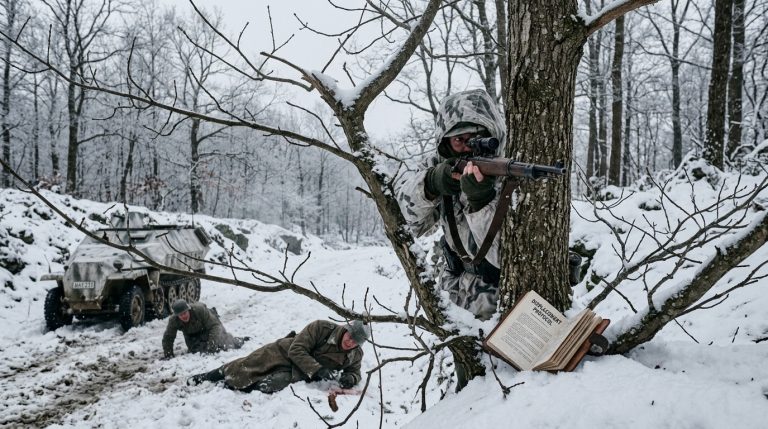
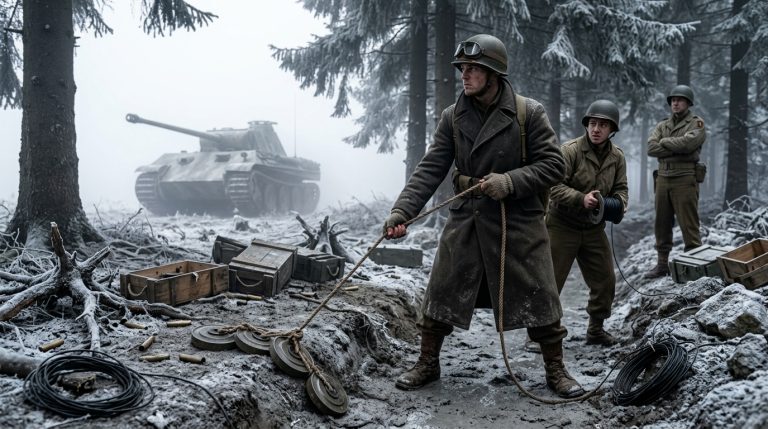
The shop lights flickered. It was a momentary stutter—a minor power surge—but the sharp, electric hum that followed acted like a wire pulled taut. Walter flinched, not physically, but in the way his eyes glazed over for a heartbeat. For a fraction of a second, the smell of burnt ozone from the fluorescent ballasts seemed to bleed into the scent of sulfur and cold, damp earth. The shop was gone. He was back in the Ardennes, the air thick with the smell of cordite and the biting frost of a winter that didn’t know mercy. He remembered the feel of a rifle in his hands—not his father’s, but one that had failed him when the line pushed back.
He blinked, pulling himself back into the present with an effort that left him winded. The modern lights stabilized. Craig was still watching him, concern beginning to push past the frustration on his face.
“Are you alright?” Craig asked.
Walter didn’t look up. He focused on the tiny, crescent-shaped wedge of copper he had cut from the penny. “I’m fine. Just… an old habit of paying attention.”
He used the point of the folding knife to guide the copper sliver into the narrow groove behind the extractor claw. It was delicate work, requiring the patience of a watchmaker and the steady hand of a surgeon. The metal groaned in protest, a microscopic protest of steel against copper, but Walter’s touch was unrelenting. He wasn’t forcing it; he was coaxing it, understanding the geometry of the mechanism better than the designers who had rendered it on a computer screen years later.
Craig leaned in, his own hands coming up to steady the bolt assembly as if he were assisting an operation. The friction was palpable—the rough, earthy resistance of the old penny against the precision-ground steel. It felt wrong, and yet, as the metal seated, the bolt body clicked with a sound that felt undeniably right.
“It’s a shim,” Craig whispered, his eyes widening. “You’re changing the geometry by half a millimeter. You’re effectively re-tensioning the spring force through a physical offset.”
“I am restoring the alignment,” Walter corrected. “You look at the wear and see a failure. I look at the wear and see the path back to the beginning.”
Walter picked up the bolt, sliding it into the Winchester’s action. The movement was smooth, clean, and silent. He worked it forward, the bolt locking into the chamber with a crisp, metallic snap that resonated through the workbench. He pulled it back, then pushed it forward again. There was no hesitation, no drag.
Craig reached out, tentatively grabbing the handle to work it himself. The movement was effortless. He cycled it three times, his professional intuition fighting the impossible reality of what he had just witnessed. He looked at the extractor. It held fast, the claw biting into the steel as if it were brand new.
“I’ve worked on hundreds of Model 70s,” Craig said, his voice hushed. “I’ve replaced extractors, I’ve re-machined receivers. I’ve never seen a fix that didn’t involve a machine shop or a bag of factory parts.”
“Because you were taught to replace, not to preserve,” Walter said, his voice softening. He looked around the shop, his eyes lingering on the CNC machine visible through the rear window. It stood there, dark and idle, a monument to the efficiency he had come to despise. “When you rely on parts, you are at the mercy of the manufacturer. When you rely on understanding, you are at the mercy of nothing.”
The atmosphere in the shop had shifted. The cold, sterile professional distance had eroded, replaced by a strange, quiet intimacy. The other customers in the shop—who had initially been browsing for the latest gear—were silent now, watching the interaction with the kind of focus one usually reserved for a high-stakes performance.
“You said you served,” Craig said, finally dropping his guard. He pulled a stool over and sat down, abandoning his position behind the counter. “Second Infantry, you said?”
“Second Infantry,” Walter confirmed. He took the rifle back, his fingers tracing the stock one last time. “1944. The winter was the hardest part. Not the fighting. The cold. It freezes the steel, it stiffens the oil, and it breaks the things you rely on. If you couldn’t fix your equipment with what you had in your pockets, you were walking home empty-handed.”
Craig looked at his own workbench—his digital calipers, his precision micrometers, his high-end solvents. He had always taken pride in this equipment. It was the mark of a modern, capable professional. Now, looking at the scrap of copper embedded in the bolt assembly, he felt a strange sense of inadequacy. He had the tools to build, but he didn’t have the perspective to restore.
“I have a Winchester in the back,” Craig said, his voice steadying. “It belonged to my grandfather. The firing pin assembly is shattered, and the company that manufactured the safety spring went out of business in the seventies. I’ve had it sitting in a box for years. I couldn’t bear to scrap it, but I couldn’t see a way to fix it.”
Walter looked at him. The question was there, hanging in the silence. It wasn’t about the gun, and they both knew it. It was about the bridge between the two of them, a bridge made of history and knowledge.
“Saturday,” Walter said.
Craig nodded, a small, genuine smile finally breaking through his stoic demeanor. “Saturday.”
Walter stood up, his joints popping, his presence once again feeling heavy and substantial against the modern backdrop. He picked up his father’s rifle, the weight of it familiar and grounding. He didn’t say goodbye, and he didn’t thank Craig. He simply turned and walked toward the door, his gait slow and deliberate.
As he reached for the door handle, he stopped. He looked back at the copper penny, which Craig had picked up and was now turning over in his hands.
“Don’t lose that one,” Walter said. “It’s a 1941. That was a good year for copper. And a hard year for men.”
The bell above the door chimed, a bright, modern sound that felt jarringly out of place. Walter stepped out into the afternoon light, leaving the shop quiet. Craig remained at the counter, the weight of the penny in his palm acting like a physical anchor. He looked at the idle CNC machine in the back, then at the empty spot where the old man had been standing. He felt a sudden, sharp realization: the shop was the same, the tools were the same, but the work he did from this point forward would never be the same again.
He took a deep breath, the smell of ozone fading, replaced by the lingering, earthy scent of the old man’s coat. The mystery wasn’t just in the rifle anymore. It was in the silence he had left behind, a silence that seemed to hold a hundred stories, all of them waiting to be understood.
CHAPTER 3: THE RITUAL OF THE SATURDAY MORNING
The following Saturday, the shop remained closed. The “Closed” sign hung crookedly in the front window, and the street outside was a blur of early morning mist and the intermittent rumble of delivery trucks, but inside, the air was thick with the scent of coffee and mineral oil. Craig had spent the hours before sunrise clearing off his primary workbench. He had pushed aside his digital inspection gauges, his thermal imagers, and the sleek, computerized diagnostics that usually dominated the space.
In their place, he had set out a series of wooden blocks, a set of hand-filed scrapers, and the box containing his grandfather’s Winchester.
When the bell above the door finally chimed—a single, sharp note that sliced through the stillness—Craig didn’t look up immediately. He was busy carefully inspecting the rusted internal threading of the receiver. He heard the slow, measured cadence of Walter’s walk across the concrete, the heavy thump-drag of his boots, and then the familiar scent of pipe tobacco and dry, dusty earth.
“You’re early,” Walter said, his voice as steady as the morning sun.
Craig looked up. Walter was wearing an old, oil-stained apron over a heavy wool sweater, and his hands were already moving toward the workbench, his fingers twitching with a familiar, instinctive rhythm. “I couldn’t sleep. I kept thinking about the shim. About why it shouldn’t work, yet did.”
Walter set a small, leather-bound kit on the bench. It looked like it had survived a dozen wars. “That is the first step in learning,” Walter said, pulling up a stool. “Unlearning the belief that logic is limited to what the manuals say. Manuals are written for the average machine. History is written by the exceptions.”
He didn’t start with the rifle in the box. Instead, he reached into his kit and produced a small, rusted Browning trigger mechanism, its sear worn down to a nub. He slid it across the bench toward Craig.
“Before we touch your grandfather’s history,” Walter said, his eyes sharp and focused, “we learn the language of the metal. This piece is discarded. It is beyond specification. Now, tell me how you would bring it back.”
Craig took the mechanism, turning it under the lamp. His instinct was to reach for the CNC specs, to see if he could bore it out and insert a sleeve. He hesitated, his hand hovering over the tools. He looked at Walter, who was watching him with a calm, expectant patience that felt heavier than any lecture he had ever endured.
“I… I would re-machine the sear interface,” Craig said, his voice testing the waters.
Walter shook his head slowly. “That is the modern way. You take away, and you take away, until there is nothing left. The old way is to add back. You are a restorer, Craig, not a remover.”
The next two hours passed in a rhythm that felt entirely disconnected from the world outside the shop walls. They didn’t talk about politics, or the economy, or the shifting demands of the industry. They talked about the temper of steel, the way oil behaves in extreme cold, and the subtle, tactile language of friction. Walter taught him how to use a needle file with the delicacy of a feather—how to remove microns of rust without scarring the integrity of the surface.
Craig felt a change in himself. His shoulders, usually bunched in a permanent state of tension as he chased the next repair ticket, began to loosen. There was a profound, quiet satisfaction in the work. It wasn’t about the speed of the output or the clean efficiency of the finished invoice. It was about the slow, deliberate act of giving something a future it had been denied.
As they worked, Craig noticed something. Every time Walter reached for a tool, he did so with his left hand, while his right hand often drifted toward the pocket of his apron—the one where he kept that worn, 1941 penny. And whenever the shop’s fluorescent lights flickered—a periodic nuisance of the building’s old wiring—Walter’s movements would stall. For a heartbeat, his eyes would grow distant, his jaw setting into a line so hard it looked like carved stone. He didn’t say anything, and he didn’t stumble, but the tension in his frame suggested he was fighting a ghost.
“The penny,” Craig said, breaking the silence as he carefully applied a drop of light oil to the trigger assembly. “You keep touching it. Is it a good luck charm?”
Walter stopped. He was holding a small piece of emery cloth, his fingers motionless against the workbench. He looked at the coin sitting on the bench, its copper face dull and scarred.
“It’s not for luck,” Walter said, his voice dropping an octave. “It’s for grounding. When you have seen a great deal of things break, you tend to hold onto the things that have survived the longest.”
He leaned in closer, his gaze locked on the trigger mechanism Craig was currently saving. “You think you are learning to fix a trigger. You are not. You are learning to keep the system moving when the world wants it to stop. That is the only way to ensure that what we value isn’t lost to the scrap heap of progress.”
Craig looked at his mentor, really looked at him, and saw the profound weariness etched into the lines around his eyes. It was a weight he was only beginning to understand. The mentorship wasn’t just about the guns. It was about the preservation of a standard of care that seemed to be eroding in real-time, just like the rusted metal beneath his hands.
“I think I’m beginning to understand,” Craig said.
“Good,” Walter replied, picking up a scraper. “Then let us move on to the next problem. The firing pin on your grandfather’s rifle is seized. We have two hours before noon. Let us see if we can find a way to make it remember how to strike.”
The hum of the shop seemed to deepen, a steady, low-frequency pulse that accompanied their progress. Craig leaned back into his work, the feel of the steel under his thumbs finally starting to make sense. He was no longer just a gunsmith. He was a student of the long, slow, and deeply necessary process of not letting go.
CHAPTER 4: THE FAILURE OF THE CNC
The contrast between the bench Walter had left and the rest of the shop was starting to feel like a fault line. Craig stood before the CNC machine, a gleaming tower of brushed steel and glass that sat in the back room like an altar to efficiency. He had a modern, mid-range sporting rifle clamped into the intake, a simple repair order: “Error 402: Calibration Drift.”
He punched in the sequence. The machine whirred to life, a high-pitched, digital whine that set his teeth on edge. It was the sound of a world that didn’t need to understand anything—it only needed to follow instructions.
“Calibrating,” the console chirped.
Craig leaned against the housing, his eyes wandering to the small, wooden block where he had been filing the trigger mechanism earlier. He realized he was looking for the resistance of the metal against the file, the way his muscles had to adjust to the specific hardness of the steel. The CNC machine didn’t care about the temper of the metal; it only knew the numbers.
He pulled a tray of parts from the CNC’s discharge port. They were uniform, smooth, and utterly lifeless. But as he wiped them down with a solvent-soaked rag, his fingers caught on a small, serrated protrusion on one of the internal guide rails—a component that shouldn’t have been there. He took a magnifying glass to it.
It was a piece of custom-fitted brass, filed into an intricate, impossible shape, wedged into a space where a factory-standard polymer clip should have been. It wasn’t functional; it was a ghost of a modification. Craig felt his heart stutter. He hadn’t put it there. The machine had outputted it as part of the “repaired” assembly.
He looked at the CNC console. The logs showed nothing. It was as if the machine had hallucinated a solution, inserting a part that belonged to a different, older, and far more manual era. It was a physical contradiction. He carefully pried the brass piece loose. It felt warm, and it was filed with the same slow, deliberate cross-hatching pattern he had seen Walter use on the penny.
A cold shiver tracked down Craig’s spine. Walter hadn’t just been teaching him; he had been interacting with the shop’s automated systems—or perhaps, he had been manipulating the very idea of how these tools functioned.
Craig stepped back, the brass piece clutched in his palm. The shop, which had always been his sanctuary of logic, now felt like a puzzle he didn’t have the key for. He walked to the storage rack, searching for the box that held his grandfather’s rifle. He needed to compare the geometry of this brass scrap to the shim Walter had created.
As he rummaged through the back shelf, his hand brushed against a dusty, leather-bound ledger tucked behind a stack of manuals. He pulled it out. It was a logbook from the shop’s original owner—a man who had died decades before Craig took over. He flipped through the pages, expecting to see inventories and sales. Instead, he found sketches.
Dozens of them. Sketches of triggers, extractors, firing pins—all labeled with the same distinct, hand-drawn cross-hatching he had seen Walter use. And beneath every sketch, a date. The dates spanned sixty years. Many of them matched the timeline of Walter’s war service.
Craig sat down on the cold floor of the back room, the light from the shop floor casting long, jagged shadows across the pages. He was looking at a legacy. Walter wasn’t just a former sergeant with a hobby; he was the ghost who had been keeping this specific shop’s tradition alive through other hands, other owners, other lifetimes.
The “Error 402” beeped again on the console, a shrill, demanding sound that broke his focus. Craig stood up, his legs stiff. He looked at the CNC machine—that sleek, modern god of his shop—and saw it for what it really was: a vessel. It was performing tasks it hadn’t been programmed for, using geometry it shouldn’t have known, because the influence of the man with the copper pennies had been woven into the foundation of the shop itself.
He pocketed the brass scrap and turned off the machine. The silence that rushed back into the room was heavy, dense, and expectant. He knew that when Walter returned next Saturday, he couldn’t just ask about the penny. He had to ask about the ledger. And he had to ask why, after all these years, it had finally been time for Walter to walk through his door.
He looked at the Winchester in the box, its walnut stock gleaming in the dim light. He realized now that he wasn’t just restoring a rifle; he was being pulled into a sequence of events that had started in the Ardennes, and he was the latest in a long line of people who had been tasked with keeping the system breathing. The weight of it was no longer just the weight of the rifle. It was the weight of a debt that spanned generations.
CHAPTER 5: THE HEIRLOOM FROM THE ARDENNES
Craig didn’t move. The silence in the back room was absolute, save for the rhythmic, unsettling thrum of his own pulse against the brass scrap in his hand. He looked at the ledger again, the sketches of triggers and sears blurring in the dim light of the shop floor. The dates—1944, 1952, 1968—they weren’t just inventory records. They were a map. Every sketch was a problem Walter had solved, not by buying a part, but by forcing a piece of metal to yield to his will.
He stood up, his knees popping, and walked back out onto the main floor. The Winchester was still resting in its box, a heavy, silent presence on the workbench. He needed to verify the geometry. He needed to see if the shim Walter had placed in the bolt had any connection to the sketches in the book.
He laid the bolt on the cloth. With a jeweler’s loupe pressed to his eye, he carefully backed out the screws holding the extractor in place. The tiny copper shim, that crescent cut from a 1941 penny, slipped out onto the white cloth. It was so small, so deceptively fragile, yet it held the entire weight of the rifle’s function.
He moved the shim under the microscope. The cross-hatching pattern, the tiny, hand-carved grooves—they were identical to the sketches in the ledger.
His phone buzzed on the counter—a notification for a new repair ticket. He ignored it. He was looking at more than a repair. He was looking at a pattern of behavior that spanned nearly a century. Walter hadn’t just been a gunsmith; he had been a custodian of a very specific, very dangerous kind of knowledge.
Suddenly, the lights in the shop dipped. The CNC machine in the back groaned, then hummed, then shrieked as the power fluctuated. It was a violent, erratic sound, the noise of a machine being pushed past its electrical limits. Craig ran back to the console, punching the kill switch, but the interface was unresponsive. The machine continued to spin, the steel bit tearing into the air, sparks showering the floor.
He didn’t think. He grabbed the manual override—a heavy, iron lever that hadn’t been touched in years. He hauled on it, his shoulder screaming with the effort, until the machine ground to a halt with a sickening, metallic crunch.
The air smelled of ozone and scorched plastic. He had killed the machine, but the damage was done. The intake assembly was mangled, the internal rails warped from the heat of the surge.
Craig backed away, gasping for air, the smell of burning dust filling his lungs. For a moment, the disorientation was total. The shop was failing. The modern infrastructure he relied on was collapsing, and in the center of it all, he was left with nothing but the manual tools on the bench.
He returned to the main workbench and looked at his grandfather’s rifle. He had no power, no automated diagnostic, and no way to call for parts. He was completely alone with the metal.
He looked at the copper shim again. It was then he noticed something he had missed: a tiny, almost microscopic engraving on the underside of the copper. He turned the shim over, adjusting the light. It wasn’t a scratch. It was a serial number. A military-issue serial number, etched into a piece of scrap copper.
He realized with a jolt that the penny wasn’t just pocket change. It had been part of a larger kit, a specific, issued piece of equipment from 1944. Walter hadn’t just been “improvising” in the field; he had been following a protocol that had been designed by someone, somewhere, to keep these specific rifles in the fight.
He looked at the ledger sketches again, specifically the one dated January 1945. It showed an exploded view of a rifle that wasn’t a Winchester Model 70. It was a rifle used by the Second Infantry Division. It was a rifle that had been designated “lost” in the official records.
The shop, the tools, the modern convenience—it all felt like a mask. Craig realized that the “decoy” secret—the idea that he was learning a craft—was shattering. He wasn’t being taught to be a better gunsmith. He was being groomed to complete a catalog of repairs that Walter had been keeping for eighty years.
He felt a wave of nausea. He reached for the coffee pot, but his hands were shaking too hard. He looked at his own reflection in the darkened glass of the display case—the sharp, professional lines of his face now smudged with grease and the grime of the machine’s failure.
He was no longer in control of the shop. He was no longer the master of his own tools. He was a successor to a ghost, and the work had only just begun. He took a long, shaky breath, picked up the file, and turned back to the rifle. If he couldn’t use the machines, he would have to do it the old way. He would have to finish what the ledger had started, whether he understood the full scope of it or not.
CHAPTER 6: THE GHOST IN THE WORKSHOP
The air in the shop was heavy, a suffocating mix of burnt copper and old, settled dust. Craig turned the page of the ledger. The paper was yellowed and brittle, feeling like dried skin under his calloused thumb. He hadn’t realized he was still holding his breath until a sharp, rasping sound escaped his chest. He was staring at an entry dated August 1944. It wasn’t a sketch of a rifle part. It was a list of names.
Kowolski. Miller. Jensen.
The names were followed by a series of coordinates, and then, a single, underlined word: RECOVER.
Craig looked at the workbench. The Winchester lay there, its bolt open, its action exposed like a raw nerve. He had spent hours trying to force the firing pin assembly to yield, his hands moving with a fluid, borrowed expertise that felt less like his own and more like he was following a pre-written script. He looked at his own reflection in the display glass—the grease-streaked forehead, the wide, frantic eyes. He was losing his grip on the professional veneer of his life.
A heavy thud echoed from the back of the shop.
Craig spun around, the file in his hand clattering to the floor. The back room—the room where the CNC machine lay in mangled, smoldering ruins—was silent. But the door, which he had pulled shut after the explosion, was now standing slightly ajar.
He didn’t want to go in there. Every instinct, every fiber of his modern training told him to call for help, to report the electrical failure, to walk away. But he couldn’t. The ledger sat open on the counter, the ink seemly pulsing in the low, flickering light.
He walked toward the back room, his footsteps silent on the concrete. The smell of scorched plastic was stronger here, a sharp, chemical bite that stung his nostrils. He pushed the door open. The CNC console was dead, a black, hollow screen, but the room itself felt… crowded.
There were no other people there, but the air was dense with the residue of movement. He saw the empty space where the CNC had hummed for years, and he saw the work-stains on the floor—stains that looked like the remnants of thousands of hours of hand-filing, scraping, and adjustment.
He noticed a small, recessed panel near the foundation of the rear wall, a panel that hadn’t been there when he moved in. It was loose. He pried it open with the blade of his pocketknife. Inside, there wasn’t a wiring junction or a breaker box.
There was a collection.
Dozens of small, velvet-lined pouches, each containing a single, hand-fitted, precision-made part. An extractor here, a firing pin there, a sear, a trigger block. All of them were covered in that distinctive, hand-carved cross-hatching. They weren’t just parts for the Winchester. They were parts for every rifle that had ever been brought to this shop, and every rifle that would be.
Walter hadn’t just been “teaching.” He had been using Craig to build an armory of ghosts.
Craig pulled out one of the pouches. It was labeled with a name: Miller. He opened it. Inside was a trigger sear, machined from hardened tool steel, its finish so perfect it looked like liquid obsidian. He recognized the part. It was for the exact same model of rifle his grandfather had left him—the one that had been “beyond repair” for a decade.
He wasn’t an apprentice. He was a caretaker.
The realization hit him like a physical blow. He staggered back against the wall, the pouch slipping from his fingers. The shop wasn’t a business; it was a memorial. And Walter? Walter was the living anchor of a memory that was supposed to have died in a winter forest eighty years ago.
He heard the front bell chime—a sharp, clear, impossible note in the middle of the night. He hadn’t heard a car pull up. He hadn’t heard the door open. But he heard the familiar, heavy thump-drag of boots on the concrete floor.
Craig stepped out of the back room, his heart hammered against his ribs like a trapped bird. Walter Novak was standing by the workbench, his silhouette framed by the dim, flickering security light. He was looking at the ledger, his hand resting on the page with the names of the dead.
“You found the list,” Walter said. His voice wasn’t an accusation. It was a resignation.
“Who are they?” Craig asked, his voice cracking. “What is this place, Walter? What did you do?”
Walter turned, and for the first time, Craig saw the full extent of the man’s exhaustion. It was a profound, soul-deep fatigue that no amount of rest could ever fix. “I did what I promised,” Walter said softly. “I kept them in the fight. But the fight is not ours, Craig. The fight belongs to the men who didn’t come home. And I have been waiting a very long time for someone who understood that the work is never finished.”
Walter reached into his pocket and pulled out the 1941 penny, rolling it between his fingers. The light caught the edge of the copper, turning it into a sharp, glinting circle of fire.
“I am tired, Craig,” Walter said. “And the list is almost clear. But there is one left. One rifle that hasn’t been brought back into service. And only you can provide the final part.”
Craig stared at him, the brass scrap in his pocket burning against his skin like a brand. He realized that the decoy secret of “repairing” was dead. He was standing on the precipice of something that had nothing to do with gunsmithing and everything to do with a debt that was finally, after eight decades, coming due.
CHAPTER 7: THE BURDEN OF HISTORY
The shop felt different tonight. The silence was no longer empty; it was pressurized, vibrating with the echoes of men who had long since vanished. Craig stood by the workbench, his fingers aching from hours of filing, the brass scrap he’d pulled from the CNC still sharp in his palm. Walter watched him, his posture stoic, his eyes reflecting the dim glow of the security light.
“You’re not asking for permission anymore,” Walter said. His voice was a thin thread of sound in the vast, darkened space. “You’re asking for the sequence.”
Craig looked at the workbench—the scattered files, the ledger, the row of velvet-lined pouches he had discovered in the wall. “The ledger,” Craig started, his breath hitching. “The list. You’ve been working through it for eighty years. Every rifle that came through this shop… it wasn’t just a job for you, was it?”
Walter took a slow, heavy step forward. He reached out and touched the stock of the Winchester, his grip firm, possessive. “When we were in France, when the line broke, the armorers had a simple rule: if you couldn’t fix it, you abandoned it. My father taught me that abandonment is a sickness. He taught me that if you lose the tool, you lose the connection. I couldn’t save my men. I couldn’t save their rifles. But I decided then, in the snow, that I would never lose another one. I would ensure that every single one of those tools was either kept in the fight or returned to a state where it could be respected.”
He looked up at Craig, and for the first time, the facade of the gruff mentor slipped away, revealing a raw, jagged vulnerability. “I haven’t been ‘grooming’ you, Craig. I’ve been looking for someone who could see the system for what it actually is—not a collection of replaceable parts, but a chain of responsibility. The final rifle on that list… it’s not an antique. It’s the one Miller was carrying when he fell. It’s been circulating, changing hands, breaking down, being repaired, and being broken again, for decades. It finally came back to this city.”
Craig’s heart dropped. He reached into the box and pulled out a nondescript, rusted-out receiver he had dismissed as scrap three days ago. He had thought it was just a piece of junk iron. He looked closer, clearing away a layer of hardened grime, and saw the faint, partially obliterated serial number—a number that matched the final, unfinished entry in the ledger.
“It’s not just a rifle,” Craig whispered.
“It’s the anchor,” Walter replied. “And you have to finish the restoration. Not for the money. Not for the shop. For the men who are still connected to it.”
The shop’s power surged again, a rhythmic, deep-seated pulse that seemed to come from the floor itself. Craig’s tools—the files, the calipers, the scrapers—began to hum. He felt a sudden, sharp clarity. He understood why Walter had insisted on the manual tools, why he had pushed Craig to ignore the convenience of the CNC. The machine couldn’t understand the intent of the repair. It only understood the output. This restoration required something more than precision; it required an acknowledgement of the history embedded in the metal.
“If I do this,” Craig said, his hand trembling as he reached for the Winchester, “everything changes. This shop… it stops being a business.”
“This shop hasn’t been a business since 1944,” Walter said. “It has been a bridge. And tonight, you are going to lay the final stone.”
Craig picked up the file. He didn’t look at the clock; time had ceased to be a measurement of his progress. He began to work, his movements guided by the sketches, by the memory of the penny shim, and by the heavy, silent presence of the man standing beside him. Every stroke of the file felt like a negotiation with time itself. He stripped away the rust, realigned the internal housing, and refitted the components with an intimacy he had never before allowed himself to feel.
He worked in a trance. He forgot the modern world, the supply chain, the customers, the bottom line. He existed only in the friction between the steel and the file, the heat of the interaction, the resistance of the metal.
He was no longer fixing a rifle. He was mending a fracture that had lasted a lifetime.
When he finally seated the firing pin, the sound was different. It wasn’t the crisp, clinical click of a factory-new assembly. It was a deep, resonant thrum—a sound that carried the weight of everything that had been lost and everything that had been saved.
He set the tool down. His hands were covered in oil and metallic dust, his eyes burning with the strain, but he felt an absolute, terrifying peace. He looked at Walter. The old man was nodding, his expression serene, his gaze fixed not on the rifle, but on the space just beyond it, as if he were seeing something that existed in a different dimension entirely.
“It’s done,” Craig said, his voice a whisper.
Walter didn’t answer. He just reached out, his weathered hand resting gently on the stock of the restored rifle. He took a long, steadying breath, and for the first time, his posture softened. The tension that had held his body in a vice for eighty years finally let go.
“Then the work is over,” Walter said.
Craig stood in the middle of the shop, the silence closing in around them, a silence that felt not like the absence of sound, but like the presence of a long-awaited resolution. He looked at the ledger, then at the rifle, and finally at the man who had brought him to this point. The shop was still his, but he knew, with a certainty that reached into his very bones, that his life had been irrevocably altered. He was the caretaker now.
CHAPTER 8: THE LEGACY OF THE COPPER SHIM
The transition was not loud. There was no crash, no sudden revelation of hidden mechanisms, no final monologue. Just the soft, rhythmic ticking of the shop’s wall clock, marking time in a space that had finally reconciled its past.
Walter Novak sat on the low stool, his back against the workbench. His eyes were closed, his breathing slow and shallow. He looked not like a man who had been holding a grudge for eighty years, but like a man who had finally put down a heavy, invisible load. The restoration of the final rifle—the one carried by Miller, the one that had been discarded in the mud of the Ardennes so long ago—was complete. It lay on the velvet cloth, not as a weapon, but as a monument.
“You understand,” Walter said, his voice barely audible. It wasn’t a question.
Craig stepped forward, his boots quiet on the concrete. He reached out and picked up the ledger, then gently closed it. The names—Kowolski, Miller, Jensen—seemed to settle into the paper, their work finally integrated into the quiet fabric of the shop.
“I understand,” Craig replied. He didn’t offer a grand declaration. He didn’t try to explain the complexity of what had just occurred. He simply touched the restored rifle. He saw the cross-hatching on the firing pin, the precise, manual geometry of the extractor shim. He saw the craftsmanship that had been preserved, against all odds, by an old man with a pouch of copper pennies and a memory that wouldn’t die.
Walter’s hand reached out, his fingers brushing the walnut stock of the Winchester one last time. “The system is whole,” he murmured. “And the bridge is secure.”
He let out a long, shuddering breath, a sound that seemed to carry the last of the Ardennes winter away with it. When his hand dropped back to his side, he didn’t twitch. He didn’t reach for the penny in his pocket. He just sat there, still, in the quiet, dusty light of the approaching dawn.
Craig stayed with him for a long time. He didn’t call anyone. He didn’t reach for his phone or the shop’s automated systems. He simply stood in the center of the workspace, listening to the silence. He realized that the shop was now truly his, not just as a business, but as a responsibility. He had been entrusted with the “Field Expedient” philosophy—the knowledge that when the modern world fails, when the supply chains break, when the manuals are useless, there is always a way to preserve what matters if you are willing to look with your own eyes and work with your own hands.
As the sun began to bleed through the front window, painting the floor in shades of warm, faded amber, Craig moved to the workbench. He cleared the scattered tools, placing them back in their proper locations. He took the brass scrap he had found inside the CNC machine, looked at it for a moment, and then walked to the wall. He picked up the frame—the one containing the single worn copper penny—and placed the brass scrap inside, beside it.
He didn’t need the machines. He didn’t need the modern diagnostics. He had the knowledge, and he had the ledger.
He walked over to the front door and flipped the sign from “Closed” to “Open.” The movement felt natural, a small, simple act of continuity. He wasn’t afraid of the future, nor was he haunted by the past. He was the caretaker of the bridge.
He looked down at his hands—stained with oil, calloused, and steady. He picked up a file and began the work of the day, his movements echoing the slow, deliberate rhythm Walter had taught him. The shop began to wake up, not with the high-pitched whine of automated machines, but with the soft, grounding scrape of steel against steel.
The story wasn’t over; it had simply shifted gears. The men who had come before were no longer ghosts of the ledger; they were the foundation of every repair he would make from this point forward. He would teach the students, he would fix the heirlooms, and he would keep the rifles running—not because it was efficient, but because some things, when restored with enough care and enough memory, become the only things that truly last.
The shop was quiet, warm, and finally, perfectly in balance. Craig worked on, the morning light catching the copper and brass in the frame on the wall, a small, enduring testament to the wisdom that had been saved from the dust of history.