Beneath the Fescue: A Cold War of Manifolds, Malice, and the Quiet Decay of Suburban Order
CHAPTER 1: The Threshold of Combustion
The leather of the sofa felt like a second skin, adhesive and hostile. I peeled myself away, the sound a wet, ragged tear that echoed too loudly in the quiet house. My shirt was a sodden shroud, clinging to my shoulder blades. I didn’t move; I just sat there, listening to the rhythmic, pulse-like throbbing in my temples.
The central air hadn’t just died; it had surrendered. The condenser outside lay in the grass like a gutted carcass, the smell of burnt wiring and ozone still ghosting through the open window. It was July in Pennsylvania, and the humidity was a physical weight, pressing down on the roof, pushing against the glass, desperate to equalize the pressure of the outside world with the mounting claustrophobia of my living room.
I glanced at the kitchen counter. The pink slip sat there, a neon scream in the beige room. Brenda’s handwriting was looped, precise, and violently judgmental. Violation 14.2.2, Section C. She hadn’t just cited me; she had declared war. She knew exactly how hot the house was. She knew the dog was pacing, claws clicking a frantic, uneven rhythm against the hardwood, and she had smiled when she handed me that paper—a tight, bloodless expression that didn’t reach her eyes.
I stood up, my knees popping, and walked to the basement door. The air down there was cooler, but only by a degree. I gripped the handle, my knuckles white, the metal cold against my sweat-slicked palm. I hadn’t planned on being a criminal, but the system had left me no other exit.
As I reached for the light switch, a drop of water hit my hand. I froze. The basement was bone-dry; the summer had been a drought-stricken nightmare. I looked up. A tiny, dark discoloration had bloomed on the floorboards above, a jagged map of dampness that hadn’t been there an hour ago. It wasn’t rain. It was deeper, colder.
I ignored it, or tried to. My focus was on the Rule Book—the 300 pages of beige oppression—stacked on the workbench. I grabbed it, the spine cracking as I flipped through the pages. I didn’t need the comfort of a hotel or the mercy of a service technician. I needed the loophole.
Outside, the silence of the neighborhood was total. It was the silence of a gated community that took pride in its uniformity, a silence that felt less like peace and more like a held breath, waiting for the crack in the facade. I found the section on subterranean development. My pulse quickened, a steady, rhythmic thrum that matched the distant, low-frequency hum of a distant jet.
I checked the time. 2:00 AM. In five hours, the sun would rise, and with it, the HOA’s patrol. I wasn’t going to fix the air conditioner. I was going to replace the ground beneath them.
The damp spot on the basement floor grew, a slow, dark smear against the concrete. I didn’t look at it again. I traced a line on the survey map with my thumb, the ink smudging under my pressure. Brenda wanted order? I was about to give her something that would be invisible, silent, and entirely impossible to excise. I closed the book, the sound sharp as a gunshot in the dark, and walked toward the back door, the plan hardening into a cold, jagged resolve.
The heat was just the beginning. The real pressure was what was coming next.
CHAPTER 2: The Blueprint of Contempt
The damp spot on the basement floor had spread. It was no longer a smear; it was a dark, weeping eye on the concrete, reflecting the harsh, unforgiving glow of the single bulb hanging from the rafters. I stood over it, my breathing ragged. For a second, the sharp, acidic smell of the earth brought back a memory so vivid it felt like a physical blow: my father, years ago, kneeling in his own garage, obsessively re-organizing a drawer of rusted drill bits by size, his hands trembling not from age, but from the terrifying, singular need to keep his world from coming apart at the seams.
I shook the image away, but the cold weight of it remained. My father had been a man who believed if you measured twice and cut once, the world would remain stable. He was wrong. The world was just waiting for the right vibration to collapse.
I looked at the Rule Book again. The pages were thin, translucent, like onion skin. I moved the light, the beam cutting through the gloom and catching the dust motes dancing in the stagnant air. I needed Bedrock. I needed a man who understood that rules were not walls, but suggestions meant to be navigated.
I hauled my laptop onto the workbench, the fan screaming in a desperate attempt to combat the ambient heat. The website for ‘Deep Core Solutions’ was a relic of the early internet—a jagged, black-and-yellow monstrosity that looked like it had been coded by someone who hadn’t slept since the turn of the millennium. My fingers moved across the keyboard, typing out an inquiry that was less a request for services and more a coded manifesto of mutual frustration. I didn’t write about cooling or HVAC. I wrote about the tyranny of the visible, the oppression of the manicured lawn, and the technical necessity of invisible infrastructure.
The reply came back in less than five minutes. It was a single line: “7 AM. No witnesses. Don’t call the city.”
I spent the next three hours in a fugue state of preparation. I didn’t sleep. Instead, I stripped the living room, moving the furniture away from the vents, my muscles aching with every tug. The heat was becoming a living thing, a predator that lived in the corners of the room, waiting for me to falter. By 5:00 AM, the temperature inside the house had climbed to 92 degrees. My dog, Buddy, was splayed out on the tile, his breathing heavy and rhythmic, a soft, pathetic wheeze that made my teeth ache.
I took the survey map and spread it out on the kitchen island. I used a thick, black permanent marker to trace the property line, then looked out the window at the common area. It was a stretch of green, pristine and unnatural, bathed in the sickly blue light of the pre-dawn sky. From this angle, it looked like a battlefield waiting for a war.
Brenda’s influence wasn’t just in the bylaws; it was in the way she kept the neighborhood paralyzed by the fear of being ‘visible.’ That was the flaw. If the mechanism of the HOA was built on the premise of what could be seen from the street, then I would operate in the space that didn’t exist for them. The underground.
I grabbed a heavy-duty flashlight and stepped out onto the back deck. The air hit me like a slap—hot, damp, and smelling of over-fertilized earth. I walked to the edge of my lawn, my boots sinking into the dry, cracked grass. I took out a stake and hammered it into the ground, twenty feet past the point where my survey ended and the common area began. The sound of the hammer striking the stake echoed off the surrounding houses, a sharp, dissonant chime in the morning stillness.
I stood there for a long time, watching the darkness. I thought about Brenda. I thought about the pink slips, the cold eyes, the way she managed our lives with the precision of a guillotine. She thought she was the guardian of the status quo. She didn’t realize that in my hand, I held the key to her undoing.
A low, guttural rumble started in the distance—the sound of an engine that had no business being in a suburban neighborhood at 6:45 AM. It was the sound of a beast waking up, a metallic, coughing roar that cut through the humidity like a blade. A pair of headlights, yellow and dim, crested the hill at the end of the street.
Bedrock.
I didn’t turn back. I walked toward the driveway, the ground beneath my feet feeling soft, almost liquid, as if the earth itself was preparing to give way. The first step was taken. There was no going back, no bargaining with God, no more waiting for the central air to kick in. There was only the drilling, and the silence that would follow.
CHAPTER 3: The Morning of the Breach
The world vibrated. It wasn’t just the ground; it was my skeleton, my teeth, the very air itself humming with the percussive agony of Bedrock’s rig. We were twenty feet into the common area—a violation so brazen it felt like a physical act of trespass. The drill bit, a jagged, diamond-tipped monstrosity, was churning through the earth, turning the pristine, HOA-approved topsoil into a gray slurry that sprayed in a wide, ugly arc over the manicured grass.
Bedrock stood at the controls, his shirt stripped off, his back a mosaic of old tattoos that seemed to ripple with every shift of the machinery. He didn’t look back. He was a man possessed by the singular physics of the hole.
“Hold that line!” he roared over the diesel thunder.
I held the stabilizer bar, my boots skidding in the slick, muddy mess. The heat was already rising, a tangible wall of pressure that seemed to intensify the closer we got to the target depth. The sun was barely over the horizon, but it felt like midday—white, brutal, and unforgiving.
Then, the rhythm broke.
A high-pitched, piercing whine—the sound of metal screaming against metal—replaced the deep, rhythmic grind. A fountain of hydraulic fluid erupted from a severed line near the rig’s primary pivot, spraying a fine, viscous mist into the air. The drill jerked, groaned, and finally shuddered to a halt, the sudden cessation of noise feeling more violent than the roar had been.
“Damn it,” Bedrock snarled, spitting a stream of tobacco onto the ruined fescue. “Hydraulic line just blew. She’s cooked until I patch that.”
I stood there, panting, the taste of ozone and mud thick on my tongue. I looked toward the neighborhood. The common area was already a disaster zone—deep, jagged holes cratering the lawn, the irrigation sprinklers shattered and gushing water into the mud. It was beautiful, in a destructive, scorched-earth kind of way.
“How long?” I asked, my voice sounding thin against the sudden, ringing silence of the morning.
Bedrock didn’t answer. He was already hunched over the engine block, his hands moving with a surgeon’s efficiency, covered in grease and grit. “Ten minutes. Maybe twenty. Just keep your eyes on the street.”
I turned. A few houses down, a curtain twitched. Then another. A neighbor—Greg, from the house with the gazebo—was standing on his porch, holding a phone to his ear, his face a mask of impotent rage. He was the first domino.
And then, it happened.
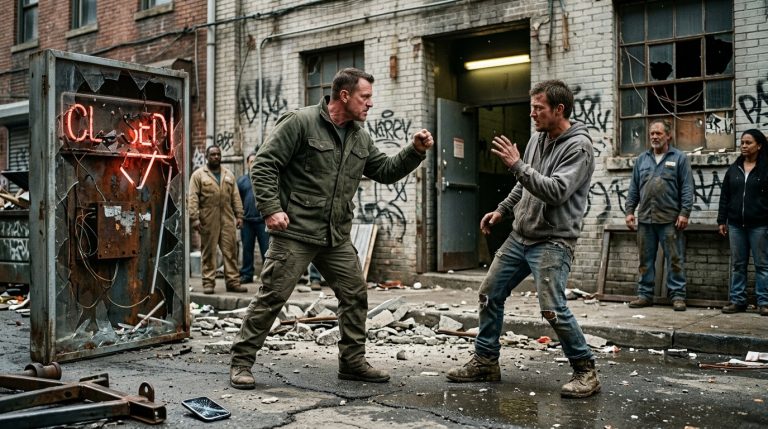
The front door of the house directly facing the common area swung open. Brenda didn’t walk out; she emerged, a vision of suburban martial law. She wore a floral blazer that seemed to vibrate with static electricity, and her hair was a sculpted helmet of defiance. She was holding a clipboard as if it were a shield, and her slippers tapped against the porch boards with the sound of a ticking clock.
She stopped at the edge of her lawn, eyes scanning the devastation. When they landed on me, they didn’t widen in shock. They narrowed into thin, cold lines of calculation. She didn’t scream. She didn’t run. She stood there, her posture perfectly vertical, and started walking toward us.
Every step she took across the grass was a measure of distance, a closing of the gap. I saw the way she looked at the mud, the way her gaze skipped over the ruined petunias and locked onto the rig. She wasn’t just looking at a violation; she was assessing the damage to the entire ecosystem of her control.
“David,” she called out. Her voice was steady, perfectly modulated, carrying across the silent yard without an ounce of tremor. “Do you have any idea what you’ve done to the structural integrity of this estate?”
I wiped the grit from my forehead, leaving a streak of dark oil across my skin. I didn’t step back. I didn’t offer an excuse. I let the silence stretch, heavy and thick, until the sound of Bedrock’s wrench tightening a bolt sounded like a gunshot.
“I’m installing infrastructure, Brenda,” I said, my voice as hard and flat as the concrete floor of my basement. “Visible or not, it’s necessary.”
She reached the boundary line where the dirt met the grass, her slippers caked in the first layer of gray, wet mud. She looked down at the slurry, then back up at me. There was a flicker of something behind her eyes—not fear, but a desperate, frantic intensity. It was the look of someone who knew that if the facade cracked, the whole house of cards would come down on her head.
“You’re not installing anything,” she said, her voice dropping, taking on an edge that made my skin crawl. “You’re destroying a foundation. You don’t know what lies beneath this soil, David. You don’t know the first thing about what it costs to keep this place standing.”
She stepped forward, her foot sinking an inch into the muck. She didn’t flinch. She just kept walking, straight toward the rig, her eyes never leaving mine. Bedrock stood up, wiping his hands on a rag, his presence a dark, immovable shadow behind me.
“Step back, lady,” he rumbled.
Brenda ignored him. She stopped three feet from me, the smell of lavender and industrial-strength hairspray clashing with the scent of diesel and wet earth. She leaned in, her voice a whisper that barely carried over the rising wind.
“You think you’re being clever. You think you’ve read the rules and found the gap. But there are laws here that aren’t in that book of yours, David. And if you go one inch deeper, you’re not just breaking an ordinance. You’re going to find out exactly why I don’t let anyone touch this dirt.”
She looked at the rig, then at the deep, dark hole we had torn into the heart of her kingdom. She turned back to me, and for the first time, I saw it—a tremor in her hand, a slight, involuntary twitch of her lip. She wasn’t just defending a bylaw. She was defending a secret.
The hydraulic line hissed again, a thin, warning stream of fluid hitting the dirt. The drill was almost ready. I looked at the hole, then at the woman standing in the ruin, and I realized that the ground beneath us wasn’t just dirt. It was a pressure cooker, and we were both holding the fuse.
CHAPTER 4: The Legal Siege
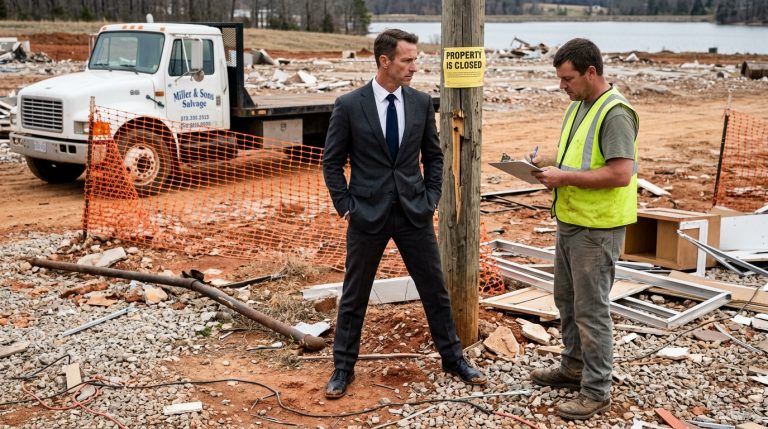
The lawyer was younger than I expected, dressed in a charcoal suit that looked entirely out of place in the middle of a muddy war zone. He held the document out, his fingers stiff, his gaze flicking nervously from the looming, rust-colored silhouette of the drilling rig to Brenda, who stood beside him like an avenging angel in a floral blazer.
“Temporary Restraining Order,” the lawyer said, his voice clipped and overly precise. “Effective immediately. Cease all excavation. If you move one more inch of dirt, Mr. Miller, you’re looking at a contempt of court charge that will cost you more than just a fine.”
I looked at the paper. The text was a blur of dense, legalese jargon, but the word Cease jumped out at me, bold and final. Beside me, Bedrock stood like a mountain of scarred muscle, his massive arms crossed, his cigar unlit and clamped between his teeth. He didn’t look at the lawyer; he looked at the hole—the deep, dark cavity we had gouged into the earth.
I felt the heat—now pushing 95 degrees—pressing against my temples like a vice. My vision wavered. The edges of the lawyer’s suit seemed to blur into the landscape of torn fescue and shattered sprinkler heads. The adrenaline that had driven the last six hours was beginning to curdle into a dull, throbbing exhaustion.
“I’m not stopping,” I said. The words came out sounding raspy, unfamiliar.
Brenda laughed—a dry, brittle sound that didn’t reach her eyes. “You don’t have a choice, David. Look around. The board is on its way. The police are already aware of the destruction of common property. You’ve lost.”
“I’ve gained,” I countered. I looked at the hole again.
I reached out and took the paper from the lawyer’s hand. The texture of it was thin, almost fragile. I didn’t read it. I knew what it said. It was a barricade, a piece of paper designed to stop the physical movement of the world. But I wasn’t fighting a physical battle anymore. I was playing a game of attrition.
“Fine,” I said, my voice quiet, almost conciliatory.
Brenda blinked, her composure faltering for a fraction of a second. “What?”
“I’ll stop,” I said, folding the document twice and tucking it into my back pocket. I turned to Bedrock. “Shut it down. We’re done for the day.”
Bedrock looked at me, a flicker of confusion in his heavy-lidded eyes, but he nodded. He walked to the control panel, his boots heavy in the mud, and hit the master kill-switch. The hum of the machine died instantly, leaving a silence that felt oppressive, ringing in my ears like a dying heartbeat.
The lawyer looked relieved, perhaps sensing the impending end of a very unpleasant morning. Brenda, however, didn’t move. She stood her ground, her eyes searching mine for the trick, for the jagged edge of the trap. She couldn’t find it, and that bothered her more than my defiance.
“You’re not finished, are you?” she asked, her voice barely a whisper. “You’re just waiting for us to leave so you can bury your mess.”
“I’m following the order, Brenda,” I said, turning away from her and walking toward my house. My legs felt like lead, each step a conscious effort to keep from stumbling. “I’m an honest, law-abiding citizen. Just like you.”
As I crossed the property line, I felt their eyes on my back—the lawyer’s confusion, the board members’ triumph, and Brenda’s lingering, clawing suspicion. I reached my porch, the wood groaning under my weight, and didn’t look back. I went inside and locked the door, the click of the deadbolt sounding final, a small, hollow victory in a much larger, crumbling landscape.
The air in the house was stifling, the smell of damp earth clinging to my clothes. I went to the kitchen and drank a glass of water, the cold liquid barely registering against the heat radiating off my skin. I stood in the dark, the blinds pulled tight against the sun, and listened to the sounds of the neighborhood.
Voices. The muffled, frantic coordination of the HOA board. The sound of a car door slamming. The heavy, rhythmic thud of feet crossing the grass. They were inspecting the holes, measuring the damage, calculating the cost of my rebellion.
They thought they had won. They thought the order was the finish line.
I walked back to the basement door, the damp patch on the floor now a full-blown, weeping puddle. I knelt down, touching the cool, slick concrete. I had a hundred and eighty holes in the ground. The pipes were already seated, the manifold was staged, and the basement heat pump was waiting like a dormant heart.
I didn’t need to dig anymore. I just needed to connect the dots.
I reached into the shadows of the workbench and pulled out the manual for the heat pump. I flipped to the diagram of the manifold connections. Everything was ready. The legal order wasn’t a stop sign; it was the signal for the final, midnight phase. They were counting on the law to keep me out of the dirt, but they hadn’t counted on me already having the earth in my pocket.
I closed my eyes, the exhaustion finally pulling at my consciousness, a heavy, velvet curtain. For a second, I saw my father’s face, etched with the same grim, silent focus as he tightened a bolt. He hadn’t been fighting to keep the world together, I realized now. He had been fighting to keep from being swallowed by it.
I would finish this by morning. Whether the HOA knew it or not, the ground beneath them was already changing. The heat would go somewhere else, into the deep, cooling embrace of the earth, and they would never know why, come sunrise, the air inside my house was finally, mercifully, arctic.
The battle wasn’t won, but it was earned. I stood up, my joints stiff, and turned toward the basement’s main breaker box. The real work was just beginning, and this time, the rules were entirely my own.
CHAPTER 5: The Midnight Manifold
The air in the basement was thick with the smell of PVC primer, cold metal, and the damp, earthy scent of the excavation that had violated the neighborhood’s pristine common area. Every pipe, every joint, every loop we had painstakingly installed was a monument to a kind of logic that existed outside the HOA’s thin, paper-bound reality. Bedrock had left an hour ago, his massive frame disappearing into the night like a shadow that had finally found its shape, leaving me alone with the machine.
My hands were raw, the skin split at the knuckles from the hours of trenching. I stepped toward the main manifold, my flashlight beam dancing over the brass fittings. It was a masterpiece of hidden, high-pressure efficiency. If anyone were to look at the ground, they’d see only the restored fescue, the manicured silence of Oak Creek Estates. But below? Below, I had turned the earth into a thermal sink, a radiator that would strip the heat from my living room and dump it deep into the dark, indifferent soil.
I needed to connect the final loop. The basement floor was still damp—a chilling reminder of how close the water table sat to the surface here. I reached into the toolbox, my fingers brushing against a stray pile of paper I’d cleared from the workbench to make room for the controls. It was a handful of shredded documents from the board’s recent “emergency session.”
I picked one up, intending to toss it into the trash, but the logo caught my eye. It was a notice from a regional bank, marked with a bold, crimson stamp: Notice of Default.
I stopped, my heart hammering against my ribs. It was tucked behind a requisition form for landscaping services. I unfolded it, the paper stiff and cold. It wasn’t addressed to the HOA. It was addressed to Brenda, at her private residence. The numbers were astronomical, a series of mounting debts and missed payments that painted a portrait of a woman living on the edge of a cliff.
The realization hit me with the force of a physical blow. Brenda wasn’t just enforcing rules because she loved order; she was enforcing them because she was drowning. She needed this neighborhood to look like a fortress of equity and value to keep the bank’s assessors from looking too closely at her own life. My “violation” wasn’t just an eyesore to her; it was a crack in the stage set.
I looked at the manifold, then back at the notice. The air in the basement felt suddenly thinner. I wasn’t just fighting for my own comfort anymore. I had stumbled into the center of her terror.
I grabbed the final coupling, my movements mechanical, devoid of hesitation. I locked it into place with a sharp, metallic click that echoed through the quiet house. I crawled over to the breaker box, the metal cold and biting against my fingertips. I didn’t think about the ethics. I didn’t think about the morality of the situation. I thought about the heat—the way it pressed against the windows, the way it clawed at my sanity for six weeks, the way Brenda had smiled when she handed me that pink slip.
I flipped the switch.
For a heartbeat, there was nothing. Then, a low, tectonic groan started somewhere deep beneath the foundation. It wasn’t the sound of a machine; it was the sound of the earth shifting, accepting the burden. The pipes hummed, a vibration that traveled through my boots and settled into my marrow.
Then, the vents in the ceiling gasped, a long, drawn-out exhalation. A blast of cold, sharp, antiseptic air poured into the basement, swirling around me like a ghost. I stood there, wrapped in the sudden, blissful frost, and watched as the heat pump’s light shifted from amber to a steady, confident green.
I turned and walked up the basement stairs, the air getting colder with every step. I reached the living room and stopped. The thermometer on the wall was dropping, the red needle shivering as it plummeted. 75. 70. 68.
The silence in the house was absolute. It was no longer the oppressive, suffocating heat that made your pulse pound in your ears. It was the silence of a tomb, cool and still.
I sat down on the leather sofa, the material now cool to the touch. I closed my eyes, the cold air washing over me like a baptism. Tomorrow, Brenda would come knocking. She would smell the change. She would see the condensation on my windows and know that I had found the one thing she couldn’t control: the quiet, invisible power of the earth itself.
I wasn’t just a resident anymore. I was the ghost in her machine. I waited for the sun to rise, the cold air humming around me, my mind already calculating the final, inevitable confrontation.
CHAPTER 6: The Arctic Settlement
The morning light hit the kitchen counter with an aggressive, antiseptic brightness. Outside, the neighborhood was waking up. I could hear the faint, distant whine of a leaf blower, the rhythmic click of a neighbor’s gate, the mundane symphony of Oak Creek Estates. But inside, it was 68 degrees, and the air felt like glass—sharp, clear, and perfectly still.
I heard the knock before I saw her. It wasn’t the sharp, official rap of the day before; it was hesitant, a series of soft, uneven strikes that lacked the rhythm of authority.
I walked to the door, my movements fluid, my mind purged of the frantic heat-addled panic that had driven me for the last week. I opened the door.
Brenda stood on the porch, her floral blazer now looking slightly rumpled at the lapels, her hair—the iron-sculpted helmet that hadn’t moved since 1998—slightly disarrayed by the morning humidity. She didn’t look at me. She looked past me, into the hallway, her nostrils flaring as she caught the draft of cool, conditioned air.
“It’s quiet,” she said. Her voice wasn’t the sharp, judgmental instrument of the HOA president. It was hollow, worn thin by something I couldn’t fully comprehend until I saw her eyes. They were red-rimmed, glassy, the defiant shell finally beginning to flake away.
“Come in,” I said.
She stepped over the threshold, her feet hesitating on the welcome mat. She didn’t head for the living room. She drifted toward the kitchen island, where I had left the bank’s notice of default sitting face up, weighted down by my car keys.
She saw the paper. She didn’t react with anger. She simply leaned against the counter, her hands coming up to cover her face. I didn’t move to comfort her; I didn’t move to gloat. I watched the physical collapse of the woman who had spent months trying to turn my life into a series of violations. It was a slow, agonizing descent—the straightening of her spine, the lowering of her head, the way her shoulders seemed to carry the weight of a thousand invisible inspections.
“The bank called,” she whispered, her voice barely audible. “They said the inspection is coming on Tuesday. If the property doesn’t meet the standards… if the maintenance isn’t perfect…”
She stopped, the sentence trailing off into the cold, empty air. She didn’t have to finish it. The perfection of Oak Creek Estates, the pristine grass, the absolute lack of visible “mechanical protrusions”—it hadn’t been about the HOA bylaws. It had been about her own survival. She had been polishing a tombstone, desperate to keep the vultures from seeing that the grave was already dug.
“I wasn’t trying to ruin you, David,” she said, looking up at me, her face pale. “I was just trying to stay afloat. If people saw that I couldn’t maintain my own house—if they saw the bank coming—I would lose everything. Everything I worked for. Everything I was.”
I looked at her, and for a moment, the barrier between us—the predator-prey dynamic, the legal threats, the bitter, cold-blooded maneuvering—vanished. I didn’t see an antagonist. I saw a mirror. She was terrified of the ground shifting beneath her, just as I had been terrified of the heat. We had both been building fortresses against an encroaching, chaotic reality, using whatever tools we had.
“The geothermal system,” I said quietly, “isn’t going anywhere. It’s staying exactly where I put it. It’s going to keep this house cool, and it’s going to keep it quiet. And no one, not the bank, not the board, is ever going to know it’s there.”
She looked at me, a flicker of confusion crossing her face. “Why?”
“Because,” I said, leaning against the counter, “I don’t want to win, Brenda. I just wanted to survive. And you’re not going to be the one who burns this place down.”
I walked over to the drawer and pulled out a small, plastic bag containing the original screws I had lost when installing the window unit—the ones I’d spent hours swearing over, the ones that had represented my initial, clumsy attempt to force the world back into shape. I placed them on the counter next to her papers.
“We’re going to file the paperwork for an aesthetic waiver,” I said. “We’re going to cite ‘environmentally responsible, non-invasive ground-source mitigation.’ It’ll be a gray area. Nobody on the board will understand it, and nobody will dare to challenge it. You’ll keep your property values, and I’ll keep my cool.”
She stared at the screws, then up at me, her breath hitching in a jagged, uneven sob. She reached out, her fingers trembling, and touched the plastic bag. The silence in the kitchen wasn’t heavy anymore; it was simply calm, the air circulating with a gentle, mechanical purr that sounded like peace.
“Tuesday?” she asked.
“Tuesday,” I confirmed.
She turned and walked to the door, her pace slower, the weight on her shoulders shifted but not gone. She didn’t thank me. She didn’t need to. As she stepped out onto the porch, the sunlight hit the fescue of the common area—still scarred by our drilling, still showing the faint, jagged outlines of where the earth had been opened. It would heal. The grass would grow back, the holes would vanish, and the neighborhood would return to its perfect, orderly, unthinking state.
I closed the door, the lock clicking into place. I stood in my hallway, feeling the temperature settle into a steady, comfortable 68 degrees. I looked at the thermometer one last time. The needle was rock-steady.
I went to the sink, picked up my coffee mug, and watched the condensation track down the side, a slow, winding river that eventually vanished into the drain. My house was quiet. My life was, for the first time in weeks, my own. I went to the window, pulled back the curtain, and watched the neighbors go about their day, oblivious to the fact that beneath their feet, the earth was working for me.
I sat down, opened a book, and let the cool air settle into my bones. The war was over. And in the silence, I found the only victory that mattered: I had learned how to live in the space between the rules.