The Weight of the Dirt: A Battle for Ownership, Integrity, and the Rusted Truth of Land
CHAPTER 1: THE DUSTY GRAY
The silence at 7:02 a.m. on Lake View Drive was not peaceful; it was the hollow, ringing silence of a crime scene. I had walked around the bend expecting the morning light to catch the glass of my guest wing, a simple comfort after eight months of brutal schedules in the Dubai sun. Instead, the trees pulled back to reveal nothing but a ragged tear in the landscape. Two thousand four hundred square feet of stone, cabinetry, and memories had been ground into the red Tennessee clay.
I didn’t scream. I stood there, my boots crunching on Portuguese tile that had been reduced to gravel, listening to the orange construction fencing snap rhythmically against its metal posts in the breeze. The sound was abrasive, like a dry rasp against iron.
My eyes found the front door—or what was left of it. A yellow notice was stapled to a splintered post, curling at the corners from the night’s rain. I pulled it free, the paper damp and fragile. Delinquent dues. Eight months unpaid. Authorized demolition. Signed by Karen Hollis.
I let out a short, sharp breath that might have been a laugh if there had been any humor left in my chest. Karen had signed the death warrant for my house with the confidence of someone who thought the world was limited to her view of the local bylaws. She didn’t know that she wasn’t just managing a neighborhood; she was trespassing on a ledger I had spent millions to close.
I reached into my pocket, the friction of my palm against the rough denim of my jeans grounding me. I pulled out my phone and dialed Richard Cole. My thumb hovered over the screen, feeling the cold weight of the metal.
“Richard,” I said, my voice sounding like gravel under a heavy tire. “They demolished my house.”
There was a pause on the other end—the kind of silence that usually precedes an earthquake. “Say that again.”
“They tore it down. Not a renovation. Not a teardown. They leveled it.”
I looked out over the property. The eighty-four acres I owned stretched toward the water, a vast, quiet expanse of dirt that Karen and her board treated like an abstract concept. They had mistaken my silence for absence, and my patience for weakness. They had touched the ground, and they had no idea that the ground had a memory.
Behind me, the sound of a distant engine hummed—a truck, perhaps a contractor coming to clear the rest of the salvage. I gripped my phone tighter. The dust of my own house was coating my skin, gritty and dry. I wasn’t just going to sue them for the house. I was going to teach them exactly what it meant to live on land that didn’t belong to them.
CHAPTER 2: THE BREACH
I lowered the phone, the metal casing slick with a fine paste of sweat and pulverized mortar. The screen went black, cutting off the faint electronic hum of Richard’s silence. Left behind was the abrasive friction of the Tennessee morning—the dry wind rustling through the pines and the escalating, heavy vibration of a diesel engine climbing my driveway.
A white flatbed truck rounded the curve, its massive tires crushing the edges of my manicured gravel into the red clay. On its door, faded blue lettering spelled out Miller & Sons Salvage. It groaned to a halt just inches from the orange plastic fencing. Air brakes hissed, a sharp, mechanical exhale that scattered a cloud of white tile dust over the remains of my porch.
A man in a faded neon safety vest hopped down from the cab, a metal clipboard clapping against his thigh. He didn’t look at the sky, the lake, or the destruction. He looked at the pile of my home like it was an arithmetic problem.
“Morning,” he called out, his boots crunching over the shattered remnants of an imported Portuguese tile I had spent three weeks sourcing. “You the neighboring owner? HOA told us to come clear the hazard. Supposed to haul the heavy masonry today.”
I didn’t move. I let the weight of my stance settle into the dirt, feeling the rigid soles of my work boots press against the uneven rubble. The air smelled of cracked iron pipes and dry, dead earth.
“Property is closed,” I said. My voice was entirely devoid of elevation, a flat, rusted implement dragging across concrete.
The driver paused, clicking a ballpoint pen. He squinted at me through the rising glare of the sun. “I got a work order here. Signed by a Karen Hollis. Says this structure is condemned and abandoned. I get paid by the ton, buddy, and I ain’t leaving empty.”
“Karen Hollis,” I repeated, tasting the syllables. They felt like grit in my teeth. “Karen Hollis owns a house three miles up the road. She doesn’t own this driveway. She doesn’t own that gate you just drove through. And she doesn’t own the dirt you’re standing on. You have exactly thirty seconds to put your truck in reverse before I have you arrested for trespassing on a catastrophic crime scene.”
He looked at my face, then down at the ruined estate, the gears turning in his head. Pragmatism won out over the promise of a paycheck. The driver didn’t say another word. He turned, the heavy friction of his boots pivoting in the dirt, climbed into the cab, and threw the truck into reverse. I watched him back down the winding drive until the engine noise faded, leaving only the sound of the wind tearing at the plastic fencing.
I waited. For forty-two minutes, I stood in the center of the wreckage, my hands in my pockets, acting as a human anchor to the ground beneath me. I mentally traced the original foundation lines. The kitchen here. The study there. The architectural skeleton of a life I had built to be permanent, currently reduced to splintered oak.
The crunch of tires returned, this time slower, more calculated. A black sedan pulled up to the perimeter. Richard Cole stepped out.
He didn’t wear a suit—it was Saturday morning—but his pressed khakis and polished oxfords looked alien against the post-apocalyptic gray of my front yard. Richard was a man who lived in the margins of contracts, a creature of clauses and contingencies. He walked up to the edge of the orange fencing, his eyes scanning the geometry of the destruction. He didn’t offer empty condolences. He didn’t gasp. He just did the math.
“They brought down the load-bearing walls on the east elevation,” Richard said quietly, stepping carefully over a twisted piece of aluminum framing. His oxford shoes immediately took on a dull, dusty coating. “The roof structure collapsed inward. This wasn’t a vandalism job. It was a professional demolition.”
“I know,” I said.
He stopped beside me, hands shoved deep into his pockets. “I ran the HOA’s financials on the drive over. They have three hundred and eighty thousand dollars in their reserve account. Maybe another fifty in operating funds.” He turned his head, his gaze sweeping over the $3.8 million wreckage. “This is tortious destruction of private property. Compensatory damages alone will start at six million. Add punitive, we’re looking at eight. The organization is functionally bankrupt the second we file.”
“They’ll try to hide behind the bylaws,” I said, toeing a piece of broken cabinetry. “They’ll say I was delinquent. They’ll say the property was a blight.”
“Bylaws do not override property law,” Richard replied, his tone clinical. “But it will be a slog. Their insurance will fight the claim, argue gross negligence on the board’s part to deny coverage. We’ll be tied up in civil court for three years trying to bleed water from a stone. Karen Hollis will file for personal bankruptcy.”
I looked out over the expanse of the property, past the ruins, down to where the water of the lake lapped quietly against the shore. “I don’t just want the money, Richard. I want the ground.”
Richard stopped. The silence between us thickened, heavy and absolute. He slowly turned his body to face me, his eyes narrowing as he mentally shifted gears from a standard tort claim to something far more archaic, far more dangerous.
“You’re thinking about the master deed,” he said, his voice dropping an octave.
“Nineteen sixty-two,” I said, the numbers heavy on my tongue. “The ground lease agreement. Section fourteen, paragraph three.”
Richard stared at the dirt beneath his feet. “Material breach. If a leaseholder causes damage to the ground lessor’s property, the lease may be terminated.” He looked up, a sharp, razor-thin smile touching the corner of his mouth. “She didn’t just authorize the destruction of your house. She did it as a leaseholder on land you own.”
“We’re going to terminate her lease,” I said, the pragmatic reality of the strategy locking into place like a deadbolt. “We’re going to terminate all of them who voted for this. We take the dirt back.”
Richard nodded slowly, already drafting the injunctions in his head. He took a step backward to get a wider view of the wreckage. As his foot shifted, the toe of his shoe snagged on something partially buried under the pulverized drywall. He paused, frowning, and crouched down, brushing the white powder away with his bare hand.
I watched as he pulled it free. It wasn’t a piece of my house.
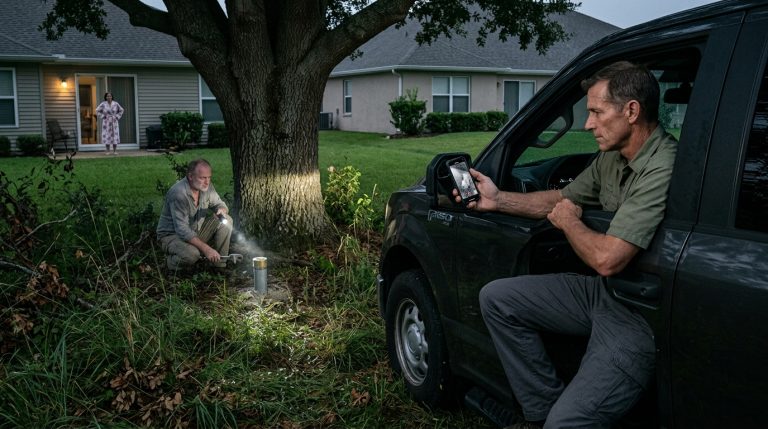
It was a wooden surveyor’s stake, driven deep into the soil beneath the foundation line. Wrapped around the top was a strip of neon pink flagging tape, stamped with a serial barcode and a series of topographical coordinates.
“What is that?” I asked, a cold friction starting at the base of my neck.
Richard stood up, turning the wooden stake over in his hands. He wiped a smudge of red dirt off the barcode. “This is a commercial grading marker. High-density load bearing.” He looked up at me, the clinical calculation in his eyes replaced by a sharp, creeping suspicion. “Residential HOAs don’t order commercial soil surveys, and they certainly don’t drive stakes into an owner’s foundation before a demolition. Someone else has been measuring your land.”
CHAPTER 3: THE BURIED BOUNDARIES
The silence in the yard deepened, no longer just the absence of noise, but a heavy, pressurized atmosphere that seemed to squeeze the oxygen out of the morning. Richard turned the wooden stake over, his thumb tracing the jagged, machine-stamped barcode. The sun caught the fluorescent pink tape, a garish smear of color against the desaturated gray of the ruins.
“High-density commercial grading,” I repeated, the words feeling brittle in my throat. I looked toward the shoreline. The common area, a manicured stretch of green that technically belonged to me but was managed by the HOA, looked undisturbed. Except it wasn’t. Now that I was looking for the disruption, I saw it—a subtle, rhythmic misalignment in the grass. A series of small, uniform depressions spaced exactly thirty feet apart, snaking toward the water.
“They didn’t just want to clear a ‘blight’,” Richard said, his voice tight. He didn’t drop the stake; he tucked it carefully into the inner pocket of his jacket, treating it like a piece of high-caliber ballistics evidence. “They were preparing for a survey. A big one. This level of geotechnical marking is typical for a major structural development—something that needs deep pilings.”
I walked toward the edge of the common area, my boots heavy as I crossed the threshold from my private lot onto the community land. I knelt and dug my fingers into the soil. It was packed hard, unnaturally so, as if heavy machinery had been moved over it recently.
“A mall,” I whispered, the realization clicking into place with a sickening sense of clarity. “They weren’t just mismanaging the community; they were clearing the way for it. If they could get the land declared abandoned, they could trigger a rapid foreclosure and sell the whole tract to a developer. Karen wasn’t just being a power-hungry HOA president; she was a facilitator.”
Richard joined me, his eyes tracking the line of stakes that I was only just beginning to perceive. “A commercial strip-mall expansion in the middle of a protected residential leasehold? It’s absurd. The zoning alone would take years.”
“Unless the developer had an inside track on the master deed,” I countered, standing up and wiping the dust from my hands onto my jeans. “Unless they were told that if they cleared the ‘nuisance’—me—the land could be rezoned under the guise of community revitalization. They weren’t cleaning up the neighborhood, Richard. They were liquidating it.”
The anger that had been simmering in my chest turned into something cold and tactical. It was no longer a dispute over a house; it was a war over the ground. I felt a sudden, sharp pang of inadequacy—not because I had lost the house, but because I had been so busy in Dubai, so convinced that my contracts were ironclad, that I hadn’t realized someone was playing a much more physical, much more aggressive game of attrition on my own front porch.
“We need to get to the county records office,” I said, turning back toward the sedan. “I want every filing, every permit, every email between the HOA board and any commercial development firm in the tri-state area from the last eighteen months. If Karen was holding the shovel, someone else was holding the map.”
Richard didn’t argue. He navigated the gravel path with an efficiency that bordered on surgical. As we drove away from the site, I looked back at the remains of my home. The wind had picked up, and the orange construction fencing was flapping violently now, a beacon of failed order in a landscape that was rapidly descending into chaos.
We didn’t speak during the drive into Franklin. The interior of the car was insulated from the outside world, a sterile, climate-controlled bubble where the only thing that mattered was the weight of the evidence in Richard’s pocket. I watched the rolling hills of Tennessee pass by, thinking about the impermanence of the life I had built. I had spent decades as an architect of the tangible, creating structures meant to outlive me, yet I felt a creeping, hollow fear that everything I touched—the stone, the timber, the very land—was subject to the erosion of someone else’s ambition.
When we pulled into the county clerk’s lot, the building was a stark, brutalist block of concrete that looked as if it had been designed to endure centuries of administrative grinding. I stepped out, my legs feeling heavy, as if the soil of the estate had traveled with me, clinging to my boots.
“Wait,” Richard said, catching my arm before we reached the glass entrance. He checked his watch, his face shadowed. “If there’s a paper trail, it won’t just be in the clerk’s office. It’ll be in the digital filing system of the local zoning commission. And if they were really planning a commercial development, they’ll have used a shell corporation to avoid the conflict of interest.”
“Then we find the shell,” I said. “We don’t just win the court case. We expose the leverage. If Karen thinks she’s just fighting a nuisance claim, she’s going to be blindsided by a fraud investigation.”
As we walked into the lobby, the air was cool and smelled of old paper and ozone. I paused at the intake desk, my pulse thrumming in my ears. I felt like a predator on a scent trail, every step calibrated to reclaim the territory that had been violated. We weren’t just looking for records; we were looking for the architect of my home’s destruction.
I stopped at the terminal, my fingers hovering over the keys. I could feel the eyes of the other patrons, the mundane rhythm of the office, but for me, the world had shrunk down to the flickering cursor on the screen. The truth was buried somewhere in the metadata of municipal greed, and I was going to dig it out, piece by piece, until the entire structure of their little scheme collapsed.
CHAPTER 4: THE FRAGILE LEDGER
The screen flickered with a harsh, sterile blue light, the fluorescent overheads of the county records office humming a low-frequency drone that felt like a migraine waiting to happen. I stared at the terminal. Every search result for Blackwood Capital brought back a predictable stream of land-use permits and property tax filings, but beneath the surface-level bureaucracy, there were gaps. Massive, gaping holes where documents should have been.
“Look at this,” Richard whispered, pulling his chair closer. His breath smelled faintly of the black coffee he’d been nursing since we left the office. He tapped a finger against a specific file string—a series of zoning amendments filed under a holding company called Veridian Acquisitions. “They didn’t just use the HOA board. They created a parallel shadow-zoning layer. This company has been buying up the mortgages of the board members for the last six months.”
I leaned in, my eyes scanning the rows of data. The sheer scale of it was suffocating. It wasn’t just a demolition; it was a hostile takeover of a residential community, managed with the cold precision of a corporate merger. And yet, there was something else. A recurring name in the signatures for the zoning applications: Arthur Sterling. A man I had worked with on a project in Atlanta three years ago. A man who prided himself on “pruning” communities that had outlived their economic utility.
The friction of the situation tightened in my chest. I felt a sudden, irrational urge to look over my shoulder. The county records office, once a place of objective facts, now felt like a theater of manipulation. I watched a clerk walk past, their footsteps echoing too loudly on the linoleum, and wondered if they were just doing their job or if they were part of the infrastructure supporting this erasure.
“Sterling,” I said, the name tasting like copper. “He doesn’t just build malls. He builds monocultures. If he’s behind the HOA’s sudden ‘authority,’ then Karen isn’t the antagonist. She’s an asset that’s about to be discarded.”
Richard looked at me, his face drawn. “If you go after Sterling, you aren’t just fighting a neighborhood HOA anymore. You’re fighting a firm with a legal budget that could outlast our lifetimes. This changes the calculus. The material breach clause might not be enough to stop him if he has the zoning commission in his pocket.”
“He doesn’t have the deed,” I reminded him, my voice steady, though my grip on the edge of the desk was white-knuckled. “I have the deed. As long as I hold the land, he can’t break ground. He can try to squeeze me, he can try to bully the board, but he needs that ground lease terminated. That’s the only way he gets to build.”
I stood up, the chair scraping sharply against the tile. The noise was violent in the quiet room. I needed to move. Staying seated, staring at these sanitized records, felt like admitting defeat. I needed to see the land again, to walk those stakes and verify exactly how far Sterling’s encroachment had gone.
We left the records office, the afternoon heat of the parking lot hitting us like a physical blow. The air was thick, stagnant, and tasted of exhaust. I walked to my car, the gravel crunching beneath my feet, each sound amplified by the sudden, sharp clarity of my intent. I wasn’t just defending my property anymore. I was defending the principle of my own existence against a machine that sought to flatten everything that didn’t fit into its profit-and-loss sheet.
As we drove back toward Lake View Heights, I saw a familiar sight: a contractor’s truck, similar to the one that had been at my house, parked near the common area. It wasn’t doing anything—just sitting there, its engine idling. A subtle warning. They knew we were active. They knew I was digging.
“Are we being followed?” Richard asked, his eyes darting to the rearview mirror.
“It doesn’t matter,” I said, though my hands tightened on the steering wheel. “Let them watch. Let them think I’m just an angry homeowner with a lawyer. The more they underestimate me, the more room I have to dismantle them.”
But as I pulled into the drive of the estate, I felt that same hollow fear from earlier. I looked at the houses around mine—the manicured lawns, the pristine facades—and suddenly, I didn’t see a community. I saw a waiting room. I saw people living in houses they didn’t really own, on land that was being traded out from under them while they worried about their grass height and the neighborhood aesthetic.
I parked the car and walked toward the debris of my home. The silence of the lake was absolute, a stark contrast to the buzzing, artificial noise of the zoning records. I knelt down by the spot where Richard had found the surveyor’s stake earlier. I started to dig, clawing at the red clay with my bare hands. I didn’t stop until my fingernails were packed with dirt and my knuckles were raw.
There, four inches down, was a plastic casing. I pulled it out. It was a weather-resistant data logger, linked to a series of sensors buried along the property line. It wasn’t just a survey; it was a real-time monitor, tracking the stress and composition of the soil. Sterling wasn’t just planning to build here; he was already analyzing the site’s collapse potential.
The weight of the device in my palm was cold, hard, and undeniable. They weren’t just taking my land. They were planning to gut it until there was nothing left but a foundation for their vanity project. I looked up at the quiet, unsuspecting houses of Lake View Heights and realized that I was the only person standing between this community and their inevitable erasure.
CHAPTER 5: THE COLLAPSE OF THE DECOY
I stood in the center of my ruined estate, the data logger’s cold, smooth plastic digging into my skin. The silence of the lake was no longer peaceful; it felt predatory. The device was proof—not just of intent, but of advanced logistical planning. They weren’t just waiting for the land to be vacant; they were monitoring the structural integrity of the entire plot, waiting for the exact moment the ground beneath the development could be manipulated to suit a commercial foundation.
Richard remained by the sedan, watching the edge of the woods. “If that logger is reporting to a central hub, they know we have it,” he said, his voice dropping into a register of sharp, professional concern. “We need to secure the site, and we need to do it before the next board meeting. If they catch wind that we’ve bypassed their decoy and hit the primary survey data, they’ll move to scrub the records.”
“They can’t scrub the ground,” I said, my gaze shifting to the depressions in the grass.
I walked toward the common area, my boots leaving deep, rhythmic impressions in the clay. The further I moved away from the estate, the more the neighborhood felt like a staged set. The pristine landscaping, the carefully curated fences, the artificial tranquility—it all suddenly seemed like a thin veneer of civility stretched over a planned industrial site. As I reached the third stake, I felt a familiar, chilling vibration in the air.
I stopped. The stake didn’t just have a barcode; it had a specific, alphanumeric code etched into the base: D-B-A-I-S-T-R-U-C-T-0-9.
The world tilted slightly. I had worked on a massive, mixed-use commercial development in Dubai three years ago. The structural design had been managed by a firm called Sterling & Associates. I knew that code. I had signed off on the grading logs for that exact project.
The realization hit me with the force of a physical impact, the friction of the memory grinding against the reality of this Tennessee landscape. This wasn’t just a mall. This was a re-use of the architectural blueprints from a project I had helped build, being repurposed to dismantle my own home. Sterling wasn’t just a rival; he was a scavenger, using the modular engineering standards I had helped innovate to tear apart my foundation.
My vision narrowed, the world sharpening into a singular point of intensity. Was this planned? Was I being hunted specifically because of my work on those projects? Was my return to Lake View Heights not an escape, but a trap? The paranoia flared, hot and sharp, coloring every interaction I had with the neighborhood—the neighbors waving from their porches, the board members in their tidy, insulated lives. Were they all part of the machine, or were they just the next units to be cleared?
“You’re pale,” Richard said, moving toward me. He looked at the stake I was staring at, then at my face. “What is it?”
“The design,” I said, my voice barely audible over the rustle of the wind. “These stakes, the coordinates, the depth of the survey—they aren’t local, Richard. They’re international. Sterling is bringing in standardized modular planning from his firm’s overseas portfolio. He’s not building a local shopping center; he’s building a standardized commercial hub that can be plugged into any landscape, anywhere, regardless of local history or community.”
Richard’s face tightened. “That’s why the HOA board was so easily turned. They weren’t just promised a ‘community upgrade.’ They were sold on the idea of a global standard, something ‘world-class’ that would boost their property values. They thought they were being upgraded, and they didn’t care who they had to evict to get it.”
I looked at the data logger in my hand, then back toward the remains of my east wing. I had been worried about the house, about the destruction of my private retreat, but the scope of this was far, far wider. My house wasn’t just a casualty; it was the test run. The surveyor’s stakes were the front line of an industrial infection.
I dropped the stake into the dirt, the sound of the wood hitting the earth echoing like a strike on an anvil. “We go to the board meeting tonight,” I said, my voice hardening. “Not with a lawyer, and not with a settlement offer. We go with the proof of their industrial survey. We show them exactly what they sold their future for. We don’t just win the court case, Richard. We force the board to see the machine they’ve invited into their living rooms.”
As we walked back to the car, the sky began to bruise with the purple, heavy light of an approaching storm. The air felt charged, metallic and expectant. I felt a grim, tactical satisfaction. The decoy of the ‘abandoned property’ was already crumbling, and beneath it, the much larger, much colder truth was being exposed. They were playing with modular pieces, treating the world like a set of building blocks, but they hadn’t counted on the resistance of the dirt itself.
I wasn’t just defending my rights anymore. I was going to turn their own industrial logic against them, using every scrap of evidence I had to prove that this ground wasn’t a commodity to be pruned—it was the only thing that mattered.
CHAPTER 6: THE BOARDROOM BREACH
The air inside the community clubhouse was conditioned to an aggressive, unnatural chill. It smelled of lemon polish and stale coffee—the sanitized scent of bureaucracy. I walked through the double doors, Richard at my shoulder, feeling the familiar, heavy friction of the ground beneath my feet. My palms were dry, my mind functioning with the singular, grinding intensity of a machine.
Eight people sat around the conference table. Karen Hollis was at the head, her posture as rigid as a structural support beam. When she saw me, her gaze didn’t flicker. She had the defensive armor of someone who had convinced herself that her actions were beyond reproach.
“Mr. Blackwood,” she said, her voice smooth, professional. “This meeting is for the board and the residents. You aren’t invited to address the floor.”
“I’m not here to address the floor, Karen,” I said, my voice echoing slightly against the acoustic ceiling tiles. “I’m here to address the board.”
I pulled the weather-resistant data logger from my pocket and set it on the mahogany surface. The plastic made a sharp, definitive thud. Around the table, the other board members—people I had seen at block parties and community meetings for years—stiffened. A few of them leaned away from the device as if it were radioactive.
“You authorized a demolition based on a survey that was supposed to be a standard maintenance check,” I said, my voice steady, stripped of all pleasantries. “But this logger was buried in the common area, four inches deep, calibrated for deep-soil seismic analysis. You weren’t maintaining the ground. You were stress-testing it for a commercial footprint.”
The silence that followed was heavy, punctuated only by the low hum of the HVAC unit. Karen’s composure cracked, just for a micro-second. Her eyes darted toward Philip Garrett, the HOA attorney, who was already shifting his chair, his face losing its practiced indifference.
“I don’t know what that is,” Karen said, though her hands had moved from the table to her lap, clenching the fabric of her skirt. “We followed the guidelines. We had a developer provide professional assistance to ensure the community—”
“A developer,” I interrupted, the word feeling like a blade. “Not a contractor. A developer. You sold the community’s integrity to Arthur Sterling, didn’t you? You didn’t even know who he was, or what he does to communities. You just saw the promise of a ‘revitalized’ neighborhood and you didn’t look at the fine print because you were too busy feeling the power of a gavel in your hand.”
I reached into my bag and pulled out the printed zonings records, sliding them across the table. They spread out like a fan of poisoned cards. “These are the shadow-zoning filings for Veridian Acquisitions. Your personal mortgages were bought out, moved to an offshore shell, and then leveraged against your voting record. You aren’t governing this community, Karen. You’re being managed. You’re employees of a strip-mall firm that’s waiting for you to clear the land so they can pave it.”
The boardroom devolved into a chaotic, dissonant buzz. Two of the board members stood up, shouting, their voices layered over one another—defensive, terrified, and fundamentally confused. They looked at the documents, then at each other, the illusion of their authority dissolving in real-time.
Karen looked down at the data logger, then at the zoning papers. Her face was pale, the polish of her confidence stripped away, leaving only the raw, ugly reality of her failure. She tried to speak, but the words caught in her throat. She looked less like a leader and more like a woman who had just realized she was standing on a trapdoor that was about to swing open.
“We just wanted to fix things,” one of the board members, a man named Miller, stammered, his eyes darting around the room. “They told us the neighborhood was falling apart. They told us… they said you were holding it back.”
“I own the land,” I said, my voice cutting through the noise like a physical blow. “And I don’t hold anything back. I maintain it. There is a fundamental difference between ownership and maintenance, and it’s the difference between a legacy and a vacancy.”
I leaned over the table, my shadow stretching long and dark across the mahogany, engulfing the documents. “The lawsuit is already filed. The breach of contract is already documented. And now, the fraud investigation is starting. You don’t get to resign. You don’t get to step down and apologize. You get to explain to the county, under oath, exactly how much money you accepted to dismantle your own neighbors’ lives.”
Karen stared at me, and for the first time, I didn’t see arrogance. I saw the terrifying, hollow reflection of my own fear—the realization that the ground you thought you stood on was never solid, and that the structures you built were as temporary as the intentions of the people who funded them.
The storm outside lashed against the windows, a sudden, violent downpour that rattled the frames. Inside, the board was fractured, their cohesion shattered by the weight of their own compromised choices. I turned and walked toward the door, leaving them to the wreckage of their own making. My task wasn’t finished, but the board was broken. They were no longer a threat; they were a liability. And as I stepped out into the rain, I felt the cold, hard, rusted truth of the land beneath me—it didn’t care who sat on the board. It only cared about who held the deed.
CHAPTER 7: THE SETTLEMENT OF SILENCE
The rain was no longer a gentle shower; it was a rhythmic assault, drumming against the roof of my car as I sat in the darkened parking lot of the clubhouse. Beside me, Richard was already working, his laptop screen casting a pale, sickly light over his face. The boardroom had collapsed, but the fallout was only beginning. We had the board’s confession, but we didn’t have the final, ironclad signatures on the settlement.
My phone buzzed—a restricted number. I didn’t answer it. I didn’t have to. The pressure was mounting. Sterling was a professional scavenger; he wouldn’t just walk away because a few local board members had wilted. He would be looking for a loophole, a way to void the board’s authority before the ink could dry on our new ground lease.
“They’ve blocked the digital transfer,” Richard said, his voice clipped. He was typing with a speed that bordered on desperation. “The HOA’s account, the one we’re supposed to draw the initial escrow payment from, has been frozen. Sterling’s shell company just triggered a litigation hold, claiming the board exceeded their mandate by settling with you. He’s trying to hold the community hostage in court until he can bankrupt them.”
I gripped the steering wheel, the leather cold and slick under my palms. The frustration of the situation was a physical weight, a grinding friction in my joints. “He’s trying to outlast the process,” I said, my gaze fixed on the front doors of the clubhouse. “He knows that if the litigation drags on, the community will panic. They’ll look for a way out, and he’ll be the only one offering a buyout.”
“Exactly,” Richard said. “We have to bypass the HOA’s digital architecture. We need physical, wet-ink signatures from the remaining members—the ones who didn’t vote for the demolition—and we need to file them with the county clerk in person before the courthouse closes at midnight.”
It was a race against the clock, a move born out of sheer, tactical necessity. We moved. The drive to the county seat was a blurred, gray smear of rain and asphalt, the wipers struggling to keep pace with the storm. Every curve felt like a test of the car’s structural limits, the tires fighting for purchase on the rain-slicked road. I drove with a singular focus: protecting the ground I stood on.
When we arrived, the courthouse was a monolith of shadow, save for the single, flickering light of the clerk’s vestibule. I ran up the stone steps, my boots echoing like gunshots. We met Robert Marsh—the former board member who had resigned in protest—in the foyer. He looked exhausted, his raincoat dripping onto the polished marble, but he held a manila envelope tight to his chest.
“The others,” he said, handing me the file. “They’re terrified. They think Sterling is going to sue them into poverty. I’m the only one left who still has the keys to the physical seal.”
I opened the envelope. Inside were the notarized documents—a complete reversal of the demolition authority, a formal transfer of the ground-lease management to a community-led committee, and the official request for the seizure of the HOA’s remaining reserves for my compensatory settlement. It was everything.
“Get this to the desk,” I ordered Richard.
As Richard approached the clerk, I stood back, my eyes scanning the dark perimeter of the courthouse lawn. In the distance, I saw the headlights of a sedan—a high-end, black vehicle that slowed down as it approached the entrance, then accelerated when it saw the activity by the doors. It wasn’t a patrol car.
“Time,” I said, a warning.
Richard didn’t look up. He slapped the documents onto the counter, his pen moving with a frantic, aggressive rhythm. The clerk, a weary-eyed woman who looked like she’d seen a thousand midnight crises, stamped the pages one by one. Thump. Thump. Thump. Each sound was a nail in Sterling’s coffin.
When Richard stepped back, the documents safely filed, I let out a breath I felt like I’d been holding for six months. I walked over to the counter, my reflection staring back at me from the dark, rain-streaked glass of the doors. I looked tired, my clothes rumpled and stained with the red clay of my own estate, but I felt a strange, chilling sense of calm. The land was secure. The paperwork was ironclad. Sterling could send his lawyers, he could send his shell companies, but he couldn’t break a contract that had been finalized in the cold, wet reality of the law.
As we walked back to the car, the storm began to break, leaving behind a silence that felt heavy and absolute. I stopped at the top of the stairs, looking up at the sky. The clouds were parting, revealing a sliver of cold, uncaring moon. The reality of the victory settled in—it was a win, yes, but it felt dirty. It felt like a struggle that had only served to prove how precarious our sense of ‘home’ truly was.
But it was done. The settlement was binding. The machine had been stopped, at least for now. I opened the car door, the smell of damp concrete and ozone clinging to my coat, and looked at Richard. “It’s over,” I said, though I didn’t quite believe it.
“For today,” Richard replied, his voice soft. “But the real work starts tomorrow. You still have to build the house.”
I looked out into the darkness, toward the property that had been the focal point of all this chaos. The ground was waiting. And for the first time in a long time, it felt like it belonged to me.
CHAPTER 8: THE FINAL FOUNDATION
“For today,” Richard replied, his voice soft. “But the real work starts tomorrow. You still have to build the house.”
I looked out into the darkness, but before the reality of his words could fully settle, the low, predatory hum of a high-performance engine shattered the quiet. The black sedan I had spotted circling the perimeter didn’t drive away. It surged forward, its headlights slicing blindly through the clearing mist, and slammed into a hard stop just ten feet from my bumper. The tires hissed aggressively against the wet asphalt.
The driver’s side window glided down with a quiet electric whir.
Arthur Sterling sat in the driver’s seat. He looked exactly as I remembered him from Dubai—impeccably tailored, exuding the sterile, frictionless confidence of a man who viewed the physical world as nothing more than numbers on a ledger. But tonight, the shadows under his eyes betrayed a hairline fracture in his composure.
“You think a midnight filing saves you, Blackwood?” Sterling said, his voice carrying the smooth, polished edge of a corporate blade. He didn’t yell; he didn’t have to. “You registered a piece of paper. Congratulations. But I have enough capital to surround that eighty-four-acre plot of yours in litigation for the next decade. I will buy the municipal utility easements. I will petition the environmental board to classify your shoreline as a protected wetland, freezing any construction. I will salt the earth, and you will spend the rest of your life living in a construction trailer on a multi-million-dollar dirt pile.”
It was the cornered beast’s final lunge—a psychological chokehold designed to make the victory so painful that I would willingly surrender it.
I didn’t step back. I closed the distance to his car, my boots grinding against the loose gravel and wet pavement. I rested my forearms on the edge of his open window, bringing the smell of mud, sweat, and rusted iron right into the sterile, leather-scented climate of his vehicle.
“You won’t do any of that, Arthur,” I said, my voice dropping to a harsh, gravelly whisper.
I reached into my pocket and pulled out the weather-resistant data logger, dropping it onto his passenger seat. It hit the immaculate leather with a heavy, dirty thud, transferring a smear of red Tennessee clay onto the upholstery.
Sterling looked at it, and for the first time, the color completely drained from his face.
“You didn’t just leverage an HOA,” I said, leaning in closer. “You buried seismic testing equipment on private property without a municipal permit, without a warrant, and without the landowner’s consent. That is industrial espionage. It is trespassing. And when the District Attorney pulls the metadata off that device, they are going to tie it directly to Veridian Acquisitions. The board members you bought out? They’ve already flipped. They handed us your shadow-zoning documents an hour ago.”
Sterling’s jaw tightened. The frictionless world he operated in had just violently collided with the rusted, immovable laws of physical evidence.
“I build things, Arthur,” I continued, the friction in my chest finally releasing into a cold, absolute certainty. “You just trade the rights to them. But you made a mistake. You tried to trade the ground beneath my feet. And this ground doesn’t compromise.”
Sterling stared at the dirt on his passenger seat. He didn’t say another word. He hit the button to roll up the window, the glass sliding up to sever the connection between us. He put the car in reverse, the tires spinning briefly on the wet pavement, and drove away into the dark, his taillights bleeding into the mist until they were gone completely.
Richard let out a long, ragged exhale behind me. “He’s done. The risk-to-reward ratio just inverted on him. He’ll liquidate the shell company by morning and disappear.”
“I know,” I said.
We got into my car. The drive back to Lake View Heights was slow, the adrenaline draining from my system and leaving behind a heavy, profound exhaustion. The storm had passed entirely, leaving the roads slick and reflective under the intermittent glow of streetlights. We didn’t speak. The silence wasn’t tense anymore; it was the heavy, settling quiet of dust falling after a demolition.
When we finally turned onto Lake View Drive, the sky in the east was beginning to bleed a pale, bruised purple. Dawn was breaking. I parked the car at the edge of the orange construction fencing and walked out into the ruins of my home. Richard followed slowly, his polished shoes now permanently scarred by the red clay.
The pacing of my heart, which had been hammering against my ribs for days, finally slowed to a steady, deep rhythm. The air smelled of wet wood, pulverized stone, and the deep, rich scent of the lake.
Richard stopped beside me, looking at the empty space where my living room used to be. “You spent a massive amount of capital on this,” he said quietly. “You risked your firm’s reputation, you called in every favor, and you declared a scorched-earth war on a billion-dollar developer… for a house you only live in four months out of the year. Why? You could have taken the insurance payout and built a fortress on a private island.”
I looked down at the dirt. The question hung in the damp air, demanding the truth I had kept buried under layers of contracts and tactical aggression.
“Because I don’t exist anywhere else, Richard,” I said, the words feeling heavy, like pulling stones from the bottom of a well.
He frowned, looking at me.
“I’ve spent thirty years building monuments for other people,” I explained, the pragmatic armor finally cracking to reveal the rusted reality beneath. “I build high-rises in Dubai, complexes in Atlanta, municipal hubs in London. And the moment the ribbon is cut, I leave. The buildings belong to a holding company, or a government, or a billionaire. I am a ghost in my own profession. I realized, sitting in that hotel in Dubai, that if I died tomorrow, there wasn’t a single piece of this earth that would remember I was here.”
I crouched down in the mud, running my hand over the rough, broken edge of the concrete foundation that was still anchored deep in the earth.
“I bought this land—not just the house, but the dirt—because I was terrified,” I admitted, my voice dropping to a raspy whisper. “Terrified that my entire life was transient. That I was just passing through. When Karen demolished the house, she wasn’t just destroying timber and glass. She was proving my worst fear: that I could be erased. That I had no anchor.”
I dug my fingers into the rubble and felt a cold, heavy piece of metal. I pulled it free. It was one of the original, hand-forged iron hinges from the 1962 front door. It was battered, scraped, and covered in wet clay, but its structural integrity was absolute. It hadn’t broken; it had just been buried.
I stood up, gripping the heavy iron in my hand. I wiped the mud from it with my thumb, feeling the rough, unyielding texture of the metal.
“I didn’t fight this hard to punish them,” I said, looking out at the rising sun reflecting off the still, dark water of the lake. “I fought this hard to prove to myself that I couldn’t be swept away. This is my ground.”
Richard looked at the iron hinge in my hand, then out at the eighty-four acres of silent, waiting land. He nodded slowly, finally understanding the true architecture of the war we had just fought.
“So,” Richard said, a faint, tired smile touching his lips. “When do we start pouring the new concrete?”
“Tomorrow,” I said, holding the rusted iron tight against my side, feeling its weight, its permanence, and the undeniable truth of the earth beneath my boots. “We start tomorrow. And this time, we build it deeper.”