The Conduit of Resistance: A Veteran’s Gritty Stand for Property, Principle, and the Price of Peace
CHAPTER 1: THE SEVERED ARTERY
The bolt cutters didn’t just snap the cable; they silenced the world. One moment, my workshop was a humming engine of productivity—the lathe turning, the plasma table ready for the day’s fabrication—and the next, the entire grid groaned and died. The silence that followed was heavy, a vacuum that rushed in to fill the space where my livelihood used to be.
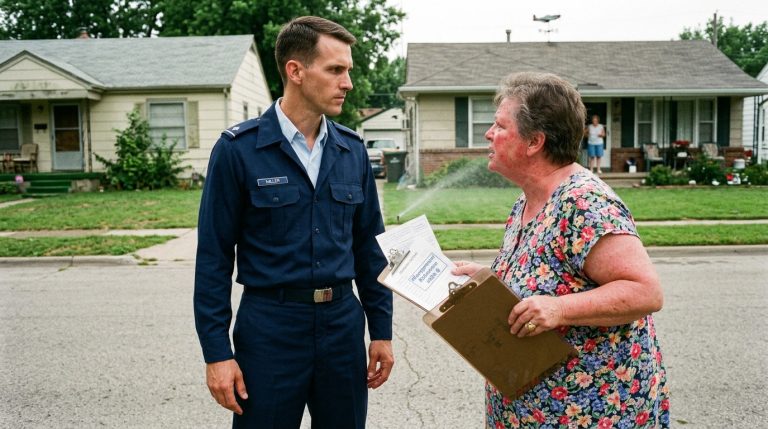
I stood on the edge of the property line, the engine of my truck ticking as it cooled in the driveway. A few feet away, Karen Peterson stood triumphant, her muumuu strained by the exertion, the yellow handles of those industrial bolt cutters gleaming like a warning flag. She held the two ends of the three-phase 200-amp line up for me to see, as if she were a fisherman displaying a pathetic, undersized catch. The black casing was shredded, the copper filaments inside exposed, jagged, and cold.
“This,” she said, her voice dripping with the kind of smug, practiced condescension that only an HOA president can muster, “is an aerial monstrosity. You were told, Mr. Miller. Approved contractors only.”
I didn’t shout. I didn’t reach for her. My body, conditioned by twenty years in the Corps to process chaos into manageable data, went still. My pulse didn’t spike; it deepened. I looked past the yellow handles and the severed cable to the trench she’d dug in the grass strip—a shallow, amateurish wound in the earth that cut straight through the registered utility easement.
“Karen,” I said, the word coming out flat, steady.
“Don’t you ‘Karen’ me,” she snapped, her eyes wide with a manic, self-satisfied glow. “I am enforcing the community standards you seem to think are optional. Your shop is a noise violation, and this cable is a blight.”
She dropped the ends of the line. They hit the mud with a dull thud.
I saw the flash of movement from a neighbor’s window—a curtain falling back into place. They were watching. I pulled my phone from my pocket, my movements precise, economical. I needed the evidence before the scene changed. I panned the camera from her face to the bolt cutters, then down into the trench, focusing on the conduit she had shattered. It wasn’t just a nuisance. It was the destruction of critical infrastructure.
“You have no idea what you’ve just done,” I said, my voice barely above a whisper, yet it carried the weight of a spent casing hitting the floor.
“I’ve restored order,” she replied, straightening her back, already moving to turn away, the victory clearly tasted like sugar in her mouth.
“You’ve committed a felony,” I said, hit record, and stepped forward to capture the look on her face as the realization didn’t land, but the threat of the documentation began to itch at the edges of her arrogance.
CHAPTER 2: THE PAPER SIEGE
Karen turned on her heel, her muumuu fluttering like a cheap flag in the wind, and marched back toward the common area. She didn’t look back. She didn’t need to. She assumed the act of cutting the wire was the end of the argument, a decisive tactical victory. She was mistaken.
I stood there for a long moment, listening to the silence. It wasn’t the peaceful silence of a suburban morning; it was the heavy, pressurized silence of an active machine shop that had just been choked to death. I could almost hear the cooling metal of the lathe, the last flickers of magnetic fields dying out in the fluorescent fixtures. My training, dormant for years, hummed to life. My mind began to map the battlefield.
I turned back to the house, the grit of the driveway crunching beneath my boots. The sensory input—the smell of damp earth from her trench, the metallic tang of the sheared copper, the distant sound of a neighbor’s dog—it all felt amplified. My hands were steady, but my jaw was a locked gate. Every instinct I had honed in Fallujah, every lesson learned about infrastructure and supply lines, was now fixated on the piece of paper currently tucked into the folder she’d handed me days ago: the CC&Rs.
I stepped into my home office, a space I had kept meticulously organized, not out of habit, but out of a need for control. I sat at my desk and pulled out the thick, three-ring binder. I didn’t look at it as a neighbor’s guide anymore. I looked at it as a field manual for the enemy.
A memory flickered, unbidden and cold: a forward operating base in the desert, heat waves distorting the horizon, and the meticulous, soul-crushing process of cataloging every piece of scrap metal and wire we had used to secure our perimeter. Back then, we were holding back insurgents. Here, I was holding back a woman with a clipboard and an oversized sense of divine right. The same meticulousness applied. If the battlefield was bureaucratic, I would fight with the same precision I used for ordnance disposal.
I grabbed a stack of legal pads and a set of highlighters. I needed to move fast. The power company wouldn’t be here for hours, and my shop was currently dead weight. If I sat and stewed, I’d lose the initiative. I needed a formal, documented response—a certified, unassailable rebuttal that would force her into the very legal framework she thought she owned.
I spent the next two hours mapping out my defense. I parsed the “aesthetic” clauses, comparing them against the county zoning records I had pulled during my initial due diligence. She was playing on the assumption that I was just another resident who didn’t know the difference between an HOA bylaw and a state-recorded utility easement. She was wrong.
I drafted the first response. It was clinical, devoid of emotion, and dripping with specific, cited references to the county permit that had been granted to the property’s previous owner—a woodworker who had navigated the exact same bureaucratic nightmare I was facing. I detailed the technical specifications of the power line, the depth of the conduit, and the legal status of the easement. I wrote it not as a neighbor asking for leniency, but as a combat engineer filing a formal incident report.
As I typed, the anger that had surged when I saw the bolt cutters began to dissipate, replaced by a cold, efficient focus. This was no longer about a workshop. It was about the integrity of the ground I stood on. If she wanted to play by the rules, I would show her exactly what the rules were—and more importantly, how easily they could be used to cage her.
My printer hummed, a sharp, mechanical sound that cut through the quiet house. I gathered the sheets, verified the attachments—copies of the easement map, the signed permit, the photographic evidence of the damage—and placed them into a clean, professional folder. I was preparing the first strike in a war of attrition.
I looked at the clock. It had been three hours since the lines were cut. My shop was still dark, but the machinery wasn’t dead; it was just waiting. I picked up my phone and dialed the power company’s emergency line again, ready to escalate from ‘reported’ to ‘documented.’ The siege had begun, and unlike Karen, I was prepared for a long, grinding campaign. I wouldn’t just fix the cable; I would rebuild the entire legal foundation of my shop so that no one, not even a woman who thought she was a queen, could touch it again.
CHAPTER 3: THE NEIGHBORHOOD PULSE
The afternoon sun hit the pavement of Oak Creek Estates, turning the asphalt into a heat-radiating slab of gray. I stood on my porch for a beat, the folder of documents in my hand feeling like a weight, a heavy, paper-thin shield. The silence of the subdivision was thick, the kind of silence that suggested the curtains were drawn and the eyes were pressed firmly to the glass.
I needed to move, not just to mail the documents, but to understand the terrain. A commander who doesn’t know his neighbors doesn’t know the scope of the insurgency he’s facing.
As I walked toward my truck, the gravel crunching under my boots—a sound that felt uncomfortably loud in the quiet air—I spotted Tom, my next-door neighbor, leaning over his mailbox. He was fussing with a stack of grocery store flyers, his movements jerky, unnatural. When he saw me, he didn’t offer the usual nod. He went stiff, his gaze dropping to the driveway as if he were studying the structural integrity of the concrete.
“Afternoon, Tom,” I said, my voice neutral.
He jumped, nearly dropping the flyers. “Oh. Hey, Frank. Didn’t see you there.” He cleared his throat, his eyes flicking toward the common area at the end of the street—Karen’s territory. “Rough day, huh? Heard the power flicker. Some of the lights in the kitchen tripped.”
“It wasn’t just a flicker,” I said, stopping a few feet away. I watched his face. There was a twitch at the corner of his eye, a tremor of suppressed anxiety. “It was sabotage. Someone took bolt cutters to the line.”
Tom’s face went pale. He stepped back, effectively putting the mailbox between us. “Yeah, well. Karen… she’s been really focused on the ‘appearance’ stuff lately. She’s got the whole board worked up about the aesthetics.”
“Aesthetics don’t explain vandalism, Tom. She didn’t like the look of the wire, so she destroyed it. That’s not a covenant violation. That’s a felony.”
I looked closer, really looking at him. There was something else there, beneath the fear. A sense of resignation. “You’ve had run-ins with her, haven’t you? The slide? The trim color?”
He let out a short, hollow laugh that didn’t reach his eyes. “You heard about the slide? We had to replace it, Frank. Cost us six hundred bucks just to keep her from filing a lien. My wife… she just wants to be able to let the kids play without a letter appearing in the door every Tuesday.”
He leaned in, his voice dropping to a low, ragged rasp. “Don’t poke the bear, man. You’re a tough guy, I get it. But she’s got the board, she’s got the lawyer, and she’s got that look in her eye. She doesn’t just want you to follow the rules. She wants you gone.”
“Why?” I asked, keeping my tone steady. “What’s the endgame, Tom? It’s not just about a power line or a swing set color. There’s something else happening.”
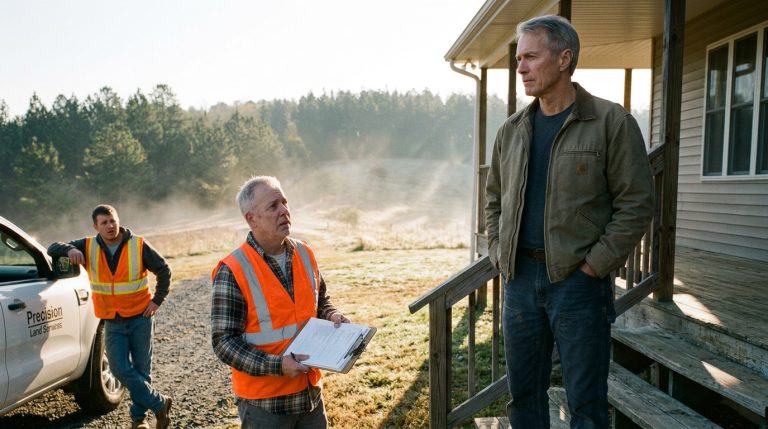
He looked at me, a flicker of something—doubt, perhaps, or a half-formed realization—passing through his expression. He looked toward the common green space at the back of the subdivision, the area where the trees still stood, providing a buffer against the main road. “I don’t know. But the surveyors were out there last week. People in hard hats. When I asked them who they were with, they just said they were ‘doing a study.’ Karen’s been spending all her time down there lately.”
He didn’t elaborate. He couldn’t. He looked at me, terrified, then shoved the flyers into his mailbox and retreated toward his garage. “Just… be careful, Frank. Seriously. This isn’t just about the yard.”
I watched him go, the weight of his fear lingering in the air. He wasn’t the only one. As I drove down the street to the post office, I noticed the subtle shifts. The way Mrs. Gable looked out from behind her blinds, her hand hovering near the lock. The way Dave, the guy from the end of the cul-de-sac, turned his back as I passed.
This wasn’t just a neighborhood; it was a collection of individual cages, each resident locked in their own private struggle with a system designed to keep them isolated. They didn’t see a war. They saw a series of unavoidable fines, a string of bad luck, a world that was becoming increasingly hostile for no apparent reason.
I pulled into the post office, the engine of the truck ticking as I killed the ignition. I sat for a moment, the folder on the passenger seat. Tom’s observation about the surveyors was the missing piece of the puzzle I hadn’t realized I was looking for.
I grabbed the folder and walked into the lobby. As I dropped the certified envelopes into the slot, the physical sensation of letting go of the paper felt like a tactical shift. I had gone on record. I had initiated the paper trail. But as I walked back to my truck, I realized the neighborhood wasn’t just silent because they were afraid. They were silent because they were being managed.
Karen wasn’t just a nuisance. She was a curator of fear. And as I looked back toward the back of the subdivision, where the wooded lot lay hidden from the street, I realized the ‘aesthetic’ violations were the dust kicked up to hide the real movement underneath. I needed to see what those surveyors had been looking at. I needed to see what was behind the trees.
CHAPTER 4: THE WAR ROOM
The truck’s interior smelled of stale coffee and the metallic, dusty scent of the workshop. I started the engine, the vibration of the dash grounding me. The post office was behind me, but the real work had only just entered its next phase. I needed a space that was disconnected from the house—a place where the rules of the subdivision didn’t apply. My workshop, silent and cold, was the only logical choice.
I pulled into my driveway, avoiding the trench Karen had dug. The sight of it still made my jaw ache—a jagged, unfinished scar across the earth. I parked and walked around to the side of the garage, where the heavy steel door stood ready. I didn’t go through the house. I entered the workshop through the side bay, my keys jangling against the lock—a sharp, clear sound that seemed to announce my presence in the hollow, dark space.
Inside, the smell was different. It was the scent of dormant potential: iron shavings, cold grease, and the faint, persistent ghost of ozone from the plasma cutter. It was a cathedral of industry, and right now, it was a tomb.
I walked to the main workbench, a massive slab of two-inch-thick steel that anchored the entire room. It was the perfect place to lay out a campaign. I switched on a portable, battery-powered work light, the beam cutting through the darkness and casting long, harsh shadows against the tool-lined walls. I began to clear the workbench, pushing aside unfinished gates and heavy-duty clamps, creating a workspace.
I didn’t have much to go on yet, but I had the core: the CC&Rs, the survey maps, and the memory of Tom’s terrified face. I started to organize. I pinned the laminated survey map to the side of the workbench with heavy magnets, the 10-foot easement highlighted in bright, fluorescent orange. It was the absolute, non-negotiable truth of my property. Whatever Karen was doing, whatever development dreams she was entertaining, she couldn’t erase this lines on a county-recorded document.
Then, I opened the “Correspondence” binder. I pulled out the violation notices, one by one. The red ink, the aggressive tone, the arbitrary rules—they looked different now. They weren’t just petty complaints; they were distractions. They were “noise” meant to keep me occupied, to force me into a reactive state where I wouldn’t have the time to look at the survey map or the wooded lot in the back.
As I worked, the silence of the shop began to weigh on me. I found myself checking the corners, listening to the ambient sounds of the neighborhood. My mind drifted to another life—clearing terrain in the valley, where every tree line and every dirt path had to be analyzed for IEDs or ambush points. The discipline was the same. You don’t just look at the threat in front of you; you look at the terrain that allows the threat to exist.
I pulled a fresh sheet of drafting paper and began to sketch the subdivision, marking the common area, the locations of the board members’ houses, and the path of the utility easement. I traced the route of the power line. It was a straight shot, direct and efficient—the exact kind of path a developer would need for a main access road.
The realization hit me with the force of a physical blow. It wasn’t about the aesthetics of the power line. It was about the fact that my power line was the only thing preventing a clear, straight-line entry to the back acreage. If they moved it, or if they destroyed the easement’s legal standing, the land value would triple.
I felt a cold, hard focus settle over me. I wasn’t just a victim of an HOA power trip; I was an obstacle to a million-dollar deal.
I needed to see it. Not from the street, and not as a neighbor. I needed to see it like an engineer. I grabbed my tactical flashlight and a pair of heavy-duty bolt cutters—not the ones Karen had used, but my own, industrial-grade tools I kept for the shop. I didn’t need to cut anything, but I needed the weight of them in my hand.
I walked out of the shop, the side door clicking shut behind me. The sun was beginning to dip, casting long, bruised shadows across the lawns. I moved along the side of the houses, sticking to the edge of the property lines, where the fences offered a sliver of cover. My senses were dialed in: the smell of fresh-cut grass, the hum of an AC unit, the muffled sound of a television inside someone’s living room.
I reached the treeline at the back of the subdivision. The transition from the manicured lawns to the overgrown, wooded buffer was jarring. Here, the ground was uneven, choked with brambles and thick, tangled underbrush. I pushed through, my boots sinking into the soft, damp earth. I wasn’t being seen, but I felt the weight of the neighborhood on my back.
I reached a small clearing. I stopped, my breath hitching.
There, half-hidden by a cluster of overgrown pines, were the stakes. Bright, orange plastic ribbons tied to wooden posts, marking a perimeter that didn’t belong to the existing residential lots. I knelt down, the damp earth cold against my knees, and pulled a small measuring tape from my pocket. I measured the distance between the stakes. It was a precise, calculated span, exactly the width of a standard municipal access road.
Karen hadn’t just been planning this; she had been surveying it. And based on the soil displacement around the stakes, the survey was recent.
I stood up, the shadows lengthening around me. My heart was a steady, rhythmic thrum in my chest. I had the confirmation. I had the ‘why.’ Now, I needed the ‘who’ and the ‘how.’ I had to find out who was backing her, who was holding the money, and where the paper trail led. The neighborhood was quiet, but as I walked back toward the lights of the houses, I knew the quiet wouldn’t last. The war room was active, and I had the coordinates of their foundation.
CHAPTER 5: THE DISCOVERY
The sky didn’t just turn gray; it shattered. One moment I was staring at the stakes in the clearing, my mind cataloging the road width and the intentional placement, and the next, the heavens opened up with a ferocity that turned the dry, overgrown forest floor into a sludge-filled trap. The rain came down in sheets, heavy and cold, drumming against the leaves with a sound like static.
I didn’t run. The urgency I felt—the need to process the data—outpaced the desire for comfort. I stood for a moment, letting the water soak through my shirt, grounding me in the immediate reality of the site. This wasn’t just a survey; it was a layout. I traced the line of the stakes once more with the beam of my flashlight, the light cutting through the driving rain like a laser. The path was undeniable. It led directly toward the main thoroughfare, and directly over the easement.
My phone, tucked deep inside my inner jacket pocket, buzzed—a vibration that felt alien in the chaos of the storm. I pulled it out, shielding the screen with my hand. It was an email notification from the county records portal, a follow-up to the request I’d submitted earlier that week regarding the common area zoning.
I leaned back against the rough bark of a pine tree, the wood slick and cold against my spine. My fingers, numb and clumsy from the temperature, tapped the screen. The document loaded slowly, the cellular signal struggling against the downpour.
It was a PDF of a rezoning application. My pulse, already elevated from the climb, kicked into a higher gear.
The application was filed under the name ‘Peterson Trust,’ and the intent was clear: change the zoning from ‘Recreational/Common Space’ to ‘Residential-Medium Density.’ The supporting documents included a site map that clearly showed the removal of the existing utility conduit. The developer’s name wasn’t immediately visible—it was marked as ‘Undisclosed Partner’—but the contact address listed on the secondary rider was the same PO Box I’d seen on the HOA landscaping invoices.
The pieces began to lock together, clicking into place like the action of a finely machined bolt. The HOA wasn’t just an association; it was a holding company. Karen wasn’t just a president; she was a facilitator. She had been creating ‘violations’ to bankrupt or intimidate the homeowners who could potentially challenge the rezoning, and the destruction of my power line was a tactical maneuver—a way to permanently sever the easement that stood in the path of a million-dollar payday.
I felt a surge of cold, rational rage. I closed the app, the screen going black, leaving me in the relative darkness of the storm. I hadn’t been fighting a petty tyrant; I had been fighting a cornered animal protecting a gold mine.
I looked back toward the neighborhood, the lights of the houses flickering in the distance. I had to get back. I had to get this data onto the server in the shop, cross-reference it, and lock it down.
The trek back through the woods was brutal. The path I’d taken was now a miniature stream, the mud slick and treacherous. Every step required a calculation. I focused on the mechanical reality of the movement: plant, shift weight, stabilize, pull. The training was back, the internal rhythm of tactical traversal taking over. I moved through the dark, the rain washing away the grime of the stakes, but nothing could wash away the clarity of what I’d found.
When I finally reached the back of the subdivision, I skirted around the edge of Tom’s yard, keeping to the shadows. A car pulled into the driveway—Karen’s sedan. I ducked behind a stack of landscaping stones, my breath held tight in my chest.
She got out, umbrella held high, her movements hurried. She didn’t look back at the woods. She walked directly to her front door, fumbled with her keys, and disappeared inside. The house remained dark for a beat, then the living room lights flickered on, casting a warm, inviting glow that looked utterly grotesque given what I knew was buried in the mud back there.
I slipped through the side gate of my property, moving with the silent, practiced fluidity of someone who didn’t want to be noticed. I needed to get into the shop. I needed the server.
I reached the steel door, my hand closing over the cool, wet metal of the handle. I looked back one last time at the direction of the woods, the rain still lashing the earth. The decoy—the aesthetic ‘standards’—had been shattered. The truth was raw, cold, and sitting on my phone’s cache.
I pushed the door open, the faint click of the latch sounding like a thunderclap in the storm, and stepped inside, the smell of ozone and steel waiting for me like a familiar, grounding presence. I was done reacting. It was time to start planning the next move.
CHAPTER 6: THE ASSEMBLY
The interior of the shop was freezing, a sharp contrast to the humid, suffocating heat of the storm outside. I shed my soaked jacket, the fabric heavy and saturated with mud, and tossed it onto a stack of steel piping. My skin felt tight, a layer of grit and nervous energy binding me, but my mind was clearer than it had been in weeks.
I sat at the workbench, my fingers dancing over the keyboard of my terminal. I didn’t need to look at the screen to know what I was pulling up. The digital footprint of the ‘Peterson Trust’ was there, buried in the county’s public ledger. I cross-referenced the property ID with the invoice numbers from the HOA’s landscaping contractors. The overlap was perfect: the payments from the HOA bank account to the landscaping firm, and then the subsequent transfers to a private account linked to Karen’s brother-in-law.
It wasn’t just graft; it was a systemic bleed. They had been siphoning the neighborhood’s resources for years to fund the very development project that would eventually displace them.
I pulled the cafeteria meeting agenda onto the screen. It was sparse, drafted by the HOA board to be as boring and non-threatening as possible, meant to keep attendance low and dissent nonexistent. I began to rewrite it. I drafted a new notice, one that itemized the ‘Common Area Improvement’ assessment from two years ago, the landscaping overcharges, and the suspicious rezoning application I’d uncovered. I set it up for a batch print, the laser printer in the corner beginning to churn out copies with a steady, rhythmic thrum.
The physical exertion of the evening—the trek through the woods, the tense navigation of the subdivision—had left me vibrating with a cold, relentless energy. I reached for the cup of lukewarm coffee I’d left on the desk hours ago and took a slow, deliberate sip. The bitterness was a grounding agent.
I heard a sound from outside—a car door slamming. My body went rigid. I killed the work lights, the shop plunging into a deep, velvety darkness, illuminated only by the faint green status LEDs of the fabrication machines and the flickering glow of the monitor.
Through the narrow window of the garage door, I saw a sedan pull up to the end of the cul-de-sac. It wasn’t Karen’s car. It was a dark, late-model vehicle, parked with the headlights killed. A figure stepped out—a man in a suit, too sharply dressed for Oak Creek Estates at this hour. He stood in the rain, looking toward my workshop, his face obscured by the darkness and the heavy downpour.
He wasn’t an HOA member. He didn’t look like a resident. He stood there for a long time, the rain soaking into his coat, seemingly unbothered by the storm. He was watching.
My pulse settled into a steady, tactical rhythm. They knew. Or at least, they were suspicious. The ‘Undisclosed Partner’ had likely been alerted to the activity on the zoning application. Karen had been sloppy, but the people backing her—the ones with the real money and the real intent—were professional.
I watched him. I didn’t move. I didn’t breathe. He was a piece of the puzzle I hadn’t accounted for, a variable that added a new, dangerous layer of complexity. If they were watching the shop, they were watching me.
After a few minutes, he got back into the car, reversed, and pulled away, his taillights fading into the gloom of the storm.
I stayed in the darkness, the silence of the shop feeling different now—less like a tomb and more like a bunker. I looked at the printer, the stack of papers growing steadily, a manifesto of evidence that could blow their entire operation apart.
I wouldn’t be able to wait for the official meeting notice to circulate. I had to move the schedule up. I looked at the names on my list: Tom, Dave, Mrs. Gable. I grabbed my phone, opening the group messaging app. My thumbs hovered over the screen. If I triggered this now, there would be no going back. The legal protection of a board meeting was the only thing standing between me and whatever that guy in the suit represented.
I tapped the screen, selecting all.
“We meet tonight,” I typed. “Bring everyone who’s been fined. We have everything.”
I hit send. The notifications started popping up almost immediately—’Read,’ ‘Read,’ ‘Read.’ The insurgency was awake. The quiet life of Oak Creek Estates was officially over. I turned the work lights back on, the harsh glare returning to the shop, and started packing the folders. It was time to take this into the light, before the shadows got any longer.
CHAPTER 7: THE VERDICT
The walk from the workshop to the cafeteria was a blur of calculated motion. Every step was measured, every shadow checked. The rain had ceased, leaving the air damp and smelling of wet iron and asphalt, but the stillness of the neighborhood was now ominous, as if the houses themselves were holding their breath.
I arrived at the school cafeteria ten minutes early. The lights were already blazing, casting a harsh, institutional glow over the plastic tables and chairs. I moved straight to the front, my folders organized and weighted. When I opened the doors, the sound of my own footsteps echoed against the linoleum, a rhythmic, solitary sound that died as I reached the podium.
Slowly, the room began to fill.
It wasn’t just the usual suspects. People I’d never seen before—families with tired eyes, elderly residents carrying their own folders of violation notices—poured into the cafeteria. They didn’t talk much; they just took their seats, the tension in the room palpable.
Then, the doors swung open one last time. Karen entered, flanked by Carol and Patricia. She looked at the crowd, her face a mask of practiced disdain, but I saw the tremor in her hands. She marched toward the front table, her heels clicking sharply against the floor, her gaze fixed on the back wall. She didn’t look at me. She didn’t look at anyone.
She reached the front, sat down, and pulled out her gavel—a ridiculous, small wooden thing that looked like a toy against the backdrop of what was coming. She rapped it twice.
“This meeting is called to order,” she began, her voice brittle. “We have a brief agenda regarding—”
“The agenda has changed,” I said, my voice cutting through her monologue. I didn’t wait for her permission. I stepped to the microphone, the feedback whine dying as I adjusted the levels.
“Tonight, we aren’t talking about swing sets or paint colors,” I said, my voice flat and commanding. “Tonight, we are discussing the financial and legal health of Oak Creek Estates.”
Karen turned, her eyes narrowed into slits. “Mr. Miller, you are out of order. This is an HOA board meeting, not a public forum for your personal grievances.”
“This isn’t a grievance, Karen. It’s an audit.”
I clicked the remote. The screen behind me flickered to life, projecting a high-resolution scan of the rezoning application I’d pulled from the county portal. The room went dead silent. The projection was stark: the stakes, the road design, and the developer’s letter.
“This,” I continued, pacing the stage, “is a plan to sell the common green space for over a million dollars. And this,” I clicked again, showing the invoice linked to her brother-in-law, “is where your dues have actually been going.”
The room erupted. It wasn’t the sound of a meeting; it was the sound of a riot being restrained by a thin wire. Shouts of “Thief!” and “Resign!” rose from the back, people climbing onto their chairs, pointing at the board table.
Karen stood up, her face a mottled, terrified mess. “That’s a lie! That’s an unauthorized forgery! You—you vandal!” She reached for the gavel, but her hand slipped, the gavel skittering across the table and hitting the floor with a hollow thud.
“Check the documents, Karen,” I said, my voice low and dangerous. “They’re all time-stamped. They’re all signed. And they’re all in the hands of the District Attorney’s office as of twenty minutes ago.”
She went deathly pale. She looked at her cronies—Carol and Patricia—who were already trying to distance themselves, their chairs pushed back, their faces turned toward the exit. She looked at the crowd, the sea of angry, betrayed faces closing in.
I signaled to the back of the room. Two uniformed officers, whom I’d coordinated with earlier, stepped forward. They weren’t there to arrest her yet—that would come with the indictment—but their presence acted as a cooling agent, freezing the room in a state of tense, expectant silence.
I stepped down from the podium and walked toward her. I didn’t raise my voice. I didn’t need to. I pulled the formal civil suit from my folder and placed it on the table in front of her.
“This is the service of process for a civil lawsuit,” I said, my voice cold. “And that?” I pointed to the detectives standing by the door. “That’s the end of your tenure.”
She looked at the papers, then up at me, her eyes empty, the arrogance completely purged by the reality of the situation. The cafeteria, once her throne room, was now the site of her total, irrevocable defeat. She tried to say something, a final, screeching defense, but her voice died in her throat. She sat down, her body folding in on itself, while the room around her began to chant, a single, unified sound of victory.
I turned away, the folders still under my arm, the truth finally exposed. The assembly had spoken. The reign was over.
CHAPTER 8: THE AFTERMATH
The silence that followed the crowd’s exodus was heavier than the noise. The cafeteria, littered with abandoned flyers and half-empty coffee cups, felt like a command post after the enemy had retreated. Karen remained seated at the front table, a lonely, singular figure of absolute ruin. The gavel lay on the linoleum, a pathetic piece of wood that could no longer command anything.
I walked toward her, my footsteps deliberate. I didn’t feel the surge of triumph I had expected. Instead, I felt the cold, empty weight of total clarity. She didn’t look up as I approached; she was staring at the legal papers I’d served her, her hands trembling as she smoothed the crease in the service document.
“It was never about the wire, Karen,” I said, my voice quiet, cutting through the vast, hollow space of the room. “The wire was just the last thing standing in your way.”
She finally lifted her head. Her eyes were rimmed with red, her makeup smudged—the carefully curated mask of the neighborhood queen had completely disintegrated. “You destroyed everything,” she whispered, the words ragged. “I was doing what had to be done. You think you’re so smart, Miller? You think you’re a hero? This neighborhood… it wouldn’t have survived without the rules. Without me.”
“It didn’t survive,” I corrected her. “It was being harvested.”
I leaned against the table, the laminate cold beneath my hands. “The development deal. The kickbacks. The brother-in-law. We have it all documented, Karen. Not just the destruction of property, but the fraud. The rezoning application wasn’t just a business move—it was an act of betrayal against the people who trusted you with their homes.”
She let out a dry, hacking laugh that quickly devolved into a sob. “They don’t care. They only care about their property values. I gave them structure.”
“You gave them fear,” I said. “And fear has a shelf life.”
Behind her, the two detectives shifted, their presence a final, iron-clad punctuation mark to her reign. She seemed to shrink, her body language turning inward, as if she were trying to occupy less space in a world that was rapidly closing in on her. She had been the architect of a system built on petty tyranny, but she had failed to account for the simple, stubborn reality of the truth.
I watched her for a moment longer, then turned and walked away. There was no point in lingering. The battle was over. The physical machinery of her control had been dismantled, and the legal gears were now grinding her into dust.
Outside, the air was crisp, the storm having scrubbed the humidity from the night. The subdivision lights were beginning to go out, house by house, returning to the normal, quiet hum of a suburb that was finally being allowed to breathe. I walked toward my truck, the weight of the last few weeks lifting with every step.
Back at the workshop, I didn’t turn on the main lights. I kept the space dim, the soft, amber glow of the workbench light sufficient. I walked to the corner where the severed cable ends sat—a coil of thick, black rubber and copper wiring. I picked them up, the texture rough and familiar.
It was a simple, manual task—stripping the ends, prepping the conduit, soldering the connections. It wasn’t ‘heroic’ work, but it was essential. I focused on the heat, the solder flowing into the joints, the integrity of the connection being restored. It was the repair I had promised myself. By the time I finished, the workshop was silent again, but the hum of the power was back, a steady, rhythmic throb that pulsed through the floorboards.
I walked to the side door and opened it, letting the cool night air flow in. I looked out toward the common area, where the orange stakes had been, and where the new picnic area would eventually stand. The neighborhood was quiet, truly quiet for the first time since I’d arrived.
My wife, Sarah, appeared in the doorway, her silhouette framed by the light from the house. She didn’t say anything, just stood there for a moment, the tension that had defined our lives for the last month finally beginning to dissipate from her posture.
“Is it done?” she asked softly.
I looked down at my hands, the slight burns from the soldering iron, the oil and dust of the workshop. “The damage is being repaired,” I said.
I leaned against the doorframe, the solid, unyielding steel of the shop behind me. The war had cost us time, money, and sleep, but we had reclaimed the ground. The threat was gone, the bureaucracy had been reset, and the future—the future was something we could build on our own terms now. I looked at the workshop, the machinery waiting, the metal cool and silent. We were safe. And in the silence of the night, that was enough.