The Weight of the Deed: A Pragmatic War for the Integrity of Home and Sovereignty
CHAPTER 1: The Idle Monster
The gravel under my boots crunched with a familiar, abrasive friction—a sound of honest labor that stood in stark contrast to the sterile, manicured asphalt stretching out behind Karen. She didn’t look at me; she looked at the machine, her eyes following the yellow steel blade as it hovered, waiting for the command to scrape away ten years of my life.
The heat was oppressive, a humid July weight that smelled of dry earth and impending static. My hands felt heavy at my sides, calloused and steady. I didn’t reach for a weapon, because in this war, the only iron that mattered was the weight of the document currently burning a hole in my back pocket.
“Covenant 17B, Mr. Reynolds,” Karen said, her voice cutting through the mechanical drone with the shrillness of a bird of prey. She gestured to the bulldozer, her floral mumu straining against the damp air. “The board has spoken. This ‘easement’ is a blight on our community’s aesthetic harmony. We are remediating the error today.”
The operator—a man whose neck was mapped with the deep, sun-baked wrinkles of a lifetime spent in the dirt—looked from Karen to the driveway, then to me. His eyes were tired, weary of the petty tyranny he was being forced to facilitate. He gripped the control levers, his knuckles white.
I took a step forward, my boots biting into the crushed stone. I didn’t shout. I didn’t match her frantic, high-pitched energy. I focused on the machine, analyzing the physics of its position, the way the tracks had already bruised the edge of the county road.
“Karen,” I said, the name feeling like gravel in my mouth.
She turned, her expression one of practiced, condescending pity. “There is nothing to discuss. The bulldozer is here. The bylaws are absolute.”
“The bylaws are paper,” I countered, keeping my voice low, steady, a sharp contrast to the vibration of the idling engine. “Gravity, friction, and geography? Those are absolute.”
I saw the flicker of annoyance in her eyes, a momentary waver in her self-assurance. She glanced at the machine, then back at me, her mouth opening to deliver another pre-scripted platitude, but she paused. For a second, the heavy, metallic smell of diesel exhaust hung between us, thick and suffocating.
I shifted my weight, letting the silence expand. I noticed something then, hidden in the shadow beneath the bulldozer’s undercarriage—a leaking hydraulic line, a tiny, weeping point of failure that the operator had clearly been nursing for miles. It was a small, overlooked detail, the kind that eventually grinds a massive machine to a halt.
Karen raised her paper scepter again, her face reddening. “Move aside, Jack. You are trespassing on community-maintained periphery.”
I didn’t move. I looked past her, toward the subdivision, seeing the pristine, uniform mailboxes standing like silent, blind sentinels. I knew what lay behind them. I knew the tight, suffocating turning radii of the cul-de-sacs. I knew the secret flaw of Oakwood Estates.
“You’re making a mistake,” I said, and for the first time, she saw the shift in my posture—the calm, calculating precision of an engineer who had already finished the war before she’d even started the battle.
She didn’t answer. She only turned to the operator and pointed at my road.
CHAPTER 2: The Architects Desk
The bulldozer didn’t move. The operator, Henderson, kept his hand on the lever, his gaze flicking between Karen’s stiff, expectant posture and the jagged line where my driveway met her precious, flawless asphalt. He wasn’t looking at her anymore; he was reading the terrain. He saw what I saw: the way the ground sloped here, the way the gravel held firm where her smooth road would have cracked under the weight of the massive Cat.
“Karen,” Henderson said, his voice dropping an octave, losing that subservient edge he’d worn just moments ago. “I’m not dropping the blade. Not on a slope like this. It’ll tear up the sub-base.”
She didn’t hear him. Or, more accurately, she refused to acknowledge that her authority had hit a physical wall. She was still vibrating with the momentum of her own ego. “The bylaws state the perimeter must be cleared,” she snapped, not even glancing at the operator. “Do your job.”
I didn’t wait for the escalation. I turned on my heel. My boots hit the gravel with a measured, heavy thud. I knew she’d keep barking, but the machine was static now, effectively neutralized by the operator’s sudden, professional hesitation. I needed to be at my desk. I needed to translate this standoff into a language she couldn’t simply ignore with a wave of her floral-print arms.
As I walked toward the house, the heat seemed to intensify, shimmering off the brickwork. A memory intruded—the smell of hot, metallic dust from a job site in the desert years ago, where a poorly surveyed grade had caused a retaining wall to collapse under its own weight. I’d been the one to sign off on the schematics then, and I’d watched as the error cost millions and nearly leveled a field hospital. The shame of it still sat in the back of my throat like dry grit. That was a failure of calculation. I wouldn’t make that mistake again. Karen’s “authority” was a faulty foundation, and I was going to pull the pins out from under it.
Inside, the house was cool, smelling of old paper and wood stain—a stark, grounded sanctuary against the frantic, thin-air madness unfolding on the front lawn. I went straight to the war room. The drafting table was covered in the physical evidence of my life here: the original surveys from Old Man Hemlock, the county plats, and the meticulously organized folders of correspondence.
I sat down, the worn leather of my chair creaking comfortably. I didn’t reach for a phone to call a lawyer—not yet. Lawyers are blunt instruments, expensive and slow. I needed a scalpel. I spread the utility schematics for Oakwood Estates across the table, pinning the corners with my heavy brass calipers.
My finger traced the blue line representing the main thoroughfare, Oakwood Lane. It was beautiful on paper, a serpentine loop designed to maximize privacy and curb appeal. But as I traced the turning radius at the intersection of the back cul-de-sacs, my stomach tightened. It was tight—too tight. It was a geometric trap. I pulled up the satellite imagery on my monitor, zooming in until the pixels blurred into the reality of the blacktop.
There was no room for error. No room for a heavy axle. I picked up a red pencil and marked the intersection, the lead pressing deep into the paper, leaving a jagged, textured scar on the smooth surface of the development plan. It wasn’t just a design choice. It was a failure of basic logistics, buried beneath the vanity of a developer who had prioritized sellable square footage over the physics of infrastructure.
The phone rang, a sharp, intrusive sound that shattered the quiet of the room. It was Sarah, calling from her office, her voice tight with the anxiety she’d been carrying for weeks.
“Jack? Is it happening? I can hear the engine all the way from the drive.”
“It’s idling,” I said, my voice as calm as I could manage. I looked at the red mark on the map. “They’re stalled. The operator has more sense than the HOA board.”
“They’ll just come back with someone else, won’t they? Someone who doesn’t care about the sub-base.”
“They might,” I admitted. I leaned back, looking out the window toward the driveway, where the yellow bulk of the bulldozer was still visible, a motionless, brooding shadow in the bright sun. “But they’re going to run out of options, Sarah. They’re fighting the land. They’re fighting the physics of this property. And they have no idea that they’re sitting on top of their own supply chain.”
I looked down at the documents, the ink and paper that defined my right of way, and then at the red mark I’d just made. I wasn’t fighting an HOA anymore. I was dismantling a poorly constructed system, piece by piece.
I picked up the handset, my mind shifting into the gear of a Corps of Engineers officer assessing a bridgehead. I had the schematics. I had the truth. Now, I just needed to start the clock on the consequences.
CHAPTER 3: The Sterile Tribunal
The walk back to the driveway felt longer than it should have, each step on the dry, crushed stone serving as a rhythmic countdown. The yellow Caterpillar was still there, a gargantuan, silent beast now, the operator leaning against the fender with a cigarette unlit between his fingers. He looked at me, a flicker of something like grim solidarity in his eyes.
Karen was still in the street. Her posture had shifted from imperious to agitated, the kind of restless, pacing energy that preceded a storm. When she saw me, her head snapped up, her face a pale, strained canvas of disbelief. She wasn’t used to being ignored, and she was clearly struggling to calibrate her reaction to a man who had walked away from her ultimatums.
“The board is waiting, Jack,” she called out, her voice thin, stripped of its earlier, practiced confidence. “This standoff is a waste of community time. You’re only ensuring the fines accrue faster.”
I didn’t answer her. I didn’t even look at her. I walked past the bulldozer, my hand trailing briefly along the cold, unyielding iron of the blade. As I passed, I glanced down at the edge of the road, where the survey markers from the original developers had been partially obscured by weeds. I stopped.
I crouched, brushing away the loose, parched soil. The marker—a rusted iron pin driven into the hard-packed clay—wasn’t where it should have been. It had been shifted, likely by the heavy grading work done during the last phase of the subdivision’s construction. It was off by nearly three feet, a small, subtle discrepancy that likely underpinned the HOA’s entire manufactured claim of “boundary infringement.”
My heart rate remained steady, but my mind accelerated. The shift wasn’t a mistake; it was an error in execution that Karen and her board had probably leveraged, perhaps even ignored, to justify their land-grab. I stood up, my knees popping, the heat of the day pressing against the back of my neck.
“If you want a tribunal, Karen,” I said, my voice cutting through the heavy, stagnant air, “then let’s have one. But you might want to call the rest of your board. They’re going to need to see this.”
She stopped pacing. She looked at me, then at the spot where I had been kneeling, her eyes narrowing with a flash of genuine, unvarnished fear. It was the first time she looked truly cornered. “You’re bluffing,” she whispered, the threat lacking any of its former, bureaucratic teeth.
“I’m an engineer,” I replied, turning toward the community clubhouse—the sterile, beige building that smelled like artificial freshness and containment. “I don’t bluff. I measure.”
I walked toward the clubhouse, the crunch of my boots on the HOA’s smooth asphalt feeling like a deliberate, tactical intrusion. I could hear her heels clicking behind me, hurried and uneven—the sound of someone who had suddenly realized the ground beneath them was no longer as solid as they had presumed.
The clubhouse was empty, the air conditioning humming a low, droning note of mechanical indifference. I walked straight to the folding table at the front, the place where she had stood only hours ago, wielding her gavel like a weapon. I sat in the chair she usually occupied, placing my binder down with a dull, final thud.
I didn’t wait for her to sit. I opened the binder to the original land survey, the one stamped and filed three decades ago, before the first beige house had even been conceptualized. I laid it out, flat and precise, the ink lines stark against the white page.
When she finally entered, breathless and flushed, I didn’t look up. I pointed to the survey, my finger tracing the line that defined my 50-foot easement.
“Your survey is wrong, Karen,” I said, finally lifting my eyes to meet hers. “The iron pin at the north corner was moved. You haven’t been fighting an infringement. You’ve been trespassing on a legal, recorded right-of-way for years. And every dollar of HOA money you’ve spent trying to ‘remediate’ this has been a fraudulent use of community funds.”
She stared at the document, her hands clutching her handbag until the knuckles whitened. She didn’t speak. She couldn’t. The silence in the room wasn’t the silence of a defeat; it was the silence of a structure beginning to crack under the weight of its own internal tension.
“Call them,” I commanded, the tone not of a neighbor, but of a superior officer giving a directive that could no longer be argued with. “Call the board. And tell them to bring their checkbooks. Because if this goes to the county, you aren’t just losing your road. You’re losing the entire phase-three permit.”
She turned, her face a mask of shattered, porcelain shock, and reached for the phone on the wall. The game had changed, and for the first time, she was playing by my rules—the rules of hard, unyielding, documented reality.
CHAPTER 4: The War Room
Karen’s hands shook, a fine, tremor-like motion that she tried to hide by clutching the edge of the folding table. The air conditioning continued its rhythmic, low-frequency hum, an uncaring mechanical pulse that seemed to mock the tension radiating from her. She didn’t look at me. Her gaze was fixed on the red-penciled markings on the survey, the proof of the displaced iron pin that had served as the silent, rusted cornerstone of her crusade.
“This,” she breathed, her voice barely audible, “is just a technicality. The community rules—the covenants—they are voted on by the collective. We don’t change course because of a misplaced stake.”
I leaned back, my chair groaning under the shift in my weight. I kept my expression neutral, but my mind was already racing, calculating the next set of variables. She was still trying to use “community sentiment” to override the physical laws of the land. She was trying to turn a material dispute into a popularity contest, and she was going to lose, but not before she made things messy.
“It’s not a technicality, Karen,” I said, my voice measured and low. “It’s a liability. If you proceed with the demolition knowing the survey is compromised, every contractor involved, every board member who voted, and the management company overseeing this disaster will be personally liable for the damages. And that’s before the fire marshal gets involved with the access routes.”
I stood up, the chair scraping sharply against the sterile tile floor. I didn’t need to stay here. I needed to be back at the desk. I needed to finalize the communications to the county inspector. I walked to the door, my movements deliberate and economical.
“I’m going home,” I said, pausing with my hand on the handle. “I suggest you take the next hour to explain to your board exactly what you’ve been doing with their dues. Because by the time I send these files to the county clerk, this isn’t going to be an HOA dispute anymore. It’s going to be a matter of record.”
The drive back to my property was a brief, tense affair. The late afternoon light was hitting the oak trees at an angle that stretched long, skeletal shadows across the road. I felt the grit of the gravel beneath my tires, a comforting, familiar resistance. My house sat at the end of the drive, a sturdy, brick-built anchor in a sea of changing light.
Inside, I didn’t waste time. I went directly to the office. The war room was exactly as I had left it, the blueprints and schematics waiting like tactical charts. I turned on the desk lamp, the warm, yellow pool of light illuminating the red-lined maps. I started the phone calls—first to the county building department, then to a colleague from my Corps of Engineers days who still consulted on local infrastructure projects.
I kept the conversations brief, transactional, and devoid of emotion. I didn’t need empathy; I needed facts. By the time the sun began to dip below the horizon, I had a digital paper trail that would withstand any amount of “collective voting.”
I realized then that the decoy secret I had been fighting—the aesthetic violation of the road—had been the perfect cover for the true structural collapse of Oakwood Estates. They weren’t fighting me because they hated the gravel; they were fighting me because if the gravel road was recognized as the primary, legally deeded access point, the entire layout of their “premier” subdivision—with its illegal, tight-turning cul-de-sacs—would be exposed as non-compliant with county fire safety codes.
They were protecting a lie that they couldn’t afford to have inspected. And I was the only person with the map to prove it.
I felt a cold, sharp satisfaction settle in my chest. The war was no longer about a garden or a driveway. It was about the integrity of the land itself. I pulled a fresh sheet of drafting paper onto the table. It was time to draw up the formal notice for the county. I had the leverage, I had the facts, and for the first time, I could feel the inevitable, grinding momentum of the truth finally catching up to the people who had tried to bury it in beige paint and paper covenants.
The phone buzzed again. It was the Millers, the young couple from down the street. I picked up, my voice calm, ready for the next move in a game that was already closing in on the antagonist. “I have the proof, folks,” I said, watching the shadows deepen in the room. “And I think it’s time we showed it to the rest of the neighborhood.”
CHAPTER 5: The Garbage Pivot
The air outside had curdled. What had been a humid, sun-drenched afternoon had been replaced by a bruised purple sky, the wind picking up enough to rattle the shutters of my office. I watched a curtain of grey rain sweep across the rolling pasture, blurring the fence line where I’d spent so many quiet hours. It was a tactical complication, but one that might actually work to my advantage. Rain turns gravel into a soft, unstable surface; for a heavy machine like the bulldozer, it becomes a liability.
I grabbed my coat—a heavy, canvas thing that smelled of cedar and hard work—and stepped out onto the porch. The first fat drops of rain hit the dry earth, sending up the sharp, metallic scent of wet iron.
My phone vibrated in my pocket—a text from Gus, the garbage truck driver. It was short, crude, and perfectly timed: Boss, they’re trying to force the turn at the intersection again. Curbs are crumbling. You coming?
I didn’t hesitate. I headed for my truck, the engine turning over with a steady, deep-throated growl that felt like a challenge to the storm. I drove down the easement, the gravel shifting beneath my tires. The rain was falling harder now, turning the dust into a slick, dark paste. As I reached the main intersection of the subdivision, the scene was already unfolding.
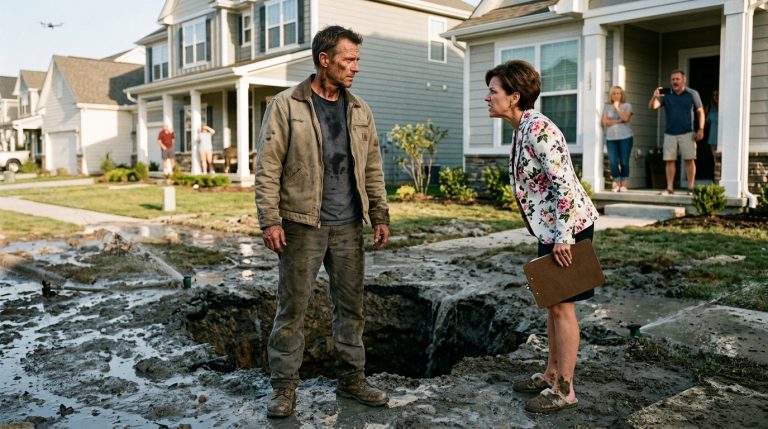
The massive green-and-white behemoth of the Allied Waste truck was angled precariously at the corner of Oakwood Lane. The driver’s side rear wheels were biting deep into the manicured Bermuda grass, and the decorative concrete curb—the very symbol of the HOA’s “aesthetic harmony”—was shattered into jagged, grey chunks.
A group of residents had gathered, huddled under umbrellas, their expressions a mix of anger and bewilderment. Bob was there, his face blotchy with fury, shouting something at Gus, who remained calmly behind the wheel, his radio crackling with static. Karen was on the periphery, her Lexus idling nearby, her phone pressed to her ear as she paced on the rain-slicked asphalt.
I pulled up, blocking the lane, and stepped out into the downpour. The rain hit my face with stinging force, cooling the heat of the last few days’ tension. I walked toward the intersection, my boots splashing through the gathering puddles.
“Stop!” Karen shrieked as she saw me, her hair already plastered to her forehead, the elegance of her morning outfit completely dissolved by the weather. “You! You’re the reason for this! You and your… your non-compliant road!”
I stopped by the shattered curb, looking down at the debris. It was perfect. The structural failure of the road design was no longer a theoretical line on a blueprint; it was a physical, unavoidable disaster.
“The road isn’t the problem, Karen,” I said, my voice cutting through the hiss of the rain. “The engineering is. This curb wasn’t built for a heavy load. It wasn’t built for reality.”
Gus leaned out of his window, rain dripping from his nose. “I told them, Jack. I told them this turn is too tight. They keep insisting I use this route because they want to ‘protect’ the privacy of the back cul-de-sacs. But they’re not protecting anything. They’re just burying the fact that they built this whole phase on a design that can’t even support the basic services the residents are paying for.”
The residents fell silent. They weren’t looking at me anymore; they were looking at the smashed curb, then at their own driveways, then at the stalled truck. The frustration that had been simmering for weeks—the petty fines, the newsletters, the endless policing of their own lives—seemed to coalesce into a single, sharp realization.
“How much is it going to cost to fix this?” someone from the crowd shouted. “And who’s paying for it?”
Karen turned to them, her composure finally snapping. “The HOA has a reserve fund! We will—”
“You’ll exhaust the reserve in a month if you have to repair every curb in this sector,” I interrupted, my voice calm, projecting over the rain. “And then, when the county inspector comes out to see why your infrastructure is crumbling, they’re going to find out the whole design was a violation of the original plat approval. They won’t just ask you to fix the curb. They’ll ask you to widen the entire lane. And that requires a zoning variance you don’t have.”
I stood there in the mud, feeling the weight of the moment. The “decoy” of my driveway had been swept away by the storm, and in its place was the cold, undeniable truth of their failure. The crowd began to murmur, the sound growing in intensity as the realization dawned on them that their perfect, beige sanctuary was built on a foundation of sand.
Karen looked at me, her eyes wide, the rain streaming down her face like tears she refused to acknowledge. She knew. She had to know. The secret wasn’t just that I was right; the secret was that she had been holding the neighborhood hostage to hide a mistake that was now impossible to ignore.
“You’re going to destroy us,” she whispered, the wind whipping the words away.
“I’m not destroying anything, Karen,” I said, turning to look at the other residents who were finally looking at the world around them with eyes that weren’t filtered through HOA newsletters. “I’m just letting the ground settle.”
CHAPTER 6: The Standoff ReIgnited
The rain had eased into a steady, grey drizzle that turned the subdivision’s broken edges into a landscape of slick mud and splintered concrete. I reached for the handle of my truck, my palm wet and cold against the metal, when Karen stepped into my path. She was trembling, the dampness of her clothes making her look fragile, almost brittle, but the look in her eyes was sharp with a manic, desperate defiance.
“You aren’t driving away from this, Jack,” she hissed. Her voice was thin, lacking the resonance it held in the clubhouse, but it was charged with the high-voltage panic of the cornered. “You don’t get to just walk away and let the neighborhood burn. You started this. You’re the ‘rogue element.’ If you think the county is going to listen to a single, disgruntled resident over the board, you’re delusional.”
I stayed by the driver-side door, my hand remaining on the handle. I didn’t want to get in the truck; I wanted to see the moment it fully clicked for her. I looked past her, toward the subdivision. A few porch lights were flickering on, silhouettes of neighbors watching from behind locked doors. They weren’t coming out to help her. They were waiting to see who would blink first.
“Karen,” I said, my voice low and steady, a sharp contrast to the ragged rhythm of her breathing. “Look at the road. Look at the curb. You’ve turned this entire phase into a liability that the insurance companies are going to audit the second a claim is filed. The county doesn’t care about ‘community standards.’ They care about fire-truck turning radii and emergency access. And you just gave them the exact footage they need to revoke your occupancy permits.”
She stepped closer, invading my space. She smelled of expensive perfume and cold, wet earth. “I’ll have you sued for interference. I’ll have your easement revoked by emergency decree. I have friends in the county planning office. I have—”
“You have a failing grade,” I interrupted, the words landing like stones in the mud. “You have a site that’s literally crumbling because you were too arrogant to listen to the physics of the land. You aren’t defending the neighborhood. You’re trying to prevent a forensic audit of the developer’s original work—the same developer who funded your initial board election.”
Her face went pale, a sudden, bloodless mask. It was the first time I’d articulated the connection, the hidden link that explained why she had been so fanatically obsessed with “aesthetic harmony” at the expense of common sense. She wasn’t just a petty tyrant; she was the cleanup crew for a failing infrastructure project.
She shoved me. It was a weak, frantic push against my chest, but the contact felt like a rupture. “You don’t know what you’re talking about!” she screamed, her voice finally breaking. “I’m the only one who cares about this place! Everyone else just—they just sit there and let it slide!”
I didn’t move. I stood my ground, my feet firmly planted in the wet gravel. I looked at her, really looked at her, and saw not an antagonist, but a hollowed-out shell of a person who had invested her entire identity into a lie. The tragedy wasn’t that she was evil; it was that she was so pathologically convinced of her own necessity that she was willing to destroy everything she claimed to be protecting.
“Move, Karen,” I said, my voice quiet but carrying the absolute authority of a man who held the evidence in his pocket. “The county inspector is on his way. I called him twenty minutes ago. If he finds you physically blocking a public right-of-way easement—which this road is, regardless of your covenants—that’s a criminal obstruction charge. And that will definitely look good in the press.”
She froze. The reality of the inspector’s arrival seemed to pierce the fog of her panic. She looked toward the entrance of the subdivision, half-expecting to see the blue and white cruiser of a county official. For a long, agonizing minute, the only sound was the drip of rain from the truck’s roof and the soft, rhythmic hum of the distant thunder.
Then, she slumped. The manic energy drained out of her, leaving her looking small and strangely diminished in the grey, dismal light. She stepped aside, her boots sinking into the mud. I didn’t say another word. I climbed into the truck, the door closing with a solid, final click.
As I pulled away, I caught one last glimpse of her in the rearview mirror. She was standing alone in the middle of the intersection, the shattered concrete of the curb at her feet, staring at nothing as the rain continued to fall. She wasn’t fighting anymore. She was just waiting for the inevitability of the audit. I kept my eyes on the road, the gravel crunching under my tires as I headed toward the main gate to meet the inspector. The war was nearing its end, and the truth was finally starting to clear the field.
CHAPTER 7: The Social Domino Effect
The drive to the subdivision entrance was a slow, deliberate exercise in containment. The rain had intensified, turning the sky a bruised, slate grey, and the windshield wipers slapped against the glass with a rhythmic, mechanical impatience. Every few seconds, the headlights cut through the gloom to illuminate the beige, identical mailboxes of Oakwood Estates, their uniformity now seeming less like order and more like a desperate, stifling attempt at concealment.
I didn’t rush. The timing was everything. I had to ensure the inspector saw the intersection exactly as it was—shattered, dangerous, and utterly incapable of handling the traffic flow the HOA had forced upon it.
As I pulled up to the main gate, a white pickup truck with the county seal on the door was already parked at an angle, its hazard lights pulsing a dull, rhythmic amber. The inspector, a man named Miller—no relation to my allies down the road—was standing outside his vehicle, a clipboard held under his raincoat. He was looking down at the curb. He wasn’t smiling.
I slowed to a stop and stepped out. The mud was thick, clinging to my boots like lead. The air smelled of wet asphalt and that lingering, foul miasma of the uncollected trash that had begun to permeate the lower end of the neighborhood.
“Mr. Reynolds,” the inspector said, not looking up. His voice was clipped, professional, and entirely devoid of the neighborly pretense that defined this community. “I received your packet. I have to say, looking at this… this isn’t what was on the approved site plan.”
“The site plan was a suggestion,” I said, walking over to join him. I didn’t point; I didn’t need to. The evidence was carved into the landscape. “The reality is that they squeezed in two extra lots per cul-de-sac than the turning radius could support. They’ve been forcing the heavy waste trucks to use my private easement for a decade to avoid exactly this.”
He clicked his pen, the sound sharp in the rain. “If this is the case, they aren’t just in violation of the aesthetic bylaws. They’re in violation of the safety code for public utility access. If that truck can’t turn, the fire engine can’t turn. And if the fire engine can’t turn, the entire phase-three permit is voidable until corrected.”
I watched him walk the perimeter of the broken curb. He wasn’t looking at the “aesthetic harmony” Karen was so fond of. He was looking at the structural integrity, the load-bearing capacity of the concrete, and the measured distance between the curb and the drainage swale.
While he worked, I felt that familiar, intrusive memory—the way this land looked back when it was Hemlock’s. I remembered the rolling, unburdened pastures, the way the fence line used to run straight and true, long before the developers had tried to force the geometry to fit their greed. It was a phantom, a ghost of a landscape, and seeing it wrecked like this, buried under the weight of poorly poured concrete and petty, manufactured rules, felt like an insult to the soil itself.
“I’m issuing a stop-work order on the remaining phases,” the inspector said, finally closing his clipboard. He looked toward the clubhouse, where a small crowd of residents had begun to gather, drawn by the presence of the county truck. “And I’m going to need a full audit of the infrastructure documentation from the HOA board. They’re going to have to prove that the initial grading was done to code, or they’re looking at a massive reconstruction project.”
I looked toward the clubhouse. Karen was there, standing on the steps, wrapped in a thin, tan cardigan that was soaked through. She looked small, spectral, her face drained of color as she watched the inspector walk toward her. The neighbors were standing a few feet back, their faces tight, the social dominoes finally starting to tip. The “silent majority” was no longer silent. They were looking at their bank statements, their property values, and the mess of the road, and they were finally doing the math.
I stood in the mud and watched as the inspector approached her. She didn’t shout. She didn’t pull out her papers. She just stood there, her hands shoved deep into her pockets, as the authority she had built on the foundation of a lie simply evaporated. It wasn’t a violent end; it was a slow, inevitable collapse, the structural weight of reality finally overcoming the aesthetic delusion.
I didn’t need to be there for the conversation. I had set the gears in motion, and now, the system was doing exactly what it was designed to do: it was grinding the error into the dust. I turned back to my truck, my work here effectively finished. The road was safe, my peace of mind was returning, and the neighborhood was about to wake up to the true, unvarnished cost of their conformity.
CHAPTER 8: The Clearing Sky
The inspector’s white truck pulled away from the curb, its tires kicking up a spray of mud that marked the end of the neighborhood’s long, suffocating reign of bureaucratic make-believe. I watched the tail-lights fade into the mist. Around me, the subdivision was still, but it was a different kind of silence—not the fearful, repressed quiet that had characterized Karen’s administration, but the strained, hollowed-out hush of a community realizing it had been living in a fragile, man-made dream.
I turned toward the clubhouse. The crowd had thinned, leaving only a few stragglers huddled by the glass doors. Karen was still standing on the steps, but the arrogance had drained away, leaving her looking uncharacteristically small against the beige facade of the building she had used as a fortress.
I walked toward her, the sound of my boots on the wet asphalt punctuating the stillness. I didn’t feel the surge of triumph I had expected. Instead, there was a heavy, pragmatic exhaustion. I stopped a few feet from the bottom step.
“It’s over, Karen,” I said. My voice wasn’t loud, but in the stillness, it seemed to vibrate with a final, unarguable authority. “The inspector has filed his report. The permits for the remaining phases are suspended, and the engineering audit will trace the initial grade failure back to the developer—and to the board’s active suppression of the original site surveys.”
She looked down at me, her eyes red-rimmed, her face stripped of the frantic, mask-like composure she’d maintained for years. “You think you’ve won something,” she said, her voice dry, brittle. “You think that by tearing this down, you’ve made it better. All you’ve done is ruined the value of every single home on this street.”
“I didn’t ruin anything,” I replied, my gaze lingering on the shattered curb that sat as a testament to their incompetence. “I just revealed the price you were already paying. You were living in a house of cards, Karen. You were just too busy polishing the siding to notice the foundation was liquefying.”
I saw the truth dawn on her then, not as a tactical defeat, but as a total collapse of her own moral logic. The layer of her authority had been peeled back, revealing the ultimate, messy reality: her “aesthetic harmony” had been a cover for a development project that was physically incapable of sustaining itself. The “nuisance” of my gravel road had been the only thing that actually functioned, because it didn’t try to be something it wasn’t.
She didn’t answer. She turned and walked back into the clubhouse, the glass door clicking shut behind her with a sound of definitive, final isolation. She was done.
I walked back to my truck, feeling the weight of the last few weeks start to lift from my shoulders. The rain began to let up, the clouds breaking to reveal a sliver of pale, watery sunlight that caught the edges of the wet trees. It was the first time in years I’d looked at the property line and seen it as it was—not a border to be defended, but a piece of land to be lived on.
When I pulled up to my own driveway, I didn’t go inside immediately. I walked to the edge of the gravel—my road, my path—and knelt, pressing my palm against the cool, wet stone. It was solid. It was real. It was exactly what it claimed to be.
Sarah was waiting on the porch, the screen door pushed open. As I climbed the steps, the tension that had defined our house for months—the constant scanning for threats, the preparation for the next round of “enforcement”—seemed to evaporate.
“It’s quiet,” she said, her voice soft, tentative, as if she were afraid the silence might break.
“It is,” I agreed, taking her hand. I felt the callouses on my fingers, the physical markers of the work I’d put in to maintain the house, to fix the fence, to grade the road. The symbolic act of repairing the gate, which had been bent during the bulldozer’s first, clumsy attempt to encroach on my land, was still ahead of me, but that was work I was ready for. It was the good kind of labor—the kind that heals instead of breaks.
The community would recover, in its own slow, grinding way. The lawyers would have their say, the insurance companies would parse the claims, and eventually, the neighborhood would become just that: a place where people lived, rather than a fiefdom to be ruled.
But for now, the sky was clearing. I stood with Sarah on the porch, watching the light change over the oak trees, and finally, for the first time in a decade, I didn’t feel like a combatant. I felt like a neighbor. I let go of the tension in my shoulders, breathing in the smell of wet earth and oncoming evening, and for the first time, I felt the peace of simply being home.