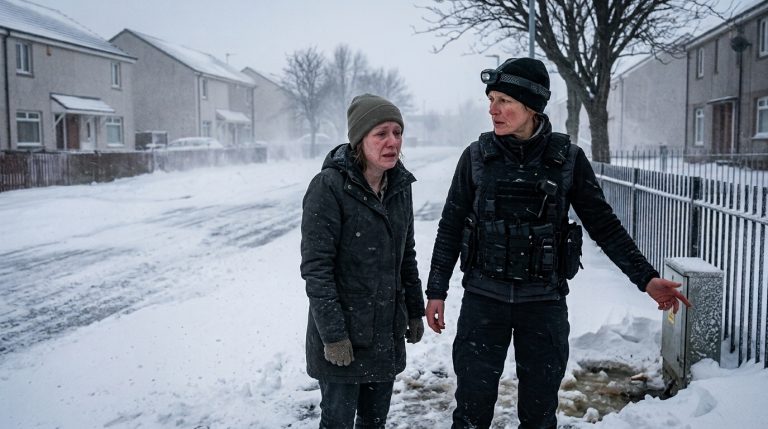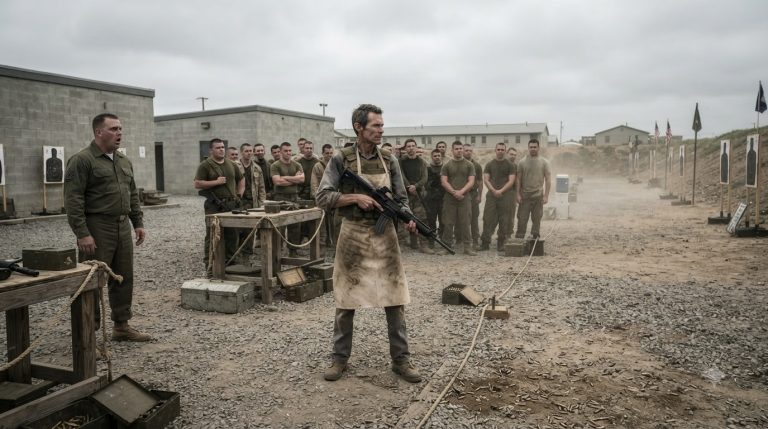
The Architect of Silence: A General’s Calculated War for Identity within the Machine of Command
CHAPTER 1: THE GATE
The sound of the pass tearing was loud, an abrupt, synthetic snap that echoed against the cinder-block walls of the Quantico visitor center. It was a precise, clean bifurcation. Lance Corporal Doolan didn’t just break the plastic; he executed it. He pushed the two pieces across the counter with a deliberate slide, his fingers lingering on the edges as if they were nothing more than confetti.
Marlena watched the plastic skid to a halt against her knuckles. The edge of the tear was sharp, catching the harsh, overhead fluorescent light. She didn’t move. She didn’t blink. In the silence of the room, her heartbeat was a rhythmic, calibrated sound—a metronome of control.
Every instinct she had cultivated for two decades—the intelligence officer’s instinct to map a threat, the Marine’s instinct to hold ground, the daughter’s instinct to disappear—collided in that single, static moment. The room felt cold, the air tasting of wet pavement and damp wool from her own clothes. She felt the weight of her rank, not as a badge of honor, but as a heavy, cold metal pressed against her skin.
She didn’t speak. She looked at the torn edges of the laminate. Beneath the plastic, her name—Major General Marlena Halloran—was sliced in two.
Gunnery Sergeant Boss was a shadow in the back, a silhouette against the flickering hum of the lights. He had stopped drinking his coffee, but he hadn’t moved. He was watching, calculating the odds of a massive, career-ending mistake or a routine disciplinary correction. He didn’t know who she was. Nobody did. To them, she was just a civilian arrival, a ghost in a windbreaker, a target of convenience for a bored gate guard.
That was the edge of the blade. The anonymity was the ultimate tactical advantage, and she had spent years honing it. But standing there, the realization bit deep: she hadn’t just been dismissed. She had been tested. And looking at the way Doolan’s eyes shifted toward the back desk—toward the Gunnery Sergeant—she realized this wasn’t a random outburst of youthful insubordination. It was a rehearsal.
The door behind her chimed again, the sound slicing through the heavy, rain-thickened air. Footsteps, heavy and rhythmic, approached the counter. She didn’t turn. She focused on the Lance Corporal’s throat, watching the pulse jump. He was terrified, but it wasn’t the terror of a mistake. It was the terror of a performer who had just missed a cue.
“General Halloran, sir,” a voice cut through the air, deeper, colder, and more precise than anything else in the room.
The Commandant of the Marine Corps had arrived, but Marlena felt the shift before he spoke. She turned, her movements slow, controlled, and devoid of heat. As General Forsythe reached across the counter to claim the torn pieces of her identity, she saw a flicker of something in the corner of the room: a shadow moving away from the side window.
Someone had been watching the gate. Someone had been waiting for the pass to be torn.
She looked at the Commandant, then back at the Lance Corporal, who had gone pale as a tombstone. The information gap hit her—a sudden, disturbing realization that the gate wasn’t just a barrier; it was a front line. And she had just arrived at the center of a much older, much darker war.
CHAPTER 2: THE COMMANDANTS ECHO
The air in the visitor center had changed. Before, it was merely stagnant, thick with the scent of floor wax and rain; now, it was ionizing, crackling with the static charge of the highest authority in the Corps. General Forsythe’s departure hadn’t drained the tension; it had merely hardened it into a structural component of the room.
Marlena stood still, her fingers pressed against the edges of the taped pass. The adhesive was cold, cheap, and fragile—a pathetic fix for a deliberate act of sabotage. She didn’t look at Lance Corporal Doolan, who was still standing at a rigid, vibrating attention, his face a study in terminal shock. She didn’t look at Gunnery Sergeant Boss, who had returned to his desk, though his posture was no longer that of a man comfortable in his own chair.
Her focus remained on the door. The Commandant hadn’t just appeared; he had materialized as a sudden, brutal correction to the environment. He was the mirror she had spent twenty-six years trying to shatter, the living embodiment of the “right child” legacy she had defied. Seeing him treat her name with deference, watching him physically repair the object of her professional existence, pulled a ghost from her peripheral vision: her father, sitting at a kitchen table in Wilmington, folding the Star News into thirds.
The phantom thought intruded with a sharp, stabbing precision. He would have hated this, she realized. Not the promotion, not the office, but the fact that the Commandant of the Marine Corps had seen her failure and intervened with a grace her father had never possessed. The cognitive dissonance was a physical weight, pressing against her ribs.
She turned slowly, the movement measured, feeling the dampness of her windbreaker against her shoulders. The silence was absolute, save for the rhythm of the rain lashing against the brick exterior. She walked toward the counter, her gaze shifting to the Gunnery Sergeant. He didn’t look up, but his eyes were darting, searching for a path that didn’t lead to a disciplinary hearing.
“Gunnery Sergeant,” she said. Her voice was low, carrying the flat, monotone resonance of a blade being unsheathed.
Boss stood up, his movements stiff. “General.”
“You were the senior watch officer. You had a direct view of the counter. You saw the pass. You heard the command.” She didn’t lean in; she didn’t need to. The gravity of her presence was enough to tilt the room toward her. “Was the order to tear the pass given, or was it a spontaneous failure of basic training?”
Boss looked at her, and for the first time, she saw the calculation behind his eyes. He wasn’t just a watch chief. He was a survivor of eighteen years of bureaucratic warfare. He saw the tape on the pass—the Commandant’s tape—and he understood the stakes. “It was a failure of judgement, General. Purely.”
“And the oversight?” she pressed. “Who authorized the standard of conduct that allowed this?”
“Standard operating procedure is as briefed by the Provost Marshal’s office, ma’am. We were told to prioritize active duty, but the system… the system is prone to lag with older identifiers.”
Marlena felt the sharp edge of the lie. It was a well-crafted one, the kind that held up in a routine report but shattered under the scrutiny of an intelligence professional. The lag wasn’t a technical glitch; it was a wall. A wall built by someone who wanted to ensure that the “Director of MCIA” didn’t make it past the threshold without a reminder of her place.
She tucked the taped pass into her pocket. The plastic felt wrong—too thick, too rough. “I don’t care about the system’s lag, Gunnery Sergeant. I care about the intent of the person who maintained the wall.”
She turned away, not waiting for a response. Doolan was still at attention, his eyes fixed on a spot on the wall behind her head. He was drowning in his own skin. Marlena passed him without a word, her boots clicking with deliberate, rhythmic force against the linoleum. Every step was an calculation of energy. She needed the office, she needed the shower, and she needed to strip off these civilian clothes that made her feel like a target.
As she stepped out into the rain, the cold air bit at her face, clearing the haze. She didn’t go to her car immediately. She walked to the edge of the parking lot, looking toward the sprawling, unseen expanse of Quantico. The base was a fortress of hierarchies, a labyrinth of men who had spent their careers measuring each other by the sharpness of their ruck marches and the rigidity of their gate guards.
She realized then that the stress-test wasn’t just at the gate. It was the entire operation. Her appointment as Director wasn’t greeted with a salute by everyone; for some, it was a threat to the established architecture of their power. The tear in the pass was a signal—a declaration of a proxy war.
She leaned against the hood of her rental sedan, watching the water pool on the windshield. She wasn’t angry anymore. Anger was a fuel for the undisciplined. Instead, she felt a cold, predatory clarity. If they wanted a war of attrition, if they wanted to test the mettle of a general who had been sharpened by a lifetime of being underestimated, they had come to the right source. She would not just survive this; she would dismantle the gate, the wall, and every man who stood behind them holding a cup of lukewarm coffee.
She pulled the pass from her pocket and looked at it again, the taped seam glowing faintly in the morning light. It was a scar, and like all scars, it was a record of what had been broken and how it had been forced to heal.
She opened the car door and slid inside, the smell of stale coffee and damp rental fabric filling the space. She turned the key, the engine groaning into life. She wasn’t just going to the BOQ. She was going to map the architecture of this resistance. Before the change of command at 0900, she would know exactly which office had updated the visitor protocol, and she would make sure they understood that the era of tearing up her credentials was over.
The rain continued to fall, a relentless, rhythmic drumming on the roof, masking the sound of her own breathing. She drove slowly, every turn calculated, every gear shift a statement of intent. The machine of command was turning, and she was the gear that was about to grind it to a halt.
CHAPTER 3: THE BRIEFING ROOM BATTLEFIELD
The road to the MCIA headquarters was a short, slick ribbon of asphalt, yet it felt like a tactical deployment. Marlena steered the sedan with the same calculated efficiency she applied to every movement in her life. The windshield wipers beat against the glass in a rhythmic, monotonous cadence—a metronome of the tension she was forced to hold in check.
She pulled into the assigned parking slot near the headquarters building, the structure a slab of brutalist concrete emerging from the gray, rain-drenched morning. It was here, inside this building, that the power dynamics of the directorate were currently in flux. She parked, killed the engine, and sat for a moment in the silence. The taped pass sat in her jacket pocket, a jagged reminder of the friction she had already encountered.
She didn’t rush. She climbed out into the rain, the cold water slicking her hair, and walked toward the entrance. Her security credentials were verified with a perfunctory, high-speed scan. The sergeant at the desk, unlike Doolan, performed the check with professional, almost robotic precision. He didn’t look at her twice, and she noted the absence of friction with an internal sigh of relief. The theater of the gate was behind her; the theater of the office was beginning.
As she entered the main corridor, she could feel the atmosphere shift. It was a subtle, almost imperceptible change in the air pressure—a sign that the directorate was holding its breath. She walked toward the briefing auditorium. Major Reyes, the junior briefer, was standing by the door, checking his watch. When he saw her, his posture snapped into a sharp, reflexive alignment.
“General,” he said, his voice clipped. “The staff is assembled. We’re waiting on your cue for the opening remarks.”
“Give me two minutes, Major,” she said, not slowing her pace. “I need to review the log entries from this morning.”
She detoured into a side office, a small, windowless space that functioned as a staging area. She pulled a tablet from her bag and accessed the visitor center logs, looking for the discrepancies she had been chewing on since the gate. She didn’t have to look long.
There it was. A log entry from 07:15, just fifteen minutes before her arrival, logged under the heading ‘System Maintenance.’ It wasn’t a standard maintenance window. It was a bypass command. Someone had manually disabled the automatic ID verification, forcing the system into a ‘manual recognition required’ mode. It was a deliberate choke point, designed to ensure that whoever arrived at that specific window would be forced to interact with the guard. It wasn’t a glitch. It was a setup.
A cold, thin smile touched her lips. They hadn’t just tested her; they had tried to engineer a public humiliation. And the person behind it had been arrogant enough to leave a digital footprint in the system logs.
She stood up and straightened her jacket. The room felt smaller, tighter, more focused. She wasn’t just a Director stepping into a room; she was an intelligence officer entering a theater of operations she had already mapped.
She walked back to the auditorium door. Major Reyes was still there, but now his expression was slightly tighter, more guarded. He had seen her step into the side office; he had seen the focused, lethal energy she brought with her.
“Let’s go, Major,” she said.
The doors opened, and the room was a sea of blue and green. The room was packed, the silence so dense it felt like a physical barrier. Marlena walked toward the podium, her steps measured and heavy, each one an assertion of her presence. She reached the stage, took a breath, and looked out over the faces of the officers and civilians who were waiting for a leader to define the tone of the directorate.
She didn’t start with an apology or a platitude. She didn’t talk about her vision for the future or the challenges of the coming year.
She looked directly at the front row, where the department heads were sitting, their faces composed into masks of professional indifference. “This morning, I had an interesting conversation at the visitor center,” she began, her voice cutting through the room like a steel wire. “It was an enlightening experience, and it reminded me that the integrity of our systems is only as strong as the intent of the individuals who manage them.”
A ripple of unease passed through the room. She watched the reaction, cataloging every micro-expression. The man in the second row, the one overseeing the digital infrastructure, stiffened just a fraction of an inch.
“I am the Director,” she continued, her gaze sweeping the room. “And I am here because I do not accept gaps in our operational security. Starting today, every manual override of our verification systems will be logged, audited, and personally reviewed by my office. We are not a collection of individual silos; we are a cohesive, intelligence-driven organization. Any breach of that cohesion, any attempt to introduce friction into our internal processes, will be met with immediate, decisive action.”
She waited, letting the silence settle over the room, heavy and suffocating. She hadn’t revealed her hand, but she had let them see the blade. She walked off the podium, the room still dead silent behind her, and headed straight for her office. The war hadn’t started; it had been declared.
CHAPTER 4: THE ARCHITECTURE OF PARANOIA
The silence of the Director’s office was not an absence of sound; it was an presence of intent. Marlena stood behind the mahogany desk, her fingers resting on the smooth, cold surface. The two-star flag stood behind her, a stiff, synthetic sentinel. The air conditioning hummed, a low-frequency vibration that seemed to match the thrum of blood in her temples. She didn’t sit. Sitting was an invitation to stillness, and right now, she needed to keep the momentum she had ignited in the auditorium.
She moved to the window, looking out over the parade deck where she had once run for her life and her future. The rain had slowed to a drizzle, leaving the concrete glistening like dark slate. She traced the lines of the grid below, watching the formation of Marines moving with a rhythmic, mechanical precision. It was beautiful, in a way—the absolute surrender of the individual to the function of the machine.
Then, the phantom sensation struck. It was a prickle at the base of her neck, the unmistakable, cold draft of an unseen observer. She didn’t turn around immediately. She waited, letting the feeling settle, letting it map itself against the geometry of the room. She was alone, officially. The log indicated no visitors were scheduled for another hour. Yet, the air felt dense, crowded.
She moved back to the desk, her eyes scanning the room. Everything was precisely where it had been: the brass paperweight, the empty shelves, the framed photograph of her fourteen-year-old self. She picked up the photograph. The girl in the picture looked back at her with a defiance that felt foreign, a raw, unrefined instinct for survival. Don’t let them see you blink, the girl seemed to whisper.
Marlena placed the photo back down, but she rotated it by exactly five degrees. It was a small, almost invisible adjustment, yet it changed the lines of the desk. She walked to the bookshelf, running her hand along the wood. It was solid, well-crafted, but there was a faint, irregular scratch near the base—a detail she hadn’t noticed during the morning inspection. She knelt, her dress blues straining against her movement, and examined it.
It wasn’t a scratch. It was a marking, a minute, etched symbol, almost like a serial number, but encoded. It was hidden, tucked into the shadow of the trim.
Her heart didn’t race; it slowed, dropping into a rhythmic, predatory pace. This wasn’t an office. It was a surveillance node. Someone had been watching the Director of MCIA long before she had set foot in the building, and the gate incident had simply been the triggering event to test how she would react to the pressure of being observed.
She stood up, her face a mask of iron. The paranoia, which she had initially dismissed as a side effect of her father’s rigid household, was revealed to be a necessary, hard-won survival tool. She began to sweep the room, not with a technical device, but with the eyes of a woman who had been trained to spot a sniper in a forest. She checked the molding, the ventilation grate, the underside of the desk drawers.
In the fourth drawer down, taped to the underside of the sliding track, she found it. A small, compact transmitter, no larger than a thumbprint, its LED light deactivated. It was sophisticated, military-grade, and silent.
She didn’t rip it out. She sat in the chair, pulling the drawer shut with a deliberate, smooth motion. The room felt different now. The walls weren’t just boundaries; they were lenses. She knew who had put it there. It wasn’t the Lance Corporal at the gate; he was a pawn. This was the work of the ‘Strategic Assessment Group’—the department that had been pushing for her reassignment for months. They didn’t want a Director; they wanted a puppet they could monitor and manipulate until she broke.
She picked up her desk phone, her hand steady, and punched in a code—not for the office lines, but for a private, encrypted channel she had built years ago during her time in Iraq.
“Yes?” The voice on the other end was clipped, efficient. Imogene Trask.
“The office isn’t secure,” Marlena said, her voice a low, steady murmur. “And the gate incident was a dry run.”
“How deep?” Imogene asked, the lack of hesitation proof of their shared history.
“Direct surveillance. The SAG is operating inside the directorate. They’re tracking the Director’s office in real-time.”
“Marlena, if you go after the SAG, you’re hitting the command infrastructure. That’s a political death sentence.”
“It’s not a political move, Em. It’s a tactical one. If I’m being watched, I’m going to make sure they see exactly what I want them to see.”
Marlena stood up and walked to the window again. She looked out at the parade deck, her reflection ghosting against the glass. The girl in the picture had fought to be seen. The woman in the office was going to win by disappearing in plain sight. She would let them watch, let them catalog every movement, every hesitation, and every reaction. She would feed them a performance so perfect, so disciplined, that they would never realize they were being fed a lie until it was far too late to correct their own internal navigation.
The rain began to fall in earnest again, masking the world outside in a blur of gray. The office felt cold, but it was a cold she knew how to survive. It was the temperature of the truth.
CHAPTER 5: THE LOCKDOWN SHIFT
The klaxon didn’t just sound; it tore through the structural integrity of the office’s silence. It was a high-frequency, piercing wail that vibrated in the marrow of Marlena’s bones. She was on her feet before the first oscillation hit its peak, her hand instinctively checking the drawer where she’d tucked the transmitter.
The room changed instantly. The ambient hum of the electronics died, replaced by the red strobe of the emergency lighting. The hallway outside, previously a corridor of orderly movement, erupted into the chaotic shuffle of boots and the sharp, urgent bark of voices.
She moved to the door, her pace controlled, her eyes scanning the shadows. This was not a drill. A drill had a cadence; this was an improvisation of panic. She stepped into the hall, finding the floor littered with discarded folders and the discarded composure of the morning staff. Major Reyes was ten feet away, clutching a secure laptop to his chest, his face drained of color.
“Report,” Marlena commanded, her voice cutting through the electronic scream.
Reyes looked at her, his eyes wide. “General, it’s a total perimeter breach. External sensors, all sectors, triggered simultaneously. It looks like a system-wide override.”
Marlena felt the sharp bite of clarity. The transmitter. They knew she’d found it. Or, more precisely, they knew she’d found something. The override that had been a slow-drip annoyance at the gate had just been pushed to its violent conclusion. They weren’t just watching her anymore; they were trying to isolate her.
“Seal the building,” she ordered, her fingers moving to her own communication gear. “If it’s an override, don’t rely on the digital network. Go analog. Get the Provost Marshal on the radio, not the VOIP. Tell her to lock down the sector and report to my location.”
“General, the network is down,” Reyes said, his voice straining. “I can’t even get a local frequency.”
Marlena didn’t blink. She grabbed Reyes by the shoulder, her grip iron-hard. “Then use the courier protocol. Move.”
As Reyes bolted toward the stairwell, Marlena turned back toward her office. The lockdown was a cage, but cages had hinges, and hinges were points of failure. She wasn’t just defending her command; she was being maneuvered into a position where she could identify the architects of the intrusion. If they were shutting down the building, they were looking for a physical entry point.
She moved back to her desk, not to the drawer, but to the bookshelf. She pulled the brass paperweight from the shelf, turning it over in her hand. It was heavy, a dense block of cold metal. She looked at the wall again, at the array of photographs. The history of the directorate. Men who had built this place on top of rigid codes and forgotten names.
She realized then that the breach wasn’t just digital. It was coming from inside the history of the directorate itself. She needed to reach the basement, the original, analog archive that predated the digital obsession. That was where the real leverage lived—the original blueprints of the facility, the old security protocols that the current network-dependent officers had discarded.
She exited her office, taking the long way around, avoiding the main arteries of the corridor where the panic was most visible. She kept her posture low, her movements fluid. She passed a maintenance closet and paused, catching a glimpse of a shadow moving in the far corner of the mezzanine.
It was a figure in a black tactical jumpsuit, moving with the rhythmic, calculated grace of a trained operative. It wasn’t base security. It was professional.
Marlena didn’t hesitate. She stepped into the shadows of a structural pillar, her hand finding the cold grip of her service sidearm—a habit she had kept since her time in Iraq, a comfort against the uncertainty of the world. The shadow was moving toward the stairwell—the same stairwell Reyes had just taken.
The conflict in her chest spiked—a sharp, cold, analytical tension. She was the Director. She was supposed to manage the situation from a position of authority. But authority was a static concept, and the situation was kinetic.
She followed. Her boots were silent on the industrial carpet. She reached the stairwell door and pulled it open just as the figure vanished down the shaft. She didn’t track the operative; she tracked the path. She calculated the trajectory, the speed, the destination.
She stopped on the landing, listening. The sound of the klaxon was muffled here, trapped by the concrete walls. She heard a click—a mechanical engagement. The door to the basement archives.
Marlena descended, her pulse hammering against her ribs like a bird in a cage. She reached the bottom, the air here smelling of damp paper, ozone, and dry, stagnant time. She rounded the corner, her pistol raised, but the room was empty.
The archive vault was open, the heavy steel door swinging slightly on its hinges. She moved to the entrance, her light cutting through the oppressive darkness of the inner chamber. She saw a single folder left on the central table. It wasn’t a file. It was a photograph, laid out with deliberate, mocking intent.
She approached it, her light focused on the image. It was a picture of her father, in his commissioning portrait, next to a man she didn’t recognize—a man who bore a striking, chilling resemblance to the Commandant.
The connection struck her with the force of a physical blow. The decoy secret, the stress-test, the gate—it wasn’t just about her. It was a bridge to a past she had spent twenty-six years trying to burn down. The room felt smaller, the walls closing in. She heard a metallic sound from above—the archive vault door clicking shut.
She was trapped. And in the dark, she realized she had been led exactly where they wanted her to be.
CHAPTER 6: THE ARCHIVE OF BURIED TRUTH
The click was final, a heavy, mechanical sound that seemed to pull the oxygen from the room. Marlena didn’t move. She stood in the center of the dark vault, the silence pressing against her eardrums with the weight of subterranean tons of concrete. She held her light steady, the beam cutting a sharp, clinical path through the dust-moted air.
She wasn’t just in an archive; she was in a tomb of dead paper, a place where the history of the Corps was filed away in cabinets that hadn’t seen the light of day in decades. She walked to the door, feeling the cold, solid steel with her palm. No handle on this side. No electronic keypad. It was an analog dead-end.
She turned back to the center table. The photograph remained where it had been left—a deliberate taunt. She picked it up. Her father looked young, unburdened by the cynicism that would later become his default setting. Beside him, the man who was now the Commandant looked remarkably like a man who had already decided how the board was set. They were standing at a Marine Corps League dinner, their posture mirror images of one another—alert, proud, and utterly indifferent to the world around them.
The realization didn’t come as a sudden insight; it unspooled like a tape. The commandant hadn’t just been tracking her career. He had been monitoring the Halloran bloodline, perhaps even guiding it, using her and her father as pieces in a long-standing project of institutional control. The gate incident hadn’t been a test of her leadership; it had been an initiation into a history she had spent her life trying to outrun.
She shoved the photo into her pocket and began to work. If there was a way in, there was a way out, but it wouldn’t be through the door. She scanned the perimeter of the room, her light catching the subtle irregularities in the floor—the way the dust was disturbed in a precise, rectangular pattern along the far wall.
She knelt, her knees hitting the concrete with a dull thud. She brushed the dust away, revealing a seam. A floor panel. She tugged at the edge, the metal protesting with a low, screeching rasp. Below it was a narrow crawlspace, a relic of the facility’s original engineering, likely a ventilation bypass for the heavy machinery that had once housed the early intelligence mainframe.
She lowered herself into the gap, the smell of damp earth and rusted iron hitting her with a physical force. It was tight, claustrophobic, and entirely blind. She switched to her tactical flashlight, adjusting the beam to a low-intensity setting to conserve power and avoid detection. She moved with the fluid, trained grace of someone who had spent her life in the woods of Quantico, her movements silent and deliberate.
The crawlspace was a labyrinth of cables and pipes, a skeletal infrastructure that connected the archive to the rest of the facility’s nerve center. As she moved, she began to see the logic of the system. The wires weren’t just for power; they were for communication, a hidden, hard-wired backbone that bypassed the main digital network entirely.
She found a junction box—a metal casing clamped onto a bundle of conduits. She opened it, her fingers moving with the precision of a surgeon. Inside, she saw it: a manual override switch, labeled with a single, handwritten code. Halloran-07.
A chill that had nothing to do with the basement air settled in her spine. Her own name, encoded into the building’s original infrastructure.
She didn’t flip the switch. Not yet. She realized that the architecture of this entire operation was built around her. Her name, her history, her father’s shadow—it was all part of a trap that had been set years before she had even qualified for the MOS. She was a piece of software that had been written to function exactly as intended, and the current chaos—the lockdown, the breach, the “stress test”—was simply the system updating her status.
She heard a sound from above: the muffled vibration of heavy boots on the archive floor.
They were here.
She froze, her breathing shallow, her eyes fixed on the ceiling panel above her. The sound of a heavy cabinet being pushed aside, the scuff of leather against concrete. Then, a voice—low, calm, and unmistakably professional.
“Check the ventilation. If she’s in the system, she’ll be looking for the override.”
Marlena’s hand went to her sidearm. She was in the dark, in the guts of a machine that was designed to contain her, and the men coming for her weren’t just guards—they were the people who had built the cage.
She looked at the Halloran-07 switch. If she flipped it, she wouldn’t just bypass the lockdown; she would expose the entire internal network to the outside world, creating a feedback loop that would crash the facility’s digital security. It would be a suicide move for her career, a chaotic, career-ending disaster that would leave her standing in the rubble of her own authority.
But it was the only move that gave her the truth.
She reached out, her fingers hovering over the switch. She felt the weight of the room, the weight of her father’s cold kitchen, the weight of the photograph in her pocket. She wasn’t just a Director fighting a department. She was a Marine fighting the memory of a woman her father said couldn’t exist.
She flipped the switch.
The crawlspace erupted in a blinding flash of blue light, a high-pitched scream of electronic feedback tearing through the walls. Above her, the archive exploded into chaos—the sound of computers shorting out, the screech of servers spiraling into a terminal error. The lockdown was broken, but she had just burned the building down from the inside out.
She didn’t wait. She scrambled backward, pushing toward the far end of the crawlspace, toward the exit that led to the utility tunnel outside the secure sector. She was dirty, she was exhausted, and she was currently the most dangerous woman on Quantico. And for the first time in her life, she wasn’t just a Marine. She was an architect of her own survival.
CHAPTER 7: THE LEDGER OF SHADOWS
The utility tunnel was a claustrophobic throat of steel and wire, vibrating with the residual energy of the electronic crash she had triggered. Marlena moved through it with a singular, grim purpose, her tactical flashlight beam dancing across bundles of conduits that looked like the veins of some subterranean beast. Behind her, the pursuit was organized—she could hear the rhythmic clatter of boots on the archive floor, the crisp, clipped commands of the security team as they coordinated their sweep. They were methodical, which gave her the only advantage she had: speed and the element of total surprise.
She stopped at a junction where the utility tunnel widened into a maintenance node. Her breath hitched in the damp air—a sudden, sharp metallic scent. She swept her light across the wall and found a small, recessed panel that didn’t belong. It was a manual access point for the facility’s original physical records, a bypass that the digital-obsessed architects had likely forgotten existed.
She pried it open. Inside, tucked away in a moisture-resistant sleeve, sat a heavy, leather-bound ledger. It wasn’t a digital file. It was physical, tactile, and undeniably real. She opened it, the pages brittle under her touch. Her light played over columns of names, dates, and callsigns—the true chain of command for the facility.
The handwriting was familiar. It was her father’s.
The weight of the book was nearly too much to hold. She scanned the entries, her eyes darting across the ink. It was a record of every “stress test” conducted at Quantico for the last thirty years, but it wasn’t just test data. It was a roster of names—officers who had been “filtered” out of the intelligence track, their careers methodically dismantled because they didn’t fit the mold defined by the Commandant’s circle. And there, near the bottom of the list, was her own name, tagged with an annotation in her father’s hand: Candidate 07: The exception to the rule.
The betrayal was so clinical, so meticulously documented, that it left her hollow. Her father hadn’t just been a detached observer of her career; he had been an active participant in the institutional machinery that sought to mold, test, and potentially erase her. The “protection” he had offered her was a facade, a way to keep her within the lines of a game he was helping to referee.
A sudden, sharp metallic click echoed from the tunnel behind her.
She slammed the ledger shut and shoved it into her jacket. The security team was closer than she had anticipated. She didn’t look back. She scrambled toward the end of the tunnel, the light ahead shimmering with the faint blue glow of a secondary exit. She surged forward, her body aching, her muscles screaming with the strain of the flight.
She reached the exit—a heavy, push-bar door—and slammed her shoulder into it. It groaned, resisting for a split second before swinging open into the cool, rain-soaked night.
She was back on the parade deck. The storm was at its peak now, the rain a chaotic, lashing force that blurred the edges of the buildings into a dark, abstract smudge. She didn’t run for the parking lot. She ran for the only place where she could regain her balance: the director’s office. She needed to be seen, to be in her place, to reclaim the narrative before they could write the final chapter of her career.
The parade deck was empty, a vast expanse of wet, reflecting concrete. She moved like a shadow across it, her dress blues soaked, her mind burning with the contents of the ledger. She reached the MCIA headquarters and slipped in through the service entrance, her movements silent, practiced.
She entered her office and locked the door behind her. The room was exactly as she had left it—the two-star flag standing guard, the photograph on the desk. She walked to the center of the office, her hand trembling slightly as she pulled the ledger from her pocket. She placed it on the desk and stood over it, her reflection in the dark mahogany desktop appearing tired, hardened, and utterly determined.
She heard the sound of the elevator in the hallway. They were coming for her. She had a few minutes—maybe less.
She didn’t reach for her sidearm. She reached for the phone. She dialed a number she hadn’t touched in a decade—the private line of the Joint Chiefs’ Inspector General.
“General Halloran?” The voice on the other end was calm, surprised.
“I have the record, sir,” she said, her voice steady. “The physical ledger of the Quantico Stress Tests. Every entry, every name, and every hand that signed off on the filtering of our officer corps. I’m transmitting the summary now.”
She didn’t need to explain further. She opened the ledger to the final page and activated the high-speed scanner on her desk, the blue light washing over the brittle paper. She was burning the house down, but she was going to make sure the foundations were exposed for the entire world to see.
The elevator doors opened. She heard the heavy, synchronized thud of boots in the hallway. She didn’t move. She stood behind her desk, waiting, the ledger open in front of her like a shield. She had been the daughter of a Marine who measured her by the wrong yardstick, the student of a commandant who treated her like a piece of software, and the victim of a department that feared her existence. But she was done with the performance. The girl in the photograph had wanted to be seen; the woman in the office was going to ensure that everyone else was, too.
The hallway doors began to rattle. She took a breath, the air in the office feeling cleaner than it had in months. The performance was over. The truth was on the desk.
CHAPTER 8: THE LAST DISMISSAL
The door gave way with a splintering groan, a cascade of timber and hardware that clattered across the polished office floor. Marlena didn’t move. She stood behind the desk, her posture iron-straight, her gaze locked on the entrance. The security team surged in, weapons raised, their movements synchronized and lethal. Behind them, stepping through the wreckage with a slow, deliberate cadence, was the Commandant.
His face was unreadable—a mask of granite that betrayed nothing of the tectonic shifts occurring within the organization. He stopped three feet from the desk, his eyes drifting from Marlena to the open ledger.
“General,” he said, his voice quiet. The tone wasn’t of a commander addressing a subordinate; it was the tone of a master addressing a piece that had refused to stay on the board. “You’ve made a significant error in judgment today.”
Marlena didn’t flinch. She kept her hands flat on the desk, the ledger resting beneath them. “I’ve made a correction, sir. The error was in the ledger. It’s a pity it took twenty-six years to audit it.”
The Commandant glanced at the ledger, then back at her. The men in the room were static, held in a state of suspended violence. “Your father was a good Marine. He understood the necessity of keeping the Corps pure. He understood that some individuals are born to serve as the foundation, and others are born to be the structure. You were never meant to be the structure, Marlena.”
The truth, stripped of its nuance, was colder than she had imagined. It wasn’t just that her father hadn’t noticed her; it was that he had actively curated her position in the system to ensure she remained a supporting element, a tool that would never threaten the integrity of the hierarchy he served. His failures—the moving of the ribbons, the cold silences—were deliberate calibrations to keep her hungry, keep her focused, and keep her manageable.
“You call this foundation?” she asked, her voice steady. “I call it a rot. My father didn’t serve the Corps. He served a delusion of his own importance, and you used him to filter anyone who had the intellect to see the difference.”
The Commandant’s eyes sharpened. He stepped closer, the authority radiating from him like heat from a forge. “And what do you expect to achieve? The Inspector General is a political animal. They will bury this, and you with it.”
“They might try,” Marlena said. She didn’t have to shout. The weight of the room belonged to her. “But the transmission is already logged, encrypted, and backed up in three separate secure locations. You’ve spent decades controlling the flow of information, but you forgot that the flow works in both directions. The moment you chose to use me, you gave me the access to dismantle everything you’ve built.”
The Commandant’s expression flickered—not with fear, but with a sudden, sharp recognition. He saw, for the first time, not the daughter of Dwight Halloran, but an opponent who had mastered the very weapons he had taught her to wield.
He turned to his team. “Stand down.”
The weapons lowered. The tension in the room didn’t dissipate, but it changed form, shifting from a kinetic threat to a cold, calculated standoff. He looked at Marlena, the mask finally slipping to reveal the tired, aging man underneath. “You have destroyed your own path, General.”
“No,” she replied. “I just stopped walking on yours.”
The Commandant walked out, his footsteps echoing in the silence of the now-broken office. He didn’t look back. The security team followed, their exit as disciplined as their arrival.
Marlena remained alone. She sat down in the chair, the weight of the last few hours beginning to settle into her bones. She reached into her drawer, pulled out the transmitter she had found earlier, and dropped it into her wastebasket. Then, she picked up the photograph of her fourteen-year-old self. She looked at it for a long moment, then placed it face down on the desk.
The office was quiet. Outside, the rain had stopped, and the early morning light began to bleed into the room, illuminating the dust motes and the wreckage of the door. She stood up and walked to the window.
She wasn’t a girl looking for a science fair ribbon. She wasn’t a lieutenant trying to prove she wasn’t a typist. She was the Director of Marine Corps Intelligence, and for the first time in her life, the world was exactly as it appeared.
She picked up her white cover from the desk and placed it on her head, adjusting it with practiced, precise movements. She walked out of the office, stepping over the splintered door frame. She didn’t look at the ruin. She looked at the hallway ahead, a path of her own design. The load was gone, the silence was earned, and for the first time in twenty-six years, she was exactly where she needed to be.