The Sentry of Havenwood: A Quiet Life Under the Weight of Unfinished Tactical Business
CHAPTER 1: The Weight of the Ridge
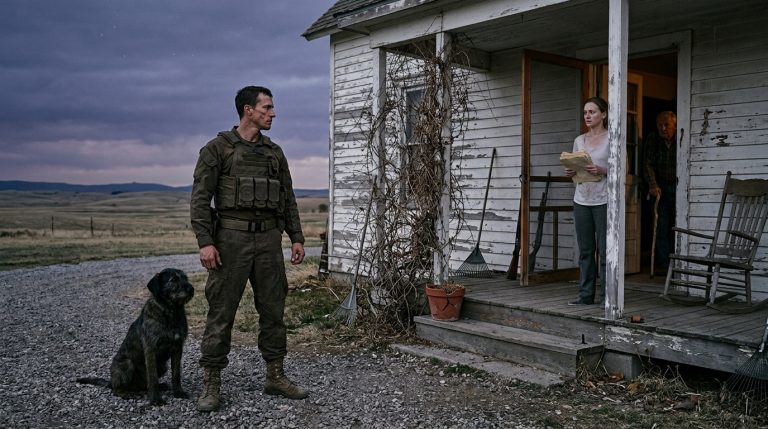
The dust on the porch rail wasn’t just dirt; it was the accumulated silence of thirty years, grit that had settled into the wood grain through every season of heat and ice. Samuel Bell sat in the rocking chair, his spine a straight line against the back, his gaze fixed on the granite teeth of the Black Bear Ridge. His hands were braced on his knees, palms open, feeling the vibration of the valley floor through the floorboards.
Down the lane, the sunlight caught the badge on Agent Carmichael’s chest, turning it into a piercing, white-hot sliver of reflected light. The man was walking toward the porch with the jerky, high-tension stride of someone who didn’t understand the terrain he was invading. Samuel didn’t move. He didn’t even blink as the FBI agent kicked up a plume of gray, choking dust that settled on the farm’s perimeter fence—a fence Samuel had painstakingly tightened just two days ago.
The static in the air was getting worse. It wasn’t the natural interference of the mountains; it was a rhythmic, artificial pulse, a stuttering heartbeat that made the hair on the back of Trip’s neck stand up. The dog whined, a low, wet sound in his throat, and shuffled closer to Samuel’s leg.
Samuel felt the shift in the air pressure before he saw the change in the landscape. It wasn’t just the helicopter noise from the ridge; it was the subtle, corrosive friction of something foreign being introduced into the valley. He watched Carmichael stop at the base of the stairs, the man’s mouth moving, the words coming out in sharp, aggressive bursts that Samuel barely registered.
Negotiation. The word felt oily. It was a language of compromise, and there was no compromise in the geology of the ridge. Samuel looked at the agent’s eyes, noting the dilation—a classic indicator of an adrenaline dump. The man was a tightly wound spring, convinced that his arrival had initiated the narrative. He had no idea he was stepping into an ecosystem that had already decided the outcome.
Then, the radio in Carmichael’s belt let out a high-pitched, discordant shriek—a digital death rattle that lasted for five seconds before cutting to dead silence.
Samuel’s fingers curled slightly, the leather of his chair creaking. That sound wasn’t a malfunction. It was a digital fingerprint. He knew the specific modulation of the scrambling protocol being used on the ridge. He hadn’t heard that code since a bunker in the humid, dark jungles of a conflict that no longer officially existed.
The militia wasn’t just holding a hostage. They were running a ghost protocol, a way to bleed the town’s data dry while everyone was focused on the guns. Samuel looked past the agent, focusing on the town hall steeple in the distance, seeing the way the local telecommunications tower light began to flicker in an impossible sequence.
He wasn’t just a farmer sitting on a porch. He was a man who had built the original blueprint for the lock that was currently being picked.
He stood up, his movement smooth and devoid of wasted energy. Carmichael stopped talking, clearly startled by the sudden shift in the old man’s presence.
“You’re making too much noise,” Samuel said, his voice as dry as the cracked soil of his field. He looked back toward the ridge, his eyes narrowing as he realized the true objective of the breach. It wasn’t just the surveyor. If they accessed the town’s server, they would trigger the Dead Hand relay, and the entire valley would go dark—permanently.
He reached down, his rough hand resting for a second on Trip’s head, feeling the warmth of the animal, the only tether left to the man he had become.
“Get off my land,” Samuel said, the words weighted with the cold, absolute certainty of a closing gate. He didn’t wait for the agent’s response. He stepped into the darkness of his home, leaving the door slightly ajar, the lock already disengaging in his mind.
Behind him, the air in the valley went completely, unnaturally still. The wind died. The crickets ceased. And in the absolute void of the silence, Samuel heard a distinct, metallic thunk—the sound of an external uplink signal successfully connecting to his own property’s hidden, buried terminal.
He wasn’t a farmer anymore. The harvest could wait.
CHAPTER 2: The Echo in the Wires
The silence wasn’t empty; it was pressurized. Samuel stood in the center of his living room, the darkness around him thick with the faint, metallic scent of ozone trailing from the radio equipment hidden within the oak chest. His breath was shallow, controlled, a rhythmic pulse that matched the ticking of the grandfather clock in the hallway. Outside, the world was still frozen in the grip of the militia’s interference, but inside, the air felt like it was humming with a low-frequency charge.
He didn’t need lights. His feet found the worn grooves in the floorboards with the instinctive precision of a nocturnal predator. He walked to the kitchen window, moving through the shadows as if he were part of them. Through the pane, he watched the patrol car’s roof light—a faint, dying ember of blue and red flickering in the distance. Agent Carmichael was still standing by his vehicle, his silhouette jagged and unsure, a man who thought he was commanding a tactical operation while the foundation of his digital world was being pulled out from under him.
Samuel felt a sudden, sharp phantom sensation: the weight of a rifle sling biting into his collarbone, the smell of damp jungle floor, the taste of metallic grit during a long-range recon mission. It was a memory of a time when the world was defined by lines of sight and the speed of one’s own reaction. He pushed the thought back down, burying it under the layers of the last forty years. He wasn’t that man anymore. He was a farmer. But as he looked at the flickering light on the utility pole near his gate, he knew the farmer had been forced to borrow the soldier’s eyes.
The militia wasn’t just scrambling radio waves. The erratic pattern of the flickering street lamp revealed their intent: they were cycling through the municipal power grid’s sub-frequencies. They were looking for the master relay.
Samuel turned back toward the oak chest. He didn’t rush. Rushing was a mistake; rushing was how things broke. He knelt, his knees popping softly in the quiet room, and rested his hands on the lid. The wood was cold, biting against his calloused palms. He didn’t just feel the wood; he felt the integrity of the hidden panel, the exact tension of the spring-loaded latch.
His fingers moved with a tactile sensitivity that defied his age. He traced the grain, his nail catching on a nearly invisible hairline fracture in the varnish—a mark he had made himself years ago, an anchor point. Two clicks to the right, one to the left, three right. The lock yielded with a sound like a single heavy raindrop falling into a bucket.
He didn’t pull the radio out yet. Instead, he reached into the back of the compartment and retrieved a set of needle-nose pliers and a roll of copper wire. His movements were economy in motion—no wasted effort, no hesitation. He was building a bridge. If the militia wanted to access the Dead Hand relay, they were going to have to walk through the gate he was about to set.
He began to feed the wire through the small, pre-drilled hole near the ceiling, the copper stiff and cold against his skin. Every motion felt familiar, a language his fingers spoke fluently even if his mind wanted to forget. This wasn’t an act of aggression; it was an act of maintenance. The valley was his farm, his soil, his air. If he allowed the militia to breach the relay, they wouldn’t just take the surveyor or the town’s data; they would initiate a cascade of hardware failures that would render the entire valley’s infrastructure dead for weeks.
As he finished looping the wire, a tremor ran through the floorboards—not from an earthquake, but from the massive, sudden power surge occurring at the town substation. The lights in the kitchen flared, a brilliant, blinding white for a fraction of a second, then died entirely. The darkness that followed was absolute, heavy, and suffocating.
Samuel stopped, his hand resting on the wire. He felt the vibration through the copper, a faint, rhythmic humming—a signal. They had hit the main line. They were in the system.
He pulled his head back, his eyes adjusting to the crushing dark. He could feel the presence of the night outside, the weight of the ridge looming over his property like a predator watching from the treeline. His heart rate remained steady, his blood pressure controlled. He stood up, the pliers tucked into his pocket, and walked back to the rocking chair on the porch.
He sat down, the wood beneath him groaning in protest. He didn’t look at the ridge. He looked at the lane. He knew they were coming. The electronic breach was the appetizer; the physical penetration of his property was the main course.
He waited, the silence of the valley now punctuated by the distant, mechanical drone of a drone engine—a high-pitched whine that the militia probably thought was covert, but to Samuel, it sounded like a child playing with a toy in a library. He leaned back, his gaze fixed on the darkness where his driveway met the road.
He wasn’t fighting for the government. He wasn’t fighting for the FBI or the town. He was fighting because his fence was broken, and he was the only one in the valley who knew how to fix it.
The drone’s whine grew sharper, a pinpoint of sound moving through the canopy of the pines. Samuel checked his watch—not the analog one he wore for farm work, but the internal one he had carried with him through every mission of his youth.
They were four minutes away.
He reached into the pocket of his flannel shirt and pulled out a small, brass-cased key. It wasn’t for a door. It was for the junction box hidden inside the hollowed-out stump of the old oak at the end of the lane. He didn’t move to hide. He simply sat, the rocking chair rhythmically creaking against the porch, the sound carrying out into the night—a steady, deliberate warning to anyone who knew how to listen.
He was a farmer. And he was waiting for the wolves to cross his line.
CHAPTER 3: The Internal Clock
Samuel didn’t stand up. To the eyes of anyone watching from the ridge or the sky, he was merely an old man idling on his porch, a fixture of the landscape as unchanging as the granite peaks behind him. But beneath the surface, his mind was a rapid-fire processor of spatial data. He tracked the drone’s position by the slight shift in the insect chorus of the valley—the way the crickets fell silent in a wide, sweeping arc as the machine drifted over the treeline.
It was sloppy. They were using a commercial-grade signal beacon, loud and hungry for power. They didn’t understand the geography of this valley; they didn’t know that the granite deposits near the northern slope would refract their signal back on itself, creating a phantom echo that would make them think they were over the command post when they were actually hovering over his barn.
He waited until the drone’s hum reached a specific, strained pitch—the sound of an engine working against the thermal updraft from the canyon. He stood, his joints moving with a quiet, efficient grace that belied his decades, and stepped off the porch. He didn’t walk toward the barn. He moved toward the shadows of the machinery shed, keeping his silhouette low against the darker geometry of the stacked hay bales and rusted iron.
His boots didn’t crunch on the gravel; he walked on the packed earth at the edge of the lane, his weight placed deliberately to avoid the loose stones. His destination was the old oak stump, a relic of a tree that had been struck by lightning years before he had even arrived in the valley. It was the anchor point for the local grid, but more importantly, it was the interface for the protocol he had buried there during a summer of quiet, lonely maintenance.
He knelt by the stump, the grit of the earth cold against his skin. The brass key felt heavy in his palm, a piece of metal that had no business being in a farmer’s pocket. He slid it into the hidden groove in the wood. It was a friction fit; the oak had grown around the brass, making the lock nearly impossible to detect without knowing the exact millimeter of pressure required to trigger it.
Click.
The panel popped, revealing not wires, but a series of weighted contact plates. He didn’t need to look. His fingers found the primary switch, the metal pitted with rust but still functional. He moved it two notches to the left—a grounding sequence.
Immediately, the static in the air around him shifted. It wasn’t a sound, but a sensation—a localized thinning of the ozone, the pressure in his inner ear equalizing. The drone’s whine changed, turning from a confident buzz to a ragged, stuttering complaint. It was losing its link.
Samuel pulled his hand back, closing the panel with a soft, dull thud. He stood, wiping the dirt from his palms onto his trousers. He hadn’t disabled the militia’s drone; he had redirected their signal to bounce off the canyon wall and into the mountain’s granite core, effectively blinding them to everything but the empty air above his fields.
A sudden, sharp movement caught his attention from the end of the lane. A pair of headlights flickered on—a brief, tactical strobe—and then went dead again. They were sending a scout. He wasn’t just sitting on his porch anymore; the perimeter was being tested.
He didn’t return to the house. Instead, he moved into the rows of standing corn, the dry, rattling stalks providing a natural, albeit brittle, cover. The stalks had been stripped of their ears weeks ago, leaving only the stalks themselves, desiccated and sharp like wooden needles. He moved through them, the friction of the leaves against his flannel shirt creating a soft, rhythmic whispering.
He reached the edge of the field, where the fence met the old logging trail. He could see the scout now—a silhouette moving in a crouch, dressed in tactical black that stood out harshly against the pale, dusty soil of the lane. The man was holding a thermal imager, the screen casting a faint, sickly green glow onto his face.
Samuel stopped, his own breathing slowing until it was almost non-existent. He knew this move. The scout was performing a “sweep and clear” protocol, a textbook maneuver for a standard unit. It was precise, it was professional, and it was entirely predictable.
The scout paused, scanning the field with the imager. Samuel stood perfectly still, his body angled to minimize his profile, his skin covered by the dust and gray tones of the field. He was invisible—not because of technology, but because he understood how to blend into the geometry of the environment. The scout’s scanner swept over him twice, the green light washing across his chest, yet the operator didn’t pause.
To the machine, Samuel was just another bundle of dry stalks.
The scout took a step forward, his boots hitting a loose stone—a sharp, clear sound in the night air. The man froze, his weapon raised, head snapping toward the field. Samuel didn’t flinch. He stayed anchored, his eyes tracking the man’s pulse points, the way his shoulder dipped when he shifted his weight. He was a young man, likely an ex-service member, but he was holding his rifle like he expected a fight, not a surrender.
Samuel let his hand drop to his side, his fingers brushing against a piece of rusted wire he had picked up earlier. It was a small, sharp instrument, but in the right hands, it was a lever. He watched the scout turn back to the lane, satisfied that the field was empty.
He had the advantage, but he didn’t take it. Not yet. If he neutralized the scout, he would trigger the militia’s “missing asset” protocol, and they would drop the surgical approach for a blunt, heavy-handed sweep.
Instead, Samuel turned back toward the farmhouse, moving through the field with a speed that defied the uneven terrain. He needed to be back on that porch before the scout reached the end of the lane. He needed to be the farmer again, the old man who was just waiting for his dog to get better.
He reached the porch steps just as the drone’s engine coughed and finally died, leaving the valley in a silence so profound it felt like a physical weight. He sat down, the wood creaking beneath him. He picked up the piece of wire from his pocket and began to idly twist it, the metal biting into his calloused skin.
Trip shifted on the porch, letting out a soft, satisfied sigh. Samuel watched the end of the lane. He was a farmer, and a farmer knows that you don’t chase the wolves away; you show them that the gate is already barred.
CHAPTER 4: The Frequency of Ghosts
The rocking chair’s rhythm was the only sound in the yard, a slow, wooden cadence that kept time with the beating of Samuel’s own heart. He didn’t turn his head when the lights of the command post at the town hall—three miles away, but visible as a persistent glow over the hills—began to pulse with an erratic, aggressive cadence. It wasn’t a standard power draw. It was a digital scream.
Samuel felt the resonance in the soles of his feet. He had spent his life reading the land, but tonight, the land was screaming in a language of encrypted packets and stolen data. The militia had moved past the drone surveillance; they were now brute-forcing the municipal firewalls.
He stood, the rocking chair settling into a final, heavy creak. The air around him felt thin, ionized by the intensity of the localized interference. He walked toward the barn, his shadow stretching long and thin across the gravel, a dark finger pointing toward the ridge. He knew what they were looking for. They thought they were hacking the town’s grid to cause a diversion, but they were digging into a dormant sector—a virtual pocket he had shielded decades ago. If they broke that seal, they wouldn’t just find blueprints; they would trigger the Dead Hand relay.
He reached the barn door, the iron latch cold and resistant to his touch. He didn’t pull it open; he tapped the wood twice, feeling for the slight give in the rot. He pulled a small, multi-tool from his pocket—an old-fashioned device, heavy and utilitarian—and slid the flat edge into the seam. He wasn’t looking for a lock. He was looking for a vibration.
The barn was a repository of rusted farm implements, but to Samuel, it was a calibration chamber. He moved toward the center, where a grain silo stood in the gloom, its corrugated walls shimmering in the moonlight. He traced his fingers along the base until he found a patch of disturbed earth.
He dug, his hands moving with the methodical persistence of a man who had cleared many a trench in his youth. He hit iron.
He pulled out a heavy, lead-lined case. It was a relic, a piece of hardware from the era of vacuum tubes and hard-wired logic. He popped the latches. Inside sat a handheld transmitter, its screen dark, its controls worn smooth by thousands of hours of use. It was a ghost machine, invisible to the digital scanners the militia were currently using to tear apart the town’s network.
He turned the dial to a frequency that didn’t exist on any commercial band—a narrow, subterranean pulse.
Hiss. Pop. Click.
The radio responded. It wasn’t a broadcast; it was a handshake. He felt the phantom vibration of a connection being made on the other side of the valley, a secure line that had been waiting for forty years to be reactivated.
He didn’t speak. He listened.
Through the static, he caught the faint, distorted pattern of the militia’s hack—it was a repetitive, recursive loop. They were stuck on a security layer he had designed himself, a logic gate that required a physical key rather than a digital password. He let out a low, dry chuckle. They were trying to break into a vault with a hammer, unaware that the vault was floating in the middle of a digital ocean they couldn’t see.
But there was a discrepancy. Among the repetitive loops of their attack, there was a new signal—a subtle, parasitic wave that was siphoning off data from the town’s registry. It wasn’t the militia. It was something else, something faster and more precise.
Samuel frowned. He recalibrated the dial, his thumb feeling the familiar tension of the spring. The discrepancy wasn’t a mistake; it was an override. Someone was using the militia’s distraction to slip through the back door.
He felt a cold spike of recognition. He knew that signature. It was an old protocol, one that had been scrubbed from every military database in the world. It was a secondary command path intended for use only if the primary Dead Hand relay was ever compromised.
They weren’t just after the town’s data. They were trying to activate the relay itself.
He looked toward the ridge, his eyes hard and focused. The mission had changed. This wasn’t just a threat to his home or the valley’s infrastructure; this was an attempt to weaponize the very thing he had spent his retirement hiding.
He stood up, his joints aching—a sharp reminder of the cost of long-dormant vigilance. He tucked the transmitter into his vest, the weight of it a grounding, heavy comfort. He had to stop the militia, but he also had to find the entity that was piggybacking on their chaos.
He walked out of the barn, the cool night air hitting his face like a slap. He could hear a truck engine approaching—a low, rumbling diesel that wasn’t moving with the tactical silence of the earlier units. It was coming up the lane, its headlights off, moving with the heavy, unhurried confidence of a wolf that knew the sheep were already cornered.
Samuel moved to the edge of the dirt lane, his hand resting on the weathered post of the entrance gate. He waited, his posture relaxed but his muscles coiled, ready to spring. He was a farmer, and a farmer knows when it’s time to stop waiting and start clearing the brush.
The truck rounded the bend, its mass blotting out the starlight. Samuel stepped into the center of the lane, a solitary figure in the dark, his hands empty but his presence a barrier that no driver could ignore.
The truck slowed, its engine grumbling, its headlights flickering to life—a blinding, aggressive white that flooded the lane. Samuel didn’t blink. He stood his ground, the light turning the dust motes in the air into a shimmering, golden curtain, watching as the driver’s side door began to swing open.
The game had shifted, and the rules of the road were about to change.
CHAPTER 5: The Rejection
The engine of the truck was a deep, guttural thrum that vibrated through the gravel and up into Samuel’s shins. As the driver’s side door creaked open, the sound was muffled by the roar of the diesel, yet Samuel heard the distinct, sharp snick of a safety being disengaged. He didn’t flinch. He stayed planted in the center of the lane, his frame a stark, stubborn silhouette against the artificial sun of the high-beams.
The man who stepped down was not wearing the tactical black of the militia. He wore a charcoal-gray windbreaker and tactical trousers that cost more than Samuel’s entire farming operation. He moved with a clinical efficiency, his eyes scanning Samuel not as a target, but as a biological variable to be neutralized or bypassed.
“You’re in the way, old man,” the driver said. His voice was flat, synthesized by the cold air.
Samuel didn’t move. He kept his hands at his sides, his fingers curled into loose, ready hooks. “This is private property,” he replied, his voice a low gravel that seemed to swallow the truck’s mechanical growl. “You’re trespassing on a closed loop.”
The driver paused, his hand hovering near his waist. He looked at Samuel, really looked at him, for the first time. The arrogance of the city-dweller flickered, replaced by a sudden, jarring confusion. He had expected an obstruction, a stubborn local; he hadn’t expected to encounter a man who stood like a weathered monolith in the path of a Category 5 storm.
“I don’t care about your land,” the driver stated, his hand shifting to his sidearm—a suppressed piece of hardware that looked like it belonged in a shadow-government inventory. “Move, or we’ll proceed over you.”
Samuel felt the familiar, icy calm wash over him—the same sensation he’d experienced in the jungles, in the bunkers, in the places where history was written in the dark. He didn’t look at the gun. He looked at the driver’s eyes, noting the slight, involuntary twitch of a muscle beneath the left eye. The man was nervous. He was a contractor, a professional mercenary, and he was currently operating without the benefit of a clear mission profile.
“You won’t get through,” Samuel said, his voice dropping an octave. “The relay is already locked. You’re just another ghost in the wires.”
The driver’s expression darkened. He lifted the weapon, but before he could clear his holster, Samuel moved. It wasn’t a charge; it was a pivot, a sudden, explosive realignment of his center of gravity. He reached out and grabbed the driver’s shoulder, not to strike, but to drag him off-balance, slamming him backward into the heavy steel frame of the truck’s grille.
The sound of the impact—a dull, meaty thud—echoed through the valley. The driver gasped, the air leaving his lungs, his weapon clattering into the dust. Samuel didn’t reach for the gun. Instead, he gripped the driver’s windbreaker and leaned in close, his face a mask of iron.
“You’re playing with a current you don’t understand,” Samuel whispered, the cold intensity of his gaze freezing the man where he stood. “If you touch that relay, you don’t just burn the town’s grid. You trigger a blackout that will reach your doorstep before you finish your next paycheck.”
The driver struggled, his face purpling, his hands clawing at Samuel’s wrists. But Samuel was a creature of leverage and momentum. He held the man pinned, his own body braced against the truck, forcing the mercenary to stare into the abyss of his own failure.
In the distance, the town hall’s lights suddenly died. A deep, heavy silence fell over the valley, the kind of silence that only comes when the power grid is severed at the source. The Dead Hand relay had been triggered.
The driver stopped struggling, his eyes going wide as he realized the tactical disaster that had just unfolded. “You… you hit the tripwire,” he choked out.
Samuel released him, letting the man slump against the fender. “I didn’t hit it,” Samuel said, his voice as heavy as iron. “I finished the cycle.”
He turned away, leaving the man gasping in the dust. He knew the militia on the ridge would be panicking now. The entire valley was black, their electronic systems dead, their digital masks stripped away. They were exposed, and more importantly, they were blind.
Samuel walked back toward the porch, the darkness feeling like a warm blanket. He knew the authorities would be confused, the FBI agent would be frantic, but the valley was safe from the data-leech. He had done what he came back here to do. He had kept the secret in the dark where it belonged.
But as he climbed the steps to his porch, the weight of the transmitter in his vest felt heavier, colder. The relay was dead, but the ghosts were not gone. They were merely regrouping.
He sat down, listening to the silence of the valley—a silence he had forged with his own hands. Trip nudged his knee, and Samuel reached down, his fingers finding the soft spot behind the dog’s ear. He wasn’t just a farmer. He was the warden of a graveyard of protocols.
He watched the ridge. The real threat wasn’t the militia anymore; it was the entity that had been piggybacking on their signal. He had cut the link, but he had also alerted them to his presence.
The game had entered its final, most dangerous phase. He was no longer waiting for the wolves; he was now the one being hunted. And for the first time in forty years, Samuel felt the exhilarating, terrifying thrill of being back in the dark.
CHAPTER 6: The Infiltration
The darkness of the valley was absolute, a heavy, suffocating blanket that swallowed the mountains and the fields alike. Samuel stood by the gate, the metallic tang of ozone still clinging to his clothes. The mercenary he had left in the dust was stirring, a low, guttural groan escaping his lips, but Samuel paid him no mind. His focus was on the ridge, specifically the fire tower that stood like a skeletal finger pointing into the void.
He knew that the blackout wouldn’t last; the militia’s backup generators would cycle on within minutes. That was the window.
He turned toward the woods, his boots finding the well-worn game trails that even the local deer avoided. He moved with a fluidity that disregarded the terrain’s roughness—the loose shale, the jagged pine roots, the tangled thicket of brush. His mind was a map, etched with the memory of the valley’s topography from before the town had even been settled.
A sudden flash of memory hit him: a damp, suffocating bunker in a different world, the smell of cordite, the sound of heavy boots on steel—a phantom sensation that made his heart stutter for a millisecond. He stopped, his hand going to his side, his fingers brushing against the cold, familiar shape of the transmitter. He breathed in, slow and deep, the scent of crushed pine needles clearing the fog in his mind.
He wasn’t in that bunker. He was on his land.
He crested the first ridge, his eyes scanning the gloom. Below him, the militia’s camp was a hive of frantic, uncoordinated light as their emergency power kicked in. They were exposed, their gear and communications equipment momentarily dead, their confidence shattered. They were scrambling to re-establish their perimeter.
But Samuel noticed something else. A flicker of movement in the brush to his left—a signature of a professional, not a militia grunt. Someone else was on the mountain.
He dropped into a crouch, his body melting into the darkness of a thick-branched spruce. He observed the figure: a runner, moving with a disciplined, low-profile stride that ignored the natural cover the militia preferred. This was the entity he had sensed earlier, the one piggybacking on the chaos.
They weren’t here to hold the ridge. They were here to harvest.
Samuel watched as the runner reached the base of the fire tower and tapped a sequence into a concealed access port at the tower’s base. It was the same sequence he had used to hide his own relay—a private, high-security code that shouldn’t have been known to anyone outside the original design team.
The realization hit him like a physical blow: the security of the Dead Hand relay hadn’t been breached by the militia; it had been compromised from the inside, years ago.
He didn’t hesitate. He pulled the transmitter from his vest, his thumb hovering over the abort key. If he pressed it now, he would wipe the entire valley’s server clean, destroying the relay and the data, but he would also burn the bridge he was standing on.
A sound reached his ears—the snap of a dry branch behind him.
He spun, his hands empty, his posture wide and ready. The runner had disappeared, but another figure had emerged from the shadows of the tower. A man in tactical gear, his face obscured by a balaclava, a weapon leveled steadily at Samuel’s chest.
“The Master Chief, I presume,” the man said, his voice cold, devoid of any warmth. “We’ve been tracking your signature since the blackout began. You’re a long way from the farm, Samuel.”
Samuel didn’t speak. He calculated the distance, the angle of the hill, the weight of the transmitter in his hand. He wasn’t afraid of the weapon; he was looking for the flaw in the man’s stance. The man was holding the rifle with a slight tremor in his right hand—an old injury, perhaps, or a sign of tactical fatigue.
“You’re working for the ones who built the backdoor,” Samuel said, his voice flat, steady. “The ones who want to turn the whole valley into a testing ground for this protocol.”
The man shrugged, a subtle movement beneath his tactical vest. “The world is changing, Master Chief. Protocols go obsolete. We’re just cleaning up the assets.”
“You aren’t cleaning anything,” Samuel replied, his hand tightening around the transmitter. “You’re just another wolf looking for a meal in a cage you don’t own.”
He didn’t wait for the man to pull the trigger. He lunged, not forward, but to the side, his body a blur of movement that exploited the slope of the ridge. He swung the transmitter with all his might, the heavy, lead-lined case connecting with the man’s wrist. The weapon spun out of the man’s hand, clattering down the slope into the dark.
The man roared, closing the distance, his hands reaching for Samuel’s throat. They hit the earth in a tangle of limbs and grit, the struggle primal and silent. Samuel felt the man’s strength—he was younger, faster, and well-trained—but he lacked the raw, tempered hardness of a man who had survived the worst the world could throw at him.
Samuel rolled, using the man’s momentum against him, driving his elbow into the man’s solar plexus with enough force to steal his breath. He scrambled back, his breath ragged, his heart hammering against his ribs like a trapped bird.
He had the transmitter. He had the high ground. But he was surrounded by a mountain of secrets, and the wolves were finally showing their teeth.
He didn’t look back at the man in the dirt. He turned and ran toward the summit of the ridge, his legs burning, his lungs gasping for air. He had one chance to trigger the system-wide purge, one chance to bury the Dead Hand relay under a mountain of static.
The wind caught his hair, smelling of iron and pine. He was a farmer, and he had a fire to put out.
CHAPTER 7: The Strike
The ascent was a brutal, vertical negotiation with gravity. Samuel’s lungs burned, a sharp, ragged fire that mirrored the growing tension in the air. Above him, the fire tower loomed, a rusted skeleton of iron against the backdrop of a blacked-out sky. The storm of static he had unleashed was already beginning to warp the environment; the air tasted of ozone, and small, errant sparks danced along the iron railings of the stairs as he climbed.
He didn’t look down. Behind him, he heard the heavy, rhythmic crunch of boots on loose shale—his pursuers were closing the gap, no longer bothering with stealth. They were pushing, confident that the climb itself would break him.
Samuel reached the landing, his grip on the rusted iron railing so tight his knuckles were white. The tower groaned under his weight, a deep, metallic protest that echoed through the valley. He scrambled to the summit platform, where the primary junction box—the physical nexus of the Dead Hand relay—awaited.
He wasn’t a farmer here. He was a ghost returning to a machine he had built to ensure that, should the world ever truly go mad, it would at least do so in silence.
He pulled the transmitter from his vest, his hands steady despite the exhaustion radiating through his limbs. The junction box was open, its guts exposed: a complex array of copper coils and ancient, vacuum-tube logic gates. It was a beautiful, lethal piece of engineering. He plugged the transmitter’s lead into the primary terminal.
Click.
The connection was cold, precise.
He heard them hit the base of the stairs. The tower rocked as they began their ascent, their movements heavy and hurried. Samuel ignored them. He began the sequence, his thumb moving over the dial, inputting the final, irreversible command.
One. Two. Three.
The relay began to whine, a high-pitched frequency that set his teeth on edge. The air around the summit started to warp, the light of the stars bending as if viewed through water. This was the trigger—the silent pulse that would collapse every digital connection within fifty miles, wiping the town’s grid, the militia’s comms, and the hidden entity’s data harvest in one clean, invisible strike.
He was twenty seconds away.
“Master Chief!” The shout came from the stairs, voice strained by the exertion of the climb. “It’s over! Step away from the terminal!”
Samuel didn’t turn. He watched the indicator light on the transmitter: a slow, pulsing amber that was shifting to a steady, defiant green. He was no longer thinking about the farm, or the silence of his valley, or the dog waiting for him on the porch. He was thinking about the machine. He was thinking about the integrity of the design.
The leader of the pursuing team burst onto the platform, weapon leveled. He was breathless, his face a mask of sweating, desperate resolve. He stopped short, his eyes locked on the transmitter, then on the junction box. He knew what he was looking at.
“You don’t understand,” the man shouted, his voice cracking. “If you trigger that, you wipe out everything! The town’s banking, the medical, the infrastructure—you’ll send them back to the dark ages!”
“It’s a necessary maintenance,” Samuel replied, his voice calm, an anchor in the storm of the tower’s vibration. “The infection has grown too deep. You don’t heal a wound by letting it fester.”
The man started to move forward, his finger tightening on the trigger. “You’re a relic, Bell! A ghost! The world doesn’t need your protection anymore!”
Samuel didn’t argue. He didn’t monologue. He didn’t plead. He watched the light turn green.
He felt the sudden, violent release of energy—not an explosion, but a seismic shift in the air itself. A wave of force, invisible and absolute, rolled out from the tower. The man on the platform was lifted off his feet, his weapon clattering harmlessly to the deck as he was thrown back against the iron support beams. The power of the pulse knocked the wind out of the entire ridge; the lights of the militia’s camp died, the drone’s hum vanished, and the very air seemed to lose its electrical charge.
The tower ceased its groaning. The silence that followed was so deep, so profound, it felt as though the entire world had stopped breathing.
Samuel stood at the center of the platform, the transmitter in his hand now nothing more than a dead, heavy block of plastic and metal. The junction box was cooling, the air around it smelling of scorched dust. He looked down at the platform. The man who had chased him was slumped against the railing, dazed, his equipment fried, his digital reach severed.
Samuel looked out over the valley. It was a sea of black, save for the faint, silver glint of the moonlight on his fields. It was clean. It was silent. It was exactly as it had been before the world tried to break into his home.
He turned and began the long, slow descent. His work was done. The machine was cold, and the valley was once again a place where a man could simply be a farmer.
CHAPTER 8: The Residuals
The descent from the ridge took an eternity, each step a deliberate measurement of his own exhaustion. Samuel moved down the slope, the heavy weight of the now-dead transmitter still in his pocket, a silent, cold anchor. The valley below was a void—a dark, unlit basin that felt less like a town in crisis and more like a blank canvas waiting for the morning to write a new, simpler history.
He didn’t need the fire tower’s vantage point anymore. He could feel the stillness in the air, a natural quiet that had been absent for days. The militia’s electronics were scrap. The contractor’s high-tech surveillance was bricked. The Dead Hand protocol, the legacy of a war that had never truly ended until this moment, was effectively buried beneath a thick, impenetrable layer of electromagnetic debris.
He reached the tree line where the dense lodgepole pines gave way to the open alfalfa field. The air here was cooler, smelling of damp, iron-rich earth and the coming rain. He stopped for a moment, leaning against the rough, lichen-covered bark of a spruce. His breath came in shallow, steady plumes in the chilly night air. The tremor in his hands had settled into a dull, rhythmic ache—the price of his return to the breaking business.
He was home.
He crossed the field, his boots sinking into the soft, yielding soil. As he neared the farmhouse, the silhouette of his porch appeared in the dark—a structure that looked unchanged, solid, and indifferent to the electronic storm that had just swept over the valley. He climbed the steps, the wood groaning beneath him with a familiar, comforting sound.
Trip was waiting. The dog stood at the top of the stairs, his tail giving a single, tentative thump against the floorboards before he stepped forward to nuzzle Samuel’s knee. Samuel reached down, his fingers burying themselves in the dog’s coarse fur.
“Quiet now, boy,” he whispered, his voice raspy and thin. “It’s over.”
He sat in the rocking chair, the movement starting slow, then falling into the easy, practiced rhythm he had kept for years. He closed his eyes, listening. There was no hum of electricity, no erratic pulse of distant digital signals, no ghost-signals haunting the airwaves. Just the wind in the pines, the soft rustle of the dry corn stalks, and the steady, grounding thrum of his own heart.
The front door of the farmhouse creaked open. Sheriff Brody stood there, a flashlight in his hand, though he didn’t turn it on. He just stood in the doorway, a shadow among shadows. He had been waiting.
“They’re gone, Sam,” Brody said, his voice quiet, almost hesitant. “The feds, the teams, the whole lot of them. They left in such a hurry it looked like they were running from a ghost.”
Samuel continued to rock. “Let them run. They don’t know what they’re looking for, and they’ll never find it.”
Brody stepped onto the porch, leaning against the railing. He looked out over the dark fields. “I think I figured it out. Not the whole thing, maybe, but enough. You didn’t save us from the militia, Sam. You saved us from… something else. Something older.”
Samuel opened his eyes and looked at his friend. The Sheriff was a good man—a man of the land, someone who understood the weight of a debt, even if he didn’t know the exact currency it was paid in.
“Doesn’t matter what it was, Bill,” Samuel said, his gaze shifting back to the dark ridge. “It’s done. The relay is burned. The valley is yours again.”
“It was always ours,” Brody corrected, his voice firm. He reached into his pocket and pulled out a small, bent piece of metal—a scrap of the fence wire Samuel had discarded earlier. “You did a lot of work today, Sam. But I think it’s time you just let someone else worry about the borders.”
Samuel smiled—a dry, rusty expression that didn’t quite reach his eyes, but carried the weight of a long-sought peace. He stood up, his body feeling the full, crushing fatigue of the day’s labor. He walked over to the porch bench and picked up a rusted wrench he’d left there earlier—the tool he’d been using to tighten the fence gate.
He gripped the tool, feeling the cold, familiar bite of the iron. He held it for a moment, considering the repair he’d started, then set it down on the table with a soft, final thud.
“Tomorrow,” Samuel said. “Tomorrow, I’ll mend the gate by the creek. The fence is still a bit loose.”
“I’ll bring the coffee,” Brody promised, turning toward the stairs. “And maybe a new latch. That one’s seen better days.”
Samuel watched his friend walk down the lane, his flashlight finally clicking on, a small, brave circle of light in the vast, quiet darkness. He stood on the porch for a long time, watching the light fade into the distance until it was swallowed by the night.
He looked at his hands—calloused, weathered, and scarred. They were made for building. For the first time in his life, he didn’t feel the phantom weight of the breaking. He wasn’t the Master Chief, and he wasn’t the Pathfinder. He was just Samuel Bell, a farmer in his valley under a sky full of stars.
The rain began to fall then, a soft, rhythmic patter on the tin roof, washing away the dust of the last few days, cleansing the earth, and settling into the soil. He sat back in his chair, pulled his flannel coat tight, and let the storm of the last forty years finally drift away into the dark.
He was home. And for the first time in his life, that was enough.