The Land Beneath the Lies: A Man of Quiet Consequence Defends His Right to Exist
CHAPTER 1: The Weight of the Deed
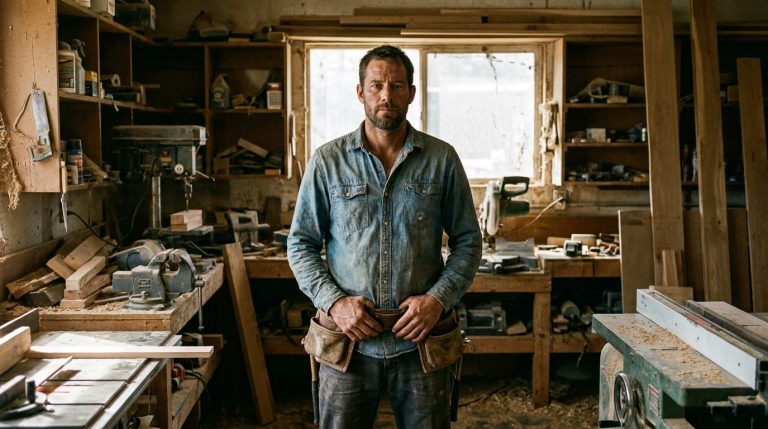
The air in the garage smelled of motor oil and dry earth, a scent that usually promised clarity. Today, it only smelled like an impending storm. My old blue pickup sat in the center of the concrete floor, its tailgate bearing the dents of a decade’s worth of labor. It looked out of place against the polished, sterile perfection of the Willow Creek estates, but for the first time in three weeks, it didn’t feel like a violation. It felt like a monument.
Lily was in the house, probably still processing the look on the HOA president’s face—that sharp, sudden collapse of her carefully curated authority. I shouldn’t have let her watch that. But in the world I came from, you didn’t hide the truth from the next generation; you gave them the tools to survive it.
I pulled the county documents from my back pocket and smoothed them out on the workbench. The paper was crisp, official, and held a weight that had nothing to do with its density. Parcel 22C. The coordinates were etched in black ink, marking the perimeter of every pristine lawn and decorative fence on the street.
The front door of the garage creaked open. It wasn’t Lily.
A neighbor—I couldn’t recall his name, just the manicured hedge he spent every Saturday morning obsessing over—stood in the doorway. He didn’t come inside. He stayed on the edge of the gravel, his shoes hovering just off the concrete as if he feared the dust might contaminate his life.
“They’re talking,” he said, his voice brittle. It wasn’t a greeting. It was an admission of fear.
I didn’t look up from the blueprints. “Who?”
“The board. The president didn’t go home. She’s at the community center, and half the street is there with her.” He shifted his weight, his eyes darting to the truck, then to me. “They’re saying you’re a squatter. That you forged the records. They want the police involved.”
I finally looked up. The man looked tired, his eyes circled by the kind of stress that comes from living in a house you’re terrified of losing. He wasn’t an enemy; he was just another occupant of a system that had been built on a lie.
“The records are verified, Frank,” I said, catching his name just as it drifted back to me. “But they don’t want the truth. They want a narrative that keeps them in charge.”
He took a step closer, his bravado failing. “They’re going to make this street hell for you. You don’t know what she’s capable of. She’s not just protecting her status; she’s protecting something else.”
He turned to leave, but I stopped him with a glance at the barn in the back. “What is she protecting, Frank?”
He hesitated, his hand on the doorframe, his face a mask of conflict. He didn’t answer. He just walked away, leaving me with the blueprints and a new, sharp realization: the violation notices weren’t about the fence or the truck. They were a smoke screen.
I looked back at the blueprints. My finger landed on a specific section of the plot map near the barn, marked with a series of notations that didn’t match the modern zoning laws. A discrepancy in the drainage lines. A detail so small, so hidden, it could only have been buried by someone who didn’t want the land to be looked at too closely.
I reached for my phone. The game had changed. It wasn’t about the truck anymore. It was about what was buried beneath the entire subdivision.
CHAPTER 2: The Paper Trail
The garage door was still cracked open, letting in a sliver of the morning sun that caught the swirling dust motes above my workbench. Frank’s footsteps had long since faded into the quiet hum of the neighborhood, but his words hung in the stale, oil-tinged air like a bad promise.
I didn’t turn around. I didn’t reach for the phone immediately. Instead, I pressed my palm flat against the cold surface of the blueprints.
The paper was rough under my skin, heavy with the weight of decades. My fingertips traced the line of the drainage system—the specific, slightly bowed arc of a pipe layout I had signed off on twenty years ago. It was a mundane detail, a standard bit of infrastructure that shouldn’t have been there on a map of Willow Creek Estates. But looking at it now, through the lens of a “violation notice” and the frantic, hollow eyes of my neighbors, the geometry didn’t just feel wrong. It felt personal.
I closed my eyes for a moment. The sensation returned—the grit of dry, red earth under my fingernails, the vibration of a steamroller in the distance, the smell of hot asphalt and wet concrete. I had been a younger man then, full of the kind of structural certainty that only exists before you realize how easily a ledger can be doctored. I hadn’t been an architect, but I had been the one who ensured the ground could hold what was built upon it.
I had been the one who insisted on those specific drainage specifications to prevent the very soil erosion that would eventually claim these high-end homes. And yet, here it was, marked as a non-approved feature.
The silence of the garage grew dense. My pulse beat against my wrist—a rhythmic, steady count. I reached for my coffee, now stone-cold, and took a drink just to ground myself. If the HOA board was using these infrastructure reports to justify their fines, they were relying on the fact that no one in this subdivision would know how to read the underlying data. They weren’t just petty tyrants; they were playing with foundations they didn’t understand.
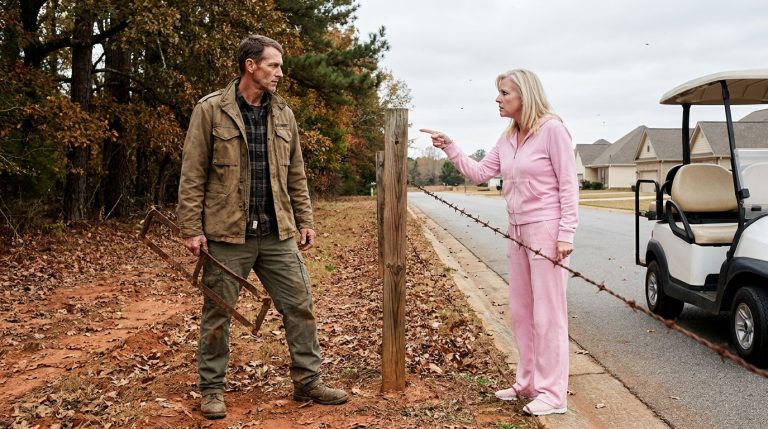
I grabbed my keys and headed out toward the truck. The gravel crunched under my boots, a sharp, metallic sound in the morning quiet. The blue pickup was exactly where it had been when the tow truck driver had realized the error of his ways. Its faded paint was a defiance in a neighborhood of perfectly manicured, neutral-toned facades.
As I drove toward the county building, the transition from the manicured streets of Willow Creek to the worn, gray edges of the city felt like moving through layers of a long-forgotten photograph. The city wasn’t pretty. It was paved in cracked concrete, lined with brick buildings that had seen better eras, and populated by people who didn’t care about HOA aesthetics.
The county land records office was a cavernous, air-conditioned tomb of paper and fluorescent light. I walked past the kiosks, ignoring the digital terminals, and went straight to the old records wing. This was a place of iron filing cabinets and the smell of ozone and yellowing parchment.
The woman behind the desk didn’t look up. Her glasses hung from a chain, clicking against her buttons. “Public access closes at four,” she said, her voice dry as the records she guarded.
“I’m looking for the 2004 site assessment for Parcel 22C,” I said, leaning over the counter. I kept my voice level, the tone of a man who knew exactly what he was looking for.
She hesitated, her pen hovering over a ledger. “That’s archived. It’ll take a few days.”
“I have the property deed,” I said, sliding the envelope across the mahogany wood. The official red stamp of ownership was still visible on the corner of the document. “I’m the current owner. I need that assessment today.”
She finally looked up, her gaze shifting from the paper to my face. She saw the grit of the garage, the worn hands of a man who worked, and the quiet, immovable expectation in my eyes. The skepticism in her expression didn’t vanish, but it folded. She knew a property owner on a mission when she saw one.
“Wait here,” she muttered, sliding off her stool.
I stood there, feeling the hum of the building around me. The air was thin, smelling of toner and dust. My mind went back to the HOA president—the way she had laughed, the way she had wielded her power like a weapon. She had relied on the assumption that I was a threat to be managed, a problem to be towed.
She hadn’t counted on the fact that I was the one who had poured the concrete.
When the clerk returned, she didn’t just have a single folder. She had a box, stuffed with thin, onion-skin maps and stapled reports. She dumped it on the counter with a heavy thud.
“Most of that’s been digitized,” she said, nodding toward the computer terminal. “But the supplemental drainage logs? Those never made it into the system. They were marked ‘pending review’ for nearly two decades.”
I opened the box. The smell of the past hit me—sharp, acidic, and unmistakably familiar. I reached in and pulled out the primary log. My thumb brushed over a familiar signature at the bottom of the page. It wasn’t mine. It belonged to the developer who had flipped this land before the first foundation was ever poured.
Beside the signature, a handwritten note in red ink was scrawled across the margin, a warning that had been ignored by time: Sub-surface instability detected. Remediation required. Do not proceed with high-density load-bearing structures.
I felt a cold, hard knot form in my stomach. The entire neighborhood—every premium-priced villa and manicured lawn—had been built on a foundation that had been flagged as unstable before the first nail was driven.
The HOA wasn’t just managing properties. They were managing a sinking ship, and they were using every penny they could squeeze from the residents to hide the inevitable collapse.
I looked at the clock. Three hours until closing. I had the truth in my hands, but the truth was no longer just a legal document. It was a structural death sentence for the neighborhood. And for the HOA president, it was the one secret that would ensure she never held power over anyone again.
I leaned back against the counter, my heart slowing down to the pace of a steady, rhythmic mechanical gear. I had wanted the truth. Now, I had to figure out how to handle the weight of it without letting the whole thing fall down on the wrong people.
CHAPTER 3: Shadows in the Espresso
The air in the county clerk’s office had grown heavy with the stagnant heat of late afternoon. I didn’t linger. I packed the supplemental logs into my bag, the thick paper feeling like a lead weight against my hip. The clerk watched me go, her expression unreadable, but I didn’t look back. I had what I needed. The truth was no longer a theory; it was a physical stack of documents, each page a testament to a foundational rot that had been festering under Willow Creek Estates for twenty years.
I stepped out into the blinding glare of the parking lot. The sun was dipping low, casting long, bruised shadows across the pavement. My truck was an island of grit in a sea of sterile, modern sedans. I climbed in, the scent of motor oil and old leather immediately grounding me. The ignition clicked, the engine turning over with a familiar, mechanical growl that felt like a quiet promise of endurance.
I didn’t head straight home. If the HOA board was gathering, returning to the house would be walking into a calculated trap. I needed a neutral ground, a place where I could process the data without the immediate threat of a confrontation.
I pulled into a small, nondescript café three miles from the subdivision. It was the kind of place where the linoleum was worn smooth by years of weary boots and the coffee tasted like it had been brewed in a pot that hadn’t seen a deep clean since the turn of the century. It was perfect.
I took a corner booth, the upholstery cracked and sagging under the weight of my coat. I spread the drainage logs out. The coffee arrived, steaming and bitter, its heat radiating against my palms. I ignored it, focusing on the marginalia, the technical notations that mapped the instability of the sub-surface soil. It was all there: the warnings about the water table, the ignored recommendations for reinforced foundation piers, the signature of a developer who had vanished before the first brick was laid.
The café was quiet, save for the rhythmic hiss of the espresso machine. I was halfway through a detailed analysis of the drainage load when a notice pinned to the community bulletin board near the counter caught my eye.
It was a standard-looking flyer, printed on professional-grade cardstock: Willow Creek Estates – Emergency Town Hall Meeting. Mandatory attendance for all property owners regarding the preservation of community integrity.
My eyes narrowed. The notice wasn’t just an invitation; it was a summons. But there was something off about it—a subtle discrepancy in the typography, a misalignment in the HOA’s official seal. It was a replica, a crude imitation of the board’s usual authoritarian flair. Someone was stirring the pot, someone who knew exactly how to trigger the collective paranoia of the neighborhood.
I felt a prickle of static on the back of my neck. I wasn’t the only one digging.
I kept my head down, my gaze fixed on the reports. A few minutes later, the door to the café chimed. Two men walked in. They were dressed in the kind of crisp, expensive casual wear that screamed “Willow Creek Estates,” but their postures were jagged, tense. They didn’t look like they were here for a quiet afternoon pick-me-up. They scanned the room, their eyes lingering on the blue pickup parked outside before settling on my booth.
I recognized one of them—a man named Henderson who lived three doors down. I’d seen him tinkering with his lawn sprinklers, a man so obsessed with his property value he’d once tried to fine me for leaving a rake out on my porch.
They walked toward me, their movements sharp, deliberate. The air in the room seemed to lose its oxygen.
“You’re the one,” Henderson said, his voice stripped of the neighborly facade he usually wore. He didn’t sit. He loomed, his hands clenching at his sides. “The one causing all the trouble with the records office.”
I didn’t look up from the blueprints. I let the silence hang, a heavy, rusted barrier between us. “Trouble is a matter of perspective, Henderson. Some people call it due diligence.”
“It’s not diligence,” the other man interjected, his voice high-pitched and strained. “It’s extortion. We know you’ve been digging into the developer’s archives. The board is already preparing a formal injunction to block any access to those records.”
I slowly closed the folder. The sound of paper meeting paper was loud in the quiet café. I looked up then, meeting their eyes with the steady, unblinking gaze of a man who had spent his life dealing with structural failures. They were scared, but they were trying to hide it behind a veneer of entitled anger. It was a thin, brittle mask.
“Injunctions require a legal basis,” I said, my voice quiet, almost conversational. “And currently, the legal basis for this entire subdivision is built on a series of zoning violations that would make the county records office very, very interested in your community center meetings.”
They froze. The color drained from Henderson’s face, leaving it pale and washed out. He hadn’t expected me to know about the fraud. He thought I was just another resident fighting a fine.
“You don’t know what you’re talking about,” Henderson muttered, but the conviction had left his voice.
“I know exactly what I’m talking about,” I replied, standing up. I gathered the reports, my movements slow and deliberate. “I know about the drainage specs. I know about the missing remediation funds. And I know that if you go through with that town hall meeting, you’re not just inviting the police—you’re inviting the collapse of the very property values you’re so terrified of losing.”
I pushed past them, the friction of their presence a sharp reminder of the hostility I was moving through. Henderson reached out, as if to grab my sleeve, but he stopped short, the weight of my stare pinning him to the spot.
I stepped out into the cool evening air. The sun had vanished, leaving the world in a state of deepening gray. My truck stood waiting, its faded paint catching the dim light of the streetlamp. As I reached for the door handle, I heard the café door creak open behind me.
“This isn’t over!” Henderson shouted into the silence. “The board won’t let you stay!”
I didn’t answer. I slid into the driver’s seat and turned the key. The engine roared to life, a deep, guttural vibration that shook the frame. As I pulled away, I glanced in the rearview mirror. The two men were standing in the light of the café, their figures small, distorted, and increasingly desperate.
I was officially a target. The quiet resolution of the morning had hardened into something else—a calculated, tactical necessity. I wasn’t just protecting a plot of land anymore; I was navigating a minefield, and the only way to get through it was to keep moving, to keep digging, and to ensure that when the foundation finally cracked, it didn’t take me down with it.
The road home was empty, the dark trees blurring into a single, seamless wall of shadow. I kept my eyes on the lane, my hands gripping the wheel. Somewhere ahead, the HOA was preparing their next move, but for the first time in three weeks, I wasn’t waiting for them to act. I was moving to finish the job.
CHAPTER 4: The Architecture of Silence
The drive back to Willow Creek Estates was a lesson in observation. I took the long way, weaving through the outskirts where the pavement turned to scarred gravel and the houses were less like fortresses and more like homes. Every mile brought the same heavy, gray sky, but it was the neighborhood itself that shifted as I crossed into the perimeter.
The silence here was not natural. It was a manufactured thing, a dense, pressurized vacuum that seemed to swallow the sound of my engine. As I turned onto my street, I noticed the subtle changes. A curtain twitching in a house three doors down. A neighbor standing on a manicured lawn, staring not at his grass, but directly at the space where my truck would eventually pull in.
They weren’t just watching; they were waiting.
I pulled into my driveway, the gravel crunching with a sound that felt deafeningly loud in the oppressive stillness. I didn’t get out immediately. I sat in the cab, letting the engine die, listening to the metallic tink-tink-tink of the cooling exhaust. My house sat dark and shadowed, the weathered barn in the back silhouetted against the encroaching twilight like an old, broken tooth.
The realization hit me with the force of a physical blow: Henderson and his companion hadn’t just followed me to the café; they had been an advance guard, a way to test my response, to see if I would fold or if I would fight. And now, they were calibrating their next move based on my performance.
I checked my rearview mirror. A black SUV—the same one the HOA president had used—was idling two blocks away, its headlights dark. It was a silhouette of intent. They weren’t hiding anymore. They were establishing a perimeter.
I grabbed my bag, the weight of the county documents pressing against my side like a sidearm. I moved toward the porch, my boots feeling clumsy on the wood steps. The house felt colder than it had this morning. I unlocked the front door and stepped inside, immediately feeling the shift in the air.
Someone had been here.
It wasn’t a robbery. Nothing was missing. It was a subtle, invasive reconfiguration. A book on the side table was moved an inch to the left. The kitchen chair was angled slightly outward, as if someone had sat, waited, and then stood up. It was a message, a quiet, surgical intrusion designed to let me know that my sanctuary was no longer private.
I didn’t turn on the lights. I walked through the living room, my senses heightened, tracking the faint, lingering scent of a dry, floral perfume that didn’t belong to me or Lily. It was the scent of the HOA president.
I moved to the back window and peered out at the barn. The shadows were deep, but I could make out the silhouette of a figure standing near the structure. They were just out of range of the porch light, a dark, motionless shape that seemed to be waiting for a signal.
My heart hammered against my ribs—not with fear, but with a cold, sharpening clarity. This wasn’t just about zoning violations anymore. By uncovering the drainage logs, I had stumbled onto the central nervous system of their scam. They weren’t trying to evict me because of my truck; they were trying to silence me before I connected the dots between the unstable foundations and the diverted remediation funds.
I walked to the kitchen counter and placed the documents down. I took a deep, steadying breath, the air tasting of dust and stale coffee. I needed to act, but I needed to be surgical. If I fought them on their terms—in the light of day, with their rules—they would bury me in litigation and intimidation. I had to force the collapse on my own timeline.
I pulled out my phone and checked the signal. It was weak, muffled by the sheer weight of the house’s construction. I looked at the contacts list, scrolling past the numbers I wouldn’t need, and settled on a name from the county records office—the one man who had sounded just as tired of the corruption as I was.
As I dialed, I kept my eyes on the window. The figure by the barn hadn’t moved. They were watching the door, waiting for me to step back out. They expected a confrontation. They expected a man who would lose his temper and make a mistake.
I looked at my hands, calloused and steady. I was a man who knew how to frame a building so it wouldn’t collapse, how to anticipate the stress points in steel and concrete. They had built their entire world on a foundation of sand, and they had mistaken me for just another tenant.
The phone connected with a low, static-filled click.
“County records,” a voice answered. It was the older man, Daniel.
“It’s the owner of 22C,” I said, my voice barely above a whisper. “I have the supplementary logs you couldn’t find in the system. But we have a problem. The archives were compromised before I got them.”
“Compromised?” Daniel’s voice sharpened. “What do you mean?”
“I mean the board has been alerted,” I said, watching as the figure by the barn turned, sensing something, perhaps just the shift in the air. “They know I have the documents. If we’re going to do this, we need to bypass the local channels. The board has the police and the inspectors in their pocket. We need someone from the state.”
There was a long, heavy silence on the other end. I could hear the hum of distant traffic, the sound of a world that didn’t know how close Willow Creek Estates was to a very real, very physical failure.
“Meet me at the north gate,” Daniel said finally. “The service entrance near the water tower. Don’t go through the main road. They have cameras on every exit.”
“I’ll be there,” I said, and hung up.
I turned away from the window. My house felt small, a cage of my own design. I grabbed my jacket and a heavy flashlight, the metal casing cold and reassuring in my grip. I wasn’t leaving through the front door. The figure by the barn was waiting there, and I had no intention of playing into their hands.
I went to the back, to the utility closet that led into the crawlspace. I knew these foundations better than anyone; I had helped design the hidden access points years ago. I would slip out the back, under the fence, and into the shadow of the woods that bordered the estate.
The neighborhood was a stage, and they were the actors, performing a play for an audience that didn’t exist. But I was the one who had built the stage, and I knew exactly where the floorboards were loose.
I crawled into the dark, the air tight and smelling of damp earth. My hands moved with muscle memory, navigating the narrow space beneath the house. Outside, the rain began to fall—a light, tapping rhythm against the ground above my head. It was the perfect cover. The rust-colored mud would hide my tracks, and the wind would swallow the sound of my movement.
The game was changing, and for the first time, I was the one setting the pace.
CHAPTER 5: The Paper Trails End
The earth beneath the house was cold and unforgiving, a damp bed of clay and gravel that clung to my jacket with every movement. I navigated the familiar joists by feel, my muscles coiled and ready for the shift in weight that would signal the exit near the barn. The rain intensified, a relentless, percussive force that hammered against the soil above like a thousand tiny hammers.
I reached the vent, pushing it open just wide enough to see. The backyard was a desaturated blur of dark green and charcoal gray. The figure who had been guarding the barn was gone, likely driven into the shadows of the porch by the deluge, but the mud was already turning into a treacherous, thick slurry.
I pushed out, my boots sinking inches into the mire. The sensation was immediate and draining—the heavy, sucking pull of the earth trying to hold me in place. I kept my center of gravity low, moving toward the cover of the woods that flanked the estate. Each step required deliberate, agonizing effort. I was a man of construction, and I knew the physics of this land: when the soil turned to liquid, the entire surface became a liability.
I hadn’t gone twenty yards when a beam of light cut through the rain—a sharp, piercing cone that swung wildly across the trees. They were looking for me. Not just the figure from the barn, but someone else, someone with a professional, tactical sweep. The HOA wasn’t just relying on neighborhood bullies anymore. They had activated the security firm they kept on retainer, the one that handled “discretionary issues.”
I dropped into the depression of a drainage ditch, the water rising past my ankles, icy and stinging. My breath hitched in my chest. I pulled the bag tighter, shielding the documents with my own body. The flashlight beam swept over the patch of brush I had just vacated, the light lingering for a heartbeat before moving on.
I waited, my pulse a frantic drumbeat in my ears, until the light faded into the distance. The rain was a deafening roar, but in the silence between the gusts, I heard the distinctive, rhythmic tread of heavy boots on the driveway—a sound that didn’t belong in a residential subdivision. They were patrolling the perimeter.
I needed to reach the water tower, but the direct route was now an active kill zone. I shifted my path, aiming for the narrow strip of land between the estates and the municipal property line—a forgotten buffer zone of tall, wild grass and rusting, discarded industrial equipment.
The movement was slow. My muscles burned with the effort of fighting the slick terrain. Every time I stepped, the mud threatened to strip the boot from my foot. I realized then that the “violation” of my land usage hadn’t just been a bureaucratic slur; it was a preemptive strike against the very man who knew how to map these borders. They had been afraid I would find this exact route, this specific vulnerability in the estate’s isolation.
I reached the edge of the woods and found the fence—a rusted chain-link barrier that had been patched and repatched over the years. I grabbed the wire, the cold, jagged metal biting into my palms, and began to climb. My fingers were slick with mud and water, making the purchase difficult. I hauled myself up, my breath coming in ragged gasps, and swung my legs over the top just as another set of lights flickered to life near the gate.
I dropped to the other side, landing hard on the wet gravel of the service road. I didn’t stop. I hit the ground running, my boots slapping against the saturated earth. The water tower loomed ahead, a dark, skeletal spire against the stormy sky.
I saw a car parked near the base—a nondescript, silver sedan that didn’t belong in this neighborhood. A figure stood beside it, leaning against the door with a cigarette that refused to stay lit in the downpour.
“Daniel?” I called out, my voice raspy.
The man looked up, his face gaunt, his eyes rimmed with the weary, hard-won wisdom of a career civil servant. He didn’t smile. He just opened the back door.
“Get in,” he said, his voice drowned out by a crack of thunder.
I scrambled inside, the upholstery smelling of damp wool and old coffee. I dropped the bag on the seat between us, my hands shaking—not from the cold, but from the sudden, sharp adrenaline of the escape.
“You brought the logs?” Daniel asked, reaching for the bag.
“I brought them,” I said, leaning back against the seat. “And I brought the context. The drainage system isn’t just a failure. It’s a crime scene.”
Daniel pulled the documents out, his flashlight cutting a stark, yellow path through the dim interior of the car. He flipped through the pages, his brow furrowing as he studied the developer’s signature and the ignored remediation warnings. His expression didn’t change, but his grip on the papers tightened until the edges crinkled.
“I knew,” he whispered, almost to himself. “I knew they’d buried the reports, but I never could prove they’d knowingly built on a liquefaction zone. If this goes to the state, the board isn’t just looking at a fine. They’re looking at criminal negligence. Every one of them.”
“They know,” I said, looking out the rear window. The headlights of the security firm’s SUV were turning onto the service road, a pair of hungry, yellow eyes searching the dark. “They’ve been tracking me since I left the office. They know I have the papers.”
Daniel looked at the rearview mirror. His face hardened. He shifted the car into gear, the tires spinning on the wet gravel for a frantic second before catching traction.
“We’re not going to the records office,” he said, turning the wheel and accelerating toward the main highway. “We’re going to the state prosecutor’s satellite branch in the city. If we get there, the local law can’t touch us.”
The car surged forward, the engine whining in protest as we picked up speed. The SUVs behind us stayed on our tail, their lights flashing, a pursuit that felt like a microcosm of the entire war. The rain blurred the world into a kaleidoscope of motion and light.
I looked at the bag on the seat. The paper was wet, the ink beginning to bleed at the edges, but the truth remained legible. The HOA was running out of time, and so was I. The perimeter was narrowing, the stakes were shifting, and for the first time in my life, I wasn’t just managing the problem—I was the one who was going to force the collapse.
CHAPTER 6: The Moral Burden
The highway was a ribbon of wet asphalt, slick with the remnants of the storm and illuminated by the streaking lights of oncoming traffic. Every time Daniel checked the rearview mirror, his face grew taut. The security firm’s SUV was still there, a persistent, predatory shadow cutting through the gloom, maintaining a distance that felt less like pursuit and more like a tactical hold.
“They’re not trying to run us off the road,” I said, my voice cutting through the hum of the engine. I watched the SUV’s headlights flicker—a signal, or perhaps just the play of light on the wet glass. “They’re waiting for us to get clear of the county line. They want to contain us where the jurisdiction is thin.”
Daniel’s grip on the wheel was white-knuckled. “If we hit the state prosecutor’s office, this whole thing goes wide. They can’t stop that.”
“They don’t have to stop it,” I countered, the logic settling into place with the cold precision of a structural beam. “They just have to make sure the evidence doesn’t make it inside. If these logs go missing, the fraud remains a rumor. My property becomes a liability, and the neighborhood continues its slow, sinking crawl into the red.”
I leaned my head against the cool window. A sudden, sharp memory surfaced: twenty years ago, I had been standing at the edge of the excavation, looking at a hairline crack in the primary drainage slab. I had flagged it. I had been told by the developer, the same man whose signature was now on the logs, that it was a simple settling issue, nothing to worry about. I had wanted the work, I had needed the money, so I had looked away.
That crack hadn’t been a settling issue. It was a failure of the earth itself. I had known, deep down, that the ground wasn’t meant for what we were putting on it, and I had stayed silent for the sake of a paycheck. The guilt, dormant for two decades, surged up, bitter and heavy. I wasn’t just a victim of the HOA; I was an architect of the very rot I was now trying to expose.
“Daniel,” I said, my eyes tracking the silhouette of the SUV. “The drainage logs. They aren’t just evidence of embezzlement. They’re proof of the structural fraud from the beginning. If we reveal them, the entire subdivision is declared uninhabitable. The neighbors—the people like Frank—they lose everything.”
Daniel took his eyes off the road for a fleeting second, his gaze searching mine. “They lose their property values, yes. But they stop living on a bomb. If we don’t do this, they’re going to be left in those homes until the ground finally gives way.”
“And the board?”
“The board gets off with a slap on the wrist for ‘mismanagement,'” Daniel said, his jaw setting. “Unless we show that the foundational rot was intentional.”
The SUV behind us suddenly accelerated, closing the gap. It pulled into the left lane, pacing us, its tires throwing a spray of water against our driver’s side door. The passenger window rolled down. I saw the silhouette of a man holding something that caught the light—not a weapon, but a camera. They weren’t trying to force us off the road; they were documenting the fact that I was leaving the scene with the evidence. It was a legal intimidation tactic, designed to set the stage for a “theft of company property” charge that would invalidate everything we carried.
“They’re setting up the narrative,” I muttered.
“Let them,” Daniel said, his voice cold. He pressed the accelerator, the engine surging.
I looked at the bag again. My internal struggle felt like a physical weight—the desire to protect my neighbors clashing with the necessity of exposing the lie that kept them trapped. I realized then that there was no clean way out. The truth would hurt, it would destroy, and it would leave scars, but it was the only thing that could stop the slow, inevitable collapse of the community.
We hit the city limits, the landscape shifting into the stark, concrete sprawl of the municipal district. The SUV dropped back, its role as a visible tail finished. It had done its job: it had tagged us.
“They’re calling it in,” I said, watching the SUV turn off toward the city center. “They’re going to have the local precinct waiting for us at the gate.”
Daniel nodded, a grim, humorless smile touching his lips. “Good. Let them meet us there. The state prosecutor has been waiting for a reason to come down here and tear this board apart for months. We aren’t just delivering evidence. We’re delivering a catalyst.”
I felt the tension in the car shift. It wasn’t fear anymore; it was the sharp, focused energy of a final, structural load-bearing calculation. We were driving into the heart of the machine, carrying the one piece of evidence that could grind the gears to a halt. The road ahead looked less like an escape and more like a demolition site. And I was finally ready to swing the hammer.
CHAPTER 7: The Meeting
The precinct parking lot was a graveyard of patrol cars and harsh, buzzing floodlights. As Daniel brought the silver sedan to a halt, the sudden silence inside the cabin was more jarring than the roar of the highway had been. My hands, still stained with the dark, iron-rich mud of the estate’s perimeter, felt leaden. I grabbed the bag. The paper inside was damp, fragile, and held the structural integrity of the entire neighborhood in its folds.
“Stay close,” Daniel said, his voice stripped of all pretense. He didn’t look at me, his gaze fixed on the double glass doors of the station. “Once we walk through those doors, we don’t stop until we’re in the Prosecutor’s office. Don’t look at the desk officers. Don’t engage with anyone who isn’t the duty sergeant.”
I nodded, stepping out into the cold, abrasive air. The rain had slowed to a fine, misty drizzle that clung to my clothes like a shroud. I could feel eyes on us—not just the officers moving inside, but the memory of the security SUV, the lingering ghost of the HOA board’s reach. They had made it clear: I was an intruder in their system.
We moved toward the entrance, our footsteps echoing against the concrete. The precinct was a temple of rules, and I felt the weight of every regulation I was about to violate. As we crossed the threshold, the smell of ozone, stale coffee, and harsh floor wax hit me—a scent that was the antithesis of the earth and rusted iron I’d been working in for weeks. It was clean, efficient, and fundamentally cold.
The duty sergeant looked up, his face a map of weary indifference. He took one look at our disheveled state—the mud on my boots, the damp folders under Daniel’s arm—and his expression hardened. He was a gatekeeper, and he had clearly been briefed on the kind of “disturbances” the Willow Creek Estates board considered worthy of intervention.
“Can I help you?” he asked, his voice slow and heavy with administrative resistance.
“We have an appointment,” Daniel said, sliding a badge across the desk. It wasn’t his county record badge; it was a state-level certification. “Internal investigation. We need the duty sergeant on the night shift, and we need the secure line to the state prosecutor’s office.”
The sergeant paused. He looked at the badge, then at me. His eyes lingered on the mud on my hem. He didn’t move. He reached for his radio, his hand hovering over the button.
“The board’s been calling,” the sergeant said, his voice dropping to a low, conspiratorial register. “They’re reporting a burglary in progress. Said a man’s been trespassing on private property, stealing sensitive financial documents.”
“They’re not sensitive financial documents,” I said, stepping forward. My voice was steady, the authority of a man who had seen the foundations of the houses crack in real-time. “They’re a death warrant for every structure in Willow Creek Estates. If you want to be the one to hold the door open while the ground gives way, keep stalling.”
The sergeant looked at the documents, then at the clock on the wall. The hum of the room seemed to amplify, a physical vibration of tension. Outside, the headlights of another car swept across the glass doors. The HOA hadn’t given up; they had sent the local law to intercept us before we could reach the state.
“You have two minutes,” the sergeant said, his hand retreating from the radio. He didn’t like us, but he was a creature of the system, and the state badge represented a hierarchy he couldn’t afford to ignore.
He pointed to a hallway behind the main desk. “Second door on the left. Don’t leave that room.”
We moved down the hall. The walls were lined with cold, gray metal lockers—the kind that held everything from service weapons to the remnants of ruined lives. We reached the office, the door a solid, featureless slab of oak. I pushed it open.
The room was small, lit by the harsh glare of a single, desk-mounted lamp. There was no one inside. Just a phone, a pile of incident reports, and the oppressive silence of a place that was built to process, not to solve.
I set the bag on the desk and opened it. The drainage logs looked archaic in the harsh, artificial light. Daniel pulled the receiver off the hook and dialed a number that wasn’t on the speed dial.
“This is Daniel,” he said into the silence. “I’m at the precinct. I have the primary logs. The board’s been tipped off, and they’re moving to seal the estate.”
I walked to the window. I could see the parking lot. Two more patrol cars had arrived, and a man in a sharp, expensive suit—the HOA president’s lawyer—was stepping out, his umbrella held over his head like a shield. He was here to claim the “stolen” property. He was here to make sure the rot remained buried.
I felt a sudden, sharp ache in my hands—the memory of the concrete, the weight of the rebar, the pride I’d once taken in building something I thought would last. I had been a pawn in a game I didn’t understand, and now, I was the one who had to tear the board down to save the people who had treated me like an outsider.
“They’re here,” I said, watching the lawyer walk toward the front door. “They’re not going to let us leave with these.”
“They don’t have to let us leave,” Daniel said, hanging up the phone. His eyes met mine, a flicker of grim satisfaction in their depths. “The state prosecutor isn’t coming for us. They’re coming for the HOA. And they’re going to bring the building inspectors with them.”
The door handle rattled. A heavy, insistent knock echoed through the room. I stood by the desk, my hands resting on the drainage logs, ready to defend the truth I had unearthed. The foundation was finally ready to give way, and I wasn’t going to be the one buried in the rubble.
CHAPTER 8: The Foundations Reckoning
The transition was violent in its quietness. The lawyer, who a second before had been radiating the smug, ironclad certainty of a man who owned the local law, shrank back as the lead inspector—a woman with gray hair and a clipboard that looked as heavy as a weapon—brushed past him. She didn’t acknowledge the lawyer or the HOA’s claims. She walked straight to the desk where the drainage logs lay.
“Is this the documentation regarding the 2004 sub-surface remediation?” she asked, her voice sharp, devoid of the local board’s practiced, sycophantic lilt.
I didn’t answer with words. I pointed to the red-inked marginalia, the warnings about the liquefaction zones that had been buried two decades prior. She leaned over the logs, her face shifting from professional detachment to a cold, hard fury as she processed the extent of the fraud.
Behind her, the precinct hallway was filling with the sounds of chaos—the shouting of the HOA board members, the rhythmic click of cameras, and the frantic, ineffective protests of the precinct sergeant. It was the sound of a system tearing itself apart, the veneer of “community integrity” being peeled back to reveal the corroded, rusted truth beneath.
The HOA president was among them. She had arrived in a blur of designer fabric and righteous indignation, but as she entered the office and saw the logs in the inspector’s hands, her composure snapped. She opened her mouth to speak, to invoke a bylaw or a violation, but the inspector held up a hand.
“The embezzlement is the least of your concerns, ma’am,” the inspector said, her voice echoing in the small room. “We’re looking at a systemic, multi-million dollar fraud involving the deliberate concealment of structural instability. Every home in Willow Creek Estates is currently being flagged as a condemnation risk.”
The room went deathly silent. The president’s face, usually so perfectly composed, seemed to sag. The logic of her position—the bullying, the fines, the performative maintenance of the neighborhood’s aesthetic—was suddenly, irrevocably exposed for what it was: a desperate, greedy attempt to keep a sinking ship afloat until the board could slip away with the remaining funds.
I walked to the window. Outside, the rain had stopped. The clouds were breaking, revealing a thin, pale strip of evening light that hit the precinct’s parking lot. The HOA board members stood together in a tight, shivering knot, their power dissolved by the simple, immutable fact of the paper on the desk. They weren’t gatekeepers anymore. They were just, finally, accountable.
Justice, I realized, didn’t feel like a victory. It felt like the aftermath of an earthquake—exhausting, hollow, and profoundly quiet.
By the following morning, the neighborhood was a different world. The “premium” signs were being pulled from the fences. The residents, those who had spent their lives under the shadow of the HOA’s reach, were finally standing in the streets, talking to one another without the frantic pressure of performative maintenance. The silence had been replaced by the sound of moving trucks and the low, murmuring hum of neighbors discussing their future.
I walked out to my porch with a cup of coffee. The barn looked different in the morning light—less like a relic of a forgotten past and more like a simple, sturdy structure that had survived because it was built right the first time. I looked at the blue pickup parked by the fence. The dents and the rust didn’t look like violations anymore. They looked like history.
Lily came out of the house, clutching a handful of chalk. She looked at me, her face bright, the fear of the last few weeks replaced by the simple, unburdened curiosity of a child. “Dad, are we staying?”
“We are,” I said, watching as a group of neighbors started clearing the debris from the overgrown lot across the way. “We’re staying, and we’re going to fix the fence.”
I reached into my pocket and pulled out the brass key to the old job site—the one I’d carried as a relic of my past life. I walked to the barn and fitted the key into the lock. It turned with a heavy, satisfying metallic click—the sound of something finally being reopened after years of neglect.
I leaned against the wood, feeling the grain beneath my palm. The neighborhood was broken, yes. The foundations were a mess of legal and structural nightmares that would take years to resolve. But the ground was stable now, at least in the ways that mattered. The lies had been stripped away, and we were left with nothing but the truth and a lot of hard work.
I walked back to the porch, my boots crunching on the gravel. I sat down and looked at the street—the wide, open, and finally quiet street. I wasn’t an owner, or a squatter, or a target anymore. I was just a neighbor, sitting in the morning sun, finally able to breathe. The long, rusted journey had ended, and for the first time in a long time, the silence didn’t feel like a threat. It felt like a foundation.