The Silent Perimeter: A Former SEAL Unearths the Corrupt Foundation of a Gated Neighborhood’s Power
CHAPTER 1: THE CONFRONTATION AT THE PROPERTY LINE
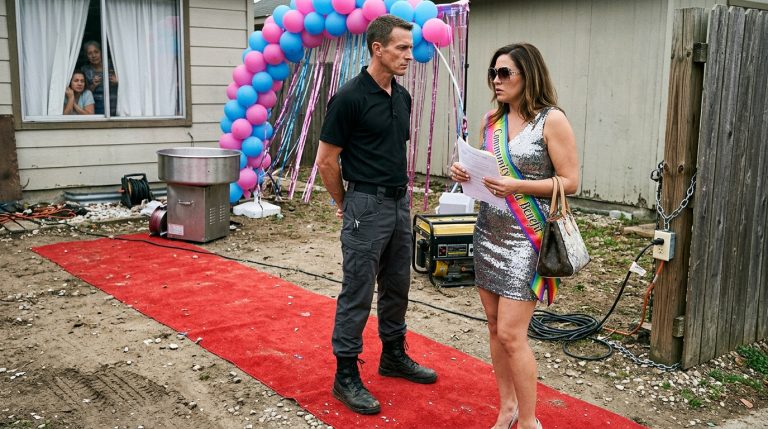
The air in the suburbs was supposed to smell like cut grass and gasoline, but tonight, it carried the metallic, ozone tang of an impending storm. I didn’t blink when the man in the tactical vest lunged. He was fast, trained to intimidate, but he was loud—a tactical amateur who telegraphed his weight onto his lead foot.
I stepped inside his guard, the movement so fluid it felt like muscle memory overriding conscious thought. My palm heel caught his jaw, snapping his head back with the force of a closing vault door. He crumpled, not from a singular strike, but from the realization that he had stepped into a yard he couldn’t hope to control.
Behind me, the front door clicked. My son, Leo, stood in the frame, his knuckles white as he gripped the door casing. I didn’t look back. I couldn’t afford the distraction.
“Stay inside,” I commanded, my voice flat, stripped of the fatherly warmth he knew.
Across the lawn, two more of them stood still, their hands hovering near their holsters. They were looking for fear. They were looking for a homeowner who would fold under the weight of a fake citation. They didn’t know that I had spent fifteen years in environments where “HOA violations” were replaced by improvised explosive devices. I wasn’t just a resident; I was a problem they hadn’t yet quantified.
I walked toward the lead imposter, who was currently scrambling to regain his footing on my driveway. He reached into his vest for a binder—the standard theater of bureaucracy.
“You’re trespassing, sir,” he spat, his voice trembling just enough to betray him. He held up a laminated sheet with an official-looking seal that was three shades of blue too light. “This property is under a mandatory compliance hold. You and your guests are being evicted for unauthorized assembly.”
I stopped inches from his face. I didn’t reach for the paper. I focused on the fraying edge of his vest—a cheap, off-the-shelf replica. I looked at the way he gripped the binder, his thumb twitching over a hidden pocket on his belt. He wasn’t a cop; he was a hired gun, and he was terrified.
“Who issued the hold?” I asked. My voice was a scalpel, cold and thin.
He sneered, emboldened by the silent presence of his two partners. “The Board. And if you don’t step aside, the Board’s enforcement division will be forced to escalate.”
“Escalate,” I repeated. I leaned in, dropping my voice to a whisper that cut through the humid night air. “You haven’t seen escalation. You’ve just seen the warmup.”
As I spoke, the streetlamp above us flickered and died. In the sudden wash of darkness, I caught a glimpse of something tucked into the waistband of the man’s tactical trousers—not a radio, not a badge, but a high-end, encrypted ledger drive. It didn’t match the cheap, intimidating gear they were wearing.
It was a piece of tech that cost more than their entire uniform package, and it shouldn’t have been on a low-rent thug.
The realization tightened my chest. This wasn’t about lawn height or noise complaints. Someone was using this house—my house—as a dead drop for something much larger. And as I turned to look at the other two, I saw the fourth man—the one in the SUV—reaching for something on his passenger seat that caught the moonlight with a distinct, matte-black gleam.
CHAPTER 2: THE FORENSIC AUDIT OF THE HOA NOTICE
The man in the SUV didn’t reach for a pistol. He reached for a remote, his thumb hovering over a button that looked like a garage door opener but hummed with the high-frequency vibration of a signal jammer. I didn’t wait for him to press it. I didn’t wait for the logic of the situation to settle.
I turned, my boots crunching on the gravel, and slammed the door of the SUV before the driver could engage the lock. The impact was clean, a jarring thud of steel against steel that rattled the windows. The driver grunted, his hand caught in the doorframe, his face contorting into a mask of sudden, frantic pain. I didn’t hesitate. I reached through the cracked window, grabbed the matte-black device, and ripped it from his grasp.
Behind me, the other two imposters were moving. Their coordination was deteriorating; the professional veneer of the “HOA Inspectors” was cracking under the pressure of a reality they weren’t trained to handle.
“Drop the hardware,” I said, my voice steady, the command born from years of shouting over the roar of helicopter rotors.
They froze. The sudden, invasive memory of the Khost Province hit me then—the smell of dry, sun-baked earth and the metallic sting of blood. It was the same stillness, the same predatory silence before a firefight. I shook it off, my focus narrowing to the ledger drive in my left hand. Its weight was wrong; it was too heavy for a simple USB, and the casing felt like high-grade, cold-forged aluminum.
Leo was still watching from the porch, his shadow long and thin against the siding. “Dad?” he called out, his voice barely a whisper. “The police… they aren’t moving. Why aren’t they moving?”
He was right. The three officers on the sidewalk were statues, their hands resting on their holsters, but their eyes were fixed not on me, but on the black SUVs. They weren’t waiting for a command from the sergeant; they were waiting for someone else.
“Get inside, Leo. Lock the deadbolt. Don’t open it for anyone without the pass-phrase,” I said, not looking back.
I turned my attention to the driver, who was now clutching his mangled fingers. The man’s eyes weren’t filled with the anger of a caught criminal; they were filled with the hollow, terrifying desperation of a man who knew he had just failed a superior.
“You don’t understand,” the driver gasped, his voice trembling. “The Board doesn’t like loose ends. This drive? It’s not just data. It’s an exit strategy.”
I didn’t answer. I stepped back, creating distance, and thumbed the edge of the aluminum drive. It didn’t have a standard port. It was biometric, keyed to a pulse that wasn’t mine. I had spent my life reading the patterns of men, and this man was terrified of the tech in his own hand. I shoved it into my jacket pocket and felt the cold, sharp edge of it pressing against my ribs—a physical reminder that the stakes had just moved from neighborhood dispute to something far more lethal.
The lead officer, the one with the tired eyes and the badge that seemed too heavy for his uniform, finally stepped forward. He didn’t approach the imposters. He approached me.
“That’s evidence, sir,” he said, nodding toward my pocket. His voice was tired, devoid of authority.
“This is private property,” I countered, keeping my stance balanced, weight centered on the balls of my feet. “And that is a piece of hardware that contains, at minimum, identity theft evidence. I’m turning it over to federal custody, not to a local precinct that seems to be taking orders from a homeowners’ association.”
The officer hesitated. He looked at the SUVs, then at the neighbors who had started to step out onto their porches, their phones glowing in the dark like fireflies. The environment was shifting. The “Dusty Gray” of the suburbs was being illuminated by the harsh, unflattering light of public scrutiny.
“You’re pushing a boulder up a mountain, friend,” the officer said, his voice dropping to a gravelly murmur. “You think you’re holding the line? You’re just standing in the way of the landslide.”
He walked away, leaving me alone on the driveway with the three men in tactical vests. They didn’t move. They didn’t attack. They simply stared at me, their faces blank, their breathing synchronized. They were waiting for a command that I couldn’t hear.
I walked toward my house, the weight of the drive pulling at my jacket, the metal cold against my skin. I knew then that the silence of the neighborhood wasn’t a lack of noise; it was the holding of breath. The HOA wasn’t just a bureaucracy. It was a mechanism, and I had just thrown a gear into the works.
I stepped into the house and slid the deadbolt home. The house was quiet, but the air felt thin. I went to the kitchen, laid the drive on the granite island, and stared at it. It was a small, unassuming block of metal, yet it felt like a bomb waiting for a detonator. I didn’t reach for a computer. I reached for a heavy-duty tactical torch and a magnifying glass. I needed to see the ports, the micro-seams, the physical architecture of the secret they were so desperate to keep buried.
If this was the decoy, as the driver suggested, then the actual mechanism was even deeper. I reached for the ledger, my hands steady, and began the delicate, surgical process of cracking the shell.
CHAPTER 3: THE MIDNIGHT RECONNAISSANCE
The aluminum housing of the drive didn’t yield like cheap plastic; it resisted, forcing me to use the precision of a field medic rather than the brute force of a brawler. I worked under the harsh, unblinking glare of the tactical torch, my hands steady despite the adrenaline still burning in my bloodstream. Outside, the neighborhood was unnervingly silent—a dead zone in the middle of a suburb that should have been humming with late-night life.
As the final casing clicked and fell away, I didn’t see wires or circuit boards. I saw a micro-etched silicon wafer encased in a protective polymer, a design I’d only ever seen in high-security military assets. It wasn’t an exit strategy. It was a ledger.
I slid the wafer into my laptop, the screen illuminating my face in a pale, sterile blue. The files were encrypted, but the directory tree was open. It wasn’t just names and numbers. It was a digital map of property deeds, every single one of them marked with a timestamp, a property value, and a ‘Transfer Status’ labeled in red. My own home was at the top of the list, dated for tomorrow.
My son, Leo, stood in the doorway, his silhouette stark against the dim hallway light. He was holding a glass of water, his hand trembling just enough to make the liquid ripple.
“They’re still out there, aren’t they?” he asked.
I didn’t look up from the screen. “They’re waiting for something,” I said. “The drive isn’t what they were supposed to leave behind. It’s what they were supposed to lose. It’s a lure, Leo.”
I closed the laptop and stood, the chair scraping sharply against the hardwood floor. The sound felt like a gunshot in the stillness of the house. I had assumed this was about property, about the pettiness of a neighborhood board, but the data on that drive suggested a systematic acquisition. They weren’t just bullying people; they were harvesting equity, clearing out families, and preparing the neighborhood for a wholesale land grab that required absolute compliance from every resident.
“We aren’t waiting for them to move,” I said, moving to the mudroom where my tactical gear was stowed. It had been years since I’d worn the plate carrier, but the weight of it felt like an old, familiar skin. I checked the straps, the buckles, the tension of the webbing.
“Dad, what are you doing?” Leo’s voice was tighter now, edged with that specific, sharp fear that only comes when you realize the person you trust most is capable of violence.
“I’m going to see exactly what the Board is protecting,” I said. “If this drive is the lure, then the trap is located at the Board President’s office. It’s the only place with a hardwired connection to the local servers.”
The mission was simple, the kind of tactical objective that once dominated my life: Infiltrate, identify, extract. But this time, it wasn’t a hostile compound in a foreign land. It was the HOA office—a nondescript, single-story building at the entrance of the subdivision, hidden behind a perimeter of manicured hedges.
I left Leo in the secure room upstairs, a reinforced space I’d built when we first moved in, back when I still felt the need to prepare for the world I’d left behind. I moved through the house with a ghost’s grace, each shadow a potential cover, each creak of the floorboards a variable to be managed.
The night air hit me like a physical blow as I stepped into the backyard. I moved along the fence line, my eyes tracking the movement of the SUVs still idling on the street. They hadn’t moved. They were stationary, watching the house, waiting for us to panic.
I reached the hedges at the edge of the property, the sharp, waxy leaves scratching at my arms. From here, I could see the office. It was dark, save for a single flickering light near the rear entrance. A security patrol—not the fake inspectors, but professional, private contractors with high-end kit—was walking the perimeter.
I dropped to a crouch, the damp earth cold against my knees. I checked the perimeter, analyzing the sweep of their flashlights, the rhythm of their patrol, the blind spots in their coverage. They were good, but they were complacent. They were guarding a neighborhood, not a fortress.
I waited for the patrol to round the corner, the sound of their boots fading into the rustle of the wind through the trees. I had a thirty-second window. I didn’t need a minute. I needed just enough time to bridge the gap and slip into the rear entrance of the office.
My heart hammered against my ribs, a steady, rhythmic thrum of cold resolve. I wasn’t just protecting a house anymore. I was dismantling the foundation of a lie. As I stood, a branch snapped under my boot—a small, sharp crack that seemed to echo for miles.
I froze, my hand dropping to the utility knife at my belt, and listened.
The patrol had stopped.
The flashlights swung toward the hedges, the white beams cutting through the darkness like searchlights. They hadn’t seen me, but they had heard me. I held my breath, the muscle in my jaw tight, my eyes locked on the men standing no more than twenty feet away.
One of them spoke, his voice low and distorted by the wind. “Check the perimeter. Something tripped the motion sensor in Sector 4.”
I didn’t move. I didn’t breathe. I was a shadow among shadows, and the hunt had officially begun.
CHAPTER 4: THE COLLAPSE OF THE PROXY
I pressed myself flat against the cold, damp stone of the office’s foundation, my breathing shallow, rhythmic. The beam of the light swept across the hedges, lingering for a heartbeat on the very spot where I had been standing. I didn’t move. I forced my heart rate down, focusing on the smell of damp mulch and the distant, low-frequency rumble of the idling SUVs back on the street.
“Nothing there,” one of the guards grunted, his voice tight. “Probably just a squirrel. These hedges are overgrown.”
“Keep your eyes peeled,” the other replied. “The Board doesn’t pay us to watch rodents. If that homeowner is scouting, we need to know.”
I waited until their footsteps faded toward the front of the building before moving. I didn’t head for the entrance; instead, I followed the foundation, mapping the layout. I needed a blind spot—a point of entry that didn’t rely on keys or codes. I reached the HVAC intake, a heavy steel grate that hummed with the vibration of the interior systems. It was bolted, but the bolts were rusted, aged by the humidity of the region.
I pulled a multitool from my vest, the steel cold and solid in my grip. With a controlled, steady torque, I began the slow work of backing out the hardware. Every micro-rotation was an exercise in discipline; if the metal shrieked, I was finished.
As the grate finally gave way, I slipped inside, the narrow ventilation shaft tight and suffocating. It smelled of ozone and recycled air—the smell of a high-tech nerve center. I crawled, my body moving with the efficiency of a machine, until I reached a junction overlooking the main office floor.
From the vent, I had a clear vantage point. The room was illuminated by a wall of monitors displaying real-time feeds of the entire neighborhood. I saw my own house on a high-definition screen, a tactical overlay showing heat signatures circling the property. They weren’t just watching us; they were tracking every move.
But it was the desk in the center of the room that held my attention. A man in a tailored suit—not a guard, not an inspector—was typing rapidly on a secure terminal. He looked annoyed, his movements jerky and impatient. He wasn’t the Board President, but he was someone with authority. As I watched, he stopped, reached into his jacket, and pulled out an ID badge—a high-clearance access card.
He didn’t put it in his wallet. He placed it on the desk and sighed, rubbing his temples.
I leaned closer, my eyes narrowing. It was an access card for the “Regional Development Authority,” a government-adjacent entity that had no business being linked to an HOA. This was the bridge. The HOA wasn’t just a private club; it was a front for state-level land acquisition.
My movement in the vent shifted a loose screw. It rattled, a tiny, metallic sound that dropped onto the desk below.
The man froze. He looked up, his eyes scanning the ceiling, his hand moving instinctively toward a pistol holstered under his arm. He didn’t see me, but he knew something was off. He stood, his chair sliding back, and grabbed the access card from the desk.
He started toward the back exit, and I realized with a jolt that he was going to walk right under my position. I reached down, my fingers finding the edge of the grate. I needed to move, to get out, but if I did, he would see the breach. I had to force the pace.
I reached down, grabbed a handful of insulation, and threw it down. It fluttered like dust, momentarily obscuring his line of sight. He looked up, startled, and in that split second, I dropped, landing in a crouch behind a row of filing cabinets.
He spun, his weapon drawn, his finger whitening on the trigger. “Who’s there?”
I didn’t step out. I didn’t speak. I used the distraction to close the distance. He turned toward the noise of the vent, and I moved. I grabbed his wrist, the one holding the gun, and slammed it against the edge of the heavy desk. He gasped, the pistol clattering to the floor.
He was quick, better trained than the guards outside, and he knew how to fight. He lunged, a desperate, swinging strike that I parried with a sharp, blocking movement. We struggled, our breaths coming in ragged gasps, the room small and filled with the sound of our effort. I didn’t want to hurt him—not yet—I needed him conscious.
I pinned him against the desk, my arm across his throat. “Talk,” I commanded, my voice barely audible above the hum of the servers. “Who are you and why are you scrubbing the deeds?”
He smirked, his face turning a dark, dangerous shade of purple. “You’re already dead, Seal. You think you’ve uncovered a conspiracy? You’ve only just started the countdown.”
I looked down at the desk. The access card he had dropped was lying near his hand. I saw a logo on it—a symbol I’d seen before, on a piece of classified paperwork during my last tour. It wasn’t just a government agency. It was the same entity that had been funding the private security firms I’d been fighting in the field.
The scope of this had just tripled.
“The countdown isn’t mine,” I said, my voice cold, “it’s yours.”
I grabbed the access card and stepped back, but the sound of heavy, armored boots hitting the linoleum in the hallway stopped me. The guards were coming, and they were no longer checking for squirrels. They were coming for the breach.
I had the proof. Now, I had to survive the exit.
CHAPTER 5: FOLLOWING THE MONEY THE FIRM
I didn’t wait for the guards to clear the doorway. As the man I’d pinned struggled beneath me, the hallway outside exploded into a cacophony of shouting and heavy, rhythmic impacts. I vaulted over the desk, the access card clutched in my palm, and slammed my shoulder into the drywall just as the office door was kicked open.
Wood splintered, the door swinging wide with a force that rattled the frames of the monitors. I slid into the gap between the desk and the wall, blending into the shadows as two men—armored, helmeted, and carrying high-caliber carbines—poured into the room. They weren’t checking the perimeter; they were sweeping for blood.
“Target is here,” one barked, his voice distorted by his comms unit. “Secure the data. Eliminate the threat.”
I watched them from the dark, my hand hovering near my belt. I couldn’t engage two trained operators in a confined space without taking a lethal risk, and my priority remained the data. I needed to move, to get out, but the entire floor was now a gauntlet.
I checked the status of the HVAC vent I had entered through—too small for a quick egress while under fire. I looked toward the window, but the reinforced glass was shatter-proof, designed to hold against anything short of a sledgehammer. The room was a kill box.
Then, the man I’d initially subdued scrambled toward the terminal, his fingers hovering over the kill-switch. He was going to wipe the server.
I didn’t think; I moved. I lunged from the shadows, hitting him mid-stride. We tumbled to the floor, my momentum carrying us into the rack of monitors. The screens erupted in sparks, cascading down in a shower of broken glass and blue-tinted plastic. The room plunged into a chaotic, strobing darkness as the power grid surged.
“There!” one of the guards shouted, his tactical light cutting through the smoke.
I grabbed the man I’d pinned, using him as a shield as I rolled toward the back service door. A suppressed shot thudded into the wall beside my head, the impact showering me with white drywall dust. I kicked the door open and hit the corridor, but the hallway was already blocked. Another team, three strong, was moving toward us from the lobby.
I was pinned.
I didn’t have room to retreat, and I didn’t have the ammunition to engage. I looked at the access card in my hand—the key to the RDA server—and then at the ceiling. The fire suppression system was triggered by the surge I’d caused, and the overhead nozzles began to hiss.
Butterfly detour.
The chemical foam erupted, a thick, white blizzard that instantly filled the hallway, reducing visibility to a few inches. The guards shouted, their coordination failing as the foam blinded their optics. This was the opening I needed.
I didn’t run toward the lobby. I went the other way, into the maintenance stairwell. I took the steps three at a time, the metal groaning under my boots. I reached the landing and burst out into the alleyway, the cool night air a welcome relief from the chemical-choked office.
But as I rounded the corner, I stopped.
Waiting for me wasn’t a guard, or an inspector. It was an unmarked sedan, its engine idling with a low, predatory hum. The window rolled down, and the face I saw staring back—composed, unimpressed, and deeply, chillingly familiar—wasn’t one of the Board members.
It was the lead officer who had interviewed me at my house, the one who had told me I was standing in the way of a landslide.
“You’re making a mess, Seal,” he said, his voice calm, devoid of the fatigue he had projected earlier. “And you’re holding onto something that doesn’t belong to you.”
“This belongs to the people whose homes you’re stealing,” I retorted, keeping my hand hidden but ready.
He didn’t laugh. He simply watched me, his gaze shifting to the access card. “You think you’re a hero? You’re just a variable. And variables are dealt with.”
Before I could move, a second car screeched around the corner, boxing me in against the brick wall. I was trapped between the law I had once served and the corruption I had sworn to destroy. My hand tightened around the card. I hadn’t just uncovered the laundering scheme; I had stumbled into the center of a regional operation.
The officer stepped out of the car, his sidearm drawn, his expression one of bored inevitability. “Hand it over. Maybe then, you can go back to your lawn and your HOA rules.”
I felt the weight of the iron in my pocket, the cold reality of the situation settling into my bones. I had lost the element of surprise, and I had lost the exit. But I still had the leverage, and as long as I held it, I wasn’t going anywhere.
CHAPTER 6: THE COMPROMISED JUDGE
The tire iron under my tactical vest pressed hard against my ribs as I shifted my weight, calculating the geometry of the alley. The local officer didn’t tremble. His weapon was extended, his posture locked into a standard low-ready stance that signaled total familiarity with field executions. He wasn’t acting as a public servant; he was an enforcement asset for a real estate conglomerate, his uniform nothing more than a legal shield.
“The card goes on the hood,” the officer said, his voice flat, completely stripped of its earlier simulated exhaustion. “Don’t overthink this, Miller. You’re a retired asset. Your family still has to live in this zip code.”
The threat against Leo was subtle, wrapped in geographical casualness, but it cleared away any remaining hesitation in my mind. I looked past the barrel of his weapon, tracking the glare of the second car’s high beams. They were blinding, designed to compromise my night vision. But they also cast long, sharp-edged shadows behind the officer, obscuring the deep pothole directly behind his right heel.
“You’re outside your jurisdiction,” I said slowly, letting my left hand lift just enough to draw his focus toward the glowing plastic of the Regional Development Authority card. “A local precinct doesn’t cover regional corporate acquisitions.”
“The Board handles the local arrangements,” the officer replied, his eyes tracking the card. “The county handles the paperwork. And the bench signs the eviction warrants. It’s a closed loop, Miller. You’re trying to break an ecosystem.”
He took a half-step forward to grab the leverage, his heel catching the uneven lip of the asphalt pothole. His balance shifted by a fraction of an inch—his muzzle dipping toward the ground.
I hit his weapon arm before his weight could settle. My palm caught his wrist, forcing the muzzle outward into the brickwork as the gun discharged with a deafening, metallic crack that chipped the masonry. The recoil vibrated through my bones, but my momentum was already locked. I drove my elbow into his collarbone, the structural force dropping him instantly to his knees. The pistol clattered onto the wet pavement, sliding beneath the idling chassis of the unmarked sedan.
The second car’s doors slammed open. Two operators in gray tactical gear stepped into the amber wash of the headlights, their hands reaching for non-lethal deployment tools—heavy zip-ties and stun batons. They weren’t here to fire live rounds in an open residential alley; they needed the data preserved, and they needed me contained.
I grabbed the fallen officer by his tactical vest, hauling his bulk up to serve as a physical barrier. The two operators paused, their boots skidding on the wet asphalt, their paths blocked by their own compromised asset.
“Clear the alley,” I muttered into the officer’s ear, driving the hard edge of my thumb into the nerve cluster behind his jawline.
He groaned, his face pale against the concrete. “Hold,” he wheezed toward his operators. “Don’t engage. He’s got the drive sequence.”
It was a lie—I only had the access card—but the hesitation it bought me was long enough to cross the distance to the rear of the sedan. I didn’t run away from the network; I ran toward the vehicle’s open driver’s side door. I jammed my boot into the accelerator while leaning across the console, forcing the sedan to surge backward with a screech of burning rubber. The rear bumper slammed into the second car, a violent crunch of fiberglass and radiator fluid that filled the alley with the smell of sweet antifreeze.
The dragnet was broken, but only for the next ninety seconds.
I left the vehicle idling against the wreckage, slipping through a narrow gap in the chain-link fence that bordered the commercial district. My breath came in measured, rhythmic gasps, the paranoia clawing at the edges of my focus. Every headlight that flickered along the main boulevard felt like an eye turning toward my position. If the bench was signed onto this, if a judge was validating these forced title transfers, then my home wasn’t a sanctuary. Leo wasn’t safe behind a standard deadbolt.
I reached the tree line of my own block within ten minutes, my legs burning from the sustained sprint through the shadows. The neighborhood was still eerily quiet, the sprinklers clicking in their rhythmic, mechanical loops, but the waxy leaves of the ornamental shrubs seemed to hold the cold light of the streetlamps like surveillance lenses.
I approached my back porch from the blind spot behind the garage, my hand searching the frame for the micro-switch I’d installed to cut the house’s external power. I flipped it, plunging the kitchen into absolute darkness before I slid through the rear sliding door.
“Leo,” I whispered, the word sharp and low.
No answer.
The kitchen smelled of cold stone and the faint, lingering ozone of the laptop I’d left on the counter. The laptop was gone. The granite surface was bare, except for a single, crisp white sheet of paper left exactly where the wafer drive had been resting.
I didn’t turn on a flashlight. I leaned down, letting my eyes adjust to the pale blue moonlight cutting through the kitchen window. It wasn’t an HOA notice. It was an official, stamped emergency injunction from the Third Circuit Court, ordering the immediate vacation of the premises due to “structural contamination.” It was signed by Judge Edward Vance.
The signature was fresh, the ink slightly raised against the cheap fiber of the paper. And beneath the seal, written in a hurried, blue ballpoint script, were four words: The boy is secured.
My chest tightened, the cold weight of iron in my pocket suddenly feeling like an anchor pulling me down. They hadn’t waited for the outcome at the office. They had used the court system to bypass my perimeter while I was busy decoding their decoy. The loop wasn’t just closed; it was tightening around my throat.
CHAPTER 7: BREAKING THE CHAIN OF COMMAND
I stood in the center of the kitchen, the blue moonlight catching the sharp, jagged edges of the court-stamped paper. My mind was racing, connecting the dots that until this moment had seemed like disparate acts of neighborhood harassment. The “contamination” was a ruse; it was a blanket term designed to bypass standard property laws, effectively rendering my home a hazardous zone where the Board could bypass the sheriff’s office and deploy private contractors under the guise of public safety.
If they were using the court to seal the neighborhood, they weren’t planning to leave witnesses. They were planning a full-scale eviction by morning.
I moved to the hidden floorboard in the pantry, pulling up the emergency cache I hadn’t touched in six years. I didn’t reach for a rifle; that would validate their “dangerous veteran” narrative. I reached for the hard-wired, analog communications kit—a relic that bypassed the grid entirely. I needed to reach someone who couldn’t be bought by the local real estate board, someone whose jurisdiction was entirely immune to the corruption of the Third Circuit.
As I worked the frequency, the hum of an engine caught my ear. Headlights swept across the kitchen curtains. They were early.
I doused the kitchen lights and moved to the living room, peeking through the slats of the blinds. Three black SUVs sat at the curb, their engines cut. No tactical vests, no “HOA Inspector” branding. These men wore dark suits—the kind that carried federal credentials but moved with the singular focus of a death squad.
I checked the time. If Leo was taken, they wouldn’t have brought him to the precinct. They would have taken him to the holding facility at the edge of the industrial park—the one property on the RDA ledger marked with a “Permanent Disposal” status.
The weight of the access card in my pocket felt like a burning coal. I had to choose: secure the physical evidence of the laundering scheme, or move to intercept the transport. I couldn’t do both.
I took a deep, steadying breath, the scent of dust and ancient, forgotten fear filling my lungs. I looked at the photograph of Leo on the mantle—the only physical reminder of a life that was currently being erased by a bureaucratic stroke of a pen.
I didn’t choose the evidence. I turned, gathered the tactical kit, and slipped out the back door, moving toward the garage where my motorcycle was stowed. I didn’t start the engine. I rolled it out into the alley, my hands moving with surgical speed as I checked the chain, the tire pressure, and the fuel line.
As I pushed the bike out onto the street, the lead SUV’s door opened. A man stepped out, holding a high-intensity spotlight that blinded the garage entrance.
“Miller!” he shouted. “We have the boy. If you move, the protocol accelerates. Drop the gear and walk toward the light.”
I stopped. The bike was balanced on the kickstand, my hands visibly empty. I stared into the blinding white light, the shadow of my own silhouette stretching out before me, long and distorted. I could see the man behind the light—his posture, the way he held his weapon, the deliberate, rhythmic tapping of his finger against the frame.
It was Judge Vance’s personal security detail.
I looked at the bike, then at the man. I had one chance to create a diversion that would force them to reveal the transport location. I didn’t reach for my weapon; I reached for the garage door opener on my key ring and slammed the button.
The heavy, steel door groaned, rising with a mechanical screech. As it went up, I kicked the bike, sending it careening forward into the path of the floodlights. The bike hit the SUV’s bumper with a sickening, metallic crunch that echoed off the neighboring houses.
The guards panicked, their focus snapping toward the collision. I didn’t stay to watch. I vaulted over the backyard fence, sprinted through the neighboring property, and jumped into the bed of a parked landscaping truck that I’d been watching for weeks.
The driver, a young man who did routine maintenance on the HOA properties, looked up in terror as I leveled a warning gaze at him. “Drive,” I said. “If you want to live to see the sun rise, take the service road to the industrial facility. Now.”
He didn’t argue. He shifted the truck into gear, the tires spinning on the gravel before finding purchase. As we sped away from my home, I felt the finality of the choice. I was no longer a resident. I was an insurgent. And the next time I saw the Board, there would be no more room for diplomacy.
The truck bounced over the uneven service road, the smell of industrial chemicals getting stronger with every mile. I checked the watch on my wrist. Three minutes to reach the facility. Five minutes to break the seal.
The real estate seizure wasn’t just about land; it was about erasing the history of every person who lived there. And as I tightened my grip on the edge of the truck bed, I realized that I wasn’t just fighting for my son. I was fighting to ensure that when the dust settled, there was still a world left worth living in.
CHAPTER 8: THE FINAL INJUNCTION
The facility was a sprawling concrete box, glowing with the sterile, sickly yellow of sodium vapor lights. I didn’t approach the main entrance; I knew the layout from the blueprints I’d seen on the server. I moved along the storm drain, my boots silent on the corrugated plastic. The perimeter was patrolled, but the guards were local muscle, not the trained operators I’d faced in the office. They were sloppy, their focus directed outward, expecting a front-door assault, not a ghost moving through the infrastructure.
I reached the vent for the secondary HVAC system, the one that serviced the holding wing. It was tight, but I slid through, the darkness of the ducting acting as my cloak. Below me, the floor opened up into a sterile corridor lined with heavy steel doors. Through the reinforced viewing port of the third door, I saw him: Leo, sitting on a metal bench, his hands tucked beneath his arms, his posture stiff with a defiance I recognized all too well.
I dropped into the hall, my movement a blur of shadow. The guard stationed at the end of the corridor barely had time to blink before I closed the distance. I didn’t strike; I moved, a kinetic surge that pinned him to the wall, his own radio snatched from his belt and silenced before he could emit a single chirp. I took his keycard, the plastic smooth and cold, and stepped to Leo’s door.
“Dad?” his voice was barely a whisper, ragged with held-back tears.
“I’m here,” I said, the lock cycling with a resonant, heavy click.
As the door swung open, the hallway lights flooded the small room. Behind me, the sound of the facility’s internal alarm—a high-pitched, insistent wail—ripped through the air. They knew.
I grabbed Leo’s hand, pulling him into the hall. “We don’t run,” I said, my voice steady. “We finish this.”
We didn’t head for the exit; we headed for the server room—the heart of the facility. I knew that the “Permanent Disposal” order wasn’t just about Leo; it was about the digital evidence of the entire neighborhood’s acquisition. If I wiped the drives, the systemic seizure would collapse. If I broadcast it, the world would see the signatures of the Board, the Judge, and the RDA.
The server room was guarded by two men in suits—the Board’s inner circle, the ones who had remained in the shadows until now. They stood by the main console, their hands resting on the keyboards, ready to execute the wipe.
“It’s over, Miller,” the taller one said, his voice clipped and bored. “You’ve made a significant amount of noise, but you’re a private citizen. You have no standing.”
“I have the access card,” I said, stepping into the light. I held it up, the light catching the etched seal of the Regional Development Authority. “And I have the decrypted logs of every property transfer you’ve coerced over the last three years.”
The man smiled, a thin, predatory gesture. “Evidence requires a chain of custody. You have nothing but a stolen card and a trespassing charge.”
“I have a connection,” I said.
I didn’t use the console. I pulled the analog transmitter from my kit, hooking it directly into the server’s auxiliary port. It wasn’t designed to download; it was designed to broadcast. I keyed in the frequency I’d set up earlier—a bypass to the local news feed and the federal regional watchdog office.
The server fans kicked into a high-pitched scream. The progress bar on the console stuttered, then turned green. Transfer: 100%.
The man’s composure shattered. He lunged, but I was already moving, my shoulder catching his chest and driving him into the rack. Leo grabbed the fire extinguisher from the wall and sprayed the second man, the white powder cloud filling the room like a sudden winter storm.
We left them there, coughing and blinded, as the sirens of the state police swarmed the facility.
The aftermath was a slow, agonizing descent into silence. The following week was a blur of depositions, federal inquiries, and the steady, grinding collapse of the Board. Judge Vance was removed from the bench by dawn, his signature on the injunction serving as the primary exhibit for the RICO investigation.
I sat on the back porch of our house, the morning sun warming the wooden planks. The neighborhood was quiet, but it was a different kind of quiet—no longer tense, no longer waiting for the other shoe to drop. The sprinkler system clicked, the rhythmic sound now just a part of the domestic landscape.
Leo stepped onto the porch, carrying two cups of coffee. He placed one down, his movements slower, more measured. We didn’t talk about the facility. We didn’t talk about the men in suits or the weight of the iron I’d carried.
I looked out at the lawn—the edges were finally greening over, the scars of the struggle beginning to fade into the routine maintenance of life. I reached down, picking up a loose screw from the deck railing, and twisted it back into place with my fingers, the simple act of repair grounding me.
The Board was gone. The fake authority had evaporated the moment the truth was laid bare. I felt the tension in my shoulders loosen, a permanent release I hadn’t realized I was holding. The storm had passed, and for the first time in my life, I felt like I was exactly where I was meant to be.
“Dad?” Leo asked, watching me.
“Yeah, son?”
“We’re staying, right?”
I looked at the house, at the quiet street, at the life we had defended with everything we were. I nodded, a small, tired smile touching my lips. “Yeah. We’re staying.”