The Weight of the Deed: A Legacy of Rust, Records, and the Quiet Justice of Boundaries
CHAPTER 1: THE BULLDOZER AT THE GATE
The morning was heavy, the kind of thick, humid air that clung to your skin like a damp wool blanket. I was ankle-deep in the clay of my own orchard, mud caking the seams of my boots, when the white SUV rolled up to the tree line. It was an intrusion of chrome and manicured plastic in a place that only understood the slow, honest rhythm of roots and rain.
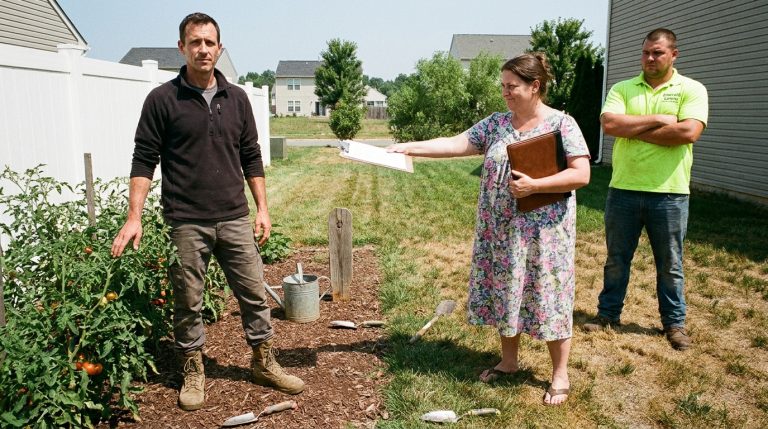
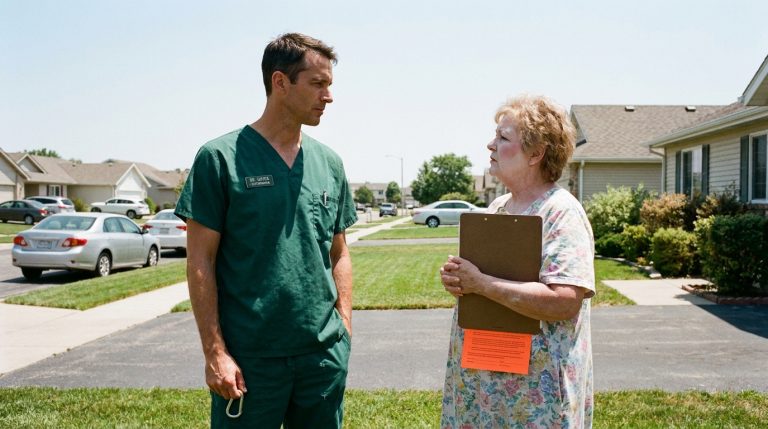
Ge Whitmore stepped out of the vehicle as if she were inspecting a conquered province. She had a deputy in tow—a man whose shifting eyes and posture betrayed his desire to be literally anywhere else. My family had worked these forty-three rows of apple, pear, and cherry trees for decades, grounding our lives in the soil of the Blue Ridge foothills. I held a busted irrigation line in one hand, the plastic grit rough against my palm, and a cooling cup of coffee in the other.
“You’re in violation, Mr. Callaway,” she said, her voice sharp, rehearsed, and utterly devoid of the dirt and grit that gave this land its value. She pointed a manicured finger toward my trees, an aggressive gesture that felt like a desecration of the harvest. “This operation is a nuisance, and frankly, an eyesore. We are moving to cease all activity here, effective immediately.”
She sounded like someone reading from a script she’d written to justify her own dissatisfaction. The deputy took a half-step forward, his hand hovering near his belt, his face a portrait of professional regret. “Mr. Callaway, we have a filed complaint regarding noise and visual blight. You’ll need to cooperate.”
I didn’t move. I didn’t drop the irrigation line. Instead, I took a slow, measured sip of my coffee, feeling the heat settle in my chest, a stark contrast to the sudden chill of her ultimatum. I looked at the line of trees, the way the light caught the leaves, and then I looked at the woman who thought a few bylaws gave her the right to rewrite the landscape.
“Ge,” I said, my voice steady, stripped of any pretense of friendliness. “Before you start planning the demolition of my grandfather’s legacy, there is a small matter you’ve clearly overlooked.”
Her jaw tightened, a hard, brittle line. “There is nothing to discuss. The HOA board has reached a consensus.”
“The HOA,” I repeated, letting the word hang in the humid air like smoke. “Tell me, Giddy, have you actually checked the deed on that clubhouse of yours? Or were you too busy counting mailboxes to notice who truly owns the ground beneath your pool?”
The color drained from her face—not instantly, but in a slow, creeping retreat that left her looking grey and hollowed out. The deputy flicked his gaze from her to me, a sudden, sharp realization dawning behind his eyes. He realized the silence wasn’t just a lull in conversation; it was a trap door, and he was standing right on top of it.
CHAPTER 2: THE PAPER TRAIL BEGINS
The silence lasted just long enough for the tension to solidify, a cold, hardening weight that settled between us. Ge didn’t speak. Her eyes, once sharp and demanding, lost their focus, darting toward the clubhouse at the edge of the development as if she were seeing it for the first time—not as a pristine symbol of her influence, but as a structure teetering on a foundation of unread ink. The deputy’s hand fell away from his belt. He didn’t know the law, but he knew the smell of a bluff being called.
“I don’t know what you’re talking about,” she finally whispered, though the strength was gone from her voice. It was a reflex, a desperate attempt to reset the scene to where she was the one issuing orders.
“Check the plat maps, Ge,” I said, my voice low and devoid of malice, which only made it sound more final. “Check the title chains. If you’re going to use the law to threaten a man’s livelihood, you really ought to know what the land actually says.”
I turned my back on them. It was a calculated risk, but a necessary one. If I stayed, the conversation would devolve into more posturing, more threats, more wasted energy. I walked back toward the barn, the mud sucking at my boots with a rhythmic, wet thud. Behind me, the SUV didn’t start immediately. I heard the low, frustrated murmur of voices—Ge’s panicked tone clashing with the deputy’s rising skepticism. A moment later, the crunch of gravel signaled their departure. I didn’t look back.
The first heavy drops of rain began to fall, turning the dust of the orchard into a slick, iron-scented paste. It was a change in the atmosphere that suited me; the weather was turning, and so was the tide. I reached the barn and pulled the sliding door shut, blocking out the wind. Inside, the space smelled of dried timber, old machine oil, and the sharp, tangy sweetness of stored apples.
I didn’t head for the main office. Instead, I went to the workbench in the back, the surface scarred by decades of surveyor’s pins and heavy wrench work. My grandfather had built this desk specifically for maps. It was wide, flat, and perfectly level. I wiped a layer of dust from the surface with the sleeve of my flannel shirt, feeling the familiar grit beneath my fingers. This was where the real work happened—not out there in the mud, but here, in the quiet, methodical reconstruction of the past.
I pulled a heavy, plastic-bound ledger from the shelf above the bench. It contained the copies I had made years ago when I first noticed the subdivision expanding like an invasive species. I spread the papers out, the ink of the old deeds fading into a pale, ghostly brown. My life as a land surveyor had taught me one fundamental truth: land doesn’t lie, but people go to great lengths to ignore what it says.
I spent the next three hours retracing the title chain of the Sycamore Bluff development. I went over the boundary markers, the easements, and the recorded covenants. I was looking for a crack, a moment of oversight that had been papered over during the developer’s rush to sell homes.
The rain hammered against the corrugated tin roof, a relentless rhythm that helped me focus. I traced the line of the clubhouse parcel, following the legal description through a thicket of bureaucratic jargon. Then, I stopped. My pencil hovered over a note from a title abstract dated twenty years ago—a transaction involving an entity that hadn’t been fully dissolved. A creditor from a failed venture, a shadow left behind when the land changed hands. It was a minor detail, the kind of thing a lawyer might skip over to close a deal quickly.
But I wasn’t a lawyer. I was a man who looked at the ground, not just the contracts. If this debt remained, if the interest had continued to accrue and the original lean had never been properly released, then the ground that clubhouse sat on wasn’t truly free. It was shackled to a history the HOA had spent a decade trying to bury.
I leaned back, the wooden stool creaking under my weight. My hands were steady, but my mind was running through the implications. I had the start of it. I had the first thread. But to pull it, I needed to see exactly how much leverage it provided. I didn’t need to destroy the clubhouse. I just needed to make sure that whatever authority Ge thought she held over my orchard was permanently and irrevocably cancelled by the very records she thought she was using against me.
I looked out the small, grime-streaked window of the barn. The storm was intensifying, the sky turning a deep, bruised purple. I had a lot of work to do. I pulled my phone from my pocket and dialed a number I hadn’t used in months—an old contact in the clerk’s office who understood the difference between a nuisance and a legal reality.
“I need a favor,” I said when he answered. “And I need you to look at something that hasn’t been touched in a long, long time.”
The game had moved from the field to the files, and for the first time in years, the advantage was mine.
CHAPTER 3: THE BOURBON CONSULTATION
The line clicked into silence, the clerk’s voice replaced by the rhythmic, hollow hum of an open connection. I didn’t hang up immediately. I stood there in the dim light of the barn, the smell of damp earth and cooling machinery pressing in from all sides. My contact at the office had been cautious, his tone shifting from professional to guarded the moment I mentioned the clubhouse parcel. He knew the politics of Harrow County; he knew that crossing an HOA president with the political reach of Ge Whitmore was a career-ending move.
But I had given him enough of a lead. If the lien was still sitting on the ledger, it was a ghost in the machine that someone had failed to exorcise.
I set the phone down and looked at the clock on the wall. It was nearly seven. The rain had settled into a steady, rhythmic drumming against the barn’s exterior, a sound that usually comforted me but now felt like a ticking clock. I needed to know more about Ge’s movements. If she was already talking to lawyers, she wasn’t just acting on personal spite; she was executing a strategy. And for that, I needed intel that couldn’t be found in public records.
I walked out of the barn, pulling my heavy canvas jacket tight against the chill. The air was raw, tasting of ozone and iron. I didn’t head for the house. I drove the old pickup truck down the gravel lane and turned onto the narrow road that connected my property to the edge of the Sycamore Bluff development. The homes sat in uniform rows, their windows glowing with a false, artificial warmth that seemed to mock the darkness of the woods surrounding them.
Wendel Oaks lived in a corner house, the yard meticulously kept, though the rest of the neighborhood’s obsession with perfection seemed to have bypassed his own property. He was a man who understood the value of letting things go wild, a trait that had made him an outcast among the HOA board. When I pulled into his drive, he was already waiting on the porch, a silhouette framed by the amber light of a lamp.
He didn’t greet me with small talk. He just stepped aside as I approached, the scent of expensive bourbon and dry pipe tobacco swirling into the night air. He looked tired—older than he had when he first brought me that folder weeks ago.
“She’s doubling down, Ruben,” he said, skipping the formalities as he led me into his study. The room was lined with books, the shelves sagging under the weight of leather-bound law volumes and histories that hadn’t seen the light of day in years.
“I know,” I replied, sitting in the worn leather armchair he gestured toward. “She showed up today with a deputy. Threatened to bulldoze the orchard.”
Wendel let out a dry, rattling laugh. He moved to the small bar in the corner, his hands steady as he poured two fingers of amber liquid into a glass. “That’s desperation, not strategy. She’s overextended herself. She’s been burning through the reserve funds on legal fees, and the neighbors are starting to notice the lack of maintenance on the common areas. The clubhouse roof is leaking, the pool heater is broken, and she’s spending thousands to prove your farm stand violates a covenant that doesn’t even apply to you.”
He handed me the glass. The bourbon was sharp, burning pleasantly on its way down. “But here’s the kicker,” he continued, leaning over his desk. “I went through the latest meeting minutes—the ones she didn’t want the board to see. There’s a missing page, Ruben. A whole sequence of entries regarding the developer’s final transfer of the clubhouse land. It’s like someone went in with an eraser.”
I felt the shift in my gut. A missing page wasn’t just an accident; it was a redaction. “Did you see what was on the previous page?”
“Just the usual—landscaping contracts, insurance renewals,” Wendel said, his eyes narrowing. “But the sequence is off. The page numbering jumps, and the ledger has been re-bound. She’s hiding something about the property status. She’s terrified that someone is going to realize that the land she’s controlling isn’t as clean as she told the homeowners.”
I looked at the glass in my hand, the golden liquid catching the low light. This was more than just a personal vendetta. She was protecting a secret, a liability that could collapse her entire house of cards. If she was hiding the record of the land transfer, she knew about the lien. Or, even worse, she knew that the lien had been overlooked and was now being used as a weapon she couldn’t parry.
“She’s not just trying to drive me out,” I realized, the pieces locking into place with a cold, metallic click. “She’s trying to clear the title before the homeowners realize the clubhouse is encumbered.”
Wendel nodded slowly. “She needs the property to be worth something so she can leverage it for more litigation. If the truth comes out that there’s an ancient, unpaid debt sitting on that dirt, the HOA board will have her head.”
I stood up, the chair scraping against the hardwood floor. The rain outside was relentless, a reminder that the world didn’t stop for the games people played behind closed doors. I had what I needed. I didn’t need to fight her on her terms—the complaints, the noise, the petty squabbles. I just needed to let the truth catch up to her, and I needed to make sure the board understood exactly what their leader had been risking with their money.
“Don’t say a word to anyone else,” I said, catching Wendel’s eye. “If she finds out we’re looking at the ledger, she’ll try to move faster.”
“She’s already moving, Ruben,” Wendel warned, his voice a low rasp. “She’s scheduled a special session for Friday. She’s going to move to pass a new assessment, claiming it’s for ‘urgent infrastructure repairs.’ But I know what it’s for. It’s to bury the legal fees. If she gets that vote, she’ll have the capital to keep burying you in paper until there’s nothing left of your orchard to defend.”
I stepped out onto the porch, the cold air biting at my face. I wasn’t going to let that happen. The orchard had survived droughts, storms, and the slow, grinding indifference of time. It wasn’t going to fall to a woman who treated a community like her own private fiefdom.
I walked back to the truck, my mind mapping out the path ahead. I had the leverage, I had the evidence of her deception, and now, I had the timer. Friday. I had three days to turn the tide.
CHAPTER 4: THE ARCHIVE OF BURIED TRUTHS
The drive to the municipal building took twenty minutes of winding through backroads that felt like they were shrinking in the dark. My headlights cut through the gloom, reflecting off the slick, rain-drenched asphalt, but I didn’t see the road. I saw the ledger Wendel had described. If the page was missing, it wasn’t a mistake; it was an admission.
I pulled into the gravel lot of the records annex, the engine ticking as it cooled in the damp night air. This building was an afterthought of county governance, a concrete bunker where the past was filed away in rows of steel shelves. I stepped out, my boots crunching on the wet rock, and felt the familiar, grounding weight of my own set of keys—earned through years of boundary work and land surveys.
The door to the annex swung open with a heavy, protesting groan of rusted hinges. The air inside was still, smelling of floor wax and the sweet, decaying scent of old paper. It was a sterile, quiet tomb for the ambitions of people long gone. I didn’t turn on the overhead lights. I kept to my flashlight, the beam cutting a sharp, yellow path through the dust motes that danced in the stagnant air.
I moved to the back, to the section marked for the Harrow County subdivisions. My pulse didn’t race; it slowed, falling into the steady, mechanical rhythm of my work. This was where the reality of ownership was stored, immune to the noise and posturing of HOA politics. I found the master volume for the Sycamore Bluff development, a massive, heavy-bound book that looked like it hadn’t been pulled from its slot in years.
I laid it out on the table, the spine cracking as it flattened. I turned the pages carefully, the paper brittle and yellowed. My mind wandered for a heartbeat, the scent of the vellum triggering a sudden, sharp memory of my grandfather standing in the middle of a field, holding a deed that had cost him everything he had. He had looked at me, his face weathered by decades of sun and struggle, and said, “Ruben, men who build with paper are the easiest to break because they never look at the ground beneath their feet. They think their words change the earth, but the earth is just waiting to reclaim what’s hers.”
He was right. I reached the section Wendel had pointed out. The sequence of pages was indeed interrupted. Where there should have been a series of property transfers and debt releases, there was only a jagged edge where paper had been torn away. It was a violent, sloppy job, done by someone who didn’t care about the history they were destroying, only the evidence they were erasing.
I adjusted the flashlight, leaning in close. I didn’t need the missing page. I was looking for the ghost of what had been there. I scanned the margins, the stamps, and the recorded signatures on the surrounding pages. Then, I saw it—a faint, indented mark on the page beneath, a transfer stamp that had pressed through the paper. It was a lean registration, signed and notarized, dated three years before the HOA took ownership of the common area.
I sat there for a long time, listening to the hum of the air conditioning unit, which sounded like a low, vibrating engine. The lien wasn’t just a rumor. It was real, and it had been systematically ignored, left to sit on the land like a dormant landmine. If I could prove that this debt was never cleared—that it remained a valid encumbrance on the clubhouse parcel—then the HOA didn’t just have a legal problem. They were operating on land that didn’t technically belong to them in the eyes of the law.
I took out my phone and used the camera to capture every detail. I needed a clean image, something I could hand to a judge or a forensic auditor if it came to that. My hands were perfectly steady. I wasn’t feeling anger anymore; I was feeling a cold, clinical sense of clarity. The leverage wasn’t just a bargaining chip; it was the mechanism of a total, structural collapse.
As I finished, I heard a sound from the front of the building. The faint, rhythmic click of a deadbolt turning.
I didn’t panic. I didn’t reach for a weapon. I simply closed the ledger, slid it back into its slot, and turned off my flashlight, plunging the room into absolute darkness. Someone had a key, and they were here late. It was either a cleaning crew working off-hours, or someone else had realized that the missing page was a vulnerability that needed to be monitored.
I stood perfectly still, my breathing slow and deliberate, merging with the silence of the room. The shadows were thick, the kind of dark that made it impossible to tell where the walls ended and the air began. I watched the doorway, a pale, dim rectangle of light at the end of the aisle. I was a surveyor; I knew how to hold my ground in the dark. I waited, my mind already calculating the quickest way out, the path of least resistance, and the next move I would make when the light finally reached me.
CHAPTER 5: THE LEVERAGE SHIFT
The beam of light danced across the rows of shelving, jagged and frantic. It wasn’t the slow, systematic sweep of a night watchman; it was the hurried motion of someone who knew exactly where they were going and was desperate to get there. I remained pressed against the end-cap of the steel shelf, my breath shallow and rhythmic. The smell of floor wax seemed to sharpen in the sudden tension, every nerve in my body tuned to the sound of footsteps on the concrete.
The intruder moved down the aisle—a silhouette blocky and tense. I didn’t wait to see if it was Ge herself or one of her paid proxies. I simply dropped to a crouch and moved with the silent efficiency of a man who spent his life navigating uneven terrain. I knew the layout of this annex better than any suburban functionary; I knew where the shadows pooled and where the floorboards held the groan of age.
I slipped behind a stack of transfer crates, my movements fluid. The intruder stopped, their light flickering over the master volume I had just returned to its place. They were looking for the gap. They were looking for the proof that I had been there, or perhaps confirming that the page was still missing.
I didn’t give them the chance to inspect the ledger. I nudged a heavy, metal-bound folder from the edge of the shelf. It hit the floor with a dull, heavy thud that echoed through the sterile silence.
The intruder spun, the light swinging wildly. “Who’s there?”
The voice was thin, nervous—not Ge, but someone she had clearly leaned on to handle the dirty work. I didn’t answer. I bolted for the side exit, a door I knew was kept latched but never locked. My boots hit the concrete with a soft, quick slap of rubber. The intruder lunged, but they were encumbered by their own hesitation. I reached the door, pushed it open, and slipped out into the cool, driving rain.
The transition from the dry, paper-scented tomb to the raw, biting weather was a shock. I didn’t stop to look back. I wove through the shadows of the gravel lot, kept low behind the rows of parked cars, and reached my truck just as a second vehicle pulled into the lot—a dark SUV, idling with its lights off.
I sat in the cab of my truck, my hands gripping the steering wheel. My heart rate hadn’t spiked, but my mind was firing with the cold, hard logic of the situation. They weren’t just monitoring the records; they were actively protecting the secret. They were panicked. And panic, as any land surveyor could tell you, was a sign of a failing structure.
I drove away slowly, keeping my lights off until I hit the main road. I needed to move, but I couldn’t move blindly. I pulled over under the canopy of an old oak tree, the rain drummed against the roof of the truck like a warning. I pulled out the photos on my phone. The indented text of the lien was clear—a testament to a debt that had been forgotten by the modern world but was still very much alive on the land.
I had the proof. Now, I needed the counter-move. I wasn’t going to fight them in the hallways of the municipal building or the boardrooms of the HOA. I needed to force the conflict into the open, onto the floor of the special meeting, where the homeowners—the people whose money was being bled away—would be forced to look at the truth.
I looked at the photos again. The name on the lien wasn’t a bank. It was a holding company that had dissolved years ago, its assets absorbed into a larger, anonymous trust. Tracking the debt to its current holder had been the hard part, but I had done it. I had reached out to the trust’s representative, a weary attorney in Richmond who barely remembered the file existed. He had been happy to offload the nuisance, and I had been happy to pay the price.
I wasn’t a cartoon villain holding the deed to their clubhouse. I was a landowner who had bought a piece of paper that gave me the right to demand accounting. And by tomorrow morning, when I sat down with Marcus Delgado, we would translate that right into a notice that would stop the “urgent repairs” assessment dead in its tracks.
I shifted the truck into gear and headed back toward the orchard. The rain was beginning to let up, leaving the world slick and glistening in the moonlight. I wasn’t just defending my land anymore; I was dismantling the architecture of their control. I could see the end of it—the way the meeting would play out, the way the faces of the board members would shift when they realized they weren’t paying for “infrastructure,” but for a wall of lies that was about to collapse.
It was a cold satisfaction, a hard, brittle joy that matched the ground I stood on. Every step of this process had been earned. There were no shortcuts, no easy wins. Just the slow, steady progress of digging through the muck until you found the bedrock. And I was finally standing on it.
CHAPTER 6: THE COURTROOM PIVOT
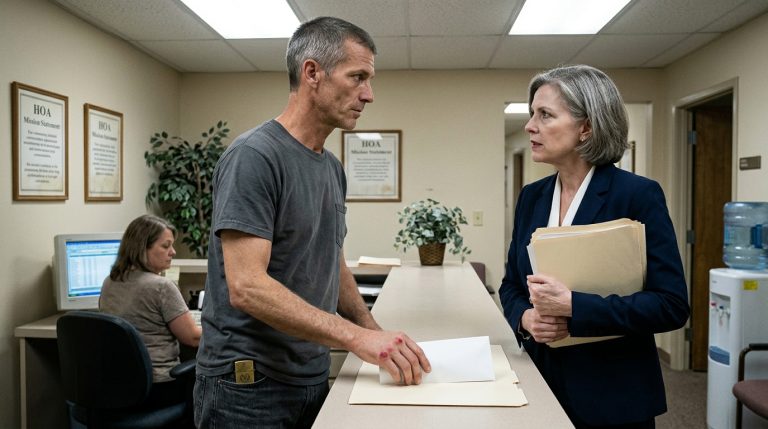
The air in the settlement room was thin, recycled through vents that hummed with a low-frequency drone. It was a space designed for quiet surrender, painted in shades of institutional beige that seemed to leach the color from your clothes. I sat across from the table where Ge Whitmore’s attorney waited, a man in an expensive charcoal suit who looked like he had never spent a day in his life dealing with mud, irrigation lines, or the stubborn reality of property law.
Ge wasn’t there. That was the first sign. A woman who defined her life by control didn’t voluntarily miss a moment where she could exert it. My attorney, Marcus Delgado, sat beside me, his presence a steady, solid contrast to the antiseptic nervousness of the room. He tapped a finger against the thick file he’d prepared—the culmination of the records I’d unearthed in the archives.
“They’re coming,” Marcus said softly, not looking at the door. “But they’re going to be aggressive. They think they can bury the lien issue in a procedural stay.”
I watched the door. When it finally opened, it wasn’t Ge who entered, but her counsel, holding a briefcase like a shield. He didn’t offer a greeting. He went straight to the table, adjusted his chair, and opened his files with a snap.
“Mr. Callaway,” he began, his voice practiced and sterile. “We’ve reviewed your filings. You’re attempting to leverage an encumbrance of questionable relevance to intimidate a community organization. I’m prepared to move for a dismissal based on the Right to Farm statutes’ lack of applicability to common-area management.”
I didn’t answer immediately. I took a slow, deliberate breath, focusing on the texture of the folder under my hands. The irony of his position was so thick it was almost suffocating; he was citing the law as a blunt instrument, exactly as I had seen Ge do for years.
“The lien isn’t questionable,” I said, my voice steady, cutting through the silence of the room. “It’s recorded, it’s valid, and it’s attached to the clubhouse parcel. If you want to talk about intimidation, I’d suggest you look at the last twenty-four months of filed complaints against my property. Not the dismissed ones, the ones that were clearly designed to harass.”
The attorney’s expression didn’t flicker. “Complaints are a procedural right, Mr. Callaway. Filing a lien against an entity you have no professional dealings with is something else entirely.”
Marcus leaned forward, his hands clasped on the table. “My client is the holder of the debt, counsel. By right of purchase and the failure of the HOA to clear the title transfer, he is a primary stakeholder in that property. He has every right to assert his interest.”
I watched the attorney’s eyes. They were guarded, flickering toward the door as if expecting someone to arrive and rescue him from the path of the truth I was about to drop. I realized then that he didn’t know the full scope of what I’d found. He was only briefed on the lien, not the missing ledger pages, not the deliberate erasure of the title history. He was walking into a war zone, and he didn’t even have his armor on.
“I’m not interested in taking their pool,” I said, leaning in. “I’m interested in the harassment stopping. I want a written acknowledgment, on the public record, that the orchard is beyond your reach. I want the legal fees reimbursed. And I want the HOA board to understand exactly what their president has been doing with their dues.”
The attorney scoffed, though the sound lacked conviction. “You’re asking for a total surrender. That’s not a negotiation.”
“It’s a clarification of reality,” I replied. “You can take this to court, you can drag it out for months, and you can let the homeowners eventually figure out that their president has been leading them toward a foreclosure because she was too arrogant to verify the title of her own clubhouse. Or, you can tell your client that the time for games is over.”
The silence that followed was heavy, filled with the hum of the air conditioner and the ticking of a clock on the wall. For a second, I felt a tremor of doubt—a phantom sensation that I might have missed a technicality, that the law might find a way to shield them once more. But then I looked at the attorney. He was sweating, just a little, a thin bead of moisture forming at his temple. He had realized, in that moment, that I wasn’t bluffing.
He didn’t need to ask Ge. He already knew.
“I’ll need to confer with my client,” he said, standing up and reaching for his briefcase.
“Do that,” Marcus said, his voice cold. “But tell her this: the clock on the interest for that debt is still running. Every day she stalls is a day that the debt increases. She’s not just hurting me anymore; she’s burning the neighborhood down.”
As they left, I leaned back in the chair. The tension didn’t leave my shoulders, but the shift had occurred. I had forced them to see the ground they were standing on, and for the first time, it was starting to crumble beneath them.
CHAPTER 7: THE SPECIAL MEETING
The air inside the clubhouse was thick with the scent of industrial carpet cleaner and the nervous perspiration of fifty people who had just realized their property values were not as secure as they had been promised. The room was packed; every folding chair was taken, and people were leaning against the walls, their faces tight with a mixture of resentment and confusion. I stood near the back, the manila envelope tucked firmly under my arm. It felt heavy—not just with paper, but with the inevitable conclusion of a two-year struggle.
Ge Whitmore was at the podium, her back to the wall, her expression a fragile mask of composure. She looked smaller than she had in the orchard, her expensive blazer slightly rumpled, her gaze darting across the room like a caged animal looking for an exit. Beside her, the board members sat in a line, their expressions guarded, waiting for her to lead them through the crisis.
“We have an agenda,” Ge began, her voice brittle. “We need to approve the infrastructure assessment immediately to ensure the longevity of our shared assets. The legal costs are a temporary burden—”
“A burden you created,” a voice cut through the silence. It was the retired firefighter who had spoken at the previous meeting, his voice rough and tired. A ripple of agreement moved through the room, a low, ominous sound that made the board members shift in their seats.
I didn’t wait for her to regain control. I stepped forward, walking down the center aisle. Every eye in the room followed me. I didn’t rush. I walked with the deliberate, heavy stride of a man who knew the boundary lines of his own property and had now laid claim to the boundary lines of theirs.
“The infrastructure doesn’t need a new assessment,” I said, my voice projecting clearly into the expectant silence. “It needs an honest accounting.”
Ge’s face hardened. “Mr. Callaway, you have no authority here. You are not a member of this HOA.”
“No,” I agreed, stopping in front of the podium. I placed the manila envelope on the table, the sound of the thick paper hitting the surface like a gavel. “But I am the lienholder for the property this building is sitting on.”
The room went completely silent. The board members looked at each other, their confusion turning into alarm. I opened the envelope and pulled out the copies of the title documents, the lien registration, and the timeline of the legal harassment I had endured. I didn’t need to speak to them; the paper did the work.
“For two years, your dues have been spent on a personal vendetta,” I continued, glancing at the board members. “You were told the orchard was a nuisance. You were told the legal fees were for your protection. The truth is that your president knew—or should have known—that the clubhouse land was never properly cleared. She gambled your money on the hope that she could break me before the truth surfaced.”
Ge reached for the papers, her movements shaky, but I laid my hand over them. She looked up at me, and for a moment, the mask slipped entirely. Her fear wasn’t about the money; it was about the loss of the reality she had built. She had defined herself by her position, and now, that position was being erased by the very paperwork she had ignored.
“The debt is real,” I said, loud enough for the back row to hear. “I bought it because I knew it was the only way to make the harassment stop. And now, I am presenting it to the board. We can settle this here, with a permanent record that my orchard is a lawful, protected operation, or we can take this to the county and let them determine how you failed to manage your own title.”
The room erupted. It wasn’t a roar of anger, but a sound of realization. The homeowners weren’t just angry at me; they were angry at the deception. The reserve fund, the failed maintenance, the constant fines—it all suddenly pointed to a single source.
Ge looked at the board, searching for support, but the board members were already standing up, their distance from her increasing by the second. She was alone. I stepped back, letting the chaos unfold, the weight of the envelope gone, the path forward finally clear. I had brought the truth into the light, and I had forced them to see that the ground they stood on was something far more complicated—and far more fragile—than they had ever dared to believe.
CHAPTER 8: THE HARVEST
The aftermath of the meeting was not a sudden explosion, but a slow, tectonic settling. Ge had left through the back exit, her silhouette disappearing into the rainy night like a ghost of the authority she had once claimed to wield. The homeowners had remained, drifting into small, tentative groups, their voices no longer sharp with anger but hushed with the weight of what they had just learned.
I stood by the podium for a long time, the manila envelope still sitting on the table. It was empty now, its contents distributed, verified, and absorbed. The retired firefighter approached me, his boots heavy on the industrial carpet. He didn’t speak for a moment, just looked at the orchard through the large glass doors that led out to the parking area.
“You did a hard thing, Ruben,” he said, his voice quiet. “Most people would have walked away, sold the land, and left us to her mercy. You didn’t.”
“I didn’t do it for you,” I said, though there was no edge in my tone. “I did it because the lines were drawn, and I knew where they were. Paper remembers what people try to forget.”
I left the clubhouse, the cool, rain-washed air of the evening hitting my face like a reprieve. The drive back to the orchard was short, the headlights catching the familiar curves of the road, the shadows of the trees reaching out to welcome me home. The property looked different now, or perhaps it was just that I was seeing it with the clarity of a struggle finally resolved.
The following weeks were a blur of quiet, methodical work. Title insurance cleared the lien, the HOA restructured under a new board, and the money that had been bled into legal fees was slowly channeled back into the neighborhood’s actual infrastructure. Wendell took over as treasurer, bringing the kind of sharp, glass-clear oversight that kept the books honest and the board focused on what actually mattered.
The orchard, meanwhile, had simply continued to do what it had always done—grow. I spent my days in the trees, the physical labor acting as a balm for the mental exhaustion of the last two years. I repaired the irrigation line that Ge had once threatened to bulldoze, my hands moving with the easy familiarity of a man who knew every joint and seal. When I turned the valve, the water flowed through the pipes, a steady, life-giving hum that vibrated through the earth beneath my feet.
One afternoon, toward the end of the season, Earl came by. He didn’t say anything, just set a basket of deep, sun-ripened tomatoes on the workbench—a quiet tribute for the compost he’d managed to reclaim. We stood there for a while, the orchard bathed in the gold of a late-summer sun, the leaves rustling in a gentle, cooling breeze.
I took the old plumb bob I’d kept in my tool kit—the same one my grandfather had used to lay the first rows—and spent a quiet hour checking the alignment of a fence post that had shifted during the winter. It was a simple task, a minor repair, but it felt like a final act of restoration. The tool hung straight, the string taut, the weight showing me exactly where the truth lay.
I had used part of the settlement money to fund a small agricultural scholarship in my grandfather’s name. A few weeks ago, I had received a letter from a young woman at the university, thanking me for the support and telling me about her plan to study sustainable irrigation. I had framed the letter and tucked it away in the barn, a small, enduring reminder that the legacy of this land wouldn’t stop with me.
The orchard was doing better than it had in decades. The trees were heavy with fruit, their branches bowed low under the weight of a harvest that had been nurtured through every mean little surprise life could throw at it. I walked to the edge of the property, looking out over the foothills, the Blue Ridge mountains rising in the distance, their peaks softened by the light.
The struggle was over, but the work—the real, honest work of stewardship—was just beginning. I knew now that land didn’t just belong to the person who held the deed; it belonged to the history it contained, and to the future that would be built upon it. I was just the current custodian, a link in a chain that stretched back to my grandfather and forward to those who would follow.
I knelt in the dirt, pressing my palm against the cool, dark soil. It was firm, reliable, and entirely, beautifully indifferent to the politics of the world outside. I stood up, brushed the earth from my jeans, and turned back toward the house. The sun was dipping below the horizon, painting the sky in colors of amber and violet, and for the first time in years, there was nothing left to defend, and everything left to grow.