The Mechanics of Land and Flesh: A Tactical Reckoning in Oakwood Estates
CHAPTER 1: THE ACCUSATION
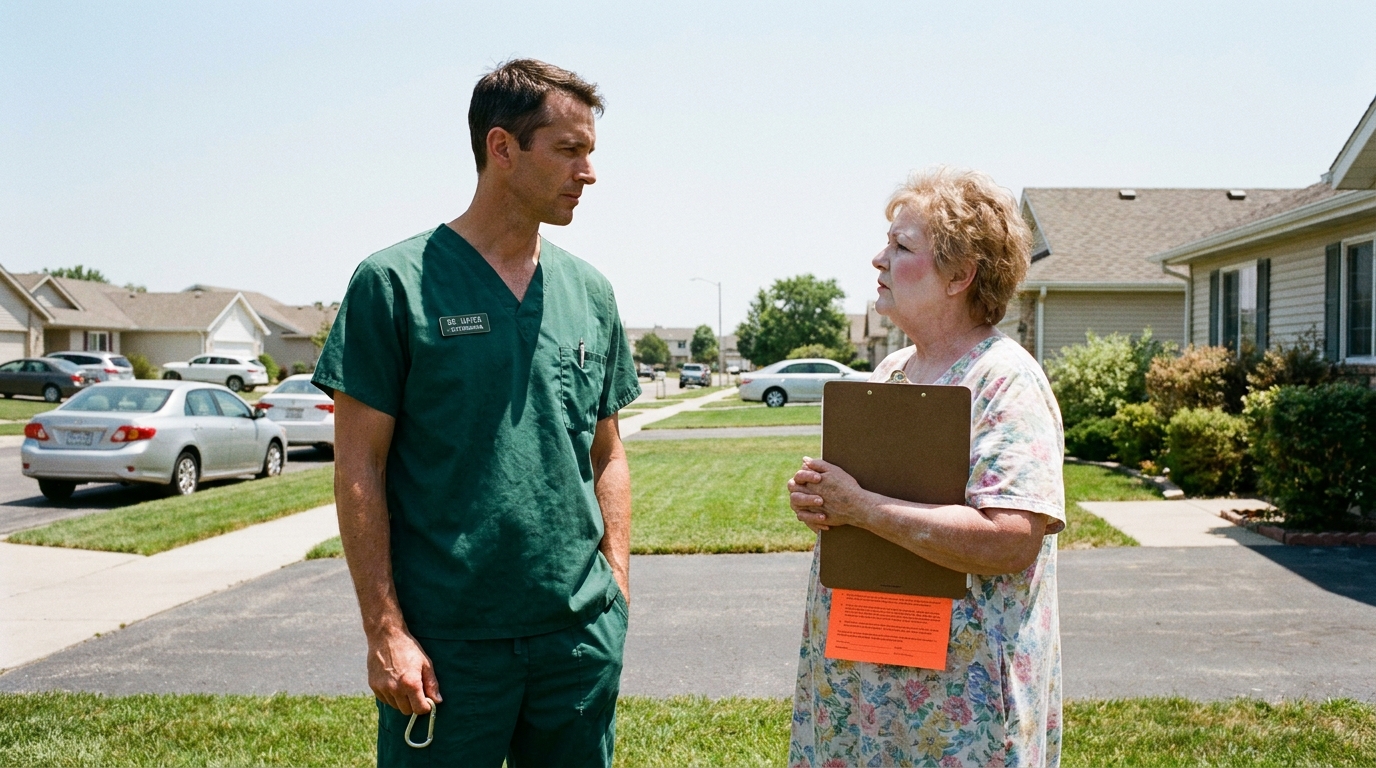
The fluorescent orange paper felt like high-grit sandpaper against my thumb.
Five thousand dollars. The bold black ink was fresh enough to smell of solvent. I didn’t look at the number twice. I looked at the three-inch rut her golf cart tires had carved into the damp turf beside my driveway.
“An unauthorized kennel is a public health hazard, Dr. Hayes.”
Karen’s voice had the dry, raspy scrape of a rusted hinge. She stood on my lawn in a floral mumu that smelled of stale lavender and cheap hairspray. Her heels sank an inch into the soil with every shift of her weight. Behind her, the plastic flag on her golf cart rattled against its fiberglass pole in the humid July air.
I didn’t answer. My right hand rested in my pocket, fingers systematically rolling a cold stainless steel carabiner—the heavy, tactical lock-ring from my deployment kit. Click. Roll. Snap. The metal absorbed the heat from my palm.
“You have thirty days,” she said. Her eyes were small, embedded in folds of powder. She was scanning my face, hunting for the twitch in the jaw, the flush of blood in the neck. “Remove the structure and pay the fine. Otherwise, we place a lien on the property. We can foreclose, Doctor. Do not test us.”
“A lien.” I kept my voice flat. Low pitch, zero inflection. The same tone I used when a military working dog came off the chopper with its belly full of shrapnel.
“Section 4.2,” she snapped, pulling a clip-board against her chest like a ballistic shield. “Unapproved structural modification. Unlicensed commercial animal facility. Public nuisance.”
“It’s a ten-by-twenty gravel run,” I said. My thumb pressed the spring gate of the carabiner until the steel bit into the callus. “Galvanized wire. Three inches off the house line. Unattached.”
“It’s a hazard.” She turned her pivot foot, grinding a two-inch patch of my St. Augustine grass down to black mud. “The board has received complaints. The smell alone.”
There was no smell. The run was washed twice daily with veterinary-grade disinfectant. The gravel rested on six inches of crushed limestone for instant drainage. A stray breeze carried only the scent of cut grass and hot asphalt.
She was lying. Not just about the hazard—about the complaints.
“Which neighbor?” I asked.
“Complaints are confidential.” She offered a thin, yellowed smile. “You don’t get to cross-examine the community, Alex.”
“Doctor Hayes,” I corrected gently.
She didn’t like that. The skin around her nostrils pinched tight. She spun on her heel, her floral dress billowing, and climbed into the vinyl seat of her cart. The electric motor whined as she backed out, tearing another small chunk of turf from the edge of my cul-de-sac.
I stood on the porch until the whine faded down the street.
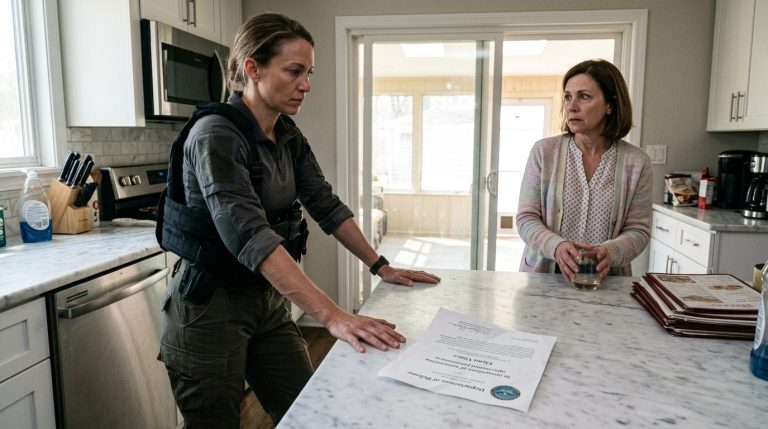
Inside, the house was cool. Sarah stood by the kitchen island, her hands wrapped around a glass of water she wasn’t drinking. She’d heard it through the screen door.
“Alex?” Her voice was tight. “Is she serious about the lien?”
“She’s serious about the threat,” I said.
I laid the orange paper on the oak table. Beside it, I set my carabiner. Snap. The heavy steel struck the wood with a solid, dull thud.
I walked to the rear window. General was lying in the shade of the cedar overhang inside his run. His head rested on his paws, his black-and-tan ears twitching at the sound of a distant mower. His hip scar—the memory of a mortar fragment in Kandahar—lay bare where the fur grew thin. He didn’t bark. He didn’t move until I slid the glass door open half an inch. Then his tail gave two slow, deliberate thumps against the gravel.
He was medical equipment. He was my anchor when the dark hours hit. And Karen had just put a price tag on his head.
“We can take it down,” Sarah whispered from the doorway. Her reflection in the glass showed her knuckles turned white. “We can just walk him on a leash. Five thousand dollars… we can’t just throw that into a legal fight.”
“We don’t take it down,” I said. My eyes remained on the fence line. “And we don’t pay.”
“She has the board, Alex. She has the covenants.”
“She has paper,” I said. I reached into my pocket, pulled out a small black notepad, and flipped to a blank page. “Paper burns if you set the temperature right.”
I sat down at the table, pulled the thick binder of HOA Covenants and Restrictions from the bottom shelf, and cracked the spine. The pages smelled of dry toner and old glue.
I didn’t open a bottle of whiskey. I didn’t raise my voice. I pulled a yellow highlighter from the drawer, clicked the cap off, and began to read.
Section 1.1. Section 1.2. Section 2.0.
Every rule is written by a human. Every human makes mistakes when they feel untouchable. Karen thought she was playing politics. She was about to find out she was dealing with logistics.
CHAPTER 2: FORTRESS OF PAPER
The steel carabiner settled into the grain of the oak table with a dull, ringing vibration. Under the halogen lamp, the yellow ink on page fourteen of the covenants was still damp, smelling faintly of glycol and ammonia.
Sarah stood at the threshold of the dining room. She didn’t come closer. Her right hand was tucked into the pocket of her cardigan, her thumb compulsively picking at a loose thread.
“How long?” she asked softly.
“Until it’s tight,” I said. I didn’t look up from Section 7.4. “Go to sleep, Sarah.”
“You have surgery at eight tomorrow, Alex.”
“Seven-thirty,” I corrected, running the tip of a red ballpoint pen down the margin. “A golden retriever with a torn cruciate. I’ll be back by noon.”
She stayed for three beats of the clock on the wall, her breath catching once before her slippers dragged softly across the hardwood toward the hall. The bedroom door closed with a muted latch.
I turned the page.
Section 7.4A: Architectural Modifications. The text was dense, set in ten-point Times New Roman, intentionally crafted to exhaust the eye of any homeowner trying to read past the first paragraph. I read it twice, word for word.
…any permanent structure or fixture physically attached to or integrated within the primary dwelling unit…
I reached for my phone, unlocked the screen, and pulled up the photos I’d taken during the build three months ago.
Photo one: the compacted base of gray crushed limestone, six inches deep. Photo two: the pressure-treated four-by-fours resting on galvanized steel deck blocks, unanchored to the ground. Photo three: the three-quarter-inch gap between the heavy wire mesh frame and the exterior cedar siding of the house.
Not attached. Not integrated. Freestanding. A modular, non-permanent enclosure. By their own definitions, it was legally indistinguishable from a portable dog crate sitting on a patio.
I clicked the pen. Red ink circled the words physically attached.
Next came the second charge. Operation of an unlicensed commercial animal facility.
I leaned back in the chair. The oak backboard creaked under my shoulder blades. This wasn’t a mistake on Karen’s part. It was a deliberate, poison-pill assertion designed to leverage my profession against me. If an HOA board officially logs a veterinarian as running an illegal kennel from his personal residence, that record gets indexed in public municipal filings. It gets picked up by insurance underwriters. It touches my clinical license.
It was a surgical strike at my livelihood.
I opened a fresh manila folder on the table. With a black sharpie, I wrote on the tab: EXHIBIT A.
From my briefcase on the floor, I pulled out my veterinary license from the state board, my Cornell diploma, and my official discharge papers—Form DD214, United States Army Veterinary Corps, Captain Alexander Hayes. I made clean, high-resolution scans of each using the flatbed printer in the corner.
Below them, I placed a laminated card: General’s official service animal certification, complete with his microchip registry number and my VA disability determination code for combat-related trauma recovery.
Under the Fair Housing Act, a service animal is not a pet. It is not livestock. It is not commercial inventory. It is an auxiliary medical apparatus. Calling a service dog run a “commercial kennel” was the legal equivalent of fining an amputee for keeping a wheelchair in their driveway.
I wrote EXHIBIT B on the second folder and slotted the FHA statutory references inside.
I worked through the night. The clock in the hall struck two, then three, its mechanical tick steady as a pulse. Outside, the neighborhood was dead quiet, save for the occasional rush of wind through the tops of the white oaks lining the street.
At four fifteen, I reached the third charge: Public Nuisance & Biohazard.
This was where she relied on subjectivity—the vague, undefinable space where an HOA president usually wins by default because no homeowner keeps records of smell or silence.
I pulled up the feed from my backyard security camera. The lens had a decibel meter overlay built into its software. I set the time parameters from midnight three weeks ago to midnight yesterday. I ran a export script, rendering a linear line graph of sound levels. The baseline was a flat thirty-five decibels—ambient night noise. The only spikes were passing vehicles on the main road two blocks over, peaking at sixty. General’s profile was a flat, unbroken line.
I printed the sound graph. EXHIBIT C.
For the biohazard claim, I drafted a sworn affidavit on my clinic’s legal letterhead, outlining the chemical composition of Virkon S disinfectant, its dilution ratio, and the twice-daily application schedule I maintained. I attached the purchase invoices from my clinic supply distributor.
At five-thirty, the sky outside turned the color of bruised slate.
I picked up an envelope that had arrived three days prior—a routine administrative notice from the HOA regarding the annual pool schedule. I hadn’t looked closely at it then. Now, my eyes caught the fine print in the bottom right corner of the return address window.
Processed by Vanguard Compliance LLC — P.O. Box 409.
The print was faint, executed in a cheap thermal ink that was already beginning to fade. I stared at the name for five seconds. Not the management company. Not the HOA’s legal firm of record. A third-party entity processing official board notices. I didn’t write it down. I didn’t highlight it. I just let the letters sit in my head while I organized the papers.
By six AM, I had a four-page formal response letter typed, proofread, and printed. Attached to it were twenty-four pages of exhibits, fully indexed, cross-referenced, and bound with a heavy binder clip.
I showered, shaved, and put on a clean set of dark green surgical scrubs.
At six-forty, I walked out to my truck. The morning air was cool and thick with ground fog. General followed me to the driveway, his nose working the damp air, his tail giving its single, calm wag before he sat beside my knee.
“Stay,” I said softly. He dropped his hindquarters instantly onto the damp concrete.
I walked down the street toward Karen’s house.
Her lawn was pristine—a dark, unnatural emerald green fed by a chemical lawn service. The golf cart was parked in the driveway, plugged into an extension cord running under her garage door.
I didn’t step on her grass. I stayed on the concrete apron of her driveway. I reached into my pocket, pulled out a heavy black rubber band, and wrapped it around the manila packet.
Her front door was painted a deep maroon. I stepped up to the porch, lifted the heavy brass knocker, and let it drop once.
CLACK.
The sound echoed through the silent cul-de-sac.
Without waiting, I slipped the heavy packet over the brass handle of her front door, wedge-anchored so that any attempt to turn the knob from the inside would force the weight of the paper to drop with a crash against the wood.
As I turned and walked down the steps, a slat in the blinds beside the door twitched open. I didn’t look up, but I felt the weight of her eyes on my back as my boots hit the pavement.
I unlocked my truck door, climbed into the driver’s seat, and started the engine. The diesel idle filled the quiet morning with a low, steady thrum.
My phone on the dashboard buzzed once. A calendar alert: 7:30 AM — Surgical Suite 1. Golden Retriever.
I put the truck in drive and pulled away, leaving the heavy manila folder hanging from her door like an unexploded shell.
CHAPTER 3: THE KANGAROO COURT
The side-view mirror caught the maroon door as I reached the end of the block. The blinds didn’t twitch again, but the gap in the aluminum slats remained open—a tiny, dark slit in the white paneling.
Four hours later, the clinic was dead quiet save for the rhythmic hum of the oxygen concentrator in Surgery Two. The golden retriever was sitting up in recovery, his tongue lolling lazily over his lower teeth, eyes heavy from propofol. I checked his bandage, verified the capillary refill time on his gums, and walked out to my desk.
My phone screen lit up. No ringtone. Just a single text notification from an unlisted local number:
Hearing confirmed. Tuesday, 19:00. Oakwood Clubhouse. Attendance mandatory for dispute resolution.
I didn’t reply. I printed the confirmation, dropped it into the manila folder beside my discharge papers, and closed my desk drawer.
Tuesday evening smelled of damp drop-ceiling tiles and burnt pot coffee.
The Oakwood Estates Clubhouse was a low-slung cinderblock building wedged between the community pool and two cracked tennis courts. Inside, six rows of beige plastic folding chairs faced a long folding table with a imitation-wood veneer.
Karen sat in the center. She wore a dark blue blazer over her floral dress, her bleached hair sprayed into a rigid, impenetrable dome that caught the glare of the flickering fluorescent tube overhead. To her left sat Sheila—a thin woman in her sixties whose face looked like it had been carved out of a turnip. To her right sat Barry, a plump man with a sweaty upper lip who kept tapping a plastic pen against an empty foam cup.
Three homeowners sat in the front row. A young couple—the Millers—sat two rows back, their hands tightly intertwined, heads bowed as if waiting for a sentence to be read.
I walked down the central aisle. My boots didn’t make a sound on the thin industrial carpet. I carried a single black leather briefcase.
“Doctor Hayes,” Karen said. She didn’t offer a chair. She didn’t look at my face; her eyes anchored directly on the handle of my case. “You requested an audience regarding Notice 408-A.”
“I filed a formal rebuttal,” I said, standing three feet from the center of the table. “With twenty-four pages of supporting documentation.”
Karen reached down, picked up my rubber-banded packet from the floor beside her purse, and dropped it onto the table. The heavy paper slapped against the veneer with a flat thud.
“We received it,” she said. She didn’t open it. Her manicured thumbnail didn’t even catch the edge of the cover sheet. “The board has reviewed your submission.”
“You haven’t read it,” I said quietly.
Barry’s pen stopped tapping against the foam cup. He cleared his throat, a wet, rattling sound, and looked at the ceiling tiles.
“The board’s time is valuable, Doctor,” Sheila snapped, her thin lips barely moving. “We don’t need forty pages of medical jargon to determine whether a structure violates community harmony.”
“It’s twenty-eight pages,” I corrected. “And it includes an affidavit certifying the run is unattached, a decibel log proving zero noise variance, and a statutory citation from the Fair Housing Act regarding service animals.”
Karen leaned forward. The blue synthetic fabric of her blazer creaked at the armpits.
“We don’t answer to federal housing memos here, Alex. This is a private residential covenant.” She smiled—a quick, bloodless flexing of her cheeks. “Furthermore, the board has received a second formal complaint regarding your premises.”
I kept my hands loose at my sides. My thumb found the smooth outer edge of my pocket seam, pressing down against the bone.
“From whom?”
“Complainants are confidential,” Sheila interjected. “To protect residents from retaliation.”
“There is no second complaint,” I said. My voice didn’t rise. It dropped half an octave, taking on the dense, heavy cadence of a tactical debrief. “My property line abuts three lots. The Hendersons to the west, the Gables to the east, and the greenbelt to the south. Mrs. Gable is eighty-two and hasn’t left her porch since April. Mr. Henderson’s backyard is blocked by an eight-foot Leyland cypress hedge.”
Karen’s eyes narrowed slightly. The powder around her mouth cracked.
“The complaint stands,” she said, tapping her finger against a yellow legal pad in front of her. “The board has voted. The $5,000 assessment for unapproved construction remains active. In addition, due to your aggressive posture and refusal to remediate within the initial seventy-two-hour window, we are applying the non-compliance multiplier under Section 12.1.”
She picked up a small wooden gavel—a novelty item, no larger than a butter knife—and tapped it once on the table.
Tink.
“The total outstanding balance is now $6,000,” she said. “Plus $100 per day until the structure is entirely dismantled and the ground restored to sod.”
In the second row, the young wife—Mrs. Miller—let out a sharp, involuntary gasp. Her husband squeezed her hand until his knuckles turned gray.
I didn’t blink. I looked at Barry. His eyes were fixed firmly on his empty coffee cup, his fingers twitching against the plastic. I looked at Sheila; her chin was raised, her expression fixed in a sneer of bureaucratic victory.
They thought this was the end of the script. They expected the anger, the raised voice, the threats of lawsuits that ninety-nine percent of homeowners never follow through on because retainer fees swallow savings whole.
“Six thousand,” I said softly.
“Six thousand,” Karen repeated, leaning back, her hands folding over her stomach. “Payable by cashier’s check to the Oakwood Estates Treasury within ten business days. Or we file the lien.”
I reached down, unlatched the brass clasps of my briefcase, and pulled out a single sheet of paper. I didn’t set it on the table. I held it between two fingers.
“I need the formal board minutes of this determination,” I said. “Signed by the secretary.”
“The minutes will be posted in due course,” Sheila said dismissively.
“Bylaw 14.3 requires immediate written notice of fine escalation handed to the member upon adjournment,” I said. “Signed by the presiding officer.”
Karen glared at me for two long seconds. Then she snatched a standard carbon-copy receipt pad from her folder, scribbled Notice 408-A Escalation — $6,000 across the top, slapped her signature across the bottom, and tore the top sheet off.
She shoved it across the table.
I took the paper. The carbon ink was smudged at the corner, leaving a faint black mark on my thumb.
Below her signature, printed in microscopic light gray type at the very bottom edge of the receipt paper, ran a single standardized printer code:
Form 109-V — Vanguard Compliance LLC (P.O. Box 409)
I folded the paper carefully into quarters, slipped it into my breast pocket, and picked up my briefcase.
“Thank you for your time,” I said.
I turned and walked back toward the double doors. I didn’t rush. As I passed the second row, Mr. Miller looked up at me, his eyes wide with a mix of awe and absolute terror. I gave him a single, barely perceptible nod.
Outside, the night air was cold and clear. The sky was black, stripped of clouds, the stars sharp as broken glass above the dark silhouettes of the oak trees.
I walked to my truck, opened the driver’s door, but didn’t get in. I stood on the asphalt, resting both hands on the cold metal frame of the door, listening to the quiet thrum of the neighborhood.
Behind the clubhouse, near the utility dumpsters, a small white sedan was parked under the shadow of a pine tree. A printed paper parking permit hung from its rearview mirror.
In the faint glow of the dash lights, I caught three letters printed across the top of the permit: VNG.
I climbed into the cab, pulled the door shut, and turned the key.
CHAPTER 4: THE PAPERWORK INSURGENCY
The high-beam headlights caught the rear bumper of the white sedan as I backed out of the space. The license plate was framed in chrome with a dealer tag from two counties over. In the lower corner of the glass, the parking permit’s white cardstock reflected starkly: VNG-088.
I didn’t follow the car. I drove home at twenty-five miles an hour, keeping my eyes fixed on the gray asphalt ahead.
When I pulled into the driveway, Sarah was standing by the front window. The living room light threw her shadow long and thin across the lawn. I turned off the ignition, sat in the dark cab for ten seconds, and picked up my briefcase.
General met me at the door. He didn’t whine. He placed his muzzle against my left kneecap, stayed there until I reached down to rest my palm on his skull, and then pivoted to walk two paces ahead of me into the kitchen.
“How much?” Sarah asked. She was leaning against the counter, an empty mug gripped in both hands. Her knuckles were red from the cold draft coming through the floorboards.
“Six thousand,” I said. “And a hundred a day.”
She closed her eyes. The skin around her temples looked paper-thin under the yellow bulb. “Alex… we can’t sustain a legal retainer for six months. We just paid off the clinic’s new ultrasound unit.”
“We aren’t hiring a lawyer,” I said, setting the briefcase on the table. “Lawyers file motions that take ninety days to sit on a clerk’s desk. We’re going to audit.”
Wednesday morning, five-forty-five AM.
I walked down the eastern curve of Oakwood Drive. The air had the damp, heavy bite of early autumn. General walked at my heel, his leash slack, his head held low and level.
Mr. Henderson was out on his driveway, wearing a heavy canvas coat, dragging his green plastic roll-cart toward the curb. His house was a clean two-story brick with immaculate white trim.
I stopped at the edge of his apron.
“Morning, George,” I said.
Henderson froze. His hand stayed clamped on the plastic handle of the bin. He didn’t turn his head right away; his shoulders hitched under the coat.
“Doctor,” he said softly.
“Tomatoes did well this year,” I noted, looking toward his side yard where the dry stalks were still tied to tall wooden stakes.
“Frost will kill ’em by Friday,” he grunted, finally turning to face me. He looked at General first, his eyes tracking the dog’s chest harness, then looked up at my face. He didn’t meet my eyes directly; he focused on my collarbone. “I heard about the board meeting last night.”
“Word moves fast,” I said.
“Sheila talks,” he muttered. “She was telling Miller’s wife at the mailboxes this morning that you’re going to lose the house.”
I reached into my jacket pocket, pulled out a clean sheet of white paper, and held it out. “I need thirty seconds.”
Henderson looked at the paper as if it were a hot coal. “I don’t want any trouble, Alex. Karen’s been on my back about the compost tumbler since May. She threatened a fifty-dollar-a-week fine if I didn’t move it behind the fence.”
“She didn’t fine you,” I said.
He blinked. His lower lip twitched.
“She offered to drop the compost violation,” I continued, keeping my voice down to a calm, matter-of-fact murmur. “If you signed a statement saying you heard General barking at three in the morning.”
Henderson took a step back. His boot heel scraped against the gravel at the edge of the asphalt. “I didn’t sign anything, Alex. I swear to God I didn’t.”
“I know,” I said. “Because she didn’t need your signature. She just needed your address on the form.”
I unfolded the paper. It was a copy of the complaint log I’d demanded under Bylaw 14.3. The name was redacted with a black marker, but the lot number wasn’t: Lot 42. Henderson’s lot.
“She forged the lot log,” Henderson whispered.
“She used your address as the leverage point,” I said. “And she did it because she knew you wouldn’t double-check the board’s public ledger.”
He stared at the paper. The wind caught the corner, fluttering it against my knuckles.
“What do you want me to do?” he asked, his voice cracking slightly.
“I don’t want you to fight her,” I said. “I just want you to give me your last three HOA dues receipts.”
Two hours later, I was sitting in my truck parked outside the Oakwood Estates Management Company office on Industrial Parkway.
The office was a suite in a low-rent brick strip mall. Through the plate-glass window, I could see a single receptionist sitting behind a laminate desk, scrolling on a tablet next to a stack of manila folders.
I walked in. The air inside smelled of carpet cleaner and old toner.
“Can I help you?” the receptionist asked without looking up.
“Alex Hayes. Lot 17,” I said. “I’m exercising my statutory right under State Code Section 608 to inspect the association’s general ledgers for the past twenty-four months.”
She stopped scrolling. Her eyes came up slow. “Financial inspections require a fourteen-day written request to the board treasurer.”
“Financial inspections do,” I agreed. “Account receivable ledgers for vendor disbursements do not. Section 608, Subsection C. Right of immediate view for any member with an active administrative dispute.”
I laid my driver’s license and a copy of the formal dispute notice on the laminate counter.
She stared at the document for five seconds, then stood up without a word and walked into a back room. A minute later, a short man in a gray polo shirt with Oakwood Management embroidered on the chest stepped out. He carried a heavy black binder with a white label on the spine: Ledger 18-B.
“You’ve got twenty minutes, Doctor,” he said, setting the binder on the counter. “No photos. Notes only.”
I opened the binder.
The pages were dense rows of computer-generated accounting lines. Monthly maintenance fees. Landscaping contracts. Pool chemical delivery.
On page forty-two, the first entry appeared:
11/12 — Vanguard Compliance LLC — Violation Processing Fee — $1,250.00
Page fifty-six:
02/18 — Vanguard Compliance LLC — Special Inspection Services — $1,800.00
Page seventy-one:
05/04 — Vanguard Compliance LLC — Legal Notice Delivery — $2,100.00
Every disbursement was approved by a single signature in the right-hand column: K. Richards, Board President.
I turned to the vendor registration page at the back of the binder.
Vanguard Compliance LLC.
Registered Agent: Corporate Filings Inc.
Mailing Address: P.O. Box 409, Oakwood Branch.
There was no physical corporate address listed. No tax ID number on file in the vendor folder—just a single hand-written W-9 form with a corporate name and a post office box.
I pulled out my notebook and copied three numbers: the bank routing string at the bottom of the check copies, the authorization code on Ledger 18-B, and the P.O. Box number.
The man in the gray polo shirt leaned against the doorframe, watching my pen move. “Finding what you need?”
“Just checking the math,” I said, closing the binder.
I walked out into the pale October sunlight.
My phone vibrated in my pocket. I pulled it out and looked at the screen. A text from Sarah:
Karen just drove past the house in her cart. She stopped at the end of the driveway and took a photo of General in his run.
I stared at the text. My thumb pressed against the cold glass screen until the display flickered.
She wasn’t trying to enforce a rule anymore. She was building a file to justify the foreclosure action. She was moving faster than the thirty-day window implied.
I got into the truck, set my notebook on the passenger seat, and dialed David’s number.
“Alex,” David’s voice came through the speaker, crisp and clear. “Did you read the notice I emailed you?”
“I’m looking at the ledgers, David,” I said. “She’s funneling two thousand a month out of the operating account into a shell company using P.O. Box 409.”
“Forget the money for a second,” David said sharply. “She just filed an emergency motion for a temporary injunction with the county magistrate. She’s claiming the dog run is an active health hazard to neighboring properties, citing ‘unidentified resident reports.’ The hearing is set for Friday morning.”
I gripped the steering wheel at twelve o’clock. The leather was cold against my palm.
“She wants an order to enter the property and remove the structure,” David added. “If the magistrate signs it, county marshals will back her up.”
“She won’t get it,” I said.
“She’ll get it if you stand in court with a binder of noise logs and no witnesses, Alex. A magistrate doesn’t know a dog run from a meth lab on a five-minute docket. He sees ‘public health threat’ signed by an HOA president, he signs the order.”
“Then I’ll give him witnesses,” I said.
“Who? Henderson? He won’t testify against her. He’s terrified she’ll lien his house next.”
“Not Henderson,” I said, looking down at my notebook where I’d written the list of every pet owner in the neighborhood from my clinic database. “The whole street.”
I hung up, put the truck in gear, and turned out of the parking lot toward the clinic.
Phase one was over. The paperwork defense wasn’t enough to stop a magistrate’s pen. I needed a public collision—one she couldn’t bury in a closed board meeting or hide behind a confidential complaint log.
I pulled into the clinic lot, parked beside the rear entrance, and walked straight into the office.
Tina looked up from the reception desk, a phone receiver pressed to her ear. “Dr. Hayes, Mrs. Gable called three times—”
“Tina,” I interrupted, setting my notebook on her desk. “Pull the active patient files for Oakwood Estates. All of them.”
She blinked. “All of them? That’s almost sixty families.”
“Print the mailing labels,” I said, my voice quiet and level. “And fire up the letterhead printer. We’re hosting a community clinic this Saturday.”
CHAPTER 5: WEAPONIZED MEDICINE
Tina’s index finger remained frozen half an inch above the enter key. The thermal label printer beside her monitor gave a low, mechanical whir, idling on standby.
“Sixty files,” she repeated, her head tilting slightly. “Dr. Hayes, that’s two thousand pages of rabies certificates and county compliance records. We’ll burn through three reams of heavy cardstock.”
“Use the heavy stock,” I said. My voice was clipped, locked into the rhythmic tempo of a pre-op brief. “Include every record where the owner’s primary residential address falls within Oakwood Estates. Priority routing for canine rabies verification.”
“And the billing?”
“Pro bono,” I said, leaning over her shoulder to tap the top row on her screen—Richards, K. — Miniature Poodle ‘Precious’. “It’s a community health initiative.”
Tina looked from the glowing monitor to my face, reading the tension in my jaw. She didn’t ask another question. Her finger came down hard on the key, and the printer mechanism engaged, spitting out high-density adhesive labels with a fast, metallic shhh-shhh-shhh.
By seven o’clock Saturday morning, the dew on the grass at Oakwood Common Park had turned to ice-edged droplets.
We had set up two heavy-duty canvas pop-up tents on the field fifty yards from the clubhouse pool. Ben and Maria—my two junior techs—were unloading folding tables from the bed of my truck, their breath plume-clouding in the crisp air. On the center table rested a thirty-two-inch flat panel monitor connected to my clinic’s encrypted offline server, shielded from the glare under a plastic awning.
By eight-fifteen, the line stretched fifty paces past the playground.
It wasn’t a protest. It was a crowd of forty neighbors holding leashes, pet carriers, and coffee cups. Mrs. Gable stood third in line, holding a woven basket of warm muffins wrapped in a checkered towel, her elderly Shih Tzu sitting quietly inside her coat flap. Mr. Miller stood near the back, holding his golden retriever on a short leather lead, talking in low, urgent tones with three other homeowners from Block B.
At eight-thirty, I saw Karen approaching across the wet grass.
She wasn’t in her mumu. She wore a dark gray trench coat, her peroxide hair stiff against the wind, flanked by Sheila and Barry. Barry carried a red clipboard pressed flat against his chest like armor.
They didn’t walk up the central path; they approached from the flank, stopping five feet from the main check-in table.
“Doctor Hayes,” Karen said. Her voice lacked its usual shrill cadence, flattened instead by a cold, sharp restraint. “This park is dedicated common property under Covenant 3.1. Unsanctioned commercial operations are subject to immediate municipal dispersion.”
I didn’t step back. I stood behind the check-in display, wearing my dark green clinical scrubs under an insulated winter jacket.
“This isn’t a commercial operation, Karen,” I said, my voice carrying cleanly across the silent line of neighbors. “It’s an official public health audit. Free of charge to all residents.”
“You don’t have the authority to audit this park,” Sheila snapped, her turnip-carved face twitching.
“I have a doctor of veterinary medicine license,” I replied, pointing to the framed state document resting beside the monitor. “And under County Health Code 402, a licensed veterinarian has the statutory duty to report and verify rabies containment protocols whenever an HOA board officially reports an active ‘biohazard’ within its boundaries.”
Karen’s eyelids flicked once. A tiny, involuntary micro-expression—the briefest drop of her left eyebrow.
“You filed an emergency injunction with the county magistrate on Thursday,” I continued, keeping my eyes fixed on hers. “You swore under oath that there was an active, ongoing animal-borne health hazard originating from Lot 17 that threatened this entire development.”
The neighbors in line stopped talking. The only sound was the cold wind snapping the edge of the canvas tent overhead.
“If there is a biohazard in Oakwood Estates,” I said, stepping around the table, “then as a veterinary officer, I am legally obligated to inspect every animal on this property to isolate the vector. Starting right now.”
“This is absurd,” Karen hissed, taking half a step backward. Her boot heel sank into the soft soil of the park lawn, leaving a jagged tread mark identical to the one on my grass. “We aren’t participating in your circus.”
“You don’t have to,” I said. I turned to Tina. “Pull up the public record for Lot 42.”
Tina hit two keys on the laptop. The thirty-two-inch monitor lit up with a high-resolution display of a county record sheet.
“George Henderson’s lot,” I announced to the crowd. “Where the board logged an anonymous complaint claiming chronic odor and midnight barking.”
George Henderson stepped out from behind the Millers. He didn’t look at the ground this time. He was wearing his heavy canvas work coat, his hands shoved deep into his pockets.
“George,” I said across the open grass. “Did you ever file a complaint against Lot 17?”
Henderson looked directly at Karen. His throat worked twice as he swallowed, his jaw tightening until the muscle stood out against his neck.
“No,” Henderson said, his voice loud enough to echo off the brick wall of the pool house. “I didn’t.”
A low murmur rippled through the crowd. Mrs. Gable shifted her basket, her mouth open in a small O.
“Karen told me she’d waive my fifty-dollar compost citation if I signed an empty incident log,” Henderson shouted, his face turning dark red. “She told me nobody would ever see the sheet.”
“He’s lying,” Sheila blurted out, her voice cracking into a high register. “He’s an uncooperative resident with an outstanding balance!”
“He’s not lying,” I said.
I reached into my pocket, pulled out the folded carbon copy of the $6,000 fine escalation receipt Karen had handed me at the clubhouse, and set it flat on the laminate table under a clear acrylic weight.
“And neither is this.”
I tapped the bottom edge of the paper, where the microscopic light gray type was highlighted in bright yellow:
Form 109-V — Vanguard Compliance LLC (P.O. Box 409)
“Every fine issued in this neighborhood for the last two years,” I said, looking Karen dead in the eyes, “doesn’t go into the Oakwood Estates maintenance fund. It goes to a third-party vendor account. Ledger 18-B shows over forty-eight thousand dollars disbursed to Vanguard Compliance LLC.”
Karen’s hands tightened inside her trench coat pockets until the fabric strained over her knuckles. Her mouth was set in a razor-thin line.
“Vanguard Compliance LLC,” I read from my notes, “is a private shell entity registered to Post Office Box 409 at the local branch. The authorized signatory on the bank account is Karen Richards.”
The park went dead silent.
Nobody moved. Even the dogs in line were quiet, sensing the sudden, dangerous spike in human tension.
Karen didn’t panic. She didn’t scream. Her eyes narrowed into two black slits, her posture straightening as she took two deliberate steps forward, stopping inches from the check-in table.
“You think you’ve done something clever, Doctor,” she whispered, her voice so low it was meant only for me. “You think a magistrate cares about internal accounting methods when an HOA contract grants the board sole discretion over vendor selection? The lien on your house was recorded with the county clerk at eight-thirty this morning. You’re six thousand dollars in default on a legal assessment. You have fourteen days before the sheriff posts the notice on your door.”
She offered a slow, venomous smile, her yellowed teeth catching the gray morning light.
“See you at the courthouse, Alex.”
She turned on her heel and began walking across the grass toward her golf cart, Sheila and Barry trailing behind her like frightened shadows.
I didn’t call after her. I didn’t raise my voice.
I turned back to the display screen, pulled up a new PDF file sent to my email five minutes prior by David, and tapped the print command.
The laser printer sputtered, pulled a fresh sheet of white paper from the tray, and spat it out into the catch bin.
I picked up the paper. It wasn’t an HOA notice. It was an official third-party audit order from the State Attorney General’s Consumer Protection Division, stamped with a red seal: Case File 804-B — Involuntary Subpoena of Records for Vanguard Compliance LLC.
I looked up as Karen reached her cart. She paused, her hand resting on the plastic steering wheel, looking back across the field at the crowd that was now closing in around my tent, clipboards in hand.
Phase two was complete. The trap wasn’t a public shouting match. The trap was making her write her own name on the check.
CHAPTER 6: ABSOLUTE DISASSEMBLY
Karen’s hand stayed frozen on the plastic steering wheel. The white cardstock of the subpoena held in my hand didn’t move in the cold morning air, but its red state seal caught the glare of the eight AM sun.
Sheila didn’t get into the cart. She stood two paces back on the turf, her purse clutched against her ribs, her eyes darting between Karen’s rigid posture and the forty residents now moving in a silent, dense wave toward the check-in table.
“You’re bluffing,” Karen said. Her voice didn’t carry across the grass this time. It was flat, compressed, stripped of its practiced bureaucratic resonance. “An Attorney General inquiry requires ninety days of preliminary review.”
“For a residential civil complaint, yes,” I said. I stepped past the table, my boots crunching softly over the frozen sod. “Not when the check routing number on Ledger 18-B matches a commercial account opened under a falsified W-9 form. That’s wire fraud, Karen. State jurisdiction.”
Barry let out a wet, whistling breath and took three steps backward, clearing his boots from the lawn entirely until he stood on the asphalt of the clubhouse parking lot. “I didn’t sign the vendor approvals,” he stammered, his fingers twitching against his empty clip-board. “I just signed the meeting minutes. Sheila handled the disbursements.”
“Shut up, Barry,” Karen snarled, turning her head slowly. The powder on her cheek was cracked along her jawline.
“The subpoena covers all bank records associated with Post Office Box 409,” I said, holding her gaze. “Every fine paid by the Millers, by Mrs. Gable, by Henderson, and by twenty-three other families over the last twenty-four months. The forensic accountant assigned to File 804-B froze the account at seven-forty-five this morning.”
Karen’s left hand left the steering wheel. Her fingers reached into her coat pocket, pulling out her key ring. She didn’t look down as she tried to slot the key into the cart’s ignition, her thumb trembling so violently the brass bit scraped loud against the plastic housing.
“The magistrate’s emergency injunction is void,” I added, taking one more step forward. “A lien filed under an active criminal investigation cannot be executed or recorded. You didn’t secure my house, Karen. You locked yourself into a financial paper trail.”
She swung her foot into the cart, turned the key with a harsh plastic snap, and slammed her foot onto the accelerator pedal. The electric motor whined in a high-pitched scream, the rear tires spinning against the damp turf, tearing two six-inch gouges of black mud from the lawn before catching the asphalt and speeding down Oakwood Drive.
Sheila didn’t follow her. She stood on the curb, her hands shaking, staring at the mud tracks left in the grass.
“Doctor Hayes,” Sheila whispered, her voice brittle as dead leaves. “I… I only signed what was put on the agenda.”
“Talk to David,” I said, pointing toward the edge of the park where David stood beside his sedan, a black leather briefcase open on his hood. “He’s taking statements for the special recall petition.”
Three weeks later.
The November rain was steady, cold, and quiet, tapping against the corrugated tin roof of General’s run. The air inside the house smelled of fresh cedar shavings and hot coffee.
The kitchen table was clear. The three heavy binders of HOA covenants were gone, stacked neatly back on the bottom shelf of the office bookcase. In the center of the oak wood sat a single white envelope from the County Clerk’s Office, bearing a blue rubber stamp across the front: Lien Cancellation & Satisfaction of Record — Case 408-A.
David sat across from me, a white porcelain mug in his hands.
“The state prosecutor accepted the plea agreement an hour ago,” David said, taking a slow sip of coffee. “Full restitution to the Oakwood Estates operating fund—forty-six thousand eight hundred dollars. Five years’ supervised probation, mandatory asset liquidation for the property on Lot 4, and a permanent ban on holding any officer position in a corporate or residential association.”
“And Vanguard Compliance LLC?” I asked.
“Dissolved by court order,” David said. “P.O. Box 409 was surrendered to the postal inspector last Tuesday. The bank returned the escrow funds to my firm’s trust account this morning. Your six thousand is back in your checking account.”
I looked out the sliding glass door.
The rain was running down the galvanized wire of the dog run in steady, clear beads. General sat inside the open door of his shelter, his dark eyes watching the fence line, his chest rising and falling in a slow, unbroken rhythm.
In the yard next door, Mr. Henderson was out in his raincoat, using a wooden mallet to drive new cedar stakes into the garden bed, preparing the soil for spring planting. Across the street, a blue pickup truck was parked in the Millers’ driveway, two men in work overalls unloading a fresh bundle of pressure-treated lumber for a new front porch deck.
I reached into my jacket pocket, pulled out the heavy stainless steel carabiner, and laid it flat on the table.
I didn’t roll it through my fingers. I didn’t press the spring gate. I pulled my pocketknife from my belt, flipped open the small file blade, and spent two minutes working on the locking ring, smoothing out a tiny burr in the steel where the gate had caught during my first week in Kandahar.
The file made a quiet, steady rasp-rasp-rasp against the metal.
“You could have sold the house,” David remarked, watching my hands move. “Avoided twenty days of hell.”
“The soil is good here,” I said, folding the blade shut with a soft click. “And the boundary line is right where it needs to be.”
I stood up, walked to the sliding door, and pushed it open. The cool, damp air filled the kitchen, carrying the scent of wet pine needles and clean rain.
General stood up, stepped out of his shelter, and walked across the crushed limestone gravel to the open door. He didn’t rush. He stopped at the threshold, rested his cold, wet nose against the palm of my hand, and let out a long, quiet exhale into the morning air.
I scratched the thick fur behind his ears, feeling the steady, unbroken pulse beneath his neck.
The fence line was quiet. The grass was growing back over the ruts. And the ground under our feet was firm.