The Silent Deed: A Masterclass in Tactical Reclamation and the Cold Dismantling of a Neighborhood Usurper
CHAPTER 1: The Temperature of Violation
The morning light through the east window was wrong. It didn’t strike the kitchen floor with the sharp, dusty gold I had cultivated for twenty-two years. Instead, it caught the unnatural, clinical sheen of a freshly wiped countertop—a surface I had left intentionally scarred from a sanding project.
I smelled her before I saw her. A cloying, synthetic floral scent that fought against the lingering aroma of my own stale coffee.
Karen Mossfield sat in the Windsor chair I had meticulously restored during the second winter of my residency. She was hunched over a smartphone, her thumb dancing across the screen with the practiced urgency of a woman who viewed the world as a series of tickets to be punched. Before her sat a plate of eggs, the whites slightly charred, the yellow yolk perfectly circular—a breakfast I hadn’t prepared.
My heart hammered a slow, uneven rhythm against my ribs—a residual echo of the procedure that had sent me to Portland. I did not feel rage. Rage was for people who still had room to be surprised. I felt a chilling, geometric clarity. The alarm system, which I had armed with a code known only to myself and the local monitoring station, was silent.
I moved into the frame of the doorway. I didn’t announce myself with a cough or a knock. I simply stepped into the periphery of her vision.
“Good morning,” I said.
She jumped, the movement sharp and uncoordinated. She looked up, her expression shifting from focused irritation to a defensive, brittle mask of authority. She stood, pulling a silk bathrobe tighter around herself as if it were armor.
“Who are you?” she snapped. “What are you doing in here?”
I didn’t answer immediately. I took a slow, measured breath, cataloging the scene: the two pieces of mail sitting near the sink—envelopes with her name printed in bold, official font—and the grocery list scribbled on my personalized library notepad. She wasn’t just hiding; she was colonizing.
“I live here,” I said, my voice steady, stripped of the fatigue that had defined my previous week.
“This is private property,” she said, her voice rising, losing its poise. “You need to leave right now, or I’m calling the police.”
I reached into my pocket and touched the cold, jagged edge of my house key. It had worked in the lock. The house still recognized me, even if the woman in my chair didn’t. I walked past her, the floorboards groaning in the specific, familiar key of F-sharp that I had lived with for over two decades. I reached the stove, turned the burner knob to the off position, and sat down in the chair directly across from her.
“My name is Walter Greer,” I said, my eyes locking onto hers, watching for the moment the narrative she had constructed for herself began to buckle. “I have owned this property since 2002. I suggest you make that call.”
She reached for her phone, her fingers trembling slightly. She didn’t look like a savior of the community anymore. She looked like a woman who had forgotten to check the locks on her own lies. And then, as she dialed, I saw it: a small, silver object sitting on the counter next to her bag. It wasn’t just a key. It was a blank, stamped with a code I didn’t recognize.
The house was mine, but the secret of how she had opened the door was hidden in that piece of metal.
CHAPTER 2: The Geometry of the Siege
The phone in Karen’s hand was a cheap, plastic thing, but as she pressed it to her ear, it looked like a weapon. She didn’t look at me. She looked at the wall above my head, reciting her address and her grievances with the practiced cadence of someone who had rehearsed this performance in the shower. She was a woman cornered, and in her panicked state, she was reaching for the only authority she understood: the state.
I sat motionless, my hands resting flat on the cool, Formica surface of the table. I watched her. She was breathing too fast, her chest rising and falling against the silk of her robe. I began to deconstruct her posture. Her left heel was digging into the hardwood, a telltale sign of shifting weight, preparing for a retreat. The way she angled her body was intended to hide the silver key sitting on the counter, but she was failing. It sat there, exposed in the morning light, a sliver of proof that the “community concern” she touted was a manufactured lie.
“He’s here,” she said, her voice dropping into a register of calculated fragility. “He’s trespassing. I don’t know who he is, but he’s refusing to leave.”
I didn’t interrupt. I didn’t reach out to grab the phone or start shouting. To do so would be to validate her narrative of a violent intruder. Instead, I waited. I let the silence stretch, forcing her to inhabit the space of her own lies. My internal clock was ticking. Eight days. That was the window. Eight days of her breathing my air, using my utilities, and reorganizing my sanctuary to fit her own shallow aesthetic.
The sound of the siren broke the tension—a distant, wavering cry that grew sharper as it moved closer to Asheford Hill. It was a cold, mechanical sound. It meant the end of the conversation and the beginning of the legal record.
I looked down at the coffee she had brewed. I hadn’t touched it. The mug was one of my own, a heavy ceramic piece I’d picked up in a small shop in Maine years ago. Seeing it in her hand was a violation of a different sort, more intimate than the trespass of the house itself. She had colonized the small rituals of my life.
“The police are on their way,” she said, hanging up the phone and finally meeting my eyes. Her eyes were hard, the color of wet flint. “You should have left when you had the chance, whoever you are.”
“I am Walter Greer,” I repeated, my voice even, lacking the tremor of anger that usually accompanies these moments. “And I have been the owner of this house for twenty-two years. The deed is in my car. The utilities are in my name. You are in a dwelling you have no legal right to occupy.”
She laughed, a thin, brittle sound that didn’t reach her eyes. She moved toward the refrigerator, acting with a confidence that defied reality. She was betting everything on her identity as the HOA president being more powerful than the simple, boring truth of a property deed. She was counting on the officers being tired, on them preferring the path of least resistance, and on her own image of community leadership being enough to sway them.
“You’re confused, Mr. Greer,” she said, turning back to me, her hand gripping the counter edge. “The homeowners association has full authority over this property. We have emergency access protocols. We have the mandate to ensure that Asheford Hill maintains its standards. Your absence triggered a wellness check, and we decided, in the interest of the community, that this home required active management.”
“Show me,” I said.
“What?”
“The policy,” I continued, leaning slightly forward. The kitchen felt colder now, the morning heat losing its battle against the creeping chill of the encroaching law. “Show me the board resolution. Show me the bylaw amendment that grants the HOA the right to bypass private locks, manufacture master keys, and reside in a member’s property. If you have that, you have a case. If you don’t, you have a felony.”
She froze. The confidence that had carried her through the last eight days flickered. It was a momentary shift—a slight tremor in her hands, a tightening of the jaw—but it was there. She reached for the silver key on the counter, a desperate reflex, as if the object itself held the power she was claiming.
“The board approved it,” she insisted, though her voice lacked the previous edge. “It’s standard procedure.”
“Procedure is written,” I said. “Where is the ink? Where is the signature? Where is the homeowner consent form?”
The roar of a police cruiser pulling into the gravel drive shattered the interior quiet. The dust kicked up by the tires billowed past the window, obscuring the morning sun. I stood up, my joints stiff, and walked to the front door, leaving her alone in the kitchen. She followed, a few steps behind, her breath hitching. She was still holding the silver key.
I opened the door, the wood groaning against the frame. Outside, two deputies were stepping out of their vehicle, their belts weighted with the tools of their trade. They looked solid, grounded, and unimpressed. I stood in my doorway—the threshold I had repaired, the porch I had rebuilt—and watched as the law arrived to decide the fate of my home.
I didn’t step back. I didn’t offer an invitation. I simply stood there, a man in his own house, waiting for the facts to speak for themselves. The senior deputy looked at me, then at Karen, who was scurrying up behind me, clutching her robe.
“Officer,” Karen said, her voice sharpening again, the mask of the victim sliding back into place. “This man broke in. He threatened me. You need to remove him.”
I didn’t look at her. I looked at the deputy. “Officer, my name is Walter Greer. I own this home. This woman is trespassing.”
The game was shifting. The geography of the standoff was no longer confined to the kitchen; it had expanded to the driveway, to the cold, hard ground of objective reality. I reached for the deed copy in my jacket pocket. It was a thick, folded sheaf of paper, the ink still fresh from the printer. It was the anchor.
CHAPTER 3: The Geometry of the Siege
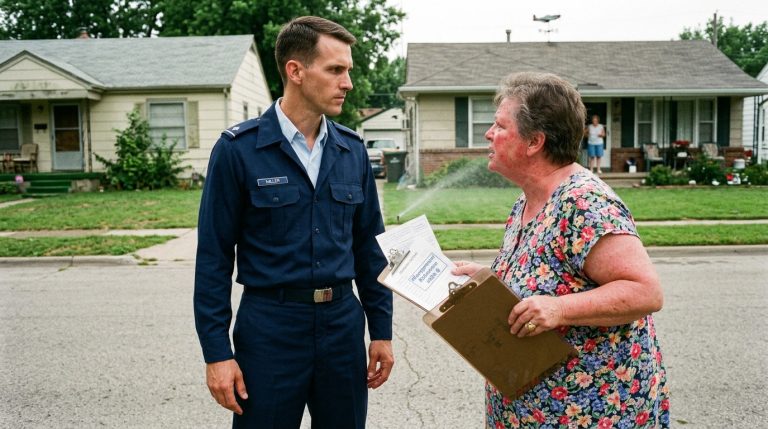
The senior officer, a man whose badge bore the nameplate Miller, shifted his weight. He didn’t look at the house with the appreciation of an architect or the curiosity of a stranger; he looked at it as a site of a domestic disturbance, a headache he wanted to resolve before his shift ended. He held a clipboard, the metal clip biting into a stack of forms.
“Mr. Greer,” Miller said, his voice clipped. He glanced at the deed I held. “You’re claiming this is your residence.”
“I am not claiming it, Officer. I am asserting my legal title to it,” I replied. I held the document out, not with the frantic energy of a man desperate to be believed, but with the flat, emotionless precision of a lawyer submitting evidence.
As Miller took the paper, I caught a glimpse of what was written on the top sheet of his clipboard. It wasn’t just a standard incident report. There was a list of properties, marked with check-boxes and shorthand notations in red ink. My address—Asheford Hill, 1887—was at the top, crossed out with a heavy, deliberate stroke, and beneath it, a sequence of numbers that looked suspiciously like a schedule.
A shiver of cold reality moved through me. This wasn’t just a random response to a trespassing call. Karen hadn’t just called the police; she had established a rhythm of engagement.
“Karen,” Miller said, turning to the woman who was currently clutching her silk robe as if it were a Victorian-era shroud. “You stated you had official HOA authority to occupy this residence. Under what specific statute?”
She didn’t hesitate. “The emergency access and property management resolution, Officer. The board approved it two weeks ago to protect the structural integrity of the district. It’s all in the minutes.”
“I’ve seen the minutes,” I interjected, keeping my voice low, dangerous in its calm. “There is no such resolution. There is no such bylaw. There is no vote on record. I am a property attorney, Officer Miller. I know the governing documents of this association better than the woman standing behind you. She is operating under a fiction of her own design.”
Miller looked between us. He was a man caught in the middle of a geometry he didn’t quite understand. He glanced back at his clipboard, then up at the house. He was looking for a sign of decay, a reason to believe the story that the “structural integrity” was at risk.
“The house is clearly occupied,” Karen said, her voice dripping with a rehearsed concern. “He’s been gone for weeks. I was merely ensuring the, uh, safety of the plumbing, the climate control… the value of the neighborhood, Officer.”
“The plumbing is fine,” I said, my gaze never leaving Miller. “The climate control is set to a constant sixty-eight degrees to prevent pipe burst. And the value of this neighborhood is currently being diminished by the presence of a squatter who has no legal access to this domicile.”
Miller looked at me, then at the house. He walked to the front door, the heavy tread of his boots echoing on the boards I had spent a summer restoring. He didn’t enter—he couldn’t, not without a warrant or my consent—but he peered into the entryway. He saw the framed drawings, the preserved plaster, the deliberate, obsessive order I had maintained for two decades.
He looked back at Karen. “Ma’am, you said you had a master key program. You said you were operating under board authority.”
“I am,” she insisted. She held up the silver key she had been clutching. It was an ugly, industrial thing—a stark contrast to the brass keys I kept on my ring.
“Show me the paperwork,” Miller said.
Karen faltered. She looked toward the blue sedan, her eyes darting to the glove compartment. “It’s… it’s at the association office. I can have it brought over within the hour.”
“I don’t have an hour,” Miller said, his voice hardening. He handed the deed back to me. “Mr. Greer, you have the paperwork proving ownership. You have the access credentials. Under the current circumstances, and based on the lack of presented board documentation, I cannot categorize this as a civil dispute. However, you need to understand that if this is a mistake, the department will be reviewing the protocols surrounding this HOA.”
“It is not a mistake,” I said. “It is a violation.”
“Then you have the right to request she vacate the premises immediately,” Miller said. “But be advised: I’m not removing her forcibly unless there’s an immediate threat of violence or a confirmed felony trespass. I suggest you file a formal notice through your legal counsel to expedite the eviction.”
He wasn’t going to arrest her. Not yet. He was playing it safe, adhering to the standard administrative dance that allowed small-scale tyrants to thrive. But the shift in his tone was clear. He had seen the truth of the house, and he had seen the emptiness of her claim.
Karen let out a sigh of relief, clearly thinking she had won another round of the game. She turned toward the front door, acting as if the matter were settled.
“I’m afraid that won’t be necessary,” I said, my voice cutting through her victory. I turned to Miller. “Officer, she is currently in possession of a master key that she claims provides her access to twelve homes in this neighborhood. If she doesn’t have the legal authority to enter this one, then she doesn’t have the authority to enter any of them. That changes the scope of the trespass from a personal issue to a systematic, neighborhood-wide criminal investigation.”
The air in the driveway stopped moving. Miller’s expression hardened. He wasn’t just looking at a nuisance anymore; he was looking at a potential liability. He stepped off the porch and stood directly in front of Karen, his presence dwarfing her.
“Ma’am,” he said, his voice devoid of the earlier politeness. “Did you say you have master keys to twelve other homes in this district?”
The silence that followed was the sound of a carefully constructed reality beginning to fracture. Karen stared at him, her lips parting, the smug, queenly mask finally failing to hold the weight of the question.
CHAPTER 4: The Architecture of the Void
Karen’s silence was not the collapse I had anticipated. It was an evolution. She didn’t crumble; she drew inward, her shoulders dropping just a fraction of an inch as if she were shedding an unnecessary costume. The frantic victimhood that had defined her performance minutes ago was replaced by a sterile, hollow calm.
“I need to make a call,” she said. Her voice wasn’t a request; it was a statement of process.
Miller, his hand still resting on his holster, watched her with narrowing eyes. The mention of twelve other homes had shifted the landscape of his report from a simple trespass to a multi-point regulatory investigation. He was no longer a peacekeeper; he was an intake officer.
“You can make your call, Ms. Mossfield,” Miller said, his tone devoid of the earlier deference. “But you’ll do it away from the property. Mr. Greer, I assume you want this documented?”
“I want it cataloged,” I said. “Every item that isn’t mine, every instance of unauthorized modification, every document she’s forged under the banner of this association. I am holding this property under absolute occupancy, and I will not be leaving again until this is resolved by the county court.”
Miller nodded once, a sharp, efficient movement. He turned toward his partner, who had been documenting the exterior from the edge of the gravel. I watched them work—the rhythmic, dispassionate documentation of my life being colonized. They photographed the mail, the grocery list, the blue sedan. Each flash of the camera felt like a scalpel removing the infection she had introduced into my home.
Karen stepped toward her car, her movements precise. She didn’t look at me. As she reached the door of the blue sedan, she paused. She didn’t look at the house; she looked at the empty air above the roofline, a vacant, almost scholarly expression on her face. For a fleeting second, the image of the “neighborhood queen” vanished, and in its place was the terrifying transparency of someone who had nothing left to lose because she had already forfeited the reality she was protecting.
I didn’t wait for them to finish. I turned and walked into the house.
The air inside was still thick with her presence—a blend of artificial floral scent and the lingering, metallic tang of the coffee she had brewed. I walked through the hall, my boots striking the floor with a rhythmic, hollow sound. I went straight to my library desk, the place where I had done the work of forty years of property law.
My desk was clean. Too clean. My stationery, my pens, the heavy brass paperweight I had inherited from my father—they were gone, replaced by a tidy, sterile organizer she had likely purchased at a big-box store. It was the “de-cluttering” of a personality that didn’t belong to her.
I picked up the phone and dialed Diane Roar. She answered on the first ring, her voice the familiar, sharp sound of clarity.
“Walter,” she said. “I assume the police are there?”
“They are,” I replied, sitting in my chair. It felt different—the angle was slightly altered, the seat cushion compressed in a way that wasn’t mine. I adjusted it, a small, stubborn act of reclamation. “She’s being escorted off-site, but she’s claiming board authorization. I need you to pull every filing, every resolution, every scrap of paper the Asheford Hill HOA has submitted to the county in the last three years. If there isn’t a board resolution on record, I want to know who authorized the printing of the master keys.”
“That’s a paper trail, Walter,” Diane said. Her voice was cautious, the sound of a lawyer weighing the cost of a war. “If she’s been running this as a personal empire, the records might not exist. If they don’t exist, we aren’t looking at a bureaucratic error. We’re looking at fraud.”
“That’s exactly what I’m looking for,” I said.
I looked out the window. Karen was speaking into her phone, her back to me. She was gesturing, but the movements weren’t angry; they were measured. She was coordinating something. A defense? A liquidation? A retreat? As I watched, she stopped, turned slowly, and looked directly at the window. Our eyes met across the twenty feet of driveway. There was no apology in her gaze, no fear. There was only a cold, crystalline recognition of a chess game that had just moved into its final, most brutal stage.
She ended the call, climbed into the sedan, and backed out of the drive. She didn’t rush. She didn’t skid the tires. She reversed with a controlled, agonizing slowness, her eyes tracking the house as if she were memorizing its dimensions, its weaknesses, its seams.
When she was gone, the silence of the house didn’t return. It was replaced by a tension that felt like a coiled spring. The police were still at the gate, their patrol lights cycling, casting rhythmic, strobe-like blues and reds across the front porch—a heartbeat of agitation that turned the room into a cage.
I stood up and walked to the kitchen. The plate of eggs was still there, the yolk congealed, a small monument to the absurdity of the last nine days. I picked up the plate. My hands were steady, but the act of clearing it felt like the first move in a much larger, much more dangerous game.
I was back in the house, but the sanctuary I had spent twenty-two years building had been mapped by a stranger. Every corner I turned felt like it had been seen through her eyes. I reached into the cupboard where I kept my own coffee beans—the ones I’d hidden in the back, behind the canisters she had rearranged. They were still there. A small victory. I took them out, the weight of the bag in my hand a grounding, tactile reminder of what was truly mine.
The house was quiet, but it wasn’t empty. It was waiting. I knew, with the cold, cynical intuition of a man who had seen the law bent until it snapped, that she hadn’t just walked away. She had left a foundation of lies behind, and now, I had to dismantle them, layer by layer, before the house could truly be mine again.
CHAPTER 5: The Architecture of the Void
The quiet that settled over Asheford Hill after the blue sedan vanished was deceptive. It was the kind of silence that precedes a landslide. I remained in the kitchen for a long time, the plate of stale eggs still in my hand. I had reclaimed the room, but the air felt thin, stripped of the comfort I had spent decades cultivating.
I set the plate in the sink, the ceramic clinking against the stainless steel—a sharp, final sound. I moved to the hallway, my footsteps echoing against the floorboards I had laid down myself in a different life. Every corner of this house was a memory, a physical testament to a time when grief was something I could build away. But now, those memories felt tainted. Karen hadn’t just been living here; she had been cataloging my life.
I walked to the closet near the study. I pulled the door open, the wood scraping slightly against the frame—a detail I had been meaning to fix for months. The closet was organized in a way that wasn’t mine. My coats were shifted to the far right, compressed and crowded, while hers occupied the center. I pushed her things aside—synthetic fabrics that smelled of cheap laundry detergent—to reach the back panel.
I had installed a hidden compartment there during the major renovation of the house, a small space for deeds, architectural plans, and the original, hand-drawn blueprints of the 1887 construction. I pushed the panel. It clicked open.
Inside, the blueprints were still there, but they had been moved. The edge of the roll was frayed, and there were faint, oily fingerprints on the document—marks that weren’t mine. She had been here. She hadn’t just been living in the house; she had been studying it. My stomach tightened, a cold, sharp knot of realization. She wasn’t just a squatter; she was an architect of my own displacement.
My phone buzzed against the dark wood of the desk. It was Diane.
“Walter,” she said, her voice vibrating with a rare, brittle urgency. “I’ve finished the audit of the county records. You were right to be suspicious. The master key policy? It isn’t just a fantasy. There’s a file, but it wasn’t filed by the board. It was filed by an LLC—Mossfield Holdings—under a ‘Property Management and Emergency Preservation’ clause. She didn’t just appoint herself president; she incorporated her own reach over the entire neighborhood.”
I stared at the blueprints, the ink lines blurring in the dim light of the hall. “She’s not just playing queen, Diane. She’s built a commercial entity out of our front doors.”
“It’s worse,” Diane continued, the sound of keyboard clicks echoing in the background. “There are three other properties on Asheford Hill currently under ‘management’ by Mossfield Holdings. All of them are owned by people who are currently out of state or in long-term medical care. She’s been rotating through them like a portfolio manager.”
The realization hit me with the force of a physical blow. The house—my house—wasn’t just a trophy for her ego; it was a node in a network of extraction. She wasn’t saving the neighborhood; she was harvesting it.
“I need you to get that information to the District Attorney, Diane,” I said, my voice barely a whisper. “If she’s been using the HOA as a front for a shell company, this is no longer a civil dispute. This is systemic fraud.”
“I’m on it, but Walter—you’re still in the house. She’s been in your blueprints. She’s been in your storage. You need to check the rest of the house. If she’s been cataloging your assets, she might have left more than just her clothes in the closet.”
I hung up, the silence of the house pressing against my eardrums. I walked back to the kitchen, my movements mechanical. I spotted a pair of gardening gloves sitting on the counter near the back door—thick, leather gloves she had used to prune my hydrangeas. The sight of them triggered a sudden, vivid memory of my wife, her hands stained with soil, laughing as we planted the bushes that now framed the porch. The phantom scent of wet earth and lavender filled my lungs for a second before the stale smell of the house shoved it aside.
The grief, once a quiet, familiar companion, was now a jagged edge. I grabbed the gloves, ready to throw them into the trash, when I noticed something tucked into the leather of the right index finger—a small, silver key, identical to the one she had held in the driveway.
I hadn’t seen it before. I felt the cold metal against my skin, the weight of it suddenly making sense. It wasn’t just a key to the house. It was a key to something else—something she hadn’t wanted the police to find.
I walked to the kitchen island and laid the gloves down. I didn’t reach for the key immediately. I stared at it, the sunlight glinting off the metal, and realized that the “emergency management” program was just a decoy. The real truth was hidden in the places she had been afraid to leave behind.
I looked at the back door. The woods beyond were dark, the trees casting long, thin shadows across the lawn. My house was a fortress, but I had been under siege from within. I didn’t turn on the kitchen lights. I stood in the growing gloom, watching the shadows stretch, and began to calculate the cost of digging for the truth. Every item in this house had a history, and I was about to find out how many of them had been rewritten by a woman who had never owned a single floorboard of it.
CHAPTER 6: The Paper Trail
The book, a dry, academic history of local land use, felt heavier than it should have. As the mechanism engaged, the leather cover yielded, revealing that the interior pages had been surgically hollowed out. I didn’t reach inside immediately. I stood there, the evening light dying against the windowpane, the blue shadows of the trees stretching across the hardwood like ink stains. The air in the study felt stagnant, charged with the sudden, undeniable realization that Karen hadn’t just been stealing my house—she had been using my own library as her private archive for her web of extraction.
I reached into the hollowed book and pulled out a stack of ledger pages, folded into tight, disciplined squares. My hands were steady, but the paper felt brittle, as if the lies written upon it had drained the life from the fiber. They weren’t just lists; they were bank routing numbers, addresses of the other eleven homes, and a detailed schedule of “occupancy periods” that mirrored the medical absences of the owners.
It was a systematic rotation. When a homeowner left for treatment, a vacation, or care, Mossfield Holdings moved in. They didn’t just squat; they leveraged the properties. They pulled equity, redirected utilities, and even charged the absent owners “emergency maintenance” fees that were automatically drafted from their accounts. It was a parasitic, high-functioning machine of fraud, hidden behind the administrative veil of a neighborhood board.
I took the ledger pages to the desk and spread them out under the lamp. The light was harsh, artificial, highlighting the neat, almost feminine handwriting that meticulously detailed the theft of our lives. My eyes traced the numbers, the math behind the madness. It was cold, clinical, and terrifyingly thorough. She hadn’t been acting out of some delusional, queenly impulse—she had been running a business.
A sound at the front door froze me. A key.
It wasn’t a gentle sound; it was the sharp, practiced intrusion of someone who expected the door to yield. I didn’t move. I left the ledger pages on the desk, the light of the lamp a beacon in the darkened house. I stood in the shadow of the bookshelf, my heart hammering a rhythm I hadn’t felt since the cardiac unit.
The door opened with a soft, confident click.
“Walter?”
It was Karen. She wasn’t shouting. She wasn’t performing for a neighbor or a deputy. Her voice was flat, tired, and deeply, dangerously intimate.
“I know you’re here, Walter,” she continued, her footsteps clicking on the entryway tile. She was moving with the familiarity of a woman who felt the house belonged to her. “I know you found the gardening gloves. I left them for you, you know. I wanted to see how long it would take for your legal mind to start connecting the dots.”
I stepped out of the shadows. She was standing in the hall, her silhouette framed by the porch light behind her. She wasn’t wearing the silk robe this time; she was dressed in a dark, structured coat, her hair pulled back into a severe, utilitarian bun. She looked like a professional—a cold, calculated operator coming to settle an account.
“You’re done, Karen,” I said, my voice cutting through the stillness. “The police have the records. Diane has the audit. There’s nowhere left to hide the paper trail.”
She didn’t stop. She took a step toward me, her eyes tracking the room, landing on the desk, on the ledger pages, on the hollowed-out book. A small, sad smile touched her lips—not the smug grin of a tyrant, but the weary expression of a gambler who had finally run out of chips.
“You think you’ve caught me in a fraud,” she said, her voice quiet. “But you’re only looking at the surface, Walter. You think this was about money? About the fees? About the houses?”
“It’s about property,” I said. “And the law.”
“It’s about the fact that this neighborhood was dying,” she replied, her voice sharpening, a sudden, desperate heat behind the words. “These houses, these relics—they were being forgotten. I was the only one holding the line. I was the only one paying the taxes, keeping the lights on, keeping the structure sound. You think you’ve been ‘recovering’ in Portland? You’ve been abandoning your stewardship. And I was simply filling the void you left behind.”
“You were stealing the void,” I said, stepping toward her. “And you were doing it for profit.”
“I was doing it for control!” she snapped, her mask finally dropping completely. The rational, bureaucratic queen was gone, leaving behind a woman who looked, for the first time, truly, hollowly broken. “I’m bankrupt, Walter. Every cent I had went into the maintenance of these properties. I didn’t own the houses, but I owned the management of them. Without them, I’m nothing. I’m just another middle-aged woman in a dying subdivision with no assets and no future.”
She reached into her pocket, her hand coming out empty, but her expression held a sudden, terrifying resolve. She wasn’t going to fight me with laws anymore. She was going to fight me with the only thing she had left: the narrative that she had built, and the desperate, cornered need to ensure it didn’t collapse with her.
I held my ground. The ledger pages on the desk behind me felt like a weight, a heavy, unassailable truth that she could no longer talk her way around. The game had shifted from a civil dispute to a psychological breakdown, and I realized then that the final barrier to my home wasn’t the law—it was the woman who had convinced herself she was the architecture itself.
CHAPTER 7: The Downfall
The darkness was total, thick and cloying, smelling of ozone and scorched copper. Karen’s voice, previously brittle with confession, suddenly shifted—a jagged intake of breath in the center of the room. The power had died, choked by the strain of the illicit devices she had hard-wired into my home’s utility bypass.
“You don’t understand the scale of it, Walter,” she hissed, her voice disembodied in the blackness. “The board… they weren’t the ones in control. I was just maintaining the infrastructure of an entire district that would have collapsed years ago without my intervention.”
I didn’t move. I stood with my back to the desk, my hand gripping the edge of the wood until the grain bit into my skin. I didn’t need light to see the shape of the room; I knew every inch of it, every floorboard, every angle. I listened to the sound of her shifting, the rustle of her coat, the frantic, shallow pace of her breathing. She was looking for a way out, or perhaps a way to reset the narrative.
“The records are in the hands of the authorities, Karen,” I said, my voice projecting into the center of the room. “There is no board. There is no district. There is only the debt you accrued to keep this fantasy alive. You’ve spent your life managing a ghost.”
A flash of blue light illuminated the room as the external transformer at the edge of the property sparked, casting long, distorted shadows against the walls. For a split second, I saw her—not as a tyrant or an architect of fraud, but as a small, shivering figure standing amidst the detritus of her own making. She looked diminished, the structure of her coat failing to hide the fragility of her frame. She looked like exactly what she was: a woman drowning in a sea of her own administrative complexity.
She moved then, not toward the door, but toward the desk, toward the ledger pages. I stepped forward, my movement instinctive, calculated. I didn’t need to strike her; I only needed to occupy the space between her and the evidence.
“Don’t,” I said.
She stopped. The flash faded, leaving us in the heavy, suffocating silence of the dark. I could hear her pulse—a rapid, panicked flutter.
“They’ll take it all,” she whispered. “The properties, the records, the history. You have no idea what it takes to keep a place like this standing, Walter. You treat it like a deed, a piece of paper. But it’s a living thing. It needs a keeper.”
“A keeper is someone who protects,” I replied, my voice hard. “A thief is someone who exploits.”
She made a small, choked sound—a laugh, or perhaps a sob. “Is there a difference, when the owner has left?”
I didn’t answer. I reached into my pocket and felt the cool, smooth surface of my phone. I dialed the sheriff’s department. I didn’t need to speak. I just held the connection open, the faint, rhythmic beeps of the signal echoing in the darkness of the room. The truth didn’t need a speech. It only needed to be witnessed.
Outside, the first wail of sirens cut through the night, a distant, growing chorus that signaled the end of the long, convoluted performance. Karen slumped against the bookshelf, the ledger pages sliding from the desk and fluttering to the floor like discarded autumn leaves. She didn’t try to run. She didn’t try to argue. She simply waited, a statue of a defeated empire, as the strobe lights of the cruisers began to wash over the house, piercing the dark and rendering her transparent.
I turned away from her and looked out toward the porch. The police were coming up the drive, their flashlights dancing across the limestone foundation—the solid, enduring geometry of the house I had rebuilt. They were coming for the record. They were coming for the paper trail. And as the front door was kicked open—a sharp, violent intrusion that shattered the stillness of the hall—I felt a strange, quiet sensation of arrival. The noise would soon be over. The house would be silent again. The truth, finally, would be the only thing left standing within these walls.
The officers flooded the study, their beams cutting through the gloom, seeking the source of the distress. They found her—not in a struggle, not in a flight, but in a quiet, defeated posture, her hands empty, her eyes fixed on the empty space where her kingdom had been. I didn’t watch as they led her out. I didn’t watch as the blue sedan was towed from the gravel. I watched the room. I watched the light return as the power flickered back to life, the house waking up, its systems sighing with the effort of the reset.
It was over. The administrative terror had reached its fiscal end. The paperwork was in the hands of the law, and the ledger of the neighborhood’s exploitation was closed. I walked to the kitchen and made a pot of coffee—the real coffee, the beans I had hidden, the scent of it finally, mercifully, reclaiming the air.
CHAPTER 8: The Threshold of Silence
The morning after the raid, the house felt different—not just empty, but light, as if a physical weight had been lifted from the timber and the plaster. I sat in my chair by the east window, the same one Karen had occupied for nine days, and watched the sunrise. The light hit the trees, the familiar gold spilling across the floor, unmarred by the sterile, organized chaos she had imposed upon it.
The legal process was a slow, grinding machine. Diane had called shortly after dawn to confirm that the county had formally frozen the assets of Mossfield Holdings. Karen was in custody, held on multiple counts of fraud, trespassing, and systemic unauthorized entry. Her world hadn’t just ended; it had been dismantled, piece by piece, document by document. The “Emergency Management” program was dead, and the neighborhood was in a state of shock, homeowners emerging from their houses to stare at the vacant space where her blue sedan had sat for so long.
I stood up, my legs feeling the long, slow ache of the last few days, and walked to the kitchen. I began the work of restoring the house. It wasn’t about cleaning; it was about reclaiming the tactile reality of my ownership. I opened the cupboards and moved the canisters back to their proper places, the heavy sound of ceramic on wood a grounding rhythm. I went to the hall closet and pulled out the box of personal effects I had been using before the cardiac procedure—the books, the photos, the small, inconsequential things that anchored my life.
I found the small, ornamental piece of molding that had broken off the corner of the fireplace during my first year in the house. I had kept it in a box, intending to glue it back into place, but the busyness of living had always pushed it to the background. I knelt by the hearth, the cold stone pressing against my knees, and fitted the wood back into the joint. It wasn’t a structural repair, just a restoration of detail, but as the pieces locked together, I felt a deep, resonant sense of closure.
The house was mine. Not because I had the deed, not because I had the police, but because I was the only one who knew the weight of every wall, the sound of every board, and the quiet, persistent pulse of the home itself.
A knock at the door pulled me from the task. I stood up and walked to the entrance. It was Ed, my neighbor. He looked older than I remembered, his face lined with the wear of the last week. He held a small, plastic bag containing a single brass key—the original, unauthorized copy Karen had made for his home.
“I’m sorry, Walter,” he said, his voice barely audible. “I didn’t know. None of us knew what she was doing. We just thought… she was doing what she said.”
“It’s over now, Ed,” I said, taking the bag. The brass was cold, a small, heavy piece of metal that held no more power. “The board is dissolved. New rules are in place. No one enters unless it’s their own door.”
He looked past me, into the hallway, his eyes lingering on the drawings I had restored. “It feels different, doesn’t it? The air.”
“It feels steady,” I said.
He nodded and walked back toward his own house, his footsteps heavy on the gravel. I closed the door and locked it—a simple, deliberate action that felt like sealing a vault. I didn’t reach for the alarm code immediately. I just stood there, listening to the house breathe. The silence was absolute.
I went to the library, to the desk where I had finally uncovered the truth. The ledger pages were gone, taken by the DA as evidence, but the hollowed-out book remained—a reminder of the void she had tried to fill with her own identity. I picked it up and walked to the back door, stepping out onto the porch. The morning air was crisp, scented with the dew on the grass and the distant, earthy smell of the woods.
I didn’t burn the book. That felt too dramatic, too much like the performances she had thrived on. Instead, I placed it in the recycling bin, a mundane, bureaucratic end to a long, complex deception. I stood on the porch, looking out over the hill. The sun was fully up now, casting the house in a sharp, clear light.
My son, Daniel, would be arriving in a few days to help me finalize the repairs on the porch. We would talk, we would work, and the house would continue its life. The trauma of the last few weeks, the cold, analytical focus of the defense I had mounted, would eventually fade into the background of the stories I would tell, but the lesson would remain. Power, in its most insidious form, doesn’t arrive with a shout; it arrives with a clipboard, a procedure, and the quiet, persistent assumption that people are too tired to fight back.
I walked to the railing and gripped it, the wood solid, weathered, and entirely my own. The, “no time-skip” rule of my life had been broken, but the rhythm had been restored. I was a property attorney, a man who believed in the weight of the law, but standing there, watching the mist clear from the valley, I realized that the law was only a tool. The real protection was the endurance—the simple, stubborn act of showing up, of paying attention, and of refusing to let the noise of the world rewrite the truth of your own home.
The house was quiet. The deed was secure. And for the first time in a very long time, I didn’t have to calculate the cost of my next step. I just had to live in it.