The Weight of Steel and Stolen Privilege: A Silent Reckoning on Asphalt and HOA Rules
CHAPTER 1: The Blockade and the Spark
The metal ticked—a sharp, contracting ping that died quickly under the oppressive humidity of a mid-July afternoon. The driveway was supposed to be a boundary, a strip of grey concrete separating our private lives from the symmetrical monotony of the subdivision. Instead, it had just become a stage.
Chad didn’t move his hand. He left his palm pressed against the warm paint of Lisa’s ’69 convertible, his fingers splayed as if claiming territory on a map. His chest-mounted camera rig caught the glare of the sun, throwing a small, blinding flash across the windshield.
“This car is mine now,” he said. His voice hadn’t cracked yet, but it carried that hollow, practiced resonance of someone who had never heard the word no delivered with consequences.
I stood by the passenger side, my hand resting on the door handle, feeling the faint vibration of the engine dying beneath the hood. I looked past him, down the immaculate street where every mailbox stood at attention and every lawn looked like it had been measured with a micrometer. This was the quiet we had paid for. This was the peace of the cul-de-sac.
Lisa didn’t reach for the door. She didn’t shift in her seat. She simply turned her head toward him, her sunglasses reflecting the distorted image of his oversized designer hoodie. Her face was entirely blank—the expression she wore when she was diagnosing an engine failure on a high-speed telemetry rig, looking for the exact point where stress would turn to fracture.
“You ever driven anything that hits back harder than your mother’s golf cart?” she asked.
The sentence didn’t carry weight; it dropped like a plumb line. Flat. Uninflected. Absolute.
Chad’s fingers twitched against the red paint. A flicker of genuine confusion crossed his face, instantly smothered by the automatic reflex of a teenager whose entire existence was mediated by an audience that wasn’t there. He opened his mouth to deliver whatever rehearsed retort he had queued up for the vlog, but Lisa had already slipped the car into reverse.
The low rumble of the exhaust didn’t roar; it tightened into a sharp, metallic growl that vibrated straight through the soles of my shoes. Chad didn’t jump back out of respect for the machine; he stepped back purely because the physics of a four-hundred-horsepower engine idling three inches from his shins suddenly made his camera feel very light.
As we backed out into the street, I glanced in the side mirror. Chad was already pulling out his phone, his thumb moving with the frantic, angry speed of a boy whose script had just been rewritten in real time.
We drove in silence for three blocks, the heavy scent of hot oil and old gasoline filling the cabin. Lisa kept her eyes on the road, her hands resting at the ten-and-two position with a stillness that felt dangerous.
“He’s going to escalate,” I said quietly, watching the rearview mirror for any sign of a following car.
Lisa didn’t look at me. She shifted gears, the transmission clicking into place with a mechanical precision that left no room for argument. “Let him,” she said, her voice dropping an octave as she turned the corner toward the highway. “Friction is how you find out what a thing is made of.”
We reached the diner on the edge of the industrial park twenty minutes later, sitting in a vinyl booth that smelled of old coffee and grease. The menu was laminated and sticky, a sharp contrast to the sanitized perfection of our HOA neighborhood. I ordered black coffee; Lisa ordered nothing, just stared out the plate-glass window at the gravel lot where an eighteen-wheeler was slowly backing into a loading bay.
The bell above the diner door jingled. A local mechanic in grease-stained coveralls walked in, carrying a heavy iron wrench that he tossed onto the counter with a dull, satisfying thud.
Lisa watched him. Her fingers traced the rim of her empty water glass, turning it half an inch to the left, then back again.
“The board meeting is tomorrow night,” I said, stirring a packet of sugar into coffee I didn’t want. “His mother already has the agenda packed with complaints about non-standard vehicle storage.”
Lisa stopped tracing the glass. She looked up, her eyes narrowing slightly as she caught her own reflection in the grease-filmed window, framed against the harsh glare of the afternoon sun.
“Let her bring her paperwork,” Lisa said softly, a faint, humorless edge touching the corner of her mouth. “Paper burns a lot faster than steel.”
CHAPTER 2: The Boardrooms Velvet Trap
The heavy glass door of the community center didn’t close with a satisfying click; it whispered shut on heavily oiled hinges designed to project an expensive, hollow sort of tranquility. Outside, the twilight cast long, sharp shadows across the manicured parking lot where the community mailboxes stood like rows of identical sentinels. Inside, the air smelled faintly of lemon-scented floor wax and stale air conditioning—the universal scent of bureaucratic containment.
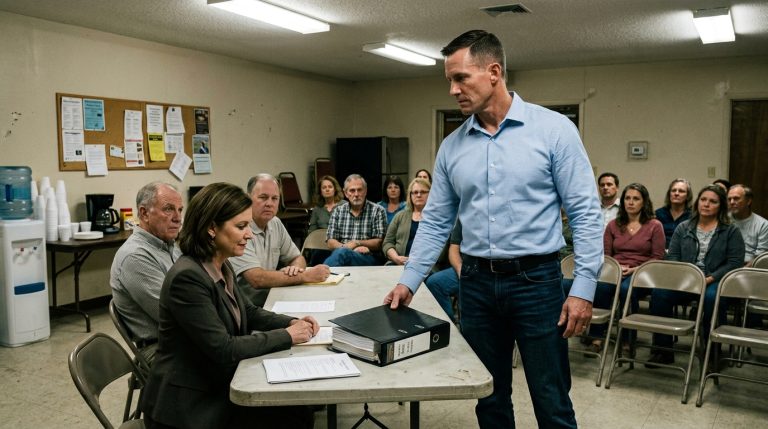
I followed Lisa down the central corridor, our footsteps muted by industrial blue carpet that muffled any sound of resistance. The meeting room was already packed. Folding chairs scraped against linoleum as thirty pairs of eyes tracked our movement toward the front row. They weren’t looking at me; they were looking at Lisa, or more specifically, looking for the microscopic crack in her composure that would justify every rule they had ever written.
At the center of the mahogany-veneered table sat Evelyn Vance, the HOA president. Her blazer was a crisp, expensive navy blue, pinned with a silver committee emblem that caught the harsh fluorescent overheads. Beside her sat Chad, squeezed into a collared shirt that looked two sizes too tight across the shoulders, his phone resting face-down beside a stack of printed color flyers. His expression was a carefully rehearsed mask of aggrieved martyrdom—the misunderstood pioneer of the neighborhood youth.
Evelyn didn’t look up immediately. She tapped a gold-plated pen against the agenda packet, setting a metronomic rhythm that filled the quiet room.
“Item four on the docket,” Evelyn said, her voice smooth and pitched to carry across the acoustic tiles without raising her volume. “Unregistered commercial asset utilization and neighborhood aesthetic compliance. Specifically, the recurring presence of non-standard automotive performance hardware within residential sightlines.”
A low murmur rippled through the middle rows. Old Mr. Henderson, who spent six hours a day measuring his lawn with a ruler, nodded sagely into his coffee cup.
Lisa didn’t sit down. She remained standing beside an empty folding chair, her hands resting lightly on the chrome backrest. The metal was cold under her fingers—sharp edges that caught the glare of the overheads.
“There’s nothing non-standard about a classic registration, Evelyn,” Lisa said. Her tone was flat, conversational, stripped of any defensive heat. “And the only thing out of sightline here is the accountability of whoever approved the printing budget for your little flyers.”
Evelyn’s pen stopped tapping. The gold tip hovered half an inch above the paper. A micro-expression of absolute, brittle irritation flickered across her face before she smoothly reassembled her administrative smile.
“We have strict bylaws regarding property modifications that alter the character of our shared space, Lisa,” Evelyn replied, gesturing gracefully to the stack of color prints. “And when minors in the community feel threatened by hostile vehicular displays—as my son clearly documented—the board has a fiduciary duty to intervene.”
My hand twitched in my jacket pocket, closing around the printed maintenance logs we had pulled from the county clerk’s office three hours earlier. The documents showed a pattern of deferred community maintenance fees and sudden, unexplained cash transfers from a holding company registered three towns over—a developer whose name I recognized from local zoning disputes. The HOA wasn’t just policing lawns; they were clearing titles.
Chad leaned forward, his chair legs scraping a sharp protest against the floor. “She revved the engine right at me,” he interjected, his voice cracking slightly on the high note before he caught himself and dropped back into his performance. “It was deliberate intimidation. Everyone saw the video.”
“Nobody saw a video, Chad,” Lisa said, her voice dropping an octave, cutting cleanly through his defense. “They saw a teenager standing where he shouldn’t have been, touching property that didn’t belong to him. There’s a distinct difference between intimidation and physics.”
Evelyn’s jaw tightened. The silence in the room grew heavy, saturated with the collective discomfort of neighbors who realized the script was going off the rails.
“Let’s dispense with the semantics,” Evelyn said, her voice dropping its honeyed veneer, revealing the sharp iron underneath. She leaned forward, resting her forearms on the table. “The board is prepared to offer a resolution. You surrender the vehicle’s secondary storage registration to the community trust for promotional community events, and we drop the current violations regarding unauthorized power outputs.”
It wasn’t a negotiation. It was an expropriation wrapped in parliamentary procedure.
Lisa stared at her for a long, unbroken beat. I watched the muscle along her jawline tighten—not out of anger, but out of the cold, clinical calculation of someone diagnosing a structural fracture under load.
“You want the car,” Lisa said softly, letting the words hang in the sterile air like a dropped wrench. “Not for the neighborhood. Not for the kids.” She let her gaze drift past Evelyn to the stack of developer permits buried at the bottom of the president’s folder. “You want it clear so the corner lot appraisal looks clean when the zoning board votes next month.”
Evelyn’s face went entirely pale. The gold pen slipped from her fingers, rolling across the mahogany table with a sharp, echoing rattle.
CHAPTER 3: Midnight Motion Sensors and Hot Metal
The pen rolled another half-inch, clicked against the base of a brass microphone stand, and finally stopped.
The silence in the community center meeting room didn’t feel peaceful; it felt like the heavy, compressed air inside a hydraulic press right before the valve turns. Evelyn Vance didn’t reach down to pick up the pen. Her hands remained flat on the mahogany-veneered table, her fingers pressed so hard against the wood that the skin across her knuckles had gone bone-white. The composure she had worn like an expensive piece of armor was suddenly riddled with microscopic fractures, leaking the distinct panic of a woman whose administrative theater had just collided with actual, verifiable bookkeeping.
Around us, the room shifted. Old Mr. Henderson stopped staring into his coffee cup. A younger couple sitting in the third row—homeowners who had quietly paid their dues for five years without missing a month—exchanged a slow, heavy look.
Lisa didn’t smile. She didn’t press the advantage with a taunt or a theatrical flourish. She simply maintained her posture, her hands resting on the chrome backrest of the folding chair like a mechanic waiting for a diagnostic read to stabilize.
“The corner lot rezoning hearing is scheduled for the first Tuesday of next month,” I said, my voice cutting cleanly through the artificial quiet of the room. I didn’t raise my tone; I let the dry, transactional weight of the facts do the work. “That’s when the commercial corridor expansion permit comes up for final review. Funny thing about municipal filings, Evelyn. They’re public record. Just like the liens on properties that haven’t cleared their maintenance assessments in two fiscal cycles.”
Evelyn’s chin jerked up, her eyes narrowing into cold, hard points. “You are entirely out of order,” she whispered, the venom in her voice carefully managed for the acoustic tiles. “This is a residential association docket, not a municipal grievance committee. Any allegations regarding commercial zoning are entirely speculative and defamatory.”
“Speculation leaves room for argument,” Lisa said quietly, finally taking a step forward, her shoes clicking against the industrial carpet with the sharp cadence of a metronome. “Liens leave a paper trail. And unauthorized use of HOA printing budgets to manufacture public campaigns against private property owners? That tends to void a president’s legal indemnity real fast.”
Chad shifted violently in his chair, his knee slamming into the underside of the table with a dull thud. His phone, resting face-down on the wood, buzzed twice—a notification light flashing a quick, repetitive blue against the dark surface. He reached for it, his fingers curling into a tight fist, but he didn’t dare lift it. The audience was watching him now, not with the amused curiosity of vlog followers, but with the cold, assessing stare of adults who realized their monthly dues were funding a teenager’s real estate leverage.
“This meeting is adjourned,” Evelyn said sharply, standing up so fast her chair screeched across the linoleum. Her breath came in short, controlled gasps. “All pending violations against the red convertible are tabled indefinitely pending board review. We are done here.”
She didn’t wait for a second. She turned on her heel, her navy blue blazer swinging stiffly as she marched toward the side exit, leaving her agenda papers scattered across the mahogany. Chad scrambled to his feet, grabbing his phone and his camera rig with awkward haste, his face flushed a dark, angry crimson as he ducked past our row without looking us in the eye.
The room emptied in a heavy, muted trickle. Nobody spoke as we walked out into the cool evening air. The cul-de-sac was dark, the matching streetlamps casting long, amber cones of light over the immaculate, identical driveways.
Back at our house, the red classic sat in the driveway under the porch light, its polished chrome fenders catching the glow like a drawn blade. Lisa didn’t go inside right away. She walked around to the front bumper, crouched down, and checked the tire pressure with a small digital gauge, the hiss of escaping air a faint, sharp sound in the quiet night.
“They’re going to try something before the zoning meeting,” I said, leaning against the brick pillar of the porch. “People backed into a corner don’t fold; they get clumsy.”
Lisa straightened up, clicking the gauge shut with a crisp snap. She wiped a speck of dust from the fender with the edge of her thumb, her face calm in the amber light.
“Let them,” she said, her voice steady and low. “Desperation has a distinct rhythm. Once you know the sound of it, you can hear it coming a mile away.”
It was past midnight when the motion sensors in the driveway clicked.
I was sitting at the kitchen island with a cold cup of water, watching the security monitor feed on my tablet. The screen flickered from grayscale infrared to full-color night vision as three distinct shapes detached themselves from the shadow of the oversized oak tree across the street. Chad was in the lead, carrying a heavy canvas duffel bag, flanked by two of his usual shadows carrying oversized cans of industrial spray paint and heavy-duty locking chains.
They weren’t trying to be quiet this time. Their movements were jerky, fueled by the reckless, frantic adrenaline of kids trying to prove something to an audience that had already stopped watching.
I didn’t wake Lisa. She was already standing beside me in the dim light of the kitchen, her phone resting in her palm, her thumb hovering over the master override icon for the car’s integrated defense grid.
“They brought chains,” I noted quietly, watching the screen as Chad stepped directly onto our property line, raising his phone to record the initial approach.
Lisa’s thumb tapped the screen. “They’re about to find out what a high-compression security relay sounds like when it doesn’t have a mute button.”
CHAPTER 4: The Transport Truck and the Paper Trail
The kitchen tablet glowed with the cold, blue light of the infrared feed. Three figures hovered near the edge of the driveway, their forms jagged and distorted by the night-vision contrast. Chad’s hand reached out, holding a heavy steel chain intended to bind the classic’s wheels, his fingers clumsy with the frantic urgency of amateur trespass.
Lisa didn’t hesitate. Her thumb swept down across the glass interface with the clinical precision of a surgeon finding a vein.
Outside, the quiet of the cul-de-sac was shattered not by a siren or a horn, but by the concussive bass of the vehicle’s custom perimeter deterrent. The speakers mounted beneath the chassis unleashed a deep, simulated engine roar that rattled the double-paned windows in their frames. At the same time, a high-intensity pulse from the rear exhaust ports vented a plume of superheated air, mimicking a backfire so violent that the asphalt seemed to shudder.
The shadows scattered instantly. One of the figures tripped over the low decorative border of the flower bed, sprawling sideways into the mulch before scrambling up on all fours and bolting toward the dark street corner like a spooked animal. Chad dropped the chain with a sharp, metallic clang that echoed against the brick siding, his camera rig bouncing against his chest as he ran blindly into the dark.
Lisa pulled her thumb away from the screen. The monitor flickered back to a quiet, empty driveway, save for the abandoned chain glinting dully under the amber porch light.
“They’re leaving a mess,” I said, looking down at the tablet.
“Let them,” Lisa replied, her voice level. “Every time they move, they leave a signature. We just need to collect the ink.”
The next morning, the formal complaint arrived in our physical mailbox before the postman had even cleared the corner. It wasn’t an ordinary letter; it was an expedited notice printed on heavy, cream-colored cardstock bearing the official seal of the Homeowners Association executive committee. They had bypassed standard mail delivery entirely, slipping it directly through the slot with a calculated aggression.
I pulled the envelope out while the morning dew was still heavy on the grass. The text inside cited Lisa’s vehicle for unregistered power output, non-standard acoustic modifications, and an alleged safety violation involving excessive thermal output during nocturnal hours. It ended with a formal demand for immediate vehicle surrender for mandatory evaluation by a board-appointed specialist, or face compounding daily fines and a lien on the property title.
Lisa read it over my shoulder while pouring her black coffee. Her expression didn’t harden; it smoothed out into absolute, mathematical stillness.
“They’re accelerating the timeline because of the zoning hearing,” I said, setting the paper down on the granite countertop. “If they can slap a lien on the house before Tuesday, they control the property votes for the commercial corridor.”
Lisa walked over to the kitchen island, picked up her phone, and dialed a ten-digit number without looking at her contacts list. She let it ring twice before speaking, her voice crisp and transactional.
“Bill? It’s Lisa. Yeah, we’re ready. Bring the flatbed down to the cul-de-sac. Let’s show them what an actual transport looks like.”
Forty-eight hours later, the heavy diesel rumble of a commercial transport truck rolled into our suburban street like an approaching storm. It wasn’t a stealthy arrival; the massive eighteen-wheeler swung its wide chassis around the tight corner with deliberate mechanical authority, its dual exhaust pipes vibrating the matching mailboxes on either side of the road.
Neighbors parted their blinds. Front doors clicked open an inch. From across the street, Chad stood on his front porch in a designer sweatshirt, his phone raised in a rigid grip, recording every second of the setup.
Out stepped a full professional crew—two mechanics in dark utility uniforms carrying heavy aluminum ramps, diagnostic cases, and a pair of spare racing slicks. They didn’t look like weekend hobbyists; they carried themselves with the practiced, heavy-footed efficiency of a professional pit crew arriving at a regional circuit.
Lisa walked out of the garage wearing her driving suit, the heavy Nomex fabric tied neatly around her waist, a matching helmet tucked under her left arm. She looked past the staring faces, walked straight up to Evelyn Vance’s front walkway where the HOA president was standing by her sculpted boxwood hedges, and handed her a thick, heavy manila envelope bound with a red legal seal.
“Thought you might want to look over the county injunction regarding property harassment and fraudulent lien filings before you mail your next batch of notices,” Lisa said, her voice carrying easily across the manicured lawn. “It’s remarkably thorough.”
Evelyn didn’t reach for the envelope. Her face went tight, her lips thinning into a pale line as she stared past Lisa at the massive transport truck idling in the middle of the street, its diesel engine humming with enough raw power to shake the foundation of every house on the block.
CHAPTER 5: The Forged Challenge
Evelyn didn’t move. Her fingers remained curled tightly against the edge of her navy blazer, her breath shallow as she stared past Lisa at the massive eighteen-wheeler blocking the lane. The air between them tasted of exhaust and damp asphalt, heavy with the realization that the rules she had weaponized for two years were suddenly being rewritten in a language she couldn’t decode.
“We don’t accept unsolicited legal filings at private residences,” Evelyn said, her voice tight, brittle around the edges. She forced her chin up, attempting to regain the altitude of authority, but her eyes flicked nervously toward the transport truck’s hydraulic lift gate.
“It’s not a solicitation, Evelyn,” I said, stepping closer to the edge of the lawn, my boots crunching softly on the dew-soaked grass. “It’s a courtesy copy. The original is already on the desk of the municipal zoning inspector, right beside the architectural variance applications for the commercial corner lots. The ones you filed under the association’s maintenance fund.”
Evelyn’s face drained of what little color remained. The administrative armor cracked right down the center, exposing the frantic scramble beneath.
From across the street, a car door slammed. Chad marched down his driveway, his oversized designer hoodie bunching around his shoulders, his phone gripped tightly in front of him like a shield. He had seen the transport truck, seen the legal envelope, and recognized that his narrative control was slipping through his fingers. Instead of retreating, entitlement pushed him forward into open tactical error.
“You can’t intimidate the board with a rented flatbed,” Chad shouted, his voice cracking slightly before he forced it down into an aggressive register. He planted himself on the pavement between our driveway and the truck’s rear tires, holding his phone up to record. “My mom runs this neighborhood. You’re violating three separate aesthetic bylaws just by idling that rig here.”
Lisa didn’t look at him. She slowly tucked her helmet under her arm, walked past Evelyn without another word, and crossed the asphalt toward the driver’s side of the red classic.
“If you’ve got something to say about bylaws, Chad, bring it to a real venue,” Lisa said, her voice cutting through the diesel rumble with absolute clarity.
Chad’s eyes flashed with a dangerous, cornered pride. The online comments on his previous clips had begun to turn; his followers were mocking the failed midnight raid. He needed a spectacle. He needed an absolute victory to reset his narrative.
“Fine,” Chad snapped, his thumb flying across his phone screen as he opened an email client and drafted a public post on the spot. “You want a venue? Let’s do a private track registration. Right here, right now, under neighborhood oversight. Me against you. Winner takes the car’s secondary title.”
I stepped forward, opening my mouth to shut down the absurdity of the stunt, but Lisa held up a single gloved hand, stopping me cold. She turned back toward him, a slow, humorless smile touching the corners of her mouth—the expression of someone watching an amateur step onto a minefield of their own design.
“The title isn’t on the table, Chad,” Lisa said softly, her eyes locking onto his. “You couldn’t afford the tax on a spark plug. But if you want to race, we’ll set the terms. One condition: if you lose, you wash every vehicle in this subdivision for a month on camera, wearing whatever gear I pick out.”
Chad didn’t hesitate for a micro-second. Arrogance is structurally incapable of calculating risk. “Deal,” he barked, shoving his phone forward as if capturing the agreement on video made it legally binding. “Public track, Saturday morning. Don’t back out.”
As he turned and marched back toward his house, flushed with the hollow triumph of a trap he had just sprung on himself, the damp mist rolling off the morning grass turned into a cold, heavy drizzle.
I looked at Lisa, watching the red classic gleam under the gray sky. “You knew he would take the bait.”
“People who think the world is a vending machine always assume the button is stuck when it doesn’t drop immediately,” Lisa said quietly, sliding into the driver’s seat. “They just keep hitting it harder until the whole machine breaks.”
CHAPTER 6: The Asphalt Verdict
The paddock behind the regional circuit smelled of wet gravel, rubber dust, and the sharp, chemical tang of high-octane fuel burning in the heavy morning air. Folding chairs lined the perimeter of the asphalt track, filled with a makeshift audience of suburban residents, curious teenagers, and local mechanics who had come out to watch an administrative feud settle its accounts where physics couldn’t be voted on by a board.
Chad’s rented sports car sat idling near the starting line, painted in a loud, aggressive shade of metallic blue and kitted out with an oversized carbon-fiber wing that looked entirely decorative. Chad stood beside it wearing a matching racing suit with corporate sponsor patches ironed onto the sleeves—an outfit so meticulously staged it looked like it had been unpacked straight from a mail-order catalog five minutes prior.
Lisa’s ’69 convertible sat twenty feet away, completely unchanged. No extra decals, no theatrical aero kits. Just polished red paint catching the flat, overcast glare, ticking softly as the engine blocks cooled from the drive over.
I stood near the timing barrier, my hands shoved deep into my jacket pockets against the damp chill. The tension in the air wasn’t casual; it was the quiet, concentrated focus of a machine under maximum load, waiting for the release valve to blow.
Lisa stepped out of the car, her helmet tucked under her arm. She didn’t look at the crowd, and she didn’t look at Chad’s elaborate racing setup. She walked straight up to the boy, stopping three feet away—close enough to see the micro-twitches of tension around his jawline.
“You lose, you scrub,” Lisa said, her voice low, flat, and carrying the absolute weight of a diagnostic certainty.
Chad’s face flushed a dark, defensive crimson. He forced a sharp, brittle laugh, lifting his chin as he slammed his helmet onto his head. “Just don’t cry when the title changes hands, old timer.”
He turned sharply, climbed into the rental coupe, and slammed the door. The sound was tinny, echoing sharply across the empty tarmac.
The race marshal, a local track official holding a heavy checkered flag, stepped out onto the center line between the two vehicles. The gray mist hung low over the asphalt, reducing visibility past the second turn to a slick, glistening blur of gray and black.
The marshal’s arm dropped.
Chad’s rental car leaped forward off the line with a screech of high-revving tires, the rear wheels slipping slightly on the damp surface before grabbing traction on the straightaway. It was fast, loud, and performed entirely for the benefit of the cameras mounted along the guardrails.
Lisa didn’t rush her launch. The red classic hooked cleanly, its rear tires biting into the wet asphalt with a deep, authoritative roar that vibrated straight through the concrete barriers. She didn’t try to out-muscle him on the straight; she simply matched his velocity, maintaining a precise, unyielding two-car gap as they approached the first sharp hairpin curve.
Physics doesn’t care about a sponsor patch, and it doesn’t negotiate with titles.
As the sharp turn rushed up, Chad braked too late, his rear end stepping out wide as he tried to muscle the steering wheel into the apex. He took the curve wide, sliding across the damp runoff line like a skater losing his edge on thin ice.
Lisa didn’t hesitate. She hit the inside line with absolute surgical precision. The classic tucked into the curve, its tires gripping the wet asphalt at the exact threshold of traction, sliding just enough to maintain momentum without losing an ounce of speed. By the time Chad wrestled his rental back onto the racing line, the red convertible was already pulling ahead, its tail-lights flashing once through the mist like a warning signal.
By lap two, the race wasn’t a contest anymore; it was an exercise in applied mechanics. Lisa took every turn with clean, efficient lines, widening her lead with every straightaway. When she crossed the finish line, she didn’t slow down with a dramatic drift or a burnout; she simply cut the engine, coasted smoothly into the paddock, and stepped out of the car without a single hair out of place.
Chad crossed the line six seconds later. He killed the engine, sat in the driver’s seat for three long seconds with his hands locked in a death grip on the steering wheel, and then slowly pushed the door open, his face pale and sweating under the fluorescent lights of the paddock.
The crowd didn’t cheer wildly; they watched in a heavy, stunned silence as the reality of the math set in.
Lisa walked over, resting her hand lightly on the fender of her classic, and looked down at him. “Guts are great, Chad,” she said quietly, her voice carrying clearly across the damp pavement. “But gears don’t lie.”
CHAPTER 7: The Safety Vest and the Public Gaze
The morning air smelled of wet asphalt and scorched brake pads. Across the paddock, Chad stood beside his rental coupe, his hands hanging limp at his sides. The oversized racing suit, with its pristine sponsor patches, suddenly looked like a costume that had lost its actor. He didn’t look at the cameras, and he didn’t look at the small group of neighbors who had gathered near the perimeter fence to watch the aftermath.
The public accountability he had engineered as a spectacle had turned inward, stripping away every layer of his manufactured immunity.
Lisa walked over to him, her boots crunching softly against the grit of the paddock floor. She didn’t offer a triumphant grin or a mocking word. She reached into the pocket of her Nomex jacket and pulled out a bright, high-visibility neon safety vest stamped with heavy reflective lettering across the front: Community Detail Intern.
“Rules are rules, Chad,” Lisa said, her voice completely even, stripped of any malice. “Guts are one thing, but execution is what leaves a mark.”
She tossed the vest forward. It didn’t land with a theatrical drop; it hit the asphalt at his feet with a dull, heavy slap. Chad stared down at the bright neon fabric for three long seconds, his jaw working silently before he reached down, picked it up, and pulled it on over his shoulders with stiff, mechanical movements.
By Monday morning, the transformation of the neighborhood’s social order was entirely visible.
The subdivision was quiet—not the tense, artificial quiet of weaponized rules and passive-aggressive HOA notices, but an honest, breathable stillness. From my position on the front porch, nursing a cup of black coffee, I watched Chad as he stood by the edge of the cul-de-sac with a bucket, a heavy-duty sponge, and a hose, washing a neighbor’s minivan.
There were no cameras. No livestream setups, no ring lights, no followers cheering him on from behind a screen. Just physical labor under the gray morning sky. Neighbors walked past, offering polite nods instead of terrified glances. The power dynamic that had choked the association for two years had evaporated, replaced by the simple, undeniable gravity of consequence.
Later that afternoon, the emergency HOA general meeting was called in the same community center room. This time, the atmosphere was entirely inverted. The mahogany table where Evelyn Vance had presided with her gold pen sat empty of its administrative terror.
Lisa and I walked in near the back. The room was packed to capacity, not with intimidated homeowners looking at their shoes, but with residents who had spent the weekend comparing notes, examining public financial records, and connecting the dots between the board’s aggressive harassment and the commercial developer’s quiet land grabs.
Old Mr. Henderson stood up near the front, clearing his throat with a dry, sharp sound. “I move that we vacate the executive board’s previous emergency filings regarding unauthorized vehicle modifications,” he said, his voice carrying clearly across the acoustic tiles. “And furthermore, I move for a full vote of no confidence on the current presidential seat.”
The second came from a young homeowner in the third row—the same couple who had watched silently weeks ago.
Evelyn sat near the side of the room, her navy blue blazer looking suddenly stiff and out of place, her hands folded tightly in her lap as she stared straight ahead at the wall. She didn’t defend herself. She didn’t pull out her stack of color-printed flyers or threaten legal escalation. The paper trail had caught up with her, and the financial reality of her position had finally broken through the surface.
When the vote was called, every hand in the room went up. Unanimous. Clean.
As the meeting adjourned and the neighbors filed out into the hallway, murmuring with a quiet, collective sense of relief, I looked over at Lisa. She stood by the doorway, her hands resting in her pockets, watching the empty board table with a calm, steady gaze.
“The new board president called about revising the bylaws,” I said quietly. “They want to implement actual due process. Real oversight.”
Lisa nodded once, her eyes catching the reflection of the overhead lights against the polished chrome of her watch. “Good,” she said softly, turning toward the exit. “A neighborhood shouldn’t need a racetrack to remember how to be fair.”
CHAPTER 8: The Last Swipe of the Sponge
The afternoon sun cut a sharp, amber line across the asphalt of the cul-de-sac, casting long shadows from the matching mailboxes and the perfectly manicured boxwood hedges. Across the street, the air smelled faintly of damp pavement, car soap, and the dry heat of an engine block cooling down in the driveway.
Chad stood by the side of a dusty gray sedan parked in front of his house, holding a coarse yellow sponge that looked like it had been wrung dry a thousand times. The bright safety vest with its stark reflective lettering hung loosely over his shoulders, catching the low glare of the declining sun. Across the street, our red classic sat bathed in the clear evening light, its polished chrome fenders gleaming like a clean, unbroken line of defense.
Lisa stood beside me on our front porch, her hands resting lightly on the brick pillar. She wasn’t watching Chad with triumph or malice; she watched him the way a mechanic looks at a machine that has finally stopped sputtering—assessing the raw, mechanical cost of friction.
The front door of the house across the street swung open with a sharp click. Evelyn Vance stepped out onto her porch, carrying a heavy cardboard storage box loaded with folders, legal pads, and the gold-plated pen set that had once ruled the association’s docket. Her navy blue blazer was unbuttoned, the sharp professional posture she had worn like armor for two years completely gone. She didn’t look at our house. She didn’t look at the neighbors down the block who were quietly tending to their yards. Her eyes remained fixed on the concrete path leading to her car trunk, carrying the quiet, crushing weight of a household whose financial foundation had finally collapsed beneath the illusion of authority.
The developer’s holding company had pulled out quietly two days after the zoning board vote, leaving the uncollected maintenance liens exposed and Evelyn’s household budget stripped bare. The tyranny of the HOA hadn’t been about community standards or neighborhood pride; it had been a desperate, managed front to mask an impending foreclosure, using rules as a weapon to inflate property values just long enough to stay afloat.
Chad dropped the sponge into the soapy bucket at his feet. The water splashed over the rim, darkening the dry dust of the driveway in a jagged circle. He wiped his forearm across his forehead, leaving a faint streak of gray soap-suds across his skin, and looked up across the street. His eyes met Lisa’s. There was no anger left in his expression, no defensive posture, no rehearsed lines for a camera that wasn’t rolling. Just the quiet, sobering realization of what happens when a person runs full speed into a wall they built themselves.
Lisa walked down the porch steps, her boots clicking softly against the concrete path. She crossed the quiet street without a word, stepping into the shade of the maple tree bordering Chad’s driveway.
Chad stiffened instinctively, his hands dropping to his sides, waiting for the inevitable reprimand or the final jab. Instead, Lisa stopped two feet from the bucket, reached into her pocket, and pulled out a clean microfiber detailing cloth, tossing it across the gap.
He caught it awkwardly out of the air, his fingers closing around the soft fabric.
“Don’t miss the chrome on the front bumper,” Lisa said, her voice entirely level, neither cruel nor kind, just clear. “Water spots bake in if you let them sit in this light.”
Chad looked down at the cloth, then back up at her. He gave a single, slow nod—the first honest, unfiltered motion I had seen from him since he first slapped his palm against our car’s hood weeks ago. “I won’t,” he muttered, his voice losing its forced edge entirely.
Lisa turned and walked back across the street, her steps unhurried, steady, and certain.
I stood by the porch as she walked up the steps, joining me in the warm, fading light of the evening. Across the street, the sound of the sponge scrubbing against metal resumed—not as an act of defiance or a performance for an audience, but as routine labor, steady and rhythmic in the quiet air.
Lisa reached out, picking up a soft cloth from the porch table, and gently wiped away a speck of dust from the gleaming fender of her red classic. The metal shone under the evening sky, reflecting the quiet street, the matching mailboxes, and a neighborhood that had finally remembered the difference between a real machine and a hollow shell.