The Landlord’s Gambit: A Cold-Calculated Dismantling of Suburban Tyranny
CHAPTER 1: COLD RECONNAISSANCE
“Your lease is void,” the speakerphone rasped, raw and vibrating against the polished desk. “Your landlord is in breach. You have thirty days before the sheriff clears your things onto the pavement.”
In the background, a toddler screamed—a high, frantic pitch that cut straight through the digital static.
“Major?” Sarah Miller’s voice broke. “She slammed a bright pink notice right over the deadbolt. She said Sergeant Miller being overseas doesn’t give us special privileges.”
I didn’t answer right away. I thumbed the brass Corps of Engineers Zippo off the desk, resting my pad over the cold metal crest. Click. The flint wheel gave a brief, dry sparks-and-steel rasp. Release.
“Sarah. Take a breath.”
“She said it’s the green turtle,” Sarah whispered, her breathing ragged. “In the backyard. Toby’s sandbox. She said it ruins the street’s aesthetic integrity.”
“Did she step onto the porch?”
“She pounded on the glass until it rattled.”
“Go inside. Lock the deadbolt. Do not speak to her again.” I kept my voice flat, low, and anchored in the low-frequency command rhythm I used for airfield logistics in Basra. “You are safe in that house. I am taking the wheel.”
I cut the line.
Silence settled over the office. Spread out across the desk were three-dimensional CAD schematics for a two-million-dollar commercial HVAC overhaul in the north district. I slid them aside with one smooth motion, exposing a blank legal pad.
At the top, I wrote a single name in block caps: KAREN PETERSON.
Twenty-five years in the U.S. Army Corps of Engineers teaches you one fundamental truth about hostile structures: you do not batter down the front gate if you can map the load-bearing joints first. A petty tyrant with a plastic clipboard and an armful of covenants wasn’t a threat; she was an unregistered obstacle on friendly terrain.
Ten minutes later, my truck idle tone rumbled outside 124 Chestnut Drive.
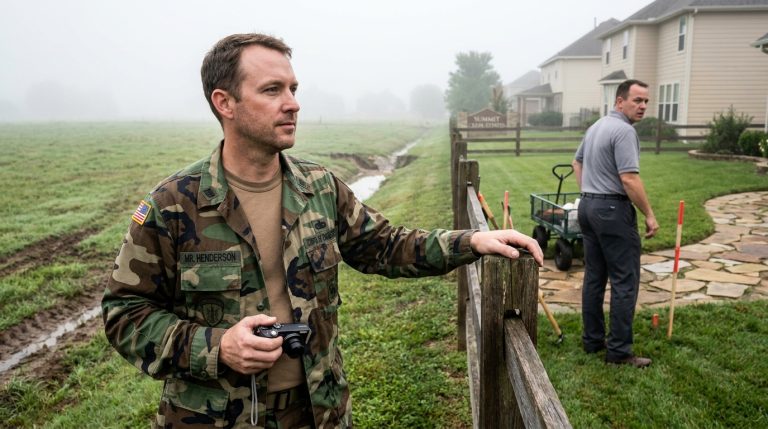
I didn’t knock on Sarah’s door first. I walked the perimeter line along the cedar fence, keeping my posture relaxed, hands jammed into the pockets of my canvas jacket. At a narrow gap between two fence posts—a gap no wider than four inches—I stopped.
If you angled your head precisely thirty degrees to the left and squinted through the pine branches, you could catch a three-inch sliver of faded green plastic. Toby’s turtle.
I pulled my phone out, notched the lens, and took twelve high-resolution photos. Distance. Angle. Obstructive foliage. Sightline from the asphalt.
The violation was a complete fabrication. It wasn’t about aesthetics. It was about target selection. Karen had picked an army wife with a deployed husband because she calculated zero resistance.
“Find what you’re looking for?”
I turned slowly.
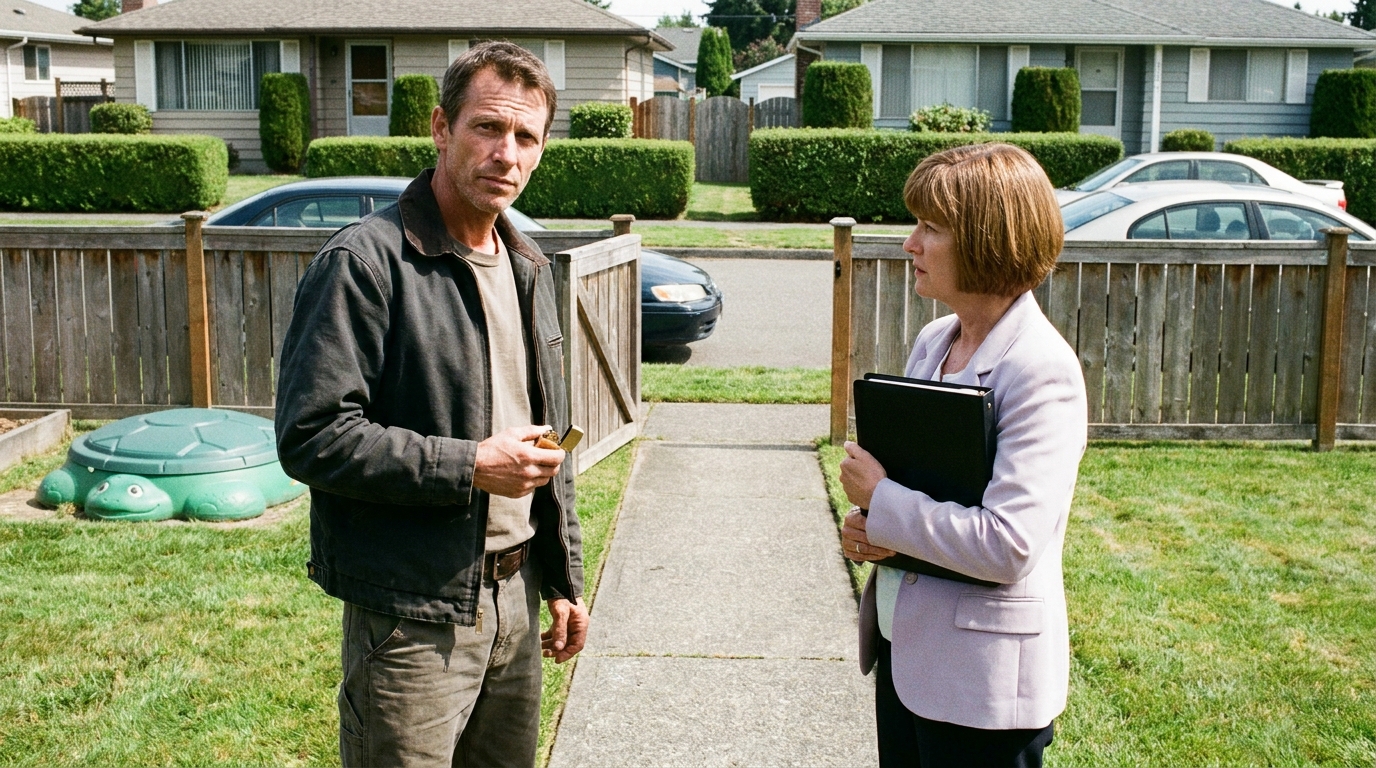
Standing on the manicured lawn across the narrow lane was a woman in her late fifties, wearing a stiff pastel blazer and holding a black leather binder like a shield. Her hair was cut into a sharp, rigid wedge. Her eyes were fixed on my license plate.
“Mark Thorne,” I said, stepping onto the sidewalk. “I own the property.”
Karen didn’t offer a hand. She tightened her grip on the binder, her chin tilting up two inches.
“Then you’re the one responsible for the eyesore,” she said, her voice dripping with artificial regret. “I’ve already issued the primary notice. Your tenants are hostile, Mr. Thorne. If you can’t manage the people in your rental unit, the board will manage them for you.”
I rolled the brass Zippo in my right palm, feeling the sharp corner press into my thumb line. I didn’t smile. I didn’t raise my voice.
“Show me the specific article in the Oakmont Creek bylaws that grants an HOA president authority to terminate a private residential lease.”
Karen’s eyelids flickered. A micro-tic caught the left corner of her lip—a tiny, involuntary jerk before she smoothed her expression back into icy superiority.
“Article Four covers community standards,” she snapped, stepping back toward her driveway. “I don’t need to quote line items to an out-of-town landlord. The fine is two hundred dollars, active as of eight o’clock this morning. It doubles every twenty-four hours until that plastic structure is in a dump dumpster.”
“Send the notice in writing via certified mail,” I said. “Include the board minutes authorizing the fine.”
“You’ll get your notice, Mr. Thorne,” she sneered, turning her back on me as she marched up her front steps. “Along with the lien proceedings if you attempt to play games with this board.”
I watched her front door slam shut.
I didn’t follow her. I pulled out my legal pad, noted the exact time—14:22—and wrote down her physical posture, her refusal to cite code, and the immediate jump to financial penalties.
She thought she was enforcing a rule about a plastic toy. She had no idea she had just opened an operational ledger with a retired logistical strategist.
CHAPTER 2: THE LINE IN THE DIRT
The idle of the diesel engine hummed through the vinyl steering wheel, a low, steady frequency against my palms. On the clipboard rested the paper trail: Karen’s notice, printed on cheap twenty-pound stock, slightly skewed on the page as if fed through a jammed tray.
I didn’t turn the key off. I thumbed the corner of the paper.
In the bottom right margin, beneath her oversized signature, sat a tiny string of alphanumeric text—a printer tracking code and an internal ledger designation: Ref: ACC-409-FIN.
The Zippo clicked in my right hand. Once. Twice.
An HOA with forty-two single-family homes didn’t run complex sub-ledger account codes unless someone was trying to bucket funds outside the standard operating budget. I logged the code into my pad, flipped the truck into drive, and pulled away from the curb.
Back at my office, the air smelled of stale coffee and old blueprints. I bypassed the HVAC schematics, brought up the public land registry on my monitor, and opened a blank spreadsheet.
I didn’t call a attorney yet. Calling a lawyer at this stage was like firing an artillery flare over an unmapped treeline; it told the adversary you were looking before you knew what you were looking at.
I dialed the main line for the Oakmont Creek Homeowners Association.
It went straight to voicemail—a canned, pre-recorded message in Karen’s sharp, clipped cadence. I didn’t leave a message. Instead, I dialed the direct cell number listed on the bottom of the violation notice.
She picked up on the second ring.
“Peterson,” she snapped. background noise was thin, echoing—the acoustic profile of a high-ceilinged retail space, not a home office.
“Mark Thorne,” I said.
A brief pause. I heard the rustle of synthetic fabric, likely her stiff blazer adjusting as she shifted her weight.
“Mr. Thorne. I trust you’ve taken steps to remove the non-compliant structure.”
“I’ve reviewed the document you handed me,” I replied, keeping my pitch level, flat, and completely devoid of heat. “Article Four, Section Two refers strictly to structural alterations and fixed masonry. A blow-molded plastic sandbox under twenty pounds does not meet the definition of a fixed structure under state property code.”
A sharp, audible intake of air over the receiver.
“The board interprets the covenants, Mr. Thorne, not the property owners. The aesthetic uniformity of this neighborhood is non-negotiable. The two-hundred-dollar penalty stands, and an additional daily fee of one hundred dollars has been assessed to Account 409.”
Account 409. She had spoken the code without thinking, slipping it into her script as if it were standard doctrine.
“Send me the itemized ledger,” I said quietly. “And send the formal board minutes authorizing the daily assessment.”
“You don’t dictate procedure to me,” Karen hissed. Her voice dropped, losing its administrative polish and hardening into personal malice. “You have thirty days before I place a lien on 124 Chestnut. I’ve tied up properties bigger than yours, Mr. Thorne. You think because you own a few rental units you can come into my community and ignore the rules? Try me. Pay the fine, or I’ll ensure the sheriff posts a notice of intent on your tenant’s front door every single morning.”
Click.
She hung up.
I sat in the quiet of my office, the phone still resting in my palm. The threat of a lien was standard muscle-flexing for predatory associations, but the daily escalation was procedurally absurd. To place a valid lien, an HOA required a two-thirds board vote, a thirty-day cure notice sent via registered mail, and a certified statement of delinquent dues.
She was cutting corners. She was skipping the board entirely.
My desk printer hummed to life as a fax arrived—a courtesy copy forwarded from my property management portal. It was a formal Notice of Intent to Lien from a private collection agency operating out of a P.O. Box three towns over. The total demanded was already $1,500, citing “accumulated administrative penalties and legal preparation fees.”
Attached to the back was a single sheet detailing payment routing.
The bank routing number didn’t point to the community’s primary credit union. It pointed to a regional commercial branch located at Oak Creek Plaza.
I stared at the bank name.
Slowly, I opened my commercial property management database, navigated to the master lease file for Oak Creek Plaza, and pulled up the tenant directory for Suite 104.
The lease was held by a national craft supply franchise. The local store manager listed on the corporate compliance filing was Karen Peterson.
I rested my thumb over the brass crest of my lighter. The flint wheel gave a small, cold spark.
She wasn’t just enforcing rules; she was manufacturing fast cash. And the bank receiving the disputed funds sat directly inside the commercial center where I collected the master rent every month on the first.
The line in the dirt wasn’t on Chestnut Drive anymore. It was already on my ledger.
CHAPTER 3: STRATEGIC ALLIANCES
The master lease file for Suite 104 stayed open on my monitor, the digital cursor blinking over Lease Clause 14-B—the default provision governing commercial tenant solvency.
I didn’t touch the keyboard. I pulled my pad forward and drew a straight line from Account 409 to Oak Creek Plaza.
Knowing your adversary’s secondary flank is useless if you don’t secure the surrounding terrain first. Karen Peterson was a creature of isolation; she survived because her victims thought they were standing on single-plank bridges alone in the dark.
Twenty minutes later, I pulled into the asphalt apron of the local diner three miles outside the Oakmont Creek subdivision boundaries.
The air inside smelled of burnt bacon fat and stale coffee. Sitting in a corner booth, his back to the wall, was George Vance. Seventy-one years old, twenty-four years delivering letters for the postal service, his knuckles scarred from decades of sorting cold metal mailboxes.
He looked up as my shadow fell across the laminate table.
“Thorne,” he said, nodding toward the bench opposite him. “You look like you’re measuring a ditch.”
“I am,” I said, sliding into the vinyl seat. “And Karen Peterson is at the bottom of it.”
George took a slow sip from a chipped ceramic mug. He didn’t laugh. He set the mug back down, aligning the handle precisely parallel to the edge of the table—a habit of a man who spent his life working within grids.
“She put a lien notice on 124 Chestnut,” I said.
“Sounds like her,” George grunted. “She tried the same trick on the Garcias two years back. Carlos had three tomato plants in raised beds behind his garage. She claimed it altered the drainage profile of the block. Issued four hundred in fines, added fifty a day in legal processing fees. Carlos paid eighteen hundred before he gave up, packed his kids, and sold at a twelve-percent discount just to clear the title.”
“Did Carlos keep his notices?”
George leaned forward, his elbows pressing into the cracked formica. His thumb rubbed a faded white scar across his index joint—a raw micro-movement that belied his calm posture.
“Carlos keeps everything. He’s living over on Third Street now. Still got the binder.”
“Give me his number, George.”
George eyed me for five long seconds. “You’re not looking for a compromise, are you, Major?”
“Compromise is for structural defects you can brace,” I said, my voice barely above a rasp. “Karen Peterson isn’t a defect. She’s an active collapse. I need names, dates, and every canceled check sent to Account 409 over the last three years.”
“I’ll get you Carlos,” George said quietly. “And I’ll get you Sarah Albright. She’s on Birch Street. Karen fined her two hundred bucks because her boy left his three-speed bicycle on the porch overnight while he had the flu. Sarah works double shifts at the laundry. She paid it out of her grocery envelope.”
I pulled out my pen, noted the names, and pushed a blank card across the table.
“Tell them to meet me at the township library room tomorrow at 19:00 hours. No public calls. No emails through the HOA portal.”
George picked up the card, tucked it into his flannel shirt pocket, and tapped his fingers against his coffee cup.
“You’re building a unit,” he observed.
“I’m building an audit,” I corrected.
I left the diner and drove directly to Third Street. Carlos Garcia was a quiet man with thick, calloused hands and a spine as straight as an iron fence post. When I sat on his front porch and laid out the printed copies of my own violation notice alongside the tax records of Oak Creek Plaza, he didn’t say a word for nearly three minutes.
He simply stood up, walked into his hallway, and returned with a blue accordion file.
He dropped it onto the glass coffee table. The thud was heavy, dense with paper.
“She took eighteen hundred dollars from my family, Mr. Thorne,” Garcia said, his voice flat, devoid of self-pity. “My wife cried when we signed the closing papers. We felt like criminals.”
I opened the file. Inside were seven cashier’s checks, all made out to the Oakmont Creek HOA, but every single endorsement stamp on the back carried the exact same routing code: the regional branch at Oak Creek Plaza.
“She didn’t deposit these into the reserve account,” I said, tracing the ink stamp with my fingernail. “She routed them through a secondary clearing clearing firm.”
“Is that legal?” Garcia asked.
“It’s not just illegal,” I said, looking him dead in the eye. “It’s Lease Clause 14-B.”
I closed the file, tucked it under my arm, and shook his hand.
By the time I returned to my truck, the shadows across the asphalt were long and cold. My phone buzzed in my pocket. It was a text from Ben Carter, my attorney.
Notice received from Peterson’s legal proxy. They are refusing mediation. Claiming board authority is absolute.
I stared at the screen, the blue light reflecting off the brass casing of the Zippo resting in my lap. I didn’t text back. I didn’t need to.
Refusing mandatory mediation wasn’t a show of strength. It was a procedural suicide pact under state administrative law. Karen thought she was closing the door on my face. In reality, she had just locked herself inside the room with the very evidence I needed to strip her authority down to the bare joists.
I started the engine, flipped on my headlights, and pointed the truck toward the public library. Phase two was no longer a plan; it was an active march.
CHAPTER 4: THE BUREAUCRATIC SIEGE
The rain hit the truck cab in sporadic, heavy drops, each thud echoing like gravel tossed against metal. I didn’t text Ben back. I shoved the phone into my jacket pocket, snapped the Zippo shut with a sharp clack, and pushed through the heavy glass doors of the township library.
Room B smelled of floor wax and wet wool.
Seven homeowners sat around a scarred oak conference table. Sarah Albright was wringing a damp paper towel into a ball, her knuckles raw from her night shift at the industrial laundry. Beside her, Carlos Garcia had his blue accordion file laid open like an anatomical surgical kit. George Vance sat at the head, his eyes tracking me as I walked in and dropped three thick black three-ring binders onto the wood.
The thud echoed off the concrete block walls.
“This isn’t a support group,” I said, staying on my feet. “This is a paper trail.”
Sarah looked up, her shoulders tight. “Karen left another notice on my door at six this morning, Mr. Thorne. She said if I don’t clear the two hundred dollar balance by Friday, she’s sending code enforcement to inspect my porch for hazardous debris.”
“She won’t,” I said, opening the first binder. “Code enforcement requires a municipal warrant. Karen Peterson doesn’t have a warrant. She has a rubber stamp and a bluff.”
I pulled out seven pre-printed, certified letter forms, each pre-addressed to the Oakmont Creek HOA P.O. Box.
“This is Phase Two,” I said, sliding one form to each person at the table. “Every single person here is filing an individual, formal grievance against the board under State Property Code Chapter 82. We are citing procedural breach, failure to provide annual meeting notices, and selective enforcement.”
Carlos picked up his pen. His hand was rock-steady. “What about the money we already paid?”
“Paragraph three,” I pointed to the printed sheet. “We are demanding a full, unredacted accounting of all funds transferred into and out of Account 409 for the last thirty-six months. We give them ten business days to produce the general ledger, the bank reconciliation sheets, and the tax filings.”
George leaned over, squinting at the fine print. “And when she ignores it?”
“She won’t just ignore it,” I said, leaning over the table, my palms flat against the grain. “She’s going to panic. Because tomorrow morning, she gets seven certified return receipts delivered to her desk at the Crafty Corner. She’ll realize this isn’t three isolated neighbors complaining about garden hoses. She’ll realize it’s a unified front using her own bylaws to choke her administrative authority.”
Sarah signed her name with a sharp, heavy stroke, her pen tearing slightly through the paper. “My boy’s bike wasn’t trash,” she whispered. “It was three weeks of overtime.”
“Sign the second page,” I said quietly. “We’re taking the overtime back.”
By midnight, all seven packets were stamped, sealed, and stacked in my truck.
Forty-eight hours later, the response arrived.
It didn’t come by mail. It came via a courier who knocked on my office door at 07:30.
The envelope was thick, heavy linen stock bearing the letterhead of Vanguard Legal Group—a mid-tier firm specializing in corporate defense. I sliced it open with a brass letter opener.
Inside was a formal Refusal of Mediation and a Notice of Emergency Assessment.
“Please be advised that the Board of Directors for Oakmont Creek HOA has deemed all outstanding grievances null, frivolous, and brought in bad faith,” the letter read. “Pursuant to emergency powers under Bylaw 12-A, an emergency legal defense fee of $450 has been assessed to all properties affiliated with the unauthorized dispute coalition. Failure to remit payment within 72 hours will trigger immediate foreclosure proceedings under Lease Clause 14-B proxy rules.”
I didn’t blink. I didn’t reach for the phone.
I picked up my pen and highlighted the phrase Lease Clause 14-B proxy rules.
Bylaw 12-A didn’t exist in the public covenants filed with the county clerk. And an HOA couldn’t invoke a commercial lease clause against residential fee simple deeds unless the board president was copying and pasting boilerplate legal threats directly from her day-job commercial compliance manual.
Karen had gotten sloppy. In her hurry to shut down seven simultaneous grievances, she had used her corporate franchise template to draft a fake legal threat.
I picked up my desk phone and dialed Ben Carter.
“Ben,” I said when he answered. “Check the county land portal. Did Vanguard Legal actually file an appearance on behalf of Oakmont Creek?”
A thirty-second pause. I heard the frantic click of Ben’s mechanical keyboard over the line.
“Negative,” Ben said, his tone turning razor-sharp. “Vanguard Legal isn’t representing the HOA, Mark. They’re the corporate retainer firm for Crafty Corner Corporate Holdings. Karen used her store’s legal stationery to fake an HOA response.”
I looked down at the brass Zippo resting on the desk.
“She didn’t just refuse mediation, Ben. She committed mail fraud using her employer’s legal assets to protect Account 409.”
“What’s the move?” Ben asked.
“The annual HOA meeting is in four days,” I said, my voice dropping into a cold, level register. “Don’t file a lawsuit yet. Let her print the ballots. Let her sit at the head table thinking she’s holding a hand full of aces. I want her completely comfortable when I step up to the microphone.”
I hung up the phone, pulled out my pad, and began drafting the dossier for the clubhouse floor.
CHAPTER 5: THE CLUBHOUSE COUP
The air inside the community clubhouse smelled of stale chlorine from the pool outside and old floor wax. Forty metal folding chairs scraped against the linoleum, filled to capacity for the first time in five years.
At the front table, Karen Peterson sat behind a microphone, flanked by two passive board members who looked like collateral damage. She wore a crimson blazer, her clipboard rested neatly over a stack of pre-printed ballots, and her expression projected untouchable administrative smugness.
“Order,” Karen declared, tapping her wooden gavel twice against the folding table. “We have a full agenda tonight. Per board rules, all public comments are restricted to thirty seconds during the open forum at the conclusion of official business.”
I sat in the back row between George Vance and Sarah Albright. Heavy leather binders rested on my knees. I didn’t raise my hand. I didn’t interrupt.
For forty-five minutes, Karen droned through her sanitized financial summary. She glossed over a forty-percent jump in administrative expenditures with vague phrases about “community preservation” and “unforeseen legal maintenance.”
“Now,” Karen said, her fingers smoothing the top edge of her red blazer. “Before we proceed to the board election, is there any new business?”
She didn’t wait. She began reaching for the pre-printed election ballots.
“Yes, Madam President,” I said.
My voice didn’t rise, but it cut cleanly across the hum of the overhead air handler. Every neck in the room turned.
I stood up, picked up the three heavy binders, and walked down the center aisle. The soles of my work boots made a measured, rhythmic thump against the tiles.
Karen’s eyelids flickered. Her hand froze over the ballots. “Mr. Thorne. As I stated, personal disputes regarding property violations are handled through written—”
“This isn’t a personal dispute,” I said, stopping two feet from her table and dropping the first binder in front of her. The thud made the microphone rattle. “This is an audit.”
“You are out of order!” Karen slammed her gavel down. The sharp crack echoed off the painted cinderblock walls, but nobody moved.
“In that binder,” I said, turning to face the room as George and Carlos began distributing forty spiral-bound copies to the seated homeowners, “you will find the bank routing logs for Account 409.”
Karen’s face flushed a blotchy, mottled purple. She reached for the microphone, her knuckles turning chalk-white. “This meeting is adjourned! Board members, we are—”
“Sit down, Karen,” George Vance said from the third row, his voice carrying the calm authority of forty years on a postal route. “We’re reading.”
A heavy silence fell over the room, broken only by the sharp rustle of forty pages turning in unison.
“Page four,” I announced, pointing toward the open binder on Karen’s table. “Every single penalty fee levied against homeowners over the past three years—from Carlos Garcia’s garden to Sarah Albright’s child’s bicycle—was deposited directly into Account 409. That account does not belong to the Oakmont Creek reserve fund.”
Karen stood up so fast her metal chair shrieked against the floor. “That is an administrative holding account! It is fully within the board’s discretion—”
“Account 409 is a commercial clearing account,” I interrupted, my tone cold and surgical. “It sits at the regional bank in Oak Creek Plaza. And every single transfer from that account was executed to pay rent arrearages for Suite 104 under Lease Clause 14-B.”
A gasp rippled through the front rows.
Sarah Albright stood up, holding her opened copy high. “You stole my boy’s bike money to pay for your craft store?”
“That’s a lie!” Karen shrieked. Her composure shattered, her voice cracking into a thin, desperate register. “I am the president of this association! I built this community standard! You are an outsider—a rogue landlord trying to destroy our property values!”
“You didn’t use the money for property values, Karen,” I said, stepping closer to the table and leaning down so my face was level with hers. “You used twenty-four thousand dollars of stolen homeowner fees to keep the Crafty Corner afloat because your corporate franchise was failing its monthly quota.”
She stared at me, her chest heaving under her crimson jacket. Her eyes darted toward the side exit, but Carlos Garcia was already standing near the door, his arms crossed over his chest, blocking the frame.
“I call for an immediate vote of no confidence,” George Vance shouted from the floor.
“Seconded!” three voices called out instantly.
“You can’t do this!” Karen yelled, her hands trembling as she tried to gather her loose papers. “The bylaws require a thirty-day written notice for a recall!”
“Under State Property Code Section 82,” I said, pointing directly at the highlighted statute in the binder before her, “a board president engaged in active commingling of funds loses administrative standing immediately upon presentation of forensic evidence.”
The vote wasn’t a contest. Thirty-nine hands shot into the air. Not a single hand stayed down.
Karen stood paralyzed behind her table, stripped of her office, her gavel, and her authority in less than twelve minutes. She snatched her purse, shoved past the empty table, and rushed toward the side aisle, her head ducked low as thirty-nine of her neighbors watched her in disgusted silence.
I watched her go, my face unreadable.
“Mark,” George said, walking up beside me and laying a hand on my shoulder. “It’s over.”
“No,” I said, looking down at the master lease document tucked into the back of my own file. “The HOA is clear. Now I have a commercial tenant in default.”
CHAPTER 6: CHECKMATE AT OAK CREEK
The rain had settled into a fine, freezing mist by the time I reached Oak Creek Plaza.
It was 08:45 the following morning. The glass storefront of Suite 104 bore the bright pastel lettering of The Crafty Corner. Through the floor-to-ceiling windows, I watched Karen Peterson adjusting a display of artificial seasonal wreaths near the register. She was wearing a faded store apron over a gray blouse. The crimson blazer was gone, replaced by a nervous, twitching energy as she repeatedly smoothed down the edges of her laminated name tag.
Beside me stood David Chen, the regional operations manager for the franchise. He held a navy leather briefcase, his face pale and drawn under the harsh morning glare of the parking lot lights.
“Mr. Thorne,” Chen said, his voice tight. “Are you absolutely certain about the account routing?”
“Check the master ledger,” I said, handing him the blue accordion file Carlos Garcia had given me, alongside the certified bank trace from Account 409. “The rent payments for Suite 104 were drawn from an unauthorized secondary account registered under her personal tax ID, funded entirely by illegal municipal assessments. Under Lease Clause 14-B, commingled funds used for corporate rent constitute a material breach of lease and an immediate event of default.”
Chen flipped through the pages, his mouth tightening into a thin, white line. “If this gets back to corporate legal…”
“It’s already on my desk,” I said quietly. “And I own the deed to the building.”
I pushed open the heavy glass door. The brass chime above the frame gave a bright, cheerful ring that cut through the silence of the empty store.
Karen didn’t look up immediately. “We open at nine,” she said, her voice sharp and dismissive.
“Good morning, Karen,” I said.
Her head snapped up. Her hands froze around a plastic bundle of faux pine needles. The color drained from her face so fast her skin took on the dull gray tone of wet newsprint. Her eyes darted from my face to David Chen standing two paces behind me, then to the navy briefcase in his hand.
“David,” she stammered, her throat working visibly as she swallowed. “What… what are you doing here? Surprises aren’t on the regional schedule.”
“We’re here about Lease Clause 14-B, Karen,” Chen said, stepping forward and laying the blue accordion file flat on the glass checkout counter. The thud was loud, echoing off the high, exposed-rafter ceiling.
“I don’t… I don’t know what that means,” she lied, though her left hand involuntarily twitched behind her back, her thumb digging hard into her palm. “If this is about Mr. Thorne’s residential dispute, I’ve already informed him that board matters are completely separate from my commercial employment—”
“Account 409,” I interrupted softly.
The word hung in the air between us, heavy and suffocating.
“Account 409 is a personal ledger,” Karen hissed, leaning across the counter, her eyes widening into a desperate, feral glare. “You have no right to access my personal bank records! That is harassment! I will file an injunction against you and this plaza!”
“Account 409 was used to remit twenty-four thousand dollars in lease payments to my commercial holding company,” I said, resting my hand flat over the glass counter. “You stole those funds from thirty-nine families in Oakmont Creek to cover your store’s operating deficit so corporate wouldn’t terminate your manager contract. You commingled stolen residential funds with commercial lease obligations.”
Karen’s breath came in short, ragged hitches. She looked at Chen. “David, listen to me. He’s twisting things. The store’s numbers were short because of the supply chain delays in Q2! I was just bridging the gap! I was going to replace the reserve funds as soon as the holiday bonuses cleared!”
“Bridging the gap?” Chen stared at her in utter disbelief. “You committed grand larceny and mail fraud using company stationery to protect your performance bonus?”
“It wasn’t larceny!” she screamed, her voice cracking as she slammed her open palm onto the counter. “I kept this store open! I protected this location! I did what was necessary to keep order!”
“You’re done, Karen,” Chen said, his voice dropping into a flat, decisive register. “Hand over your keys and your security badge. As of right now, your employment is terminated for cause. Corporate legal has already been notified, and we are surrendering all store financial records to the district attorney.”
Karen stood frozen behind the register. For five seconds, the only sound was the low hum of the store’s HVAC system. Then, her shoulders collapsed. The rigid posture, the administrative arrogance, the tyrannical posture she had worn like armor for five years—it all dissolved, leaving behind a small, cornered woman in a cheap polyester apron.
Her hands trembled violently as she unclipped her name badge and dropped it onto the glass counter beside the key ring.
“You ruined me,” she whispered, staring at me with a cold, hollow hatred. “Over a plastic turtle.”
“No, Karen,” I said, picking up the key ring and sliding it across to Chen. “You ruined yourself the moment you treated people’s lives like line items on your personal ledger.”
She didn’t answer. She grabbed her coat from the back hook, pulled her purse over her shoulder, and walked out the front door without looking back. Through the glass, I watched her cross the wet asphalt, her heels clicking uselessly against the pavement as she got into her car and drove away from Oak Creek Plaza for the last time.
Two hours later, the rain had stopped, leaving the sky a clear, pale gray.
I pulled my truck up to the curb outside 124 Chestnut Drive. The quiet of the neighborhood was total—no shouting, no pink notices stuck to deadbolts, no shadow of administrative harassment lingering over the porch.
I walked around to the cedar fence in the backyard. Sarah Miller was sitting on the back steps with a mug of coffee, watching three-year-old Toby dump a red plastic bucket of sand inside the green turtle sandbox.
She looked up as the latch clicked. A hesitant, guarded expression crossed her face before she saw who it was.
“Major,” she said, standing up.
“Sarah,” I said. “The HOA board held an emergency reorganization meeting this morning. George Vance is the interim president. All outstanding fines against this property have been formally expunged from the county ledger.”
Sarah set her coffee mug down on the wooden step. She didn’t cry. She just let out a long, slow breath that she seemed to have been holding for a month.
“Is she coming back?”
“No,” I said. “The police processed the embezzlement warrant two hours ago. She won’t be returning to Oakmont Creek.”
Sarah looked out toward the yard, where Toby was laughing as he patted down a pile of damp sand. “Sergeant Miller called from overseas last night,” she murmured softly. “I didn’t know what to tell him about the notice.”
“Tell him the perimeter is secure,” I said.
I pulled the brass Zippo from my pocket, held it in my palm, and looked at the polished Corps of Engineers crest. The metal was cold against my skin, but the flint wheel gave a clean, sharp spark when I struck it.
I walked over to the sandbox, knelt in the damp grass, and picked up a loose wooden stake that had fallen away from the fence line. I pulled my pocket knife out, notched the pine wood, and drove it firm into the earth beside the turtle’s green head, securing the barrier once and for all.
The structure was solid. The line was held.
I stood up, snapped the lighter shut with a quiet, definitive clack, and walked back to my truck.