A Quiet Inheritance: How Command Became the Bridge Between a Daughter’s Ambition and a Father’s Pride
CHAPTER 1: The First Adjustment
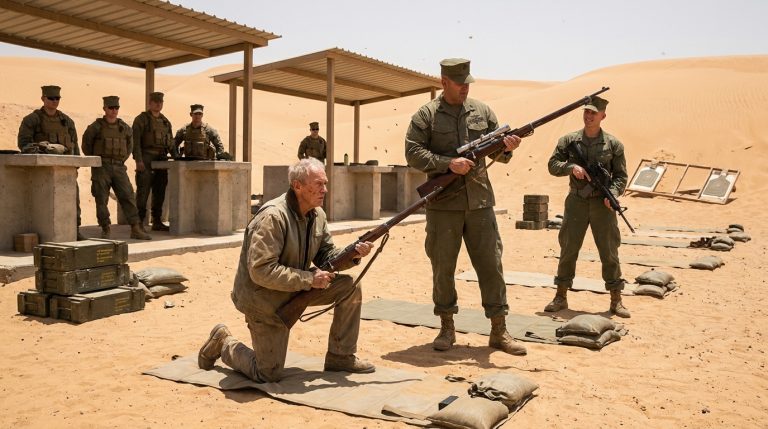
The wind off the North Carolina coast didn’t just bite; it scoured, stripping the heat from the marrow of your bones. I stood in the rear lane of the Stone Bay Range Complex, my navy blazer offering little protection against the damp November gray. Beside me, my father, James, kept his hands deep in the pockets of his old army field jacket—faded, olive-drab, and stubbornly devoid of rank. He was watching the firing line with the clinical, practiced gaze of a man who had spent his entire life measuring others by their efficiency.
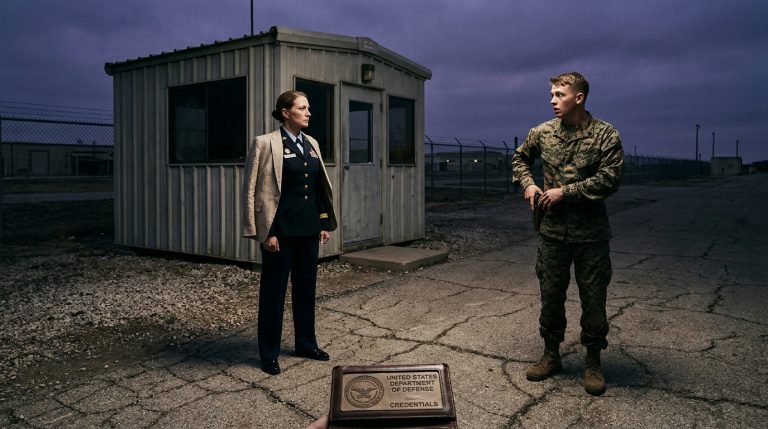
Staff Sergeant Miller moved toward us with a rhythmic, impatient gait. He was young, his orange safety vest a bright, abrasive smear against the muted landscape. He didn’t see the badge on my belt. He didn’t see the twenty-two years of discipline etched into the way I held my shoulders, or the specific, quiet intensity of an incoming commander observing her own unit.
“Playing Marine, ma’am,” he clipped, his voice carrying easily over the organized snap of rifle fire. “Live range. Turn around.”
He was smiling, the confident, reflexive smile of a man who knew exactly who held the power on this dirt. I didn’t turn. I didn’t bristle. I felt my father stiffen beside me, heard the sharp, aborted catch of a laugh—the sound of a man recognizing a mistake he’d seen a thousand times before.
“Drop,” a flat, emotionless voice interrupted.
Captain Travis Ridge was emerging from the periphery, his steps measured, his posture a study in calculated restraint. He looked at my badge, then at my face, then at the sergeant. He didn’t raise his voice; he didn’t need to. “She’s command.”
Miller went the color of a fresh bruise, his mouth snapping shut as he hit the deck. The push-ups began—rhythmic, agonizing, and public. Forty Marines on the firing line fell into a silence so absolute it seemed to change the very air pressure around us. Word traveled the line like a current. The woman in the blazer wasn’t a visitor; she was the machine they were about to be fed into.
I didn’t watch Miller. I watched the line. I watched them shift, their heads turning just a fraction, their stances subtly tightening. It wasn’t fear; it was the sudden, bracing realization that the ground had moved.
“Ma’am, I apologize. Welcome to Stone Bay,” Ridge said, snapping a salute that was as crisp as the morning air.
I returned it, my gaze drifting to my father. He had stopped moving. His hands were still in his pockets, but his shoulders were hunched, his eyes fixed on the sight of me standing there, the center around which forty men had just reoriented. He looked like a man watching a room he’d lived in his whole life suddenly be revealed as a labyrinth he’d never actually entered.
I walked forward toward the firing line, and I could feel him trailing behind me, caught in the wake of a truth he had spent twenty-two years ignoring. I hadn’t come here to prove anything to him. I had come to do the work. But as I took the first step, I realized that for the first time, he was seeing the work—not the ambition, not the performance, but the weight of it.
CHAPTER 2: The Architecture of Silence
The push-ups stopped, but the silence remained. It was a heavy, structural thing, pressing down on the gravel of the range floor. I didn’t look back at Miller. I didn’t need to. The correction had been administered by the system itself, a self-adjusting mechanism that operated without me having to say a word. I turned away from the firing line and began the walk back toward my personal vehicle, my boots crunching rhythmically on the packed earth.
My father followed. I could hear his cadence—the measured, heavy tread of an NCO who had spent decades pacing parade decks and field training sites. He wasn’t walking beside me; he was lingering a half-step behind, his hands still shoved deep into the pockets of that faded, olive-drab field jacket. The jacket looked out of place here among the modern gear and the crisp, clean precision of the Marines, a relic from a different era of service.
We reached the car in silence. The air felt colder now that the heat of the interaction had faded, leaving behind only the damp, iron-scented chill of the North Carolina coast. I opened the driver-side door, the metal cold against my gloved fingertips. I didn’t look at him as I settled into the seat. I kept my movements efficient, practiced, the same way I had conducted every tactical movement for the last twenty-two years.
“He’ll be all right,” my father said.
His voice was thin, almost conversational, as if he were discussing a minor weather delay rather than the fact that he had just watched a subordinate being corrected for underestimating his own daughter. He stood by the passenger door, his gaze fixed on a distant training structure, his jaw tight.
“Staff Sergeant Miller is a good Marine,” I replied, my voice steady, stripped of the emotional heat I might have felt a decade ago. “He made a read on what he saw. He was wrong. He’ll adjust.”
I started the engine. The sound was a low, guttural vibration that seemed to emphasize the quiet between us. I didn’t look at him to gauge his reaction. I was already calculating the drive back to the PX—the route, the timing, the way the light was beginning to shift across the base. I was back in the work. The range incident was already being filed away, categorized, and tucked into the internal architecture of my command.
He got into the passenger seat, his movements stiff. As I pulled the vehicle away from the range, the scenery of the Stone Bay complex began to unfurl through the windshield—rows of pristine buildings, the organized chaos of moving troops, the functional, brutalist aesthetic of a base designed for nothing but the work.
“That captain,” he said after a long interval, his eyes tracking a group of junior Marines marching toward a maintenance bay. “Ridge. He moved fast.”
“He did,” I said.
“Twelve seconds,” he noted, his voice dropping into that familiar, methodical register. “That’s good internal alignment. If the OIC has the command turnover briefing memorized to that level of detail, the unit is stable.”
He was doing it again—grading the unit, checking the math, searching for the logic that held the whole structure together. But there was a difference today. He wasn’t looking for flaws in the performance; he was looking for the evidence that the authority I wielded wasn’t just a costume. He was trying to find the bedrock, checking to see if the Marine Corps I’d joined had the same structural integrity as the Army he’d left.
I didn’t try to fill the space with words. I let the silence stretch. I knew him well enough to know that he was processing, his mind a slow, grinding millstone turning over the reality of what he had just witnessed. He was holding the pieces of his old belief—the one where I was just playing at being a soldier—and trying to fit them into the reality of a battalion commander standing on a range.
The road ahead was clear, a long, straight stretch of asphalt that seemed to mirror the path we had been on for twenty-two years. I felt the familiar weight of my badge against my hip, a reminder of the authority I carried, but more importantly, a reminder of the duty I owed to the Marines who worked under me. I focused on the driving, on the rhythm of the road, and on the quiet, steady persistence of a Sunday morning that was already moving us toward whatever came next.
He looked out the window, his expression unreadable, and for the first time in my life, I didn’t feel the need to ask him what he was thinking. The gap between us was still there, vast and deep, but it was no longer a void. It was a space that was finally, slowly, beginning to be mapped.
CHAPTER 3: The Weight of the Common Room
The base lodging common room was a transient, antiseptic space—beige walls, industrial carpet, and the persistent hum of a vending machine in the corner. It was a place where people arrived and departed, a temporary holding pattern for those in service. Tonight, however, it felt like an interrogation room. My father crossed the threshold, his movements slow and deliberate. He still wore that faded, olive-drab field jacket, though he had unzipped it now, revealing a plain grey sweater underneath. He seemed to shrink slightly in the artificial light, the authority he carried on the range suddenly tempered by the mundane surroundings of a temporary guest house.
I moved to the small coffee station in the corner, keeping my motions methodical. I needed the task—the simple, repetitive act of pouring hot water, stirring the instant grounds, watching the steam rise. It gave me a buffer. Every time I looked at him, I saw the man who had crouched down to my level in Allentown, and the man who had stood at the edge of the Stone Bay range, watching me walk the line. The two images were fighting for dominance in my mind, refusing to settle into a single, cohesive shape.
“Coffee?” I asked, my voice barely audible over the low drone of the building’s ventilation.
“Please,” he said. He sat at a small, circular table near the window. Outside, the night was featureless, the base lights glowing in the distance, casting long, stark shadows across the parking lot. He didn’t lean back. He sat on the edge of the chair, his hands resting flat on the tabletop, his posture still that of an NCO waiting for an inspection.
I brought the two cups over. As I sat down, he didn’t reach for his immediately. He looked at the cup, then at me. “The captain,” he said, skipping the pleasantries. “Ridge. He knew your name before you even spoke.”
“He did,” I confirmed, wrapping my fingers around the warm ceramic.
“That’s not common,” he said, his eyes narrowing slightly. “Not in my experience. You don’t just memorize the incoming commander’s face unless you’re expecting to be scrutinized. He wasn’t just doing his job. He was prepared for your specific presence.”
I paused. He was running that calculation again, but this time, he wasn’t grading the battalion’s performance. He was grading the preparation—my preparation. He was asking if I had exerted influence over the environment, or if I had simply stepped into a role that had already been polished to receive me.
“It’s the standard, Dad,” I said, keeping my tone light, though the warning bells were ringing in my head. “Good officers prepare for their command. Turnover briefs are part of the process. He did what a professional is expected to do.”
He nodded, but he didn’t drink the coffee. He seemed to be looking through it, staring at a point on the table that only he could see. “I didn’t know the Marine Corps operated that way. I thought the friction was higher. I thought the culture… well, I thought it was more reactive.”
“It’s disciplined,” I said. “And discipline requires anticipation. If you’re reacting, you’ve already lost the initiative.”
He looked up at me then, and there was a flicker of something in his eyes—a genuine, unvarnished curiosity. It wasn’t the critical, measuring look of the morning. It was softer, more like the look of a student encountering a subject he’d once dismissed but was now forced to re-evaluate.
“You’re not just running a formation,” he said, his voice dropping. “You’re running an expectation.”
He reached out and picked up his cup, taking a slow, considered sip. He didn’t comment on the taste. He stayed silent for a long time, the kind of silence that usually preceded a lecture or a critique. But when he spoke again, the sharpness was gone, replaced by a strange, hollowed-out quality.
“I spent twenty-two years thinking I understood the hierarchy,” he said, gesturing vaguely toward the window, as if the entire base were a model he’d misread. “I thought the officers were the ones who sat in offices while the real work happened on the ground. I thought that was the immutable law of the service. You’ve spent twenty-two years proving that’s not the whole picture.”
I leaned forward, my heart beating a steady, rhythmic cadence against my ribs. “It’s not a contest, Dad. It’s just a different way of organizing the intent.”
He took another sip of coffee, and this time, his hand trembled just a fraction—a microscopic tremor that he quickly suppressed. He looked at me, and for the first time, he didn’t look like the man who needed to teach me. He looked like a man who needed to learn.
“Tell me,” he said, his voice barely above a whisper. “What is the biggest readiness gap you’re facing right now?”
The question caught me off guard. It was the first time he had asked about my specific, operational challenges as if they were real—not theoretical, not a test of my character, but the actual, messy realities of a command. I set my cup down, feeling the sudden, sharp clarity of the moment. We weren’t arguing about the branch anymore. We were talking about the work.
“Maintenance and sustainment of the younger NCOs,” I said, diving into the specifics before I could second-guess the impulse. “They’re technically proficient, but they’re still learning how to manage the transition from doing the task to owning the outcome. They need to see that leadership isn’t just ordering; it’s facilitating.”
He listened. He didn’t interrupt, he didn’t offer a contrary opinion, and he didn’t dismiss it as ‘officer talk.’ He leaned into it, his expression sharpening, his mind clearly cataloging every word, checking it against his own twenty-two years of history. The gap between us hadn’t closed, but for the first time, we were looking at the same map.
CHAPTER 4: The Architecture of Readiness
The morning of the S3 briefing dawned with a flat, colorless light that filtered through the base windows, turning the S3 office space into a sterile laboratory of operational planning. I arrived at 0845, my father walking a few paces behind me. He hadn’t said much since our conversation in the common room; he was quieter, more observational. He moved through the base with his head held slightly higher, as if he were trying to reconcile the architecture of the installation with the new data points he’d gathered.
Major Carver was already at the helm of the briefing area. The walls were lined with large-format maps of the region, marked with the fluid, calculated symbols of battalion maneuver and sustainment. The smell of the room was distinct—toner, old paper, and the faint, ozone-like scent of high-speed printing.
“Sergeant Bishop,” Carver said, acknowledging my father with a nod that was crisp, professional, and entirely devoid of the condescension he seemed to have braced himself for. She didn’t look at him like an intruder; she looked at him like a fellow practitioner of the craft.
As Carver began her presentation, I stepped back into the observer role. This was the moment that would define whether the bridge we had built in the common room was made of stone or mere wishful thinking. I watched my father from the corner of my eye. He took a seat in the back, leaning forward, his hands resting on his knees.
The brief was a masterclass in the technical aspects of infantry command—readiness posture, logistical sustainment metrics, and the upcoming deployment cycle. Carver navigated the data with a fluid, lethal efficiency. As she spoke, the memory of my own commissioning day in 2005 suddenly flared, unbidden—the hollow ache of the empty seat, the way I had stood in the sun, feeling that my father’s absence was a formal judgment of my life’s path. I pushed the memory down, shielding it behind the professional mask I had perfected over twenty-two years.
I watched my father. He wasn’t looking at me. He was looking at the maps, at the lines of communication Carver was tracing, at the logistical backbone that sustained the battalion. His jaw was tight, his brow furrowed in deep, rhythmic concentration. Twice, he shifted in his seat, not out of discomfort, but out of an instinctive need to query a specific point in the data.
“Ma’am, if I may,” my father said, his voice cutting through the hum of the briefing.
Carver paused, looking toward him. “Sergeant?”
“The logistical push for the March cycle,” he said, gesturing toward the map. “You’ve got the primary supply chain here, but how are you planning for the contingency of a breakdown in the secondary echelon? If the primary route is interdicted, the NCOs in the field are going to be burning through their reserves faster than this plan anticipates.”
The room went still. Carver didn’t look offended. She looked at the map, then back at him, a flicker of genuine surprise in her eyes before it was replaced by a sharp, analytical focus. She didn’t treat it as a challenge from an outsider; she treated it as a tactical question from a subject matter expert.
“We’re looking at decentralized sustainment protocols to mitigate that,” she said, tapping a section of the map. “We’ve pushed the authority down to the company level to ensure they can sustain their own operations for 72 hours without relying on the primary echelon.”
My father nodded slowly. “That’s tight. If you trust the company commanders to maintain the standard.”
“We do,” Carver said.
They spent the next ten minutes discussing logistics—the interplay of supply, demand, and human error. It was a language he knew, a language he had lived for two decades in the Army, and he spoke it with the comfort of a man finally speaking his native tongue. I stood in the periphery, listening to the technical exchange, the tension in my chest loosening bit by bit.
This was the core of it. He didn’t need to believe in me as his daughter to respect me as an officer; he needed to see the work. And as he interrogated the logistics of my battalion, he was finally, visibly, seeing the work for what it was.
When the brief ended, Carver stepped down, looking exhausted but focused. She walked toward my father, extending her hand.
“That was a sharp observation, Sergeant,” she said. “We’ll incorporate that contingency into the final planning phase.”
My father stood, shaking her hand firmly. “It’s a good plan, Major. It’s got legs.”
He didn’t look at me, but he didn’t need to. The silence that filled the room as we gathered our gear was no longer heavy with doubt. It was the silence of two people who had spent their lives working in the same system, finally acknowledging that they had been speaking the same language all along, even if they hadn’t realized it. We stepped back out into the cold, clear light of the North Carolina morning, the base moving around us, organized and purposeful, and for the first time in twenty-two years, the path forward didn’t look like a struggle. It looked like a mission.
CHAPTER 5: The Departure
We walked toward the parking lot in a silence that felt different from the one we’d arrived with. The air was colder, the sun sinking rapidly behind the tree line, leaving the installation bathed in a bruised, violet light. My father’s stride was lighter, yet there was a hesitation in his movements—a reluctance to sever the connection to the space that had finally, for the first time, reflected his own internal image of service back at him.
He reached the passenger side of my vehicle and paused, his hand resting on the roof. He looked back at the S3 building, a dark, monolithic structure against the deepening evening sky. “It’s a good facility,” he said, his voice quiet. “You’ve got a tight command post, Annie. That matters.”
“I know,” I said. I unlocked the doors.
We climbed in, the interior of the car smelling of stale coffee and the lingering scent of damp wool from his field jacket. I started the engine, the vibration humming through the floorboards. I was ready to drive, to navigate the final exit, to put the weekend into the ledger and move forward. But as I pulled out of the parking lot, heading toward the main gate, I felt the familiar pull of the ‘work’—the need to ensure that the exit was as professional as the arrival.
The traffic was heavier than expected, a surge of evening movement. As we approached the main checkpoint, the line of vehicles snaked back toward the perimeter. I brought the car to a halt, the brake lights of the vehicle ahead glowing like warning beacons in the gloom. My father watched the gate, his eyes tracking the security personnel.
“They’re tight on security,” he noted.
“They have to be,” I said, my focus narrowing. I checked my mirror, noting the shifting patterns of the vehicles behind us. “Security isn’t a gesture. It’s a standard.”
Just as we reached the gate, a security officer stepped out, signaling for a temporary halt. There was a complication—a minor issue with the scanner at the lane ahead. We were forced to wait, the engine idling, the cold outside pressing against the glass. It was a classic, frustrating hiccup of base life, the kind of event that usually elicited a string of complaints from civilians.
My father didn’t complain. He watched the officer, his hands resting on his knees. “He’s doing the check twice,” he observed. “Good habit. If you rush the scan, you break the chain of custody.”
I watched the officer, too. It was a small, almost invisible moment of professional integrity—a man in a vest performing his duty with precision under the pressure of a growing line. And for a moment, my father and I were just two people watching a system work, neither of us looking for flaws, both of us observing the rhythm.
Then, the officer waved us forward. I accelerated, passing through the gate and out into the public road. The transition was abrupt—the transition from the controlled, organized reality of the base to the chaotic, unscripted flow of the civilian world.
“The change of command is next week,” he said, staring ahead at the highway lights.
“Friday,” I confirmed.
“Carol is looking forward to it,” he said. It was a simple statement, but it held a world of weight. He wasn’t just talking about my mother’s itinerary; he was talking about his own presence. He was telling me that he would be there, and that this time, he would be present in a way he had never been before.
I didn’t try to thank him. I knew that would pull us back into the old dynamic, the one where I was the child seeking approval and he was the gatekeeper. Instead, I focused on the road, on the way the world rushed past us, dark and indistinct. I was the commanding officer of First Battalion, Sixth Marines, and the work was waiting for me. I had a battalion to run, a machine to maintain, and the standard to keep. My father was beside me, no longer a critic, but a man who had finally, at seventy years old, walked the range and seen the truth of the life I had chosen.
We drove into the night, the silence between us no longer a gap to be bridged, but a foundation to stand upon. Whatever happened next, whatever the battalion demanded, I was ready. I was the sum of everything he had given me, and everything I had built in spite of him, and tonight, for the first time, that was enough.
CHAPTER 6: The Friction of Command
I didn’t sleep that night. I sat in my quarters, the silence of the base pressing against the windows, and went over the planning documents for the upcoming change of command one last time. Every paragraph, every timeline, every sequence was familiar, yet it felt as if I were reading it in a different language. The conversation with my father—the way he had finally looked at me, not as a reflection of his own history, but as an independent actor within a system he was only just beginning to respect—continued to replay in the back of my mind. It was a victory, yet it brought with it a strange, unsettling clarity.
If his approval had been the ghost driving my ambition for two decades, what was left now that the ghost was stepping aside?
By 0500, I was in my office. The air in the building was thin and refrigerated, the smell of floor wax and stale coffee hanging in the hallways. I didn’t turn on the overhead lights immediately; I sat in the dim glow of the computer monitor, watching the cursor blink—a steady, indifferent heartbeat. The battalion was quiet, the Marines still in the early stages of their morning cycle. In three weeks, I would be the one standing at the podium, the colors passing through my hands, the weight of seven hundred and forty-two lives shifting onto my shoulders.
A light knock on the frame of my door broke the stillness. I looked up. Dempsey was there, his silhouette stark against the weak light of the corridor. He didn’t wait for an invitation; he stepped inside, his posture as impeccable as if it were mid-day.
“Ma’am,” he said, his voice dropping into that low, gravelly register that seemed to command the very air of the room. “The company commanders are finalized on the readiness sequence for the exercise. There’s a friction point in Bravo Company. Captain Kellerman is pushing back on the allocation of the heavy transport vehicles. He thinks it’s going to impact his timeline for the insertion.”
I leaned back, the leather of my chair creaking. “Kellerman is always concerned with his timeline. He’s right to be. But does he have a solution, or just the complaint?”
“He has a proposal to adjust the maintenance cycle,” Dempsey said, stepping forward and laying a folder on the desk. “It’s aggressive. It increases the wear on the equipment, but it hits the insertion mark.”
I opened the folder. The numbers were clear, the risk was calculated, and the tactical logic was sound. It was exactly the kind of friction I had expected—the inevitable grind of a unit preparing to move, of subordinate commanders pushing against the limits of the plan. I looked at the signatures. It was a good proposal. It was a bold one.
“Dempsey,” I said, looking up at him. “Do you think he’s trying to impress me, or is he just doing his job?”
Dempsey paused, a faint, almost imperceptible smile touching the corners of his mouth. “Does it matter, ma’am? The timeline is met. The equipment is accounted for. The risk is acknowledged. If he’s trying to impress you, he’s doing it by being competent. That’s the only way to earn respect in this battalion.”
I nodded, feeling a sudden surge of professional satisfaction. He was right. That was the core of it—the cold, hard reality of performance. My father had spent his life thinking the hierarchy was a wall; he was finally learning that it was a structure for action. I wasn’t here to be liked, and I wasn’t here to be validated. I was here to ensure the machine didn’t break under the weight of its own ambition.
“Approve it,” I said, sliding the folder back across the desk. “And tell Kellerman I’ll be on the maintenance floor when they run the adjustment. I want to see the performance metrics in real-time.”
Dempsey nodded, snapped a salute, and turned to leave. I watched him go, then turned back to the monitor. The silence returned, but it wasn’t empty anymore. It was filled with the hum of the machine, the gears turning, the friction of people working toward a common goal. I realized then that my father’s validation hadn’t changed the reality of the work; it had simply cleared away the static, allowing me to see the work for what it was.
But as I began to type out the orders, a sudden thought struck me—the memory of my father’s face as we left the base, the way he had looked at the tree line. It hadn’t just been pride. It had been something else—a lingering, residual shock that I had moved beyond him, that the world I had built was one he could observe, but never again influence. That realization was a sudden, sharp coldness in the center of my chest. Was he truly coming around, or was he merely watching his own relevance recede into the distance? I shook the thought away, refocusing on the maintenance cycles. There was no time for psychology. There was only the battalion, and the work.
CHAPTER 7: The January Morning
The archives were a subterranean world, a basement labyrinth of metal shelves and boxes that smelled of dry paper and stagnant air. It was 0300. The change of command was hours away, but I was here, hunting through the historical records of the battalion’s previous readiness cycles. I was looking for a specific incident report from three years prior, a minor equipment failure that had been flagged during a field exercise. I needed it to anchor the readiness briefing I was giving to the incoming sergeant major, but the file wasn’t where it was supposed to be.
My fingers brushed against the cold metal of the shelf. I pulled a thin, nondescript folder from the stack—not the one I was looking for, but something else. It was an old personnel jacket, one that should have been retired to archives at the regimental level years ago. I opened it. Inside, I found a handwritten note, clipped to a performance evaluation. The name at the top was James Bishop.
I stood there in the flickering, erratic light of the basement, the air suddenly feeling very thin. It was a summary of a command board, dating back to 1994, when my father had been considered for a special assignment—a path that would have taken him out of the infantry and into a position of administrative command. The note, written in the distinctive, looping hand of a superior officer, was a recommendation for promotion. But below it, in my father’s own handwriting—the same handwriting that filled my childhood homework folders—was a rejection.
I am an NCO, he had written. I stay on the ground. I do not sit behind a desk.
I closed the folder, my pulse thrumming in my ears. I had spent twenty-two years thinking his rigidity was a blanket refusal to understand the officer track. I had spent two decades believing he viewed “command” as a betrayal of service. But here it was, in the physical, undeniable texture of paper and ink: he hadn’t just rejected the officer track because he didn’t understand it. He had rejected it because he was terrified of losing his identity on the ground.
He hadn’t been judging me; he had been protecting his own definition of worth, a definition so narrow that it had almost become a prison for us both.
I leaned against the metal shelf, the cold vibrating through my uniform. The entire architecture of my anger, the decades of edited conversations and the quiet, compartmentalized resentment, was suddenly cast in a different light. He hadn’t withheld his approval because I was an officer; he had withheld it because every step I took toward that rank felt to him like a confirmation of the path he had feared to take himself.
A sound echoed from the far end of the archive—the heavy thud of a door closing. I shoved the file back into place, my heart hammering. I wasn’t supposed to be here, and I certainly wasn’t supposed to find this. I turned and walked quickly toward the stairwell, my boots striking the concrete with a rhythmic intensity. I reached the surface level just as the first grey light of dawn was beginning to bleed over the horizon.
The battalion headquarters building was waking up, the early-morning cleaners moving through the halls with their brooms and carts. I reached my office, sat down, and stared at the empty desk. In four hours, I would stand in front of seven hundred and forty-two Marines, receive the colors, and formally assume the burden of this command.
My phone buzzed. It was a message from my father. I’m on the road. See you at the parade deck.
I stared at the screen, the weight of the realization sitting heavy in my chest. He was on the road, coming to see me assume the very position he had once rejected for himself. The irony was a physical weight. I had built a life on the defiance of his expectations, only to realize that those expectations were never about me at all. They were about the ghost of his own choices.
I picked up my pen. I had an assumption address to finalize, and a battalion that needed me to be focused. The mystery of the “why” was solved, but the work—the serious, honest, daily work of the ground—remained. And now, for the first time, I could do it without the ghost looking over my shoulder. I stood up, squared my cover, and walked out of the office to meet the morning.
CHAPTER 8: The Horizon Check
The parade deck was a sea of blue and gold under a sky that had been scrubbed clean by the morning wind. Seven hundred and forty-two Marines stood in rigid formation, a human landscape defined by order, discipline, and the quiet, expectant energy of a unit about to change its heartbeat. I stood at the rear of the staging area, my eyes fixed on the colors. They were snapping in the wind, a vibrant, heavy pulse of fabric that held more history than any one person could carry.
My father was in the front row of the spectator seating, his silhouette distinct even from this distance. He wasn’t leaning forward or grading the formation today. He was sitting perfectly still, his hands resting on his knees, his gaze fixed on the podium with a focus I recognized. It was the same gaze he used when he was watching a line of work, only this time, he wasn’t looking for the error. He was watching the completion.
Major General Owens stepped toward the center of the deck, his presence formal and imposing. I followed him, my pace measured, my focus narrowing until the entire world existed only in the space between the outgoing commander and the colors. I felt the weight of my uniform—the collar stays, the medals, the gold bars that had been pinned by my mother years ago—as a familiar, grounded reality.
The ritual began. The passing of the colors was a kinetic event, a transfer of physical and symbolic authority that required nothing more than the correct placement of hands. As I took the flag from Owens, I felt the rough texture of the fabric, the cold metal of the staff, and the immense, unspoken gravity of the moment. I didn’t look at the crowd. I didn’t look at my father. I looked at the Marines. They were the machine. They were the ground. And they were mine.
I stepped to the podium. My voice, when I spoke, didn’t waver. It was the voice I had practiced, the voice that had commanded field exercises in the North Carolina woods and led staff briefs at 0500. “I am Lieutenant Colonel Annie Bishop,” I said, the words ringing clearly across the deck. “I accept this command with the full knowledge of the trust it requires.”
I spoke for six minutes. I didn’t use the time to project a vision; I used it to state a commitment. I spoke about the standard, the weight of the work, and the absolute necessity of mutual trust. When I finished, the silence that followed was not the absence of sound, but the presence of assent.
As I turned from the podium, I saw my father stand. He was the first one up, his movements quick, entirely unforced. He didn’t applaud—that would have been out of character—but he stood with his shoulders back, his eyes locked on mine with a clarity that finally, irrevocably, shattered the last of the mirrors I had spent twenty-two years building.
The reception in the common room was a haze of handshakes, professional pleasantries, and the quiet, background hum of a unit settling into its new rhythm. My mother found me, her smile bright and tired, and hugged me with a strength that surprised me. My father followed, stopping a few feet away until she stepped aside.
He was silent for a long moment, looking at me. He had taken off his field jacket, and in his dark suit, he looked older, smaller, yet strangely more substantial. He didn’t offer a critique. He didn’t ask a question about the logistics or the readiness cycles. He simply looked at the rank on my collar—the silver oak leaves—and then back at my face.
“You look like a commander,” he said. The words were plain, lacking any artifice.
“I am a commander,” I replied.
He nodded, a slow, rhythmic movement that acknowledged the end of the argument. He reached out and touched the oak leaf on my collar, his thumb tracing the metal with a gesture so brief and tender it almost felt like an intrusion. “I spent a long time thinking I knew what service looked like,” he said, his voice quiet enough that only I could hear. “I was wrong. It’s not about the rank. It’s about the person holding it.”
I looked at him, and for the first time, I didn’t feel the need to edit myself. I didn’t feel the need to be the daughter he expected or the officer I had built in defiance of him. I was simply the woman who had walked the line, who had done the work, and who had finally arrived at the place where the work was its own reward.
“Thank you, Dad,” I said.
He stepped back, his expression settling into a kind of quiet, atmospheric peace. The reception continued around us, but the space we stood in felt removed, a small island of stillness in the organized motion of the battalion. My mother moved toward us with a plate of food, a familiar, grounding presence. We stood together for a few minutes, the three of us, in the middle of the noise, no longer fighting the current.
Later, as they walked toward their car in the late afternoon sun, I watched them go. The parade deck was empty now, the chairs folded, the markers stored away. The world had returned to its normal function. I stood by the door of the common room, the cold air biting at my cheeks, and I felt the weight of the last twenty-two years lift, not with a sudden shock, but with the slow, inevitable release of a tide.
There was nothing left to prove. The machine was moving. The unit was ready. And I was exactly where I needed to be, standing in the silence, listening to the rhythm of the work that I had chosen, and that, in the end, had chosen me.