The Golden Hum: How a Quiet Beekeeper and Fifty Thousand Inseparable Allies Transformed a Divided Suburban Wasteland into a Living Sanctuary
CHAPTER 1: The Weight of Cedar
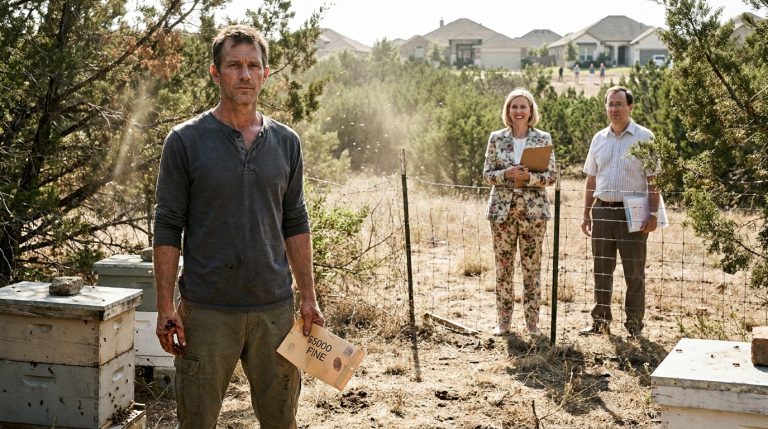
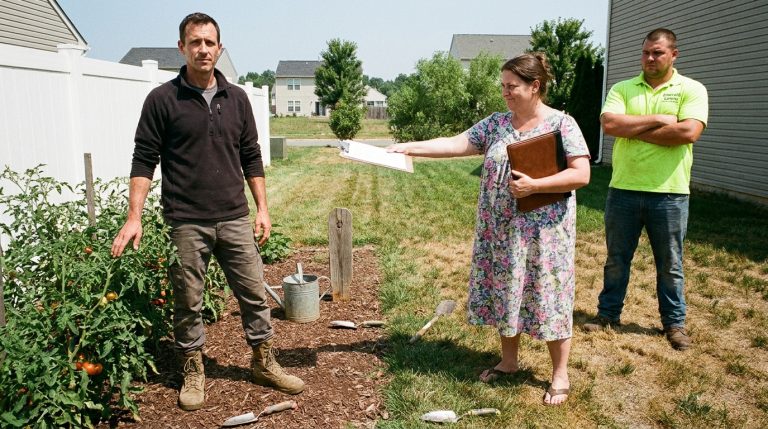
The soil beneath her sensible, square-toed sandals did not belong to her, yet she planted them with the finality of a monument being sunk into wet concrete. Karen’s clipboard rested against her ribs like a shield, its pages fluttering in the draft kicked up by the distant lawnmowers of the Estates at Willow Creek.
“Your bees are a menace, and I’m shutting you down,” she said, her voice carrying the practiced flatness of an office manager issuing a reprimand. “This is your final official warning, Mr. Thorne.”
Marcus did not look up immediately. He finished wiping the edge of the hive tool with a square of clean cotton, his movements unhurried, measured by the internal clock he had calibrated during two decades of listening to distant mortar checks and rotor wash. The air here smelled of sweet clover and dry pine needles, an antidote to the metallic tang that still hummed behind his left ear whenever the barometric pressure dropped.
“A menace, Karen,” he said softly, letting the silence stretch between them until her chin twitched upward in defensive irritation.
She was a creature of parameters, her world bounded by three approved shades of beige paint and grass kept strictly under three inches. She looked past the neat rows of white Langstroth hives tucked two hundred yards away behind the black willow screen, seeing only an irregularity in her grid. She could not see the blossoms opening in the orchards three miles out, nor could she perceive the delicate, invisible web of pollen sticking to the legs of workers returning heavy-laden to the brood chambers.
“Agnes Miller in lot forty-two is deathly allergic,” Karen snapped, her face flushing a blotchy, uneven pink that clashed with her peroxide fringe. “Little Timmy Garcia was stung last week. The entire neighborhood is living in fear.”
Marcus knew Agnes’s medical chart better than Karen did; Agnes’s only real affliction was an intolerance for gluten that she weaponized at every neighborhood potluck. He knew Timmy had taken a tumble from a splintered two-by-four in his own treehouse. But facts were clumsy tools in the hands of someone who preferred a clean, ironed narrative.
“They’re Italian bees, Apis mellifera ligustica,” Marcus said, his tone low and level. “They don’t have time for grudges. They’re too busy working.”
He gestured vaguely toward the property line, where the unpaved earth of his grandfather’s ten acres met the manicured sod of the subdivision. The line was clear in the county deeds, marked by iron pins driven deep into the loam back when Eisenhower was in office, long before the cornfields had been skinned alive by bulldozers to make room for four hundred identical brick-and-siding boxes.
Karen stepped forward, her sandal heel crossing the boundary by half an inch, as if physical occupation could rewrite the plat map. “I am the president of the Estates at Willow Creek,” she declared, her chest swelling beneath the floral fabric. “My authority extends to any nuisance that threatens property values. Pay the fine, or we will place a lien on your land. You will lose everything.”
She dropped the sheaf of papers at his boots—a carbon-copy citation, a pseudo-legal cease-and-desist letter printed on heavy stock—and turned with a sharp rustle of her muumuu, marching back toward the pristine asphalt without once using the sidewalk.
Marcus remained still for a long moment, listening to the steady, rhythmic heartbeat of the hives. The paper lay among the fallen willow leaves, curling slightly at the edges where the morning dew was beginning to soak through. When he finally bent to pick them up, the scent of artificial gardenias lingered in the air, sharp and synthetic, like an unwashed memory.
He walked back toward the old farmhouse, his boots crunching on the gravel path. Sarah was inside, standing at the kitchen island with her sleeves rolled to her elbows, carefully packing small glass hex jars with amber honey. She looked up as the screen door latched behind him, her eyes catching the stiff papers in his hand before reading the set of his jaw.
Before he could speak, seven-year-old Lily trotted in from the hall, holding a crayon drawing of a bee with eight legs and a remarkably cheerful smile. “Daddy, look what I made for the kitchen window,” she said, holding it up.
Marcus looked from the clumsy, beautiful strokes of yellow crayon to the heavy legal jargon resting on the wood. The cold knot in his chest began to dissolve, replaced by a quiet, immovable clarity that felt less like anger and more like the laying of foundations.
“It’s wonderful, sweetheart,” he murmured, lifting her high enough to press a kiss against her cheek, his eyes meeting Sarah’s across the counter. “Just a little paperwork from someone who doesn’t understand our garden.”
CHAPTER 2: The Logic of Plat Maps
The dawn light filtered through the cracked kitchen windowpanes, catching the fine dust motes that danced above the wooden surface where Karen’s cease-and-desist letter still lay like an unexploded shell. Marcus didn’t touch the coffee cup right away; instead, his thumb traced the jagged corner of the carbon-copy citation, feeling the cheap, abrasive texture of the paper. It was a sensory echo of old deployment requisitions—the kind filled out by junior NCOs who mistook volume for authority.
He pulled the heavy county plat map across the table, flattening the oversized blue-and-white sheet with the flat of his palms. The creases were worn soft, feathering at the edges from years of unfolding, but the red ink boundary lines remained crisp. There was the ten-acre rectangle of Thorne Apiary, stamped with agricultural zoning codes that predated the neighboring subdivision by three decades. And right beside it, carved out of what used to be old man Henderson’s south pasture, sat the Estates at Willow Creek—a tight, geometric grid of four hundred identical lots boxed in by curbs and covenants.
The phone beside the coffee maker buzzed once, a short, sharp vibration against the wood. Marcus picked up the receiver on the second ring, his voice dropping into the neutral, level cadence he used when verifying supply manifests.
“Thorne.”
“Marcus. Tell me you’re not sitting out there staring at a patch of clover wondering if she’s going to send the sheriff with a butterfly net.” Dave Rosetti’s voice came through the line, crisp and clipped with the practiced acceleration of a man who spent his mornings picking apart municipal contracts. “Because I’ve spent the last hour pulling the county filings for your lovely neighbor’s little association, and I found something rather amusing.”
Marcus leaned back against the kitchen counter, his eyes fixed on the distant rows of white hives standing silent and industrious against the morning mist. “Amusing usually means expensive for someone, Dave.”
“Only if they’re holding the bag,” Dave replied, paper shuffling in the background. “Here’s the structural reality of your situation: Karen’s cease-and-desist is legally about as intimidating as a strongly worded note left on a windshield. She cites Section 7, Paragraph 4, Sub D—livestock and commercial operations. But her jurisdiction stops dead at the property line. Your land isn’t covenanted. It never was. If she tries to slap a lien on your title without an actual court-ordered judgment, we hit her with a slander of title suit so fast her permanent wave will straighten out.”
Marcus felt the tight knot of tension in his chest loosen slightly, but the tactical caution drilled into him during twenty years of service kept the satisfaction in check. A bully didn’t stop swinging just because you showed them a rulebook; they simply looked for a heavier stick.
“She’s not just swinging blindly, Dave,” Marcus said quietly, his gaze shifting to the small stack of neighborhood directories he’d pulled from online archives the night before. “She’s claiming multiple public complaints. That means she’s either manufacturing the panic or leaning on people who don’t know any better.”
“Then change the terrain,” Dave said, his tone turning sharp and professional. “You’re a logistics guy, Marcus. You don’t fight an insurgency by arguing with every soldier on the perimeter; you cut the supply lines. Get yourself down to the county agricultural extension office. Talk to Dr. Vance or whoever handles local apiculture protection. Find out if your state has a right-to-farm act that covers small-scale pollinators. Once you anchor yourself to state agricultural code, her little HOA bylaws become nothing more than expensive toilet paper.”
“Already on it,” Marcus said.
“Good. And Marcus? Document everything. Every phone call, every footprint on your side of the property line, every scrap of paper she drops. When we drop the counter-notice, I want an airtight mountain of facts so high she can’t climb over it.”
The line clicked dead with a sharp tone. Marcus set the phone down and stared at the plat map once more. Dave was right about the legal firewall, but an administrative defense only held the line; it didn’t push the enemy back. To do that, he needed intelligence on the terrain beyond his own fence.
He left the farmhouse ten minutes later, sliding behind the wheel of his dented pickup truck and driving the short distance down the county road toward the agricultural extension office. The air through the rolled-down window carried the dry, earthy scent of late-summer stubble and the faint, sweet trace of ripening apples from the orchards bordering the subdivision.
At the extension office, tucked away in a low brick building behind the county courthouse, Dr. Eleanor Vance looked up from a massive topographic display glowing on her desktop monitor. She was a woman whose graying hair was caught back in a sensible clip, her fingers stained faintly with printer ink and potting soil.
“An HOA dispute?” she sighed, removing her half-moon reading glasses as Marcus laid out the paperwork. “Mr. Thorne, it’s the oldest tragedy in modern zoning. People move out of the city because they want the rustic charm of open fields, orchards, and fresh honey, but the moment they see a honeybee doing its job near their pristine patio furniture, they panic as if you’ve uncaged a tiger.”
She turned her monitor toward him, clicking a mouse to overlay a complex web of translucent green circles across a satellite image of the local township.
“Your state’s Right-to-Farm Act explicitly protects registered apiculture from nuisance suits filed by residential interlopers,” Dr. Vance said, tapping a finger against the glass of the screen. “As long as you’re following best management practices—water sources, flight barriers, density limits—you’re completely insulated from municipal overreach.”
She paused, a slow, knowing smile touching the corners of her mouth as she zoomed in tighter on the cluster of rooftops representing the Estates at Willow Creek.
“In fact, Mr. Thorne, if you look at the GIS data we’ve been compiling for the county orchard registry, your apiary isn’t just a quiet hobby. It’s the primary engine keeping half the backyard fruit trees in this zip code alive. Look at these properties inside your three-mile foraging radius—apples, pears, plums. Their yields have quadrupled since you set up those Langstroth boxes five years ago. Without your bees, half the ornamental crabapples and fruit trees in that subdivision are nothing more than expensive, sterile sticks.”
Marcus stared at the glowing green circles intersecting the rigid, sterile grid of the subdivision. The hot coal of anger in his gut shifted, cooling into something sharp, bright, and structural. Karen hadn’t just picked a fight with a neighbor; she had threatened the very invisible infrastructure holding her own neighborhood’s value together.
He thanked Dr. Vance, gathered his files, and walked back out into the bright afternoon glare. The pickup’s engine turned over with a familiar, heavy rumble as he headed back toward the gravel drive of Thorne Apiary. The legal firewall was built. The intelligence was gathered. Now it was time to map out the counter-offensive.
CHAPTER 3: The Midnight Distribution of Amber and Ink
The kitchen counter was a sea of small, amber-filled hexagons and stiff white paper. Sarah worked beside him with quiet efficiency, her fingers wrapping twine around the necks of two-ounce sampler jars while Lily pressed custom labels onto each one—a tiny line drawing of a honeybee resting on a clover blossom, accompanied by the bold stamp of Thorne Apiary.
“They’re going to think we’re running for mayor, Marcus,” Sarah said, though her mouth curved in a faint, knowing smile as she tucked a stray lock of dark hair behind her ear.
“Mayors have to campaign,” Marcus replied, sliding another printed GIS map beneath the heavy glass of a jar to check its alignment. “We’re just reminding people what’s keeping their apple trees from turning into firewood.”
The legal firewall Dave Rosetti had constructed was strong, but a legal defense only kept the walls standing. To shift the momentum, he needed the constituents of the Estates at Willow Creek to look past Karen’s manufactured panic and see the physical reality right outside their kitchen windows. The data from Dr. Vance—the four-hundred-percent spike in fruit yields, the invisible pollination corridor stretching right across their manicured lawns—was too valuable to keep locked in a file folder.
By dusk, the boxes were packed. The autumn air had grown sharp, carrying the dry, rustling scent of fallen oak leaves across the property line into the silent, rigid grid of the subdivision.
Marcus left the pickup in his own drive and walked the perimeter on foot, a ghost moving through the shadows of the uniform brick houses. There were no streetlights deep within the cul-de-sacs, only the amber glow of carriage lamps mounted beside identical front doors. The quiet was absolute, broken only by the distant hum of an air conditioner or the faint murmur of a television behind triple-paned glass.
House by house, he moved with the measured, silent grace he had practiced in other places under different stars. On every concrete step, tucked neatly behind the brass handles of storm doors, he placed a single two-ounce jar of honey and a folded two-page briefing packet. The packet laid out the facts plainly: the maps, the property value premiums driven by mature fruit trees, and the hard economic truth of who was keeping their orchards alive. He skipped only one house—lot 12, the corner property where a heavy stone fountain and manicured boxwoods marked Karen’s domain. Let her find out what was happening from her neighbors. Let the buzz start without her intervention.
As he stepped back onto his own land, slipping past the black willow barrier where the hives whispered in the dark, a cold, steady satisfaction settled into his bones. The seeds were planted. When the emergency board meeting convened next week, Karen wouldn’t just be facing a lawyer’s letter; she would be facing a neighborhood waking up to its own interests.
CHAPTER 4: The Climate in the Clubhouse
The air inside the Estates at Willow Creek community clubhouse smelled of commercial carpet cleaner and damp wool. It was an environment designed for bland conformity—beige walls adorned with framed certificates of architectural approval and rows of cheap metal folding chairs that scraped harshly against the linoleum whenever someone shifted their weight. Tonight, however, the room was packed to the point of suffocation. Residents stood three-deep along the back walls, their faces tight with a nervous, collective energy that felt less like a routine budget review and more like a muster before an engagement.
Marcus walked down the center aisle with slow, measured strides, his boots making a dull, solid sound against the floor. Sarah walked a half-step behind him, her presence steady and unyielding. They took seats in the second row, directly facing the long folding table where the board of directors sat.
At the center of the table sat Karen. She wore a power-red blazer that strained slightly across her shoulders, her face set in a rigid, unyielding mask of righteous indignation. To her right, the nervous treasurer dabbed his forehead with a handkerchief; to her left, Brenda the secretary stared intently at a bound copy of the association bylaws, her expression carefully neutral.
Karen struck a small wooden gavel against the table, the sharp crack cutting through the low murmur of the crowd.
“This emergency meeting of the Estates at Willow Creek Homeowners Association is now in session,” Karen announced, her voice pitched high and tight. “The sole item on tonight’s agenda is the ongoing public nuisance and safety violation posed by the commercial bee farm operating on the adjacent property. We are here to vote on authorizing legal counsel to pursue an immediate injunction and property lien.”
A ripple of uneasy whispers moved through the rows. Karen raised a hand, her eyes sweeping over the crowd with calculated authority. She began to speak, her tone dripping with rehearsed concern—invoking plummeting property values, the phantom menace of aggressive swarms, and the supposed terror of families living in the shadow of an unchecked hazard. It was a masterclass in fearmongering, designed to push the room into blind compliance.
Marcus didn’t interrupt. He unzipped his leather folder, his fingers sliding across the crisp edges of the GIS maps and the financial spreadsheets Mr. Miller had quietly slipped him earlier that evening. The decoy secret—the quiet realization that Karen’s aggressive crusade was deeply tied to protecting her own mismanaged landscaping contracts and hiding inflated community expenditures—was about to collide directly with her public performance.
“Point of order, Madam President,” a voice boomed from the back of the room.
Carlos Garcia stood up, his massive frame towering over the rows of seated residents, holding one of the honey-jar briefing packets in his heavy hand. “The bylaws state that a property owner facing board action has the right to be heard before any vote is cast. Mr. Thorne is sitting right there. He has a floor right now.”
Karen’s face tightened into a mottled, dangerous purple. “Mr. Garcia, this is an administrative safety matter concerning the community—”
“He’s right,” Brenda interrupted from the end of the table, her voice cutting clean across Karen’s protests as she tapped a finger against the open pages of the bylaws. “Section twelve, paragraph three. Right to be heard. The resident must be permitted to address the board.”
The tension in the room snapped taut. Karen looked around the table, realizing too late that her absolute control had begun to fray at the edges. With a sharp, shuddering breath, she gestured toward the small wooden lectern.
“Five minutes, Mr. Thorne,” she hissed, her voice vibrating with suppressed fury. “Not a second more.”
Marcus rose from his metal chair, leaving the folder resting flat on his knees for one final moment before walking forward into the harsh glare of the fluorescent lights. The room fell utterly silent, waiting for the first collision between the grid and the living earth.
CHAPTER 5: The Unraveling of the Gilded Ledger
The hum of the ceiling ventilation units felt unnaturally loud in the sudden vacuum of sound. Marcus didn’t rush his approach to the lectern; he moved with the steady, unhurried cadence of a man who had walked across worse terrain under heavier skies. Every pair of eyes in the packed room—from the nervous treasurer clutching his damp handkerchief to the rigid, mottled face of Karen behind the board table—anchored on him as he placed the leather folder down on the small wooden surface.
“Thank you, Madam President, and thank you, members of the board and residents of the Estates,” Marcus began, his voice level, carrying effortlessly across the linoleum without a trace of hesitation. “My name is Marcus Thorne. My wife Sarah and I live on the property next door. I’m not here tonight to debate your bylaws, because as everyone in this room is well aware, they do not apply to my land. I am here to talk about value.”
He paused, letting the word sink into the stale air. A few heads nodded slowly in the front rows.
“I understand this community was founded on the promise of protecting property values. That is the core mission of an association like yours—to ensure that the collective investment of every homeowner here remains secure and grows over time. Last night, I left a small sample of honey and a short briefing packet on your doorsteps. I hope you had a chance to look at it, because the figures inside are not about personal feelings or neighborhood disputes. They are about your money.”
Marcus gestured toward Carlos Garcia, who stood tall near the back aisle. “Mr. Garcia is a construction foreman. He understands foundations. But the true foundation of this subdivision’s curb appeal isn’t just the uniform coat of beige paint on your siding or the strict height of your lawns. It is the mature landscaping, specifically the vast network of fruit-bearing trees planted by the original developer.”
Karen gripped the edges of the folding table so tightly her knuckles whitened to a translucent bone color. “Mr. Thorne, this is entirely out of order—”
“Point of order,” Mr. Miller, the retired accountant sitting near the front, cut in with a calm, surgical precision that silenced her instantly. “The resident has the floor, and the community has a right to financial transparency.”
Marcus didn’t break his rhythm. “For the past five years, those trees have become remarkably, almost miraculously fruitful. Pears, apples, cherries—your yards overflow with them every autumn. Real estate data shows that properties with mature fruit orchards command a five to seven percent premium in curb appeal. Across this entire subdivision, that fruit premium accounts for over one and a half million dollars in collective property value.”
A low murmur rippled through the rows. Neighbors began looking down at the printed sheets they had carried in from their porches.
“Now, you might ask why those trees suddenly turned so productive,” Marcus continued, his eyes scanning the room. “The answer is straightforward biology and pollination. According to county agricultural records, the native pollinator population within this immediate grid is practically zero. The sole reason your trees bear fruit—the reason for that million-and-a-half-dollar boost in your collective net worth—is sitting right across your property line. It’s my bees.”
He let the silence stretch, heavy and absolute, before turning his gaze directly toward the center of the board table.
“Your president is asking you tonight to spend your association dues on legal fees to sue me, to force the removal of the very asset underpinning a significant portion of your property values. She is asking you to pay for the privilege of diminishing your own investment.”
Karen’s face had shifted from a furious crimson to a pale, mottled ash. She opened her mouth to speak, but no sound came out.
Before she could recover, Mr. Miller stood up, holding his own set of printed bank statements and public ledger summaries. “And while we are on the subject of where our association dues are going, Madam President,” the retired accountant said, his tone conversational yet lethal, “perhaps you can explain why the landscaping budget has mysteriously ballooned by thirty percent this year, with every single extra dollar funneled directly to a company called Lawn and Order Landscaping—a business owned by your nephew, which conveniently spent its entire season installing an unpermitted, high-end stone koi pond and waterfall exclusively in your backyard.”
The room erupted. The controlled tension of the meeting shattered instantly into a chaotic wave of outraged shouts and disbelieving gasps. The nervous treasurer slumped forward, burying his face in his hands, while Karen scrambled to her feet, her voice cracking as she shrieked accusations of slander and betrayal into a room that had already stopped listening.
Carlos Garcia pushed forward down the center aisle, his voice booming over the din. “I move for an immediate vote of no confidence in President Karen!”
“Seconded!” shouted a dozen voices simultaneously from the middle rows.
Brenda, the secretary, barely glanced at the sputtering former president before consulting her manual. “Motion is properly seconded. All in favor of removing Karen from her position effective immediately, say aye.”
A deafening roar of ayes filled the clubhouse, shaking the cheap metal folding chairs against the floor. It was nearly unanimous.
Karen stood frozen for a long, agonizing heartbeat, her eyes darting across the sea of turned backs and hard, unyielding gazes. There were no allies left, no rules left to twist, no administrative shields behind which to hide. With a choked, desperate sob, she grabbed her purse and her empty clipboard, shoving blindly through the crowd toward the exit. The heavy double doors slammed shut behind her, cutting off the noise and leaving a breathless, trembling calm in the room.
Marcus remained standing at the lectern as the acting vice president sheepishly took the gavel, formally tabling the lawsuit against the apiary forever. Sarah met his eyes from the second row, her expression radiant with a quiet, fierce pride. The administrative war of attrition was over. The grid had finally recognized the living world that sustained it.
CHAPTER 6: The First Harvest Festival and the Weight of Silence
The weeks following the tumultuous club meeting settled over the Estates at Willow Creek like a slow, unhurried breath. The sharp, abrasive friction of strict municipal codes began to soften around the edges, worn down by the quiet realization that a community did not need to be uniform to be whole. A basketball hoop appeared at the end of a driveway on lot thirty-eight and stayed there, unremarked and unpunished. Bright patches of marigolds and wild coneflowers sprouted in borders where clipped Kentucky bluegrass had once reigned supreme.
Karen’s house sold within a month, though at a heavy discount dictated by the unpermitted, costly removal of her stone koi pond before closing. She became a ghost of her own making, slipping away into the wider city without a word of farewell. Her former allies on the board had resigned in quiet disgrace, replaced by a newly constituted administration under Mr. Miller, whose first official act was to draft a formal, written apology to Marcus, accompanied by a check refunding the petty fines. Marcus never cashed it; instead, he framed the paper and hung it on the rough pine wall of his workshop—a silent monument to a conflict resolved not through force, but through weight of fact.
The second official act of the new board proved far more enduring. Ratified by a unanimous vote during a crisp October evening, the association amended its covenants to establish a formal community support zone, recognizing Thorne Apiary not as a nuisance, but as an essential ecological and economic partner. A small annual stipend was allocated for pollination services, and a carved oak sign was erected near the property line, bearing the script: Welcome to The Estates at Willow Creek, a pollinator-friendly community, proudly supported by Thorne Apiary.
On a brilliant Saturday afternoon in late October, the neighborhood held its first annual autumn harvest festival. The central green space behind the clubhouse groaned under the weight of long wooden tables laden with apple pies, pear crisps, and spiced ciders, every single entry crafted from the abundant fruit yielded by the subdivision’s revitalized orchards. A massive banner fluttered in the gentle breeze, celebrating the local bake-off where honey from Thorne Apiary was the mandatory baseline ingredient.
Marcus stood near the edge of the green, his boots planted firmly in the dry earth, watching seven-year-old Lily run across the grass with a handful of children from the neighborhood, her laughter mingling with the steady, distant drone of the hives. Sarah stood beside him, her hand tucked comfortably into the crook of his arm, her eyes reflecting the warm, slanted amber light of the setting sun.
Mr. Miller walked over, holding a paper plate weighed down by a generous slice of apple-honey pie, a sheepish yet genuine grin creaking across his weathered features.
“Evening, Marcus,” the retired accountant said, nodding respectfully toward Sarah as well. “I was just telling the committee down by the cider press that we owe you more than just an apology. The county agricultural extension office called in another report today. They’re calling it the Willow Creek effect—native bumblebees and butterflies we haven’t seen in a decade are returning to the yards. You didn’t just defend your land, Marcus. You woke ours up.”
“People just needed to see what was keeping the trees alive, Miller,” Marcus replied, his voice quiet, steady, and devoid of any triumph. “Nature doesn’t care much about property lines. It only cares about what you give back to the soil.”
As Miller wandered back toward the murmur of the crowd, Marcus felt the faint, familiar ringing in his left ear—a lingering echo of distant days and old deployments—fade into the background, completely drowned out by the warm, persistent hum of the evening settling over the land. The war of paperwork and pride was long gone, replaced by a deeper, enduring reality. Karen had wanted to build walls of separation and scarcity, but the bees had built bridges.
He looked down at his calloused hands, then out across the vibrant, fruitful orchards stretching toward the horizon. The truth of the land was simple, patient, and unbreakable. You did not conquer a landscape; you tended it, and in return, it held you upright.