The Echo of the Steel: A Final Promise Kept Under the Pine Ridge Sun
CHAPTER 1: The Weight of Wood and Iron
The wood of the counter was scarred, mapped with the nicks of a thousand weekend shooters who had come here to chase a feeling they couldn’t quite name. Walter James Hendricks laid his hand flat against it, feeling the grain. It was solid. Real. He had been doing this for half a century, and his body knew the topography of a firing bench better than it knew the layout of his own quiet house.
“He’s just an old man,” the voice came from the register, sharp and careless. Derek Callahan leaned back against the wall, his arms folded in a way that mimicked the posture of better men than him. “Probably lost. Somebody point him toward the pistol bay before he hurts himself.”
Walter didn’t flinch. He didn’t even turn his head toward the sound. The sneer meant nothing; it was just the friction of the world, and he had learned long ago that the world was mostly noise. He focused on the logbook. The ink of his signature was deliberate, steady, a sharp contrast to the tremor that had been plaguing his right thigh since the damp air settled in last night. He wasn’t here for the rangemaster. He wasn’t here for the smirks of the men gathered near the coffee pot.
He was here for a debt.
“Lane seven,” Walter said, his voice a dry rasp, like leaves dragging over pavement.
Derek’s gaze flickered to the rifle case Walter carried—a sturdy, weathered thing with a distinct dent on the corner. It was a scar earned in a different life, on a tarmac where the sun had been too bright and the silence had been too heavy. Walter hadn’t bothered to repair it. Some things aren’t meant to be fixed; they are meant to be carried.
“The Mike Course,” Walter added.
The room went still. The low, incessant whir of the ceiling fan seemed to catch in its gears. Derek’s smirk vanished, replaced by a momentary, confused silence that suggested he didn’t know whether to laugh or reach for a rulebook. He knew what the Mike Course was. Everyone in this building knew. It was the white whale of Pine Ridge—ten rounds, five distances, four minutes. Cold bore. No warm-up. And for forty years, the record had been held by a ghost.
Walter reached into his inner pocket, his fingers brushing against the worn leather of his wallet. Tucked inside was a card, its edges softened by time, its lamination peeling back like a scab. It was a piece of him, a sliver of 1985.
As he slid the money across the counter, his hand betrayed him, twitching just enough to catch the light. Derek’s eyes narrowed, a cruel realization dawning on him.
“Sir,” Derek began, his voice dropping into a patronizing register, “I don’t think you understand. This isn’t a hobbyist’s lane. Last guy who tried that was a Delta operator, and he walked off the line in pieces. You’re going to want to take your time.”
Walter didn’t look at him. He was looking past the counter, through the glass, toward the red clay of the berms. He could already feel the rifle, the way the bolt would catch, the way the scope would settle into the heat-haze of the morning.
“I won’t be taking any time at all,” Walter said softly.
He turned, but as he reached for the handle of his rifle case, his eyes caught the reflection in the observation window—not his own face, but the flickering image of something else entirely. Behind him, the shadow of a man was standing in the doorway, wearing a field jacket that looked far too familiar, his hand already moving toward the brim of his hat. It wasn’t the rangemaster. It was someone who knew exactly why Walter was here, and as their eyes locked in the glass, Walter felt a sudden, sharp clarity: the promise wasn’t just a memory anymore. It was standing right behind him.
CHAPTER 2: The Geometry of Silence
The man standing behind Walter was not a shadow. He was substance and memory, a living anchor dropped into the churning drift of the morning. Tommy Branson. The name sat in the back of Walter’s mind like a spent round, heavy and metallic. He didn’t turn around immediately. He kept his eyes on the glass, watching the way Tommy’s silhouette stood—shoulders square, hands relaxed but ready, a posture that hadn’t changed since the mud-caked winters of the late seventies.
“Lane seven,” the rangemaster, Derek, repeated, his voice losing its mocking edge and taking on a brittle, uncertain quality. He was looking past Walter, his eyes darting toward the figure behind him, his own bravado wilting like a cut flower in the heat. “You’re really going to run the Mike?”
Walter didn’t bother answering the boy. He reached for his rifle case, his movements slow and deliberate. Every hinge of the case, every latch of the lock, had a specific sound—a mechanical language he had learned to translate into a rhythm of calm. He placed the case on the bench. When he unlatched it, the click was loud, almost aggressive, cutting through the ambient hum of the range.
Inside, the Remington 700 rested on its velvet bed. It was more than a tool; it was a testament. The walnut stock was worn smooth at the contact points, polished by the friction of a thousand hours of patience. Walter didn’t look at Tommy. He didn’t need to. He could feel the older man’s gaze—not on him, but on the rifle, acknowledging the integrity of the steel.
“You’re going to need more than steady hands for that course, old-timer,” Derek muttered, trying to regain his footing, his voice a frantic attempt to reassert control over a situation he clearly didn’t understand.
Walter ignored him. He began the ritual. It was a sequence of movements so ingrained in his muscle memory that his brain could remain entirely focused on the geometry of the target. He laid out the rounds. Each one was a hand-loaded, 168-grain match bullet, set in a neat, equidistant row.
He didn’t look at the record wall. He didn’t look at the brass plates that other men had fought to earn. He simply sat on the stool, closed his eyes, and began the breath.
Four seconds in. The air, cool and metallic, filled his lungs.
Four seconds hold. The stillness of the world locked into his diaphragm.
Six seconds out. The tension of the morning—the mockery, the doubt, the weight of the years—evaporated with the carbon dioxide.
From the corner of his eye, he saw Tommy shift his weight. A boot scraped on the concrete, a dull, resonant sound that felt like a heartbeat. The air in the range shifted. The sneers from the coffee drinkers near the office door had died out. There was a new stillness here, a heavier, more expectant gravity.
Walter opened his eyes. He didn’t look at the targets yet. He looked at the rag he kept in his kit—a piece of green fabric that had seen better decades. He wiped the scope lens, not because it was dirty, but because the act itself was a prayer, a way of narrowing his world down to the exact diameter of the lens.
“Jeff,” Derek called out, his voice now high and thin. “Go check the electronic scoring on lane seven. It better be calibrated.”
“It’s calibrated, Derek,” a voice from the office replied, sounding tired and annoyed. “Leave the man alone.”
Walter shifted, his body adjusting to the prone position. The mat beneath him was thin, frayed at the edges, but it felt like the firmest ground he had ever occupied. He felt the cold concrete through the material, the solidity of the earth beneath the range. He checked the wind. The flag at four hundred meters was listless, barely shivering against the pale blue of the morning sky.
He loaded the first round. The bolt glided forward, a seamless, silent operation of steel against steel. He didn’t rush. He didn’t try to prove anything. He simply existed in the space between the finger and the trigger.
Behind him, he heard a sharp, intake of breath. It was Tommy.
Walter leaned into the stock. He felt the familiar weight of the walnut against his cheek, the cold hardness of the receiver, the way the rifle seemed to naturally seek the horizon. For a fleeting second, the forty-year gap vanished. He wasn’t seventy-four. He wasn’t the man with the shaking hands and the faded jacket. He was in the triple canopy, in the soft, wet heat of 1968, waiting for the wind to tell him when it was time.
He adjusted his sight, not by the numbers on the dial, but by the feel of the resistance in the knob. He knew this rifle’s personality. He knew how it hungered for the target.
“Shooter ready,” Walter whispered, the words intended only for himself.
He felt a presence shift closer. Tommy was standing right behind his shoulder now, so close that Walter could smell the scent of old spice and stale coffee. Tommy didn’t speak. He didn’t offer advice. He simply stood in silence, a sentinel to a promise that was about to be honored.
Walter’s finger found the trigger. It wasn’t a choice; it was a conclusion. The tremor in his hand, which had been so apparent when he first walked through the door, vanished. The stillness returned, absolute and terrifying. He waited for the wind to offer its permission. He waited for the world to stop moving.
And in that moment, as the morning sun hit the steel targets down-range with a blinding, white-hot glare, Walter finally understood why he had come back. It wasn’t to reclaim a glory that had long since rusted. It was to see if the version of himself he had carried for forty years was still capable of seeing the truth.
He didn’t fire. Not yet. He just sat there, braced against the earth, holding his breath as the range, the office, the rangemaster, and the entire waking world held theirs with him.
CHAPTER 3: The Arrival of the Witness
The sound reached them first—a gravel-spraying, high-velocity arrival that didn’t belong in the deliberate, slow-motion atmosphere Walter had carved out on lane seven. It was the roar of an engine pushed too hard, followed by the crunch of heavy tires digging into the packed earth of the parking lot. Dust, caught in the low-slung morning light, billowed up like a warning signal.
Walter didn’t turn. He stayed locked in the prone position, his cheek pressed against the walnut stock, his vision confined to the circular, unwavering world of the scope. But he felt the change in the air. The vibration of the truck’s door slamming echoed against the range’s corrugated metal walls, a sharp, percussive bang that made the rangemaster, Derek, jump.
“Oh, what the hell now?” Derek’s voice was a thin, panicked whine. He had been edging toward the observation window, his face pale, but he now turned, his attention split between the old man on the mat and the newcomer.
Tommy Branson moved before anyone else could. The man who had been standing as still as a statue behind Walter’s shoulder finally broke his posture. He didn’t rush—he didn’t know how to rush—but he moved with the surgical, efficient economy of a man who had spent three decades teaching others how to manage space. He stepped away from the lane, his gait rolling and heavy, and moved toward the edge of the covered walkway.
Walter kept his breathing rhythmic. Four seconds in. Four seconds hold. Six seconds out. The arrival was a complication, but complications were just physics. They were obstacles to be calculated, windage to be accounted for.
He heard footsteps on the gravel—heavy, rhythmic, authoritative. They weren’t the hurried, stumbling steps of a civilian. They had the distinct, weighted cadence of a man who had marched on parade decks and through jungle brush, a man who moved because he had somewhere to be and the absolute right to be there.
“You can’t be up here,” Derek called out, his voice cracking, trying to maintain some vestige of his authority. “I’m telling you, this is a private—”
“Son,” a voice interrupted. It was a low, gravelly vibration that seemed to carry the weight of a thousand miles. “I need you to go back to the office, sit down, and be quiet right now.”
Walter felt a ghost of a smile touch the corners of his mouth. It was Tommy. The voice was unmistakable—a blend of drill instructor command and something softer, something earned.
“Excuse me? I work—”
“I know who you work for,” the voice continued, smooth and dangerous. “I’m friends with him. You’re going to want to do what I just said.”
The silence that followed was total. It was the silence of a man being told the truth for the first time in his life. Walter shifted his weight, adjusting the bipod just a fraction of a millimeter. He didn’t look back. He didn’t need to see the look on Derek’s face. He could imagine it—the slow, creeping realization that the hierarchy he had built in his mind was nothing more than a fragile shell.
Tommy returned to his spot, ten feet behind Walter. He stood at attention, his hands clasped behind his back, his jaw set in a line of granite. He was an anchor. He was the only person on this range who knew the specific weight of the promise Walter was currently trying to keep.
Marcus, the young shooter on lane nine, had lowered his rifle. He was watching the interaction with a look of stunned reverence. He hadn’t touched his own gear in minutes. He looked at Tommy, then at the back of Walter’s head, and finally at the rifle resting on the bench. He was seeing the architecture of a legend, and he was trying to memorize every bolt, every scratch, every breath.
Walter ignored the mounting pressure. The presence of Tommy Branson wasn’t a distraction; it was a baseline. It was the standard. It was the reason he had spent four months in the garage, cleaning the Remington, oiling the bolt, and visualizing this specific target, this specific wind, this specific morning.
“Shooter ready,” the range officer, Pete, said. His voice was different now. It had lost its professional detachment and gained a tremor of genuine, unadulterated awe.
Walter exhaled. “Ready.”
“Stand by.”
The wind shifted. A breath of air from the north, smelling of damp loblolly pines and the faint, copper-like tang of cooling brass, drifted across the range. Walter felt it against his neck. He felt the minute shift in the rifle’s balance. He didn’t need to look at the flags. He could feel the movement of the air in the way the rifle sat against his shoulder.
He had promised Elias Moore. It wasn’t a promise made in a grand hall or under a flag. It was made in the dark, frantic, desperate hours of a field hospital where the air was thick with the smell of iodine and ozone. Elias had looked at him, his face pale, his hands still, and whispered, 98 ain’t a hundred, son.
Walter had spent forty years proving he could hit 98. He had spent the last four decades wondering what it would take to hit a hundred.
He didn’t think about the score. He didn’t think about the record wall. He didn’t think about the young man at the counter or the gunnery sergeant behind him. He focused entirely on the image in his scope. The silhouette was just a shape—a piece of physics, a challenge to be answered.
He squeezed the trigger.
The rifle didn’t jump; it moved with him, a extension of his own skeletal structure. The report was a clean, sharp crack that seemed to peel away the layers of noise and chaos surrounding the range. For a split second, there was nothing but the sound of the steel—a pure, resonant ring that echoed down the valley and seemed to hang in the air long after the echo had faded.
“Ten,” Pete said, his voice quiet.
Walter didn’t blink. He worked the bolt, the brass case spinning out and clattering against the concrete with a sound like a dropping coin. He was ready for the next one. The world was narrowing, focusing, sharpening into a single, crystalline point of intent. The arrival of the F-250, the slamming door, the hushed voices of the crowd—all of it had receded into a dull, unimportant hum. There was only the rifle, the target, and the debt he was currently paying down, one round at a time.
CHAPTER 4: The Cadence of the Promise
The second round was a mirror of the first. There was no hesitation in Walter’s fingers as he worked the bolt—a fluid, practiced motion that felt less like operating a machine and more like unfolding a familiar map. He felt the weight of the bolt handle, the cold, reassuring resistance of the spring, and then the satisfying thunk as the round seated itself in the chamber.
He adjusted his position on the mat. The fabric was rough against his elbows, a texture he had known for decades, a map of his own history written in friction. He didn’t look at the score console at the back of the lane. He didn’t need the red LED numbers to tell him what his ears had already confirmed. The strike on the steel silhouette had been perfect, a clean, high-frequency ring that spoke of precision and physics held in perfect balance.
From the corner of his eye, he could sense the shift in the range’s internal climate. The skeptical whispers that had been present only minutes ago—the patronizing “old-timer” comments from the rangemaster—had been choked out by the sheer, undeniable reality of the performance. The silence that had descended on the covered walkway wasn’t merely the absence of talk; it was the heavy, attentive quiet of a crowd that had realized it was witnessing something singular.
Walter focused on the next distance. Four hundred and seventy-five meters.
He didn’t need a calculator. He didn’t need a wind-meter. He understood the air, the way it curled around the pine trees at the edge of the range and flowed into the valley like an invisible river. He dialed the windage knob—one-eighth of a click—and his hand was steady. The tremor that had plagued him in the office, the one the rangemaster had mocked, was completely gone. It was as if the rifle had absorbed the instability, pulling the energy from his nerves and grounding it into the earth.
Four seconds in.
He felt the rifle’s heartbeat, the slight vibration of his own pulse against the stock. He didn’t fight it. He let the reticle dance on the edge of the target, waiting for the oscillation of his own body to sync with the natural rhythm of the environment.
Four seconds hold.
He was thinking of Elias. Not the Elias of the field hospital, the man with the sweat on his brow and the fear of the unknown in his eyes, but the Elias of the winter of ’67. The man who had shown him that a rifle was not an instrument of violence, but an instrument of philosophy. You don’t fight the target, son, Elias had said, his voice as smooth as polished stone. You find the space where the bullet belongs, and you simply open the door for it.
Six seconds out.
He pressed the trigger.
The recoil was a gentle, familiar shove against his shoulder. He watched through the scope, his eye glued to the magnified world of the distance. He saw the flicker of the steel silhouette, the way it shivered under the impact, and then, a heartbeat later, the sound returned—a sharp, musical note that seemed to carry the weight of everything Walter had been carrying for forty years.
“Ten,” Pete said, his voice barely a whisper.
Walter didn’t react. He was already working the bolt. Clack-clack. The brass shell spun out, glittering in the morning light like a small, discarded star, and landed on the concrete with a sound that felt loud, final, and undeniably rhythmic.
He was in the flow now. The “Mike Course” was no longer a series of targets; it was a conversation. Each distance was a question, and his rifle was providing the answer. He shifted his grip, feeling the sweat start to prickle on his forehead, a mild, cooling dampness that didn’t distract him but rather sharpened his focus.
He noticed, in a moment of peripheral clarity, the brass casing from the first round. It was lying near his left hand, and for a fleeting second, his gaze snagged on the small, folded yellow piece of paper tucked inside the open mouth of the cartridge. It was his anchor. The decoy secret—the idea that he was just an old man trying to prove his relevance—was currently being dismantled, one round at a time, but the true weight of the exercise remained locked in that small, metallic cylinder.
Tommy Branson was still behind him. Walter could feel the man’s presence, a wall of support that didn’t need to speak. Tommy was the witness to the promise. He was the only person present who understood that this wasn’t about the record wall, nor about the rangemaster’s ego, nor about the crowd.
Walter chambered the third round. Five hundred and fifty meters. The distance was creeping up, the difficulty increasing, but Walter felt lighter. The “Kintsugi” of his own life—the cracks, the repairs, the shrapnel scars in his thigh, the grief of losing Margaret, the hollow ache of Elias’s departure—was being gilded by the performance. He was repairing the architecture of his own memory with every perfect shot.
He caught a glimpse of Derek Callahan through the observation window. The rangemaster wasn’t sneering anymore. He was standing there, his phone clutched in his hand, his eyes wide and fixed on lane seven. He looked as if he were watching a house collapse, the foundation of his assumptions crumbling in real-time. Walter felt a strange, cold pity for the boy. Derek wanted to be a guardian of the gate, but he had never learned that the gate wasn’t for protection—it was for entry.
Walter’s breathing remained calm. The range was so quiet that he could hear the wind rustling through the pines at the far end of the property. He was in the rhythm now. Ten rounds. Ten hits. And each one was a thread being pulled tight, stitching the past to the present until there was no gap left between them.
He settled his cheek back onto the walnut. He found the target. He opened the door.
CHAPTER 5: The Friction of Memory
The bolt didn’t slide home.
It hung for a heartbeat—a jarring, mechanical protest that vibrated up Walter’s arm and into his shoulder. It was a sound he knew: the protest of metal that had been pushed, the wear and tear of a Remington that had been firing for more than forty years. But in that same millisecond, the sound transformed. It wasn’t just metal on metal; it was the screech of a heavy transport door slamming shut on the tarmac at Da Nang, the smell of jet fuel and rot, the feeling of his hands fumbling with a dropped case—the case that still bore the dent from that day.
The memory hit him like a physical blow, a phantom pressure in his chest. His heart, which had been a steady, metronomic companion throughout the first four shots, suddenly stuttered. A pulse of heat flared behind his eyes.
Walter forced himself to freeze. He didn’t try to force the bolt. He breathed—slowly, painfully—recalculating the space between the action and the reaction. He felt the phantom weight of the past trying to drag his hand down, trying to remind him that he was seventy-four, that his knees were brittle, that the man he was honoring was long dead, and that even the best steel eventually fatigues.
He waited. He didn’t force the action. He allowed the rifle to settle. After a long, agonizing moment, he nudged the bolt handle. It slid home with a soft, forgiving click.
He had lost six seconds.
He didn’t check his watch. He didn’t look at Pete. He simply refocused on the scope. Six hundred meters. The target was a grey smudge in the distance, partially obscured by the heat shimmer rising off the red clay. He wasn’t shooting against the wind anymore; he was shooting against the erosion of his own biology.
He felt Tommy’s presence behind him like a heat source. Tommy didn’t make a sound, but Walter could feel the focus of the other man—a quiet, absolute stillness that acted as a stabilizing force. If Walter had faltered, if he had let the memory of that tarmac in 1968 dictate the mechanics of his movement, Tommy would have seen it.
He didn’t let it happen. He exhaled, the sound a soft, controlled hiss in the silence of the firing line. He pressed the trigger.
The rifle bucked. The ring of steel followed, a fraction of a second later than before, but just as true.
“Ten,” Pete said.
The sound of his voice seemed to pull Walter back from the edge of the memory. He worked the bolt again. Clack-clack. The brass ejected, hitting the concrete with a rhythmic, predictable sound. But as he reached for the next round, his hand—that hand he had fought so hard to steady—developed a tremor, a fine, high-frequency vibration.
He looked down at the box of ammunition, at the remaining rounds laid out with military precision. They looked like small, copper-topped sentinels. He picked one up. The surface was cool, smooth, and utterly indifferent to the history he was trying to exorcise.
He chambered it. He had to use two hands this time, his thumb guiding the bolt handle down with an extra measure of care. The exertion was minimal, but to Walter, it felt like he was lifting an iron bar.
Seven hundred meters.
The range seemed to expand, the distance becoming a physical weight. The shadows on the range were stretching, the morning light losing its clarity as the atmosphere warmed. He knew the variables were changing, that the air was becoming thicker, less predictable. He adjusted the elevation by a hair.
He was pushing the limits of the rifle, and he was pushing the limits of his own grace. The “Mike Course” wasn’t meant to be handled with a body that had seen seventy-four years of friction. It was meant for the young, for the ones whose nerves hadn’t been frayed by loss and whose joints hadn’t been ground down by the slow, relentless erosion of time.
He peered through the scope. The target seemed to dance, the black silhouette undulating against the shimmering red earth. He didn’t wait for it to stop. He found the center of the motion, the point of absolute stability within the shift.
He squeezed.
The sound returned, but this time, it was slightly duller.
“Nine,” Pete said.
The word hit Walter harder than the recoil. A nine. The first imperfection. It wasn’t just a miss; it was a crack in the narrative he had been building, a reminder that the world was imperfect and that he was, despite his best efforts, human.
He felt a flare of something—not anger, but a sudden, sharp clarity. The phantom memory of Da Nang surged again, but this time he didn’t fight it. He acknowledged it. He accepted the dent in the case. He accepted the tremor in his hand. He channeled it. He took the friction, the failure, and the heat of the memory, and he wove them into the next movement.
He wasn’t fighting for perfection anymore. He was fighting for honesty.
He reached for the next round. His hand was still vibrating, but he didn’t try to stop it. He let the vibration be part of the rhythm. He chambered the round. He didn’t try to be the man he was in 1985. He was exactly who he was right now: an old man with a scarred rifle, a heavy heart, and a promise that refused to die.
He settled back into the stock, his eyes fixed on the distant, shimmering clay.
“Eight hundred meters,” he whispered.
He was ready.
CHAPTER 6: The Crucible of the ThousandMeter Mark
The heat had become a presence. It wasn’t just the ambient temperature of a late September morning in the valley; it was a physical weight that settled onto Walter’s shoulders, pressing down with the intensity of a physical hand. The red clay berm at the thousand-meter mark shimmered and warped, turning the steel targets into fluid, dancing ghosts.
Walter felt the sweat stinging his eyes, a sharp, salty burn that he couldn’t afford to wipe away. He was deep into the course now. His muscles—the deltoids, the triceps, the small, stabilizing muscles along his spine—were screaming, a dull, thrumming ache that communicated directly with the limits of his endurance. He felt his age, not as a collection of years, but as a physical resistance, a friction that was slowly dragging the speed out of his movements.
He chambered the eighth round. The bolt felt heavier than it had at four hundred meters.
Clack-clack.
The sound was less resonant, muffled by the sheer exhaustion of the moment. He settled back into the stock. The eye relief of the scope seemed to shift, the black ring of the periphery encroaching on his field of vision. He didn’t panic. He adjusted, narrowing his world down to the absolute center.
He was at nine hundred meters. The target was a sliver, an impossible, distant promise. He felt the phantom memory of Da Nang again, but it had changed. It wasn’t the sound of the tarmac anymore; it was the silence of the hospital tent. The way the light filtered through the canvas, turning everything a dusty, sick-yellow.
He didn’t fight the memory. He leaned into it.
He squeezed.
The report was delayed—or at least it felt delayed, a slow, rolling crack that traveled forever before finding the steel. The impact, when it came, was a faint, almost apologetic ping.
“Ten,” Pete said. His voice sounded thin, as if he were calling from a different room.
Walter exhaled, a ragged, uneven sound. He didn’t move. He stayed prone, his chest pressed into the hard, unforgiving mat. He could hear the crowd behind him—the collective, held breath of thirty people. He could hear the sharp, shallow breathing of Derek Callahan near the office door, the boy’s arrogance replaced by a profound, hollowed-out confusion.
He chambered the ninth round. The bolt felt like a dead weight.
Clack.
He paused. He needed a second. The tremor in his hand was no longer high-frequency; it was a deep, bone-weary shake, the protest of a structure that had been pushed to its absolute threshold. He closed his eyes.
He was not seventy-four. He was twenty. He was sitting in the mud, cleaning a rifle with a piece of scavenged rag, and Elias was sitting across from him, laughing at some absurdity of a life they barely understood. You worry too much about the hit, Walt, Elias had said. The bullet doesn’t care about your fear. It only cares about the path.
Walter opened his eyes. The target was there. The thousand-meter mark. The place where the impossible lived.
He didn’t try to stop the shaking. He let it be. He found the rhythm of the oscillation and timed his trigger pull to the swing of the tremor, turning the instability of his hand into a coordinated, deliberate movement.
He fired.
The recoil was a shove that felt like a betrayal, but he held on. He didn’t come off the rifle. He didn’t break his form. He stayed glued to the glass, watching the target, waiting for the impact.
A second. Two seconds. Three.
The silence stretched, agonizing and wide.
“Ten,” Pete finally called out.
Walter’s head sank. He didn’t lower the rifle; he simply let his forehead rest against the stock. He had one round left. One.
He heard the movement behind him. Tommy Branson stepped forward—Walter could feel the air displacement as the man moved. He didn’t say a word, but the presence of the retired gunnery sergeant was a command, a silent, iron-clad instruction to finish what had been started.
Walter reached for the final round. His fingers were stiff, the skin dry and mapped with the fine, white lines of a lifetime of work. He placed the bullet into the magazine. It felt like he was handling a feather, and yet, he was terrified he might drop it. He guided the bolt forward. The metallic click sounded like the closing of a tomb.
The heat was blinding now. The target was nearly invisible in the shimmer, a black shape dancing in a sea of white-hot glare.
This was it. Not the record. Not the wall. Not the validation of the strangers standing in the shadows behind him. It was the closing of the door Elias had opened in that field hospital forty years ago.
He adjusted the elevation one final time. He didn’t look at the flags. He looked through the wind, through the years, through the layers of ghost-smoke that filled his mind. He was tired—a profound, existential exhaustion that transcended the fatigue of his muscles. But beneath the tiredness, there was a core of absolute, crystalline purpose.
He found the silhouette. It was there, waiting for him.
He didn’t wait for the perfect moment. He chose the moment and made it perfect.
He fired.
The rifle kicked, and for the first time in his life, Walter didn’t follow the shot. He didn’t look through the glass. He didn’t care if it hit or missed. He simply lay there, his face pressed against the rough walnut, his heart hammering against the hard, solid earth, waiting for the sound that would tell him his watch was over.
CHAPTER 7: The Weight of the Salute
The silence was absolute. It was the kind of soundless space that existed only in the moments after a life-altering truth has been spoken, or after a long-held secret finally finds its release. Walter didn’t move. His finger was still curled, just barely, around the trigger, a vestigial habit that felt increasingly foreign as the rush of adrenaline began to ebb, replaced by a deep, hollowed-out exhaustion that settled into his very marrow.
He heard the brass roll across the concrete—a small, tinny sound that seemed to measure the distance between the world he had just inhabited and the one that was currently waiting for him to stand up.
Then, the movement began.
It wasn’t a cheer. It wasn’t the boisterous, chaotic noise of a sports arena. It was the rhythmic, synchronized sound of boots coming together on the concrete. Thump.
Walter didn’t turn around. He didn’t have to. He could hear the posture change behind him—the straightening of spines, the shifting of weight, the collective intake of breath. He felt, in the small of his back, the sudden, sharp projection of respect that felt almost like a physical current.
He slowly pushed himself up from the mat. His knees, the ones that had been crying out for hours, felt as if they were made of dry, brittle glass. He forced them to hold. He reached out and cleared the action, pulling the bolt back to expose the empty chamber. He checked it twice—once with his eyes, once with his finger—and laid the rifle down on the bench. It was a heavy, deliberate action, the placement of a tool that had done its final work.
Only then did he turn.
The range had been transformed. The men and women who had come here to mock him, the ones who had watched from the shadows of the walkway, the ones who had hidden behind the office window—they were all there. But the distance between them and the firing line had vanished. They were standing at attention.
His eyes found Tommy Branson first.
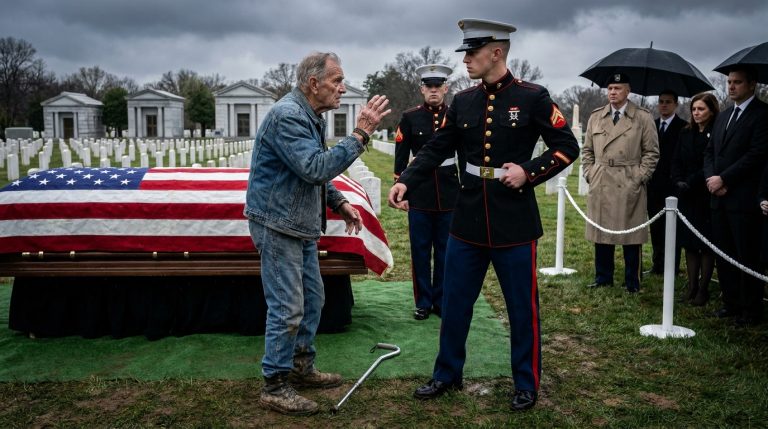
Tommy was a monument. He was sixty-three years old, his hair a close-cropped silver, his green field jacket standing out against the modern gear of the other shooters like a relic of a time when honor was the primary currency of existence. Tommy’s hand was raised to his brow, his fingers straight, his elbow at the perfect angle—a salute so sharp and precise it seemed to cut through the humid afternoon air.
Walter felt the breath hitch in his throat. He looked at Tommy’s face. The Gunnery Sergeant’s jaw was clamped shut, his eyes fixed on the horizon, but there was a tremor in his upper lip that betrayed the composure of the posture.
Walter didn’t salute immediately. He felt the weight of forty years pressing down on him, the memory of the hospital, the letter in the brass casing, the long, lonely decades of living with a promise that no one else could see. He looked at the pin on Tommy’s collar—the mark of a man who had gone places no one else would talk about. He looked at the reflection of his own life in the posture of this other Marine.
He brought his hand up.
It was slow. His elbow felt like a rusted hinge, and his fingers, callused and stiff, trembled as they ascended. But as he completed the arc, as his hand met his forehead, the tremor stopped. The salute was ragged, unpolished, and entirely un-regulation, but it was the most honest thing he had done since the day he walked away from the service.
Behind Tommy, the others followed. The young man from lane nine—Marcus—was at attention, his eyes glistening. Derek Callahan, standing at the very back of the crowd, had his hand up too. The boy’s face was transformed, stripped of the brittle arrogance he had worn like a shield. He looked young, exposed, and entirely shattered.
No one spoke. The wind caught the flag at the end of the range, causing it to snap with a sound like a wet towel against a wall, but it was the only noise.
Walter held the salute until Tommy dropped his. When the Gunnery Sergeant’s hand finally fell, it wasn’t a sudden motion; it was a slow, respectful release, as if he were putting down something infinitely heavy.
Walter lowered his arm. He didn’t look at the crowd. He didn’t look at the record board where the brass plate was waiting to be updated. He turned back to the bench.
He reached out and picked up the brass casing—the first round, the one he had stood upright at the beginning of the morning. The yellowed paper, the letter to Elias Moore, was still tucked inside. He pulled it out, his fingers fumbling slightly, and smoothed the paper against the wood of the bench.
He didn’t read it. He knew the words by heart. He had written them on a piece of hospital stationary while the pain meds were still pulsing through his system, while the sound of the jungle was still screaming in his ears. He had carried it in his wallet, his jacket pocket, his breastbone for four decades, waiting for the day he could come back and prove the truth of what he had promised.
“He would have liked that last shot, Tom,” Walter said.
The voice was quiet, so quiet that it barely carried to the back of the walkway, but in the silence of the firing line, it felt like a bell.
Tommy’s composure finally broke. The rigid set of his shoulders slumped, and he took a shaky, uneven step forward. “Yes, sir,” he replied, his voice thick, rough, and entirely raw. “He would have.”
Walter felt the exhaustion finally catching up to him, a wave that threatened to buckle his knees, but he stayed upright. He looked at the letter, then at the target in the distance, then back at the man who had been his student, his subordinate, and finally, his witness. The promise wasn’t just a duty anymore. It was a memory that had finally been given permission to rest.
CHAPTER 8: The Pines and the Promise
Rebecca didn’t move toward him immediately. She stood on the gravel, her hands shoved deep into the pockets of her gray sweater, watching the exchange between her father and the Gunnery Sergeant. She didn’t have to hear the words—the way her father’s shoulders slumped, the way Tommy Branson looked at him with an expression of profound, unshakable relief—to understand that something seismic had just concluded.
Walter turned. He saw her then.
He didn’t need to speak. He looked at her—his daughter, the only person left who knew the man behind the uniform, the man who made black coffee at five fifteen in the morning and never spoke of the jungle—and he saw, for the first time in years, that she wasn’t looking at him with pity. She was looking at him with recognition.
He walked toward her. His legs felt heavy, the muscles twitching with the residual energy of the day’s work, but he didn’t stumble. He kept his stride measured, deliberate.
“Dad,” she said, her voice catching on the single syllable. She stopped a few feet from him, her eyes searching his face, looking for the phantom, the memory, or the old man she had brought her own children to visit. “Tommy called me.”
“I know,” Walter said. His voice was raw, like sand being scraped against silk. He reached out and touched her arm. The fabric of her sweater was soft, a stark contrast to the grit of the firing range, and for the first time in his life, the contrast didn’t feel jarring. It felt like coming home. “You didn’t have to come.”
“Yes, I did,” she said, and her voice was firm, carrying a strength he hadn’t realized she possessed. “You promised me you were done, Dad. You promised.”
Walter looked past her, toward the stand of loblolly pines at the edge of the range, the same kind Margaret had planted decades ago. He remembered the promise—the one he had made to himself, the one he had made to his wife, the one he had made to the life he had tried to lead in the quiet brick house.
“I am,” he said. He meant it. The weight that had been sitting on his chest for forty years was gone. The letter was delivered. The shot was fired. The debt was settled.
They stood there for a long time, just the two of them, while the activity around them slowly began to wind down. Derek Callahan had disappeared into the office, the lights flickering as he did his work in the quiet. Marcus, the young shooter, was packing his gear with a slow, almost reverent care. Pete, the range officer, was folding the American flag on the flagpole with the precision of a man who understood the geometry of sacrifice.
Rebecca finally leaned forward and hugged him. It was a long, slow embrace, a moment of profound, wordless reconciliation. In that hug, Walter felt the years of silence between them start to fracture, the gap closing. He realized that for all the years he had spent protecting her from the truth, he had been keeping her away from the only part of him that was real.
“Let’s go home,” she whispered against his shoulder.
“Home,” Walter repeated. The word felt new, light, unburdened.
They turned away from the firing line and walked toward her car—the rusted silver Toyota parked on the gravel lot. As they walked, Walter took one last look back at the range. The Mike Course was empty. The electronic scoring pads were dark. The brass on the concrete was already being swept up by someone who would likely never know what it had cost to put it there.
It didn’t matter.
He had kept the promise.
As they drove out of the gravel lot, the sun was beginning to dip below the tree line, casting long, golden shadows across the red clay. Walter sat in the passenger seat, his hands resting on his knees. He didn’t check for his wallet. He didn’t touch the key beneath his shirt. He looked at the passing pines, the rhythmic flash of light through the branches, and felt the immense, cooling peace of a life that was finally, truly, in his own hands.
He looked at Rebecca. She was watching the road, her hands steady on the wheel.
“I’m sorry,” he said. It wasn’t just for today. It was for the silence. It was for the years. It was for the dented case and the locked door and the ghost of Elias Moore that had occupied the house for longer than either of them could remember.
Rebecca didn’t look at him, but she reached out and took his hand. Her grip was firm, warm, and utterly unyielding.
“You’re here now,” she said.
And for the first time in forty years, that was enough.
The Toyota rumbled down the long, winding road toward the highway, leaving the range behind. The dust settled on the gravel. The flags on the berms went still in the cooling air. At the edge of the range, the record wall stood in the fading light, the new plate catching the last of the sun’s warmth, marking the spot where a man who had been forgotten had finally remembered who he was.