The Sky Above Oak Meadows: A Calculated Dismantling of Tyranny Through the Lens of Federal Procedure
CHAPTER 1: THE WEIGHT OF A WING
The sound was the first thing that registered—not the shrill pitch of Karen’s voice, but the hollow, rhythmic thwack of the clipboard hitting my chest. It was a precise, synthetic sound, the kind of noise that usually preceded a catastrophic failure in an approach pattern. I caught the board with an instinct honed by years of watching metal tubes pass through my airspace with only seconds of clearance to spare.
I didn’t look at her yet. My gaze remained fixed on the roof. The P-51 Mustang weather vane was spinning with a lazy, elegant indifference, its steel prop slicing through the heavy, humid air of the afternoon. It was the only thing in the neighborhood that didn’t feel like it was vibrating with the artificial, high-strung intensity radiating from the woman standing on my lawn.
“Unregistered aeronautical obstruction,” Karen hissed.
I finally shifted my focus. She was a study in excess—the gaudy gold ring that seemed to be actively strangling her finger, the floral mumu that strained against her frame, and the flushed, blotchy skin of a person who had spent their life terrified of losing control. She held her clipboard like a weapon, the plastic surface catching the sharp, blinding glare of the three-o’clock sun.
My internal clock began to tick. I didn’t feel anger. I felt the familiar, cold clarity of a professional analyzing a radar blip. This wasn’t a neighborly dispute anymore. This was a violation of the established order. She wasn’t just complaining; she was attempting to project authority into a space that didn’t belong to her.
“Karen,” I said. My voice was a low-frequency hum, stripped of all warmth.
She paused, her breath hitching in the sudden silence of the street. Even the neighbor’s sprinkler, usually a rhythmic pulse against the grass, seemed to quiet itself.
“You have absolutely no idea what you’ve just done,” I continued.
I looked down at the paper she had slapped against me. It was a formal violation notice. I didn’t need to read it to know the content. It was a collection of bureaucratic buzzwords designed to intimidate, built on a foundation of shifting sand. But beneath the surface, something caught my eye—a smudge of ink on the bottom margin that didn’t belong to the printer. It was a faint, blue-ink stamp, partially obscured: Management Reference #884-B.
My mind snagged on the detail. Why would an HOA violation have a management reference number that traced back to a corporate registry?
I folded the paper, my movements mechanical and deliberate. I watched her face, searching for the flicker of fear that inevitably accompanies the realization that a target has stopped acting like prey. She was vibrating, literally humming with a righteous, self-imposed fury. She still believed this was her arena.
She turned to storm off, her steps heavy and aggressive on my manicured lawn. I didn’t stop her. I didn’t raise my voice. I simply stood there, a static figure in the center of a developing storm, feeling the cold, hard logic of the FAA manual settling into my mind like a set of coordinates.
She reached her car, a pristine SUV that gleamed with a sterile, soul-less shine. She paused, looking back over her shoulder, her eyes narrow and predatory. She thought she had marked her territory. She had no idea she had just handed me the keys to her own destruction.
I turned back toward the house, but as I glanced once more at the roof, I noticed the shadow cast by the Mustang weather vane. It didn’t just point into the wind; it pointed toward the management office, long and thin, like a needle searching for a pulse.
The air felt thinner now, charged with the static of an impending decision. I reached into my back pocket and felt the sharp corner of the folded notice.
The investigation had already begun.
CHAPTER 2: THE PAPER TRAIL OF SHADOWS
The sound of the clipboard hitting my chest still vibrated in my sternum as Karen’s SUV crunched over the gravel of the driveway, the sound sharp and grating, like teeth on porcelain. I didn’t watch her go. I kept my eyes on the folded paper, specifically that blue-inked stamp: Management Reference #884-B.
Twelve years in Air Traffic Control had taught me one fundamental truth: patterns do not lie, and they rarely happen by accident. If a code appeared on a document that was supposedly generated by a local, residential homeowners’ association, it meant that the HOA wasn’t the one pulling the strings. It meant they were a terminal, a node in a much larger, more structured system. I could feel the cold, logical gears of my mind grinding into action, moving past the petty insult of her visit and toward the structural anomaly buried in her own paperwork.
I walked toward the house, the afternoon heat pressing down on me, but my focus was entirely internal. I needed to cross-reference that reference number. My home office was a sanctuary of order, a place where I kept my own archives of the neighborhood’s “regulations,” though I had never truly parsed them with an investigator’s eye.
I entered through the back, the screen door clicking shut with a familiar, muted snap. The kitchen was cool and quiet, a stark contrast to the volatile energy Karen had left lingering in the driveway. I didn’t stop for a drink or to check on the house. I headed straight for the den. My desk was a clean expanse of dark oak, save for the thick, beige binder of HOA covenants that had sat gathering dust for three years.
I opened the binder. It was bloated with addendums, stapled-on revisions, and laminated “clarifications” that felt more like a frantic attempt to create a legal fiction than a set of rules. I flipped to the back, to the administrative disclosures, looking for any mention of the management company. Oak Meadows Management Group. I pulled my laptop from the dock, the screen flickering to life.
I didn’t search for “HOA rules.” I searched for the registry of corporate entities.
The silence of the room was heavy, punctuated only by the rhythmic clicking of my keyboard. The reference number 884-B didn’t pull up a local firm. It pulled up a holding company based in a neighboring state, one that managed dozens of “communities” across the region. My brow furrowed. If a single management group held the contracts for fifty different HOAs, they weren’t just managing lawns and mailboxes. They were running an operation at scale.
“Mark?”
Sarah’s voice was soft, hesitant. I hadn’t heard her enter. I turned my chair, the leather creaking slightly. She was standing in the doorway, her expression a mix of concern and lingering confusion. She had seen Karen from the window, and she knew that the woman was the human equivalent of a hurricane.
“She’s gone,” I said, keeping my tone steady.
“She was shouting again,” Sarah said, stepping fully into the room. “The neighbors are talking, Mark. Mrs. Gable across the street said Karen was throwing around threats about federal airspace. It’s absurd. Can she really do anything?”
“She can’t do anything,” I said, my gaze shifting back to the screen where the corporate filing was still open. “But she’s been busy, Sarah. She’s been very busy, and she’s been sloppy.”
I didn’t explain the reference number. It was too early, and the connection was still too tenuous. I needed more data. I needed to see how the fines were processed, how the funds were moved. If Karen was the enforcement arm of this corporate structure, she wouldn’t be keeping the money. She would be feeding a machine.
“I’m going to the tower early tomorrow,” I said, turning back to the desk. “I need to talk to Frank. Not about her, but about the sector procedures. I need to make sure I’m completely insulated if this becomes an official FAA inquiry.”
Sarah hesitated, then walked over, placing a hand on my shoulder. She was the one who had kept us grounded, the one who had seen us through the stress of my years in the Air Force. She understood the weight of procedure, but she also saw the edge I was riding.
“Don’t let her pull you down, Mark,” she said, her voice dropping into that familiar, soothing register. “She’s a small, angry person. Don’t make her the center of your world.”
“She’s already tried to make herself the center of mine,” I replied. I looked at the Mustang weather vane through the window. It was still spinning, capturing the last golden light of the day. “I’m just going to ensure she occupies a very, very small space in the future.”
I waited until Sarah left the room before I turned back to the screen. The screen reflected in the dark glass of the window, a ghost of a man staring at a web of corporate filings. I was an Air Traffic Controller. My entire professional identity was built on identifying threats, calculating paths, and ensuring that nothing collided. Karen Peterson was a rogue signal, and I had the entire frequency map in my hands.
I started a new document. Case File: N774-P51-MV. I typed the first entry: Subject filed complaint with malicious intent; verified corporate link between HOA and management entity.
The room began to darken, the shadows stretching across the floor like cooling asphalt on a runway. I sat in the gathering dusk, letting the plan form in my mind, step by surgical step. I would play the role of the beleaguered neighbor, the one who tried to “comply,” while I systematically mapped every corner of her empire. I would document the fines, the threats, and the inconsistencies, and I would weave them into a narrative so tight and so cold that the system itself would have no choice but to purge the rot.
It wasn’t about the weather vane. It was about the fact that she had challenged the wrong man, in the wrong sector, with the wrong set of tools. I stood up, the chair pushing back with a soft, final sound. The house was quiet, but the air felt charged, as if a storm was rolling in from the coast, unseen and unstoppable. I looked at my reflection in the dark glass once more. The face looking back was calm, focused, and utterly devoid of hesitation.
The procedure had started. And in my world, there were no deviations permitted.
CHAPTER 3: THE PROCEDURAL GATEWAY
The drive to Northwood Regional was a study in controlled tension. The dawn sky was a bruise-colored purple, leaking light over the horizon, and the roads were empty save for the occasional delivery truck and the rhythmic sweep of my wipers, though not a drop of rain had fallen. I kept my hands at ten and two, a habit from years of duty, my mind locked on the variables I had isolated the night before.
I reached the security gate of the airfield exactly at 05:45. The guard, a veteran who’d seen me arrive for a thousand shifts, offered a brief nod as he verified my credentials. I didn’t engage in the usual banter. I couldn’t afford the distraction. My current status—the man under investigation for an “aeronautical hazard”—was a delicate piece of information. I needed to move within the tower’s internal bureaucracy like a ghost, utilizing the infrastructure I had helped build without triggering an automated alarm.
When I stepped into the control tower, the air was cool, smelling faintly of ozone and industrial-grade floor wax. The transition from the chaotic, emotive sphere of the HOA to the stark, rule-bound world of air traffic control was refreshing. Here, everything was quantifiable. Everything had a precedent.
I headed directly to the administrative office, a glass-walled box that overlooked the main radar array. Frank was already there, hunched over a steaming cup of coffee that looked thick enough to pave a runway. He looked up, his brow furrowing as he caught sight of me.
“Miller,” he grunted. “You’re early. I thought you were tied up with that ‘official’ nuisance you mentioned yesterday.”
“I am,” I said, sliding into the chair opposite him. I didn’t reach for coffee. I reached for my tablet. “But I need to ensure the tower’s log reflects the reality of the complaint properly. I’ve reviewed the intake packet that was forwarded from the regional office, and there’s a discrepancy.”
Frank leaned back, his chair groaning in protest. “Discrepancy? It’s a civilian complaint, Mark. It’s a line item in a database. What kind of discrepancy are you digging for?”
“The filing time,” I said, tapping the screen to bring up the digitized record. “The complaint was registered at 02:15 AM on a Tuesday. The regional safety office isn’t staffed at that hour, and the automated portal doesn’t accept obstruction reports without a secondary verification. Someone bypassed the standard intake protocol to push this through.”
Frank frowned, leaning in to look at the screen. He was a creature of habit, and he didn’t like it when someone messed with the workflow. He traced the timestamp with a thick, calloused finger. “You’re right. That’s out of sync. It’s an unusual time for a civilian to be lodging a federal concern.”
“Exactly,” I said. “And the management reference number linked to the filer’s identity—884-B—isn’t a residential code. It’s a corporate marker. I want to see if the tower’s internal communication logs show any prior contact from that same management group to this facility.”
Frank looked at me, his eyes sharp. He’d known me long enough to know when I was onto something, and long enough to know when the job was no longer just about the job. “You’re not just clearing your name, are you?”
“I’m following the protocol, Frank,” I replied. “If there’s an attempt to compromise the intake process, it’s a security breach. That falls under my jurisdiction as a senior controller.”
He stared at me for a long, silent moment, the only sound the steady hum of the radar equipment filtering through the ceiling vents. Finally, he gave a sharp, decisive nod. “I’ll pull the archives. But if this blows back on the sector, I’m putting it all on your desk.”
“Fair enough.”
I spent the next two hours in a state of hyper-focused labor. I pulled every digital scrap of communication related to the neighborhood. The tower’s records were a labyrinth, but they were a logical one. I began to map out a secondary chain of events: a series of inquiries from the Oak Meadows Management Group regarding “zoning enforcement” and “airspace clearance” that predated my own weather vane installation by months.
They weren’t just reacting to me. They had been trying to define the legal boundaries of that sky long before I ever mounted the P-51 to my roof. The realization hit me with the force of a headwind. Karen wasn’t the strategist; she was a blunt instrument being used to stress-test the local jurisdiction. They were baiting the system, trying to see how much pressure they could apply before someone in the FAA pushed back.
And now, they had pushed back against the one person who knew exactly how the system worked.
I sat back, my eyes straining from the constant focus. On the radar screen, a small craft was approaching the final approach fix. I watched its descent, the data block hovering next to it—altitude, ground speed, heading. Everything in order. Everything transparent.
Unlike the web Karen and her corporate masters had tried to spin.
I looked at the notes I had compiled: a list of timestamps, corporate links, and the curious, recurring reference to 884-B. I was building a case that reached far beyond a neighborhood dispute. I wasn’t just defending my home; I was insulating the system from a predatory parasite.
I stood up, the chair pushing back with a quiet scrape against the linoleum. My hands were steady, my resolve hardened. I had the initial clues. I had the procedural high ground. Now, I just needed to deliver the envelope that would begin the process of turning their own weapon against them. I was going to be the most annoying, by-the-book investigator the FAA had ever seen, and I was going to start by confirming every single irregularity I had found this morning.
The shift was just beginning, and for the first time in years, the sky felt perfectly, beautifully predictable.
CHAPTER 4: THE DINING ROOM INTERROGATION
I stood on the porch, my boots feeling heavy against the scrubbed stone. 08:59:58. I waited the two seconds, watching the second hand on my watch sweep past the twelve, and then pressed the bell. It emitted a discordant, electronic chime that sounded entirely too cheerful for the confrontation that was about to unfold.
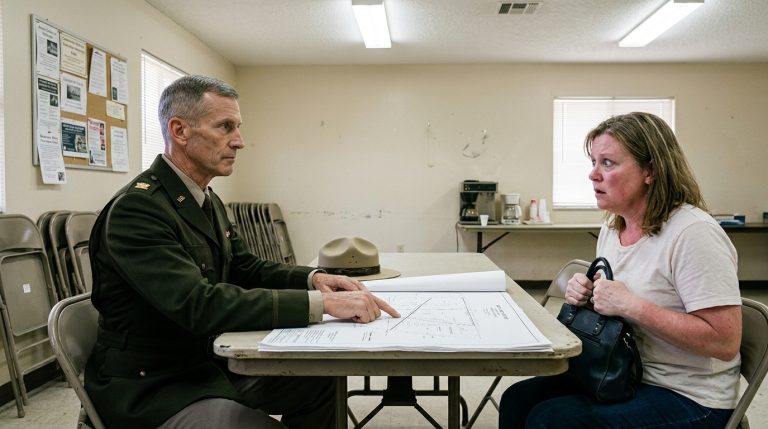
Karen opened the door before the chime had even finished. She was wearing a beige cardigan, buttoned to the throat, and her hair was pulled back so tightly it looked painful. Her eyes were rimmed with a faint, tired red. She had spent the last twenty-four hours stewing, and now, seeing me standing there in my navy-blue polo and holding a metal clipboard, the surprise on her face curdled instantly into a defensive, brittle mask.
“Agent Miller,” she said, her voice strained. She didn’t move aside to let me in. “I wasn’t sure you were actually coming.”
“I don’t leave investigations unfinished, Miss Peterson,” I replied, my voice flat, professional, and entirely devoid of the neighborly subtext she expected. I stepped forward, forcing her to retreat into the foyer.
The house smelled of stale air and expensive, cloying potpourri. It was a space designed to suppress rather than welcome, all white crown molding and beige carpet that looked like it had never known the imprint of a careless foot. I walked toward the dining room, my eyes tracking the room’s geometry. I wasn’t just observing her; I was mapping her weaknesses.
“The dining room will suffice for the interview,” I said, gesturing to the table.
She followed, her steps choppy. As she sat, she tried to reclaim the narrative, smoothing the edge of the mahogany table. “This whole thing is a misunderstanding, Mark. I’m sure we can just agree that the weather vane is a distraction and move on. I have the power to waive the fine if—”
“This is not a negotiation, ma’am,” I cut her off. I placed the clipboard on the table with a firm, hollow thud. It echoed in the high-ceilinged room. I watched her flinch at the sound. “This is an FAA field investigation. Your offer to waive a fine is noted as an attempt to influence a federal proceeding. I suggest you keep your remarks strictly to the technical concerns you raised in your complaint.”
I pulled out the interview log. My pen felt like a surgical instrument. “Let’s start with the claim of ‘aeronautical obstruction.’ You stated in your written complaint that the weather vane interferes with landing approaches. Which runway, specifically, do you believe is being impacted?”
She looked at me, stunned. The memory of my father’s calm voice—stay on the glide slope, Miller, don’t let the noise distract you—flashed through my mind. I held that focus now. I didn’t care about her feelings. I cared about the discrepancy between her words and the reality of the sector.
“I… it’s just the ones coming from the east,” she stammered, her fingers clutching the edge of the table until her knuckles went white. “You can see them. They fly right over.”
“The eastern approach passes three miles from this location,” I said, pulling out a printout of the sector chart. I didn’t let her speak. I set the document down in front of her. “Are you asserting that this structure—a thirty-inch steel model—possesses the capability to deflect an aircraft three miles off its registered flight path? Or are you admitting that you have no basis for this assertion?”
“You’re twisting it!” she cried, her composure finally shattering. She stood up, her chair screeching against the hardwood. “You just want to humiliate me! You’ve been looking for an excuse to undermine me since you moved in!”
“Sit down, Karen,” I said. It was a command, not a request. It carried the weight of the tower, the weight of a thousand hours of absolute authority.
She hesitated, her chest heaving, then sank back into the chair. She looked small, the “queen of the HOA” suddenly stripped of her armor. I noticed then, for the first time, a stack of folders near the edge of the table, half-hidden by a centerpiece. They were marked with the same corporate logo I had seen in the registry search: 884-B.
They weren’t community records. They were invoices.
I didn’t reach for them. I didn’t acknowledge them. But I knew what they were. They were the physical proof that she was not the mastermind; she was the collector. And she was terrified of what would happen if the collection stopped.
“The investigation will proceed,” I continued, my voice calm. “I have several more sites to survey, and I will be interviewing the other board members regarding their awareness of this ‘aeronautical hazard.’ If you have any further evidence of interference, I suggest you produce it now.”
She looked at me, and in her eyes, I saw not just the petty tyrant, but the panic of a woman who was in way over her head. She opened her mouth to speak, then closed it. The silence stretched between us, thick and heavy with the weight of her own lies.
I checked my watch. “We’ve covered the first three points. We’ll pick up the rest during the exterior inspection. Let’s go outside.”
I stood up, gathering my papers. As I walked past the table, I paused, glancing down at those hidden folders. She watched me, her breath held, a desperate, hollowed-out look on her face. She was realizing, with horrifying clarity, that she had opened a door she could never close. I stepped out onto the porch, the sunlight blinding, and waited for her to follow. The hunt was no longer about the weather vane. It was about seeing how long she could keep running before she hit the wall she had spent years building for everyone else.
CHAPTER 5: THE NETWORK OF AFFIDAVITS
The transition from Karen’s driveway back to the quiet, tree-lined streets of Oak Meadows felt less like a walk and more like a tactical redeployment. I kept my stride purposeful, the metal clipboard tucked under my arm like a shield. Behind me, the door to Karen’s house remained closed—a shuttered aperture that I knew, with absolute certainty, was currently being watched from behind the blinds.
I didn’t head for home. I turned toward Mr. Henderson’s place. The air was thick with the scent of mowed grass and the distant, dry hum of a lawnmower, sounds that were mundane but, in the context of my investigation, now felt like signals of a restless, contained energy.
Mr. Henderson answered the door before I even finished the first ring. He was wearing his gardening gloves, his face etched with a cautious hope that made my throat tighten.
“Agent Miller,” he said, his voice a low, gravelly conspiratorial whisper. “You were there for a long time. I was worried you might have gotten trapped in that dining room of hers.”
“I’m still on the clock, Mr. Henderson,” I said, stepping inside. The interior of his home was a direct antithesis to Karen’s—cluttered with books, overflowing with framed photographs, and smelling of lemon oil and old paper. It was a space defined by history, not by enforcement.
We moved to his living room, where the light filtered through lace curtains, casting geometric patterns on the floor. I didn’t waste time on pleasantries. I withdrew the affidavit template, the paper crisp and demanding.
“I need a formal statement regarding the fine you received for the rose bushes,” I said, laying it on the low coffee table. “Not just the amount, but the process. Who delivered the notice? Was it the board, or was it her? Did you receive a formal hearing, or was it an administrative decree?”
As he began to speak, detailing the afternoon Karen had marched onto his property with a tape measure to prove his bushes were two inches over the sidewalk, I felt a strange shift in my own perception. The room seemed to contract. The weight of all these individual grievances, these hundreds of minor, petty acts of cruelty, began to feel like a physical pressure in the room. I wasn’t just recording facts; I was collecting ghosts.
“She didn’t even knock,” Henderson said, his hands trembling slightly as he clutched a pen. “She just stood there, clicking her tongue, marking her clipboard like she was writing a death warrant for a shrub.”
I wrote it down, my script precise. But as I listened, I found my gaze drifting to the window. Across the street, the GarcAs were pulling into their driveway. They looked tired, their shoulders slumped from a day of construction work, but when they saw me through Mr. Henderson’s window, they stopped. They didn’t wave. They just looked—a long, searching stare that suggested they were waiting for me to turn the key that would finally release them.
The sensation was uncomfortable. I was an Air Traffic Controller; I was the one who provided the structure, not the one who became the object of hope. I pushed the feeling aside, anchoring myself in the cold logic of the procedure.
“Thank you, Mr. Henderson,” I said, rising as he signed the final page. “This is sufficient. The investigation is progressing exactly as planned.”
I left his home and crossed the street to the GarcAs, the sun now high and white in the sky. My boots felt heavier on the pavement. The neighborhood felt like it was holding its breath. Every window seemed like an eye, every silence like a question. I was the one bringing the storm, and the irony was that I was doing it by being the most pedantic, rule-bound person in existence.
Maria Garcia met me at the door. She didn’t say a word, just moved aside to let me enter. Her house was vibrant, filled with the sounds of a family moving through their evening, but as soon as we entered the kitchen, she signaled for the others to go into the other room.
“She called again,” Maria said, her voice barely audible. “Not a notice. Just a call. She said if we keep talking to you, the board will vote to revoke our right to use the community pool.”
I felt a sudden, sharp spike of adrenaline—not fear, but a cold, crystalline clarity. The pool. That wasn’t a standard HOA rule violation; that was a direct threat of social exclusion. They were panicking. They were pulling at threads they didn’t even understand.
“They won’t be revoking anyone’s rights,” I said, setting the affidavit on the counter. “Because they’re going to be too busy defending their own eligibility to hold office.”
“Are you sure, Mark?” she asked, looking at me with a desperate, naked intensity. “If this fails… we’re the ones who have to stay here.”
I looked at the stack of papers in my hand—the evidence of their petty, destructive lives. I thought of the corporate records, the 884-B references, the trail of numbers that pointed toward something much larger and much colder than Karen. I realized then that this wasn’t just a neighborhood spat. It was a confrontation between two different ways of existing: one built on the rigid, cold safety of procedure, and one built on the fragile, abusive power of a manufactured reality.
“It won’t fail,” I said, my voice steady, though it sounded strange to my own ears, as if it belonged to someone else. “Because I have the flight plan, Maria. And I’m the one flying the plane.”
As I walked out of their house, the street seemed to tilt. The evening shadows were long and sharp, reaching out across the lawns like fingers. I had the affidavits, I had the corporate links, and I had the neighborhood’s silent, simmering rage. All that was left was to bring the final piece of the logic to its conclusion. I walked toward my own house, the P-51 weather vane spinning frantically in a sudden gust of wind, a metallic blur against the darkening sky. I felt the exhaustion, a deep, bone-weary weight, but it was anchored by the absolute, undeniable, and utterly ruthless logic of what came next.
CHAPTER 6: THE ALTITUDE OF ERROR
I stood in the center of my den, the silence of the house pressing against my eardrums like the pressure in a cabin at high altitude. I had my tablet open, fingers poised to upload the latest batch of affidavits to the FAA regional portal, when the screen flashed a jagged, pulsating red. Access Denied. Credentials Revoked. Contact System Administrator.
I stared at it, the blood draining from my face. My credentials were not just administrative; they were keyed into the hardware of the tower itself. To have them revoked required a manual override from the regional office, or—more chillingly—a security lock-down initiated by someone within the facility.
I set the tablet down on the desk. My hands were perfectly steady. That was the training: when the instrument fails, you rely on the mental model. I looked out the window at the P-51 weather vane. It was still, the wind having died down into a deceptive, oppressive calm.
The lock-down wasn’t a glitch. It was a counter-move. Someone, somewhere in the 884-B chain, had realized that the “neighborhood dispute” was being mapped by a professional. They hadn’t come for me with lawyers yet; they had come for my access. They were trying to blind me, to cut me off from the data that provided my leverage.
I didn’t try to log in again. I shut the lid of the tablet and walked to the kitchen, my movements precise. I needed to move. My internal clock was ticking. If they had locked my credentials, they would soon follow up with a physical audit of my activity. I had about an hour before someone from regional security would likely show up at my door or the tower to “investigate” the suspicious access attempts.
I grabbed my keys and headed for the garage. I didn’t drive to the tower. I drove to the one place they wouldn’t expect me to be: the legal office of Dave, my Air Force buddy.
The city streets were turning a bruised, neon-tinged gray as the evening set in. I drove without checking the rearview mirror. I wasn’t being followed—not yet. They didn’t need to follow me; they owned the infrastructure.
Dave’s office was a small, brick-faced building in the older part of town, nestled between a machine shop and a shuttered bookstore. I entered, the bell above the door chiming with a sound that felt like an intrusion. Dave was at his desk, his sleeves rolled up, a half-eaten sandwich sitting on a pile of legal briefs.
He looked up, his expression shifting from casual to alert the moment he saw my face. “Miller. You look like you just lost a hold pattern.”
“I lost my credentials,” I said, sliding the tablet onto his desk. “Forty minutes ago. Someone triggered a security lock-down on my sector access.”
Dave’s eyes dropped to the tablet, then back to me. He didn’t ask how. He knew me well enough to know that if I was here, the “how” was already solved in my head. “That’s not a standard HOA move. That’s federal-level noise.”
“It’s not the HOA,” I said, pulling up a chair. “It’s the management entity. They’ve got hooks into the regional registry. I was mapping their activity through the tower’s logs, and they shut me out. Which means they know I’m not just a neighbor. They know I’m an investigator.”
Dave stood, walking to the window and peering through the blinds at the street. The office was quiet, the hum of the city outside a distant, muffled roar. “So, the decoy is gone. If they’re using security overrides, they aren’t trying to hide the weather vane violation anymore. They’re trying to hide the racketeering.”
“Which means the clock is ticking,” I said. “If I can’t get back into the system, I can’t finalize the report for the FAA. I’m effectively grounded.”
Dave turned back, his face hard. “We don’t need the tower anymore, Mark. We have the affidavits. We have the corporate filings. We have the link between Karen and the 884-B entity. We have enough to initiate the harassment suit today. We don’t wait for the FAA report to be ‘official.’ We make the report public as an exhibit.”
“It’s risky,” I countered. “Without the official FAA stamp, it’s just my word against theirs.”
“No,” Dave said, a slow, predatory smile touching his lips. “It’s their word against a dozen neighbors, a stack of illegal fines, and a documented pattern of abuse. We file in the morning. We serve the management office, the HOA board, and Karen. By the time they realize you’ve been locked out of the tower, they’ll be drowning in discovery requests they can’t suppress.”
I looked at the files on his desk. The room felt stifling, the air thick with the smell of old paper and legal threats. My resolve was solid, but I felt a strange, cold shiver of anticipation. This was it—the shift from a surgical procedure to a broad-scale engagement.
“Make the call,” I said.
Dave picked up the phone. “I’m going to need to bring in a process server who doesn’t mind a little heat,” he muttered, his fingers dancing across the keypad.
I looked at my hands. They were steady. I felt the sharp, bitter taste of frustration—the loss of my access, the feeling of being cut off—but it was being replaced by something else. A sense of direction. They thought they could ground me by pulling my credentials, but they had forgotten that I had spent my entire life learning how to navigate without the aid of the instruments.
I would file the suit. I would take the fight out of the quiet, sterile world of bureaucratic protocol and into the harsh, uncompromising glare of the courtroom. And I would make sure that when it was over, the only thing left of their little empire would be the rust.
CHAPTER 7: THE FILING OF THE HAMMER
The community center was a monument to beige austerity, a box of drywall and acoustic tile that smelled faintly of stale coffee and the damp, lingering ghost of a recently concluded children’s craft fair. I stood in the small side-vestibule, watching through the glass panes as the members of the HOA board began to trickle in. They looked like people walking toward an gallows—shoulders hunched, eyes darting, their usual veneer of self-importance stripped away by the news of the impending litigation.
Dave stood beside me, his briefcase held like a weapon. He had the lawsuit tucked into the primary slot, the 150-page FAA report acting as the anchor for every claim. He leaned toward me, his voice a low, disciplined murmur. “The process server just finished with the board’s management liaison. They know what’s in the envelope. Look at George—the man is vibrating.”
I looked. George, the meek accountant, was staring at the floor, his hands shoved deep into his pockets. He hadn’t looked up once. He knew, just as I did, that the document he’d been served wasn’t just a legal complaint; it was a map of his own negligence.
“They’re waiting for her,” I observed, scanning the room. Karen hadn’t arrived yet. The tension in the room was a physical thing, a static charge that made the hair on my arms stand up. Every resident who had signed an affidavit was here, sitting in the front rows, a silent phalanx of testimony.
I pushed through the glass door, the hinges protesting with a sharp, metallic whine. The conversation in the room cut off instantly, like a radio being pulled from its socket. I walked down the center aisle, my boots striking the linoleum with rhythmic, echoing finality. I didn’t look at the residents. I looked at the board table, where the empty chair at the center stood as a silent testament to the void Karen was about to fill.
“Miller,” George whispered, his voice cracking as he looked up. “You shouldn’t be here. This is a private meeting of the association.”
“The meeting is being held to address the litigation I initiated, George,” I said, my voice cutting through the silence. “I am an interested party. And Dave here is my legal counsel. We aren’t here to disrupt. We’re here to witness the board’s response to the evidence.”
I took a seat in the front row, directly facing the table. I felt the gaze of every person in the room on me. It was a pressure I knew well from the tower—the weight of a hundred lives depending on the next decision. But here, the consequences were not measured in flight paths; they were measured in the ruin of a predatory structure.
Just as the clock hit the scheduled start time, the double doors at the back of the room swung open. Karen didn’t walk in; she made an entry, her heels clicking against the tile with a sharp, rhythmic aggression. She was dressed in a tailored black suit that looked like it had been pressed with a razor blade. She didn’t look at the board. She looked directly at me.
Her face was a mask of calculated fury. She had seen the lawsuit. She knew the game was changing, but she clearly hadn’t grasped the scale of the trap. She walked to the table, her presence dominating the room, and sat down with a flourish that was meant to reclaim the territory.
“Let’s begin,” she said, her voice tight, a shrill note of desperation hidden beneath the surface. She reached for the microphone, her knuckles white. “There has been some… confusion regarding the association’s legal standing. We are here to clarify that any reports filed with the FAA regarding private property obstructions are official business, and the resident in question is in violation of community standards.”
She was still fighting with the decoy. She was still trying to frame this as an HOA versus Homeowner issue. She had no idea that the 884-B references, the corporate links, and the patterns of extortion were about to be read into the record.
Dave stood up. He didn’t shout. He didn’t perform. He simply held up a copy of the lawsuit. “Miss Peterson, before you clarify the association’s standing, I think you should clarify your own. This lawsuit, served to you and every member of this board this morning, alleges a pattern of systematic harassment and financial fraud involving an external management entity. Do you intend to address the corporate racketeering charges, or shall I read the findings of the FAA report, which is currently an exhibit of record, for the benefit of all the homeowners in this room?”
The room went silent, a depth of quiet so profound it felt like the vacuum of space. Karen’s face turned from a pale white to a mottled, dangerous crimson. She opened her mouth, her eyes darting between Dave, the board, and the silent, staring residents.
She was cornered. I watched her, observing the way her shoulders slumped, the way her hand trembled as she reached for the glass of water on the table. She was a scavenger who had been caught in the beam of a spotlight, and the truth—the cold, procedural, unyielding truth—was finally catching up to the lie. She turned toward me, a look of pure, unadulterated hatred in her eyes, and I knew: she was going to make one final, visceral, and likely disastrous counter-move. She had no intention of surrendering. She was going to try to burn the whole room down to save her own skin.
I shifted in my seat, my muscles coiled, prepared for the inevitable eruption. The procedure was complete. Now, the aftermath began.
CHAPTER 8: THE UNPACKING OF THE TRUTH
Karen didn’t just grab the microphone; she tore it from the stand, the cable whipping through the air like a lash. Her eyes were fixed on the back of the room, on the faces of the neighbors who had finally stopped looking down. She was screaming now, a raw, serrated sound that tore the professional veneer of the meeting to shreds.
“You think you’ve won?” she shrieked, her finger stabbing toward Dave. “You think you’ve ruined me with a few pieces of paper? This isn’t just about a weather vane! You have no idea what you’re playing with!”
She lunged toward the board table, her hands scrambling for the hidden invoices—those 884-B files I had identified as the foundation of her racketeering. She shoved them toward the microphone, shouting gibberish about “structural integrity” and “community obligations,” trying to force the room to see a victim where there was only an enforcer.
“Look at the data!” she yelled, her voice breaking. “I was only following the mandates! The management group dictated the policy! I was the one keeping the property values from hitting the floor!”
I stood up. I didn’t rush. I walked forward with the slow, measured pace of a controller approaching a damaged aircraft on the runway. The room had fallen into an unnatural, heavy silence. Even the board members had frozen, their faces pale as they realized the depth of the corporate web they were tethered to.
“The mandates,” I said, my voice cutting through the ringing in the room. “The mandates from Oak Meadows Management Group—a shell entity tied to a regional racketeering operation designed to squeeze communities into bankruptcy through manufactured debt. You weren’t protecting property values, Karen. You were conducting forced liquidations for a firm that treats homes like liquidated assets.”
She spun to face me, her breathing ragged. She looked like a cornered animal, her hair disheveled, her fine suit crumpled. “I did what they asked! They gave me the power! They said I was the president!”
“You were a debt collector with a title,” I said. “And the system you abused to collect those debts is the same one that just revoked your credibility.”
The reveal wasn’t a sudden explosion; it was a slow, agonizing unspooling. Dave stepped forward, holding the FAA report aloft. “This document doesn’t just clear Mr. Miller. It documents the communication logs between your ‘management company’ and the regional safety office—logs that prove a conspiracy to manipulate federal reporting channels. The authorities have been copied on these findings as of one hour ago.”
Karen slumped. The microphone slipped from her hand, hitting the floor with a dull, heavy thud. The defeat was total; she wasn’t just being ousted, she was being erased. The power she had clung to—the power to name, to fine, to control—had been exposed as nothing more than the hollow mechanics of a corporate parasite.
The aftermath was a long, slow cooling. George and the remaining board members sat in stunned silence as the residents began to stand, one by one. There was no cheering. It was a somber, heavy realization of how close they had come to losing everything. Mr. Henderson was the first to speak, his voice thin but steady. “We resign the board, effective now. All of us.”
Over the next month, the world of Oak Meadows reset itself. The settlement, orchestrated with ruthless efficiency by Dave, forced the management company to liquidate its holdings in our district. The 884-B entity vanished as quickly as it had appeared, dissolved by its own investors once the regulatory spotlight became too hot to bear.
Karen sold her house in a quiet, anonymous transaction that took place on a Tuesday morning. She didn’t say goodbye. She just loaded her SUV and drove, a small, inconsequential figure leaving a neighborhood that finally felt like it had space to breathe.
I spent the final days of the settlement process working in the den, cleaning up the digital debris of the investigation. The tower had restored my credentials—a formal, cold apology buried in an automated email—but I spent less time staring at the radar than I used to. I spent my evenings on the porch.
Sarah and I sat together one night, the air crisp with the coming autumn. Lily was playing near the new community playground, the swing set arching against the sky. I looked up at the roof. The P-51 Mustang weather vane was still there, but it looked different now. It wasn’t just a memorial anymore. It was a tool. A piece of metal that had acted as the fulcrum for the entire restoration.
I took the small, bent wrench I had used to tighten the vane’s base months ago and laid it on the porch railing, the metal cool and solid under my touch. It was a small, physical repair—a final, tactile closing of the loop.
“It’s quiet,” Sarah said, resting her head on my shoulder.
“It’s ordered,” I replied.
The sky above was clear, the flight paths over the neighborhood steady and predictable. I watched a commercial airliner streak across the horizon, a tiny, glowing dot in the vastness of the darkening blue. It was moving exactly as it should, following the invisible, ironclad laws of the system, and for the first time in a very long time, I didn’t feel the need to watch it. I felt the peace of a system functioning perfectly, a quiet that I had finally, earned. The Mustang spun once, slow and deliberate, and then held its course, pointing straight into the wind.