The Stonewall Siege: A Calculated Descent into the Ruin of a Suburban Tyrant’s Hollow Kingdom
CHAPTER 1: The Calculus of the Wall
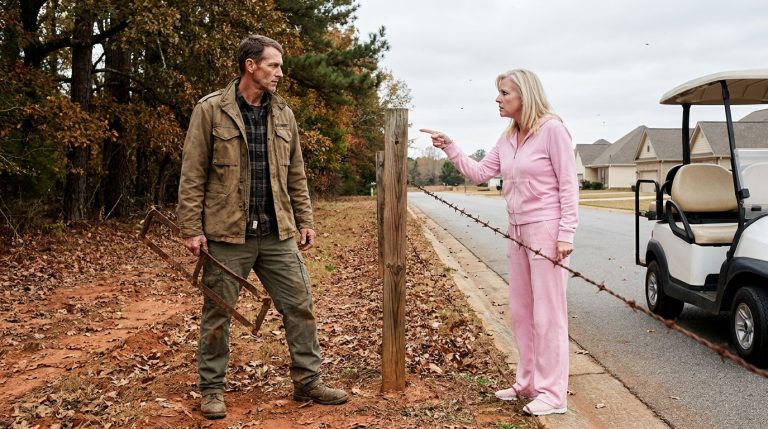
The stone wall was older than the town, older than the county, and certainly older than the pastel-pink tracksuited woman who currently stood on its other side, shivering in the autumn breeze. It was a boundary of mossy granite and historical weight, a line drawn in 1840 that the modern world had seemingly forgotten how to respect.
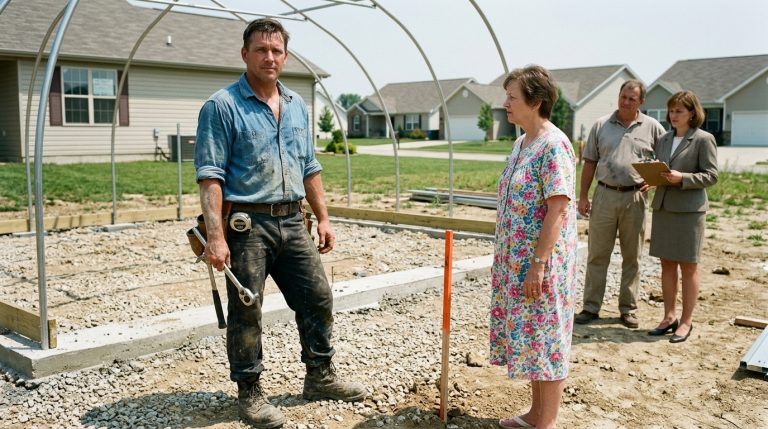
“We’ll be sending our appraisers next week,” Karen said. The words hit the air like wet lead. Behind her, two men in navy-blue blazers stood with the rigid, rehearsed discomfort of middle-management goons. They looked at my pasture—fifty acres of rolling, untamed green—as if it were a blank slate waiting for the desecration of a golf course.
I didn’t blink. My pulse remained a steady, rhythmic thrum, the kind I’d relied on back when a tremor in the hand could mean the difference between a mission’s success and a body bag. I looked at the men’s shoes—polished, expensive, and entirely unsuitable for the damp earth of a pasture. They were out of their element, and they didn’t even know it yet.
“Progress is inevitable, Colonel,” Karen added, her chin tilting upward in a display of practiced arrogance. “The association voted. You’re simply in the way.”
I leaned against a gatepost, feeling the familiar, grounding texture of rough-hewn cedar under my palm. I wasn’t looking at Karen. I was looking at the way the light caught the shoulder of the man to her left—his tension was palpable, his grip on his briefcase white-knuckled. He didn’t want to be here. He knew this was a mistake, even if the woman in the pink tracksuit was too blinded by her own self-importance to see it.
“Karen,” I said. My voice was low, devoid of the jagged edge she expected. It was the voice I used for bridge inspections and structural reports—calm, detached, and final. “You’re talking about seizing land that isn’t just a pasture. You’re talking about an ecosystem, a history, and a legal reality you haven’t bothered to read.”
Her smile faltered, just for a fraction of a second. It was a hairline fracture in a mirror, easily ignored if you didn’t know where to look. “The law is what the board decides it is,” she countered, her voice rising in pitch.
“The law,” I replied, “is exactly what I’ve been waiting for you to test.”
I turned my back on her, a deliberate, dismissive move that I knew would cut deeper than any insult. I walked toward the barn, the heavy silence of the pasture wrapping around me like armor. But just as I reached for the barn door, the sharp, rhythmic tap of her heels against the pavement stopped.
“You’re not going to be able to live here in peace when we start the bulldozers, Miller!” she shouted at my back.
I stopped, my hand lingering on the latch. I didn’t turn around. I didn’t need to. I heard the scuff of one of the blazer-clad men’s shoes as he tried to pull her away, a frantic, hushed whisper reaching my ears.
“Karen, please, the legal department said—”
That was the information gap. The legal department was already nervous. The men she brought were the ones who knew, and she was the one who refused to listen. The context of her “official” authority had just shifted from a command to a countdown.
CHAPTER 2: The Architecture of Shadows
The latch of the barn door was cold, a biting, industrial iron that seemed to suck the warmth right out of my palm. I didn’t pull the door open. I held it there, listening to the sound of Karen’s heels retreating across the driveway. They were uneven, a frantic, clicking cadence that spoke of a woman who had just realized she’d stepped into a room and accidentally locked the door from the outside.
Behind me, the horses shifted—Goliath let out a low, vibrating huff. The smell of damp hay and the metallic tang of the tractor shed pressed against me, bringing with it a sudden, sharp memory of Sarah. It was the way she used to lean against this very wood, her hand finding mine in the quiet moments between the chores. The phantom sensation of her skin against my knuckles, warm and steady, felt like a warning. The land wasn’t just dirt; it was the last anchor holding my equilibrium in a world that seemed to be eroding into gray dust.
I turned slowly. Karen was halfway to her SUV, her bulldog frame stiff. The two men in navy blazers—Bob and Arthur, I knew their names from the local registry—were trailing behind like nervous ghosts. As they reached the pavement, the man on the right, the one with the white-knuckled grip on his briefcase, hesitated. He looked back at my pasture, then at his own feet, his posture slumping in a way that had nothing to do with fatigue.
He knew. The realization settled in my chest, heavy and cold. It wasn’t just a hunch. They were terrified because they were the ones who had done the paperwork, and they were the ones who had seen the fine print Karen had chosen to ignore.
I didn’t call out. I didn’t gloat. I watched them climb into the vehicle, the doors slamming shut with a sound like a gavel strike. The SUV reversed, tires crunching on the gravel, and pulled away, leaving nothing behind but the exhaust fumes and the settling dust.
I finally pulled the barn door wide. The interior was dark, smelling of oil and ancient wood. My 1985 John Deere sat in the corner, a hulking shape of dark green and yellow, its presence a constant thorn in Karen’s side. I walked over and rested my hand on the hood. It was a sturdy machine, built for work, not for show.
I needed to see what they had left behind.
I walked back to the stone wall, the path worn smooth by a decade of my own boots. On the top flat stone, where Karen had been standing, there was a small, crisp white envelope. It hadn’t been there ten minutes ago. It must have fallen from one of the men’s pockets, or perhaps been discarded in their hurry to exit the scene.
I picked it up. The paper was heavy, cream-colored, with the embossed logo of a law firm I didn’t recognize: Wittman, Price, and Holloway. I didn’t open it yet. I stood there, letting the wind tug at the edges of the paper, feeling the weight of the coming conflict.
This wasn’t just a neighborhood spat. The professional nature of the stationery suggested a premeditated campaign, a legal architecture designed to grind someone down until they stopped existing. They weren’t fighting for a golf course. They were fighting for something much more desperate. People don’t hire high-priced city lawyers to bully an old man out of a field unless there is a fortune tied to the dirt.
I walked back to the house, the envelope tucked into my coat pocket. My phone vibrated—a standard notification—but I ignored it. I needed to see Marcus. I needed to know why a suburban HOA president would be bankrolling a war using a city law firm as her primary instrument.
I sat at the oak dining table, the same one where Sarah and I had spread out the blueprints for the land trust papers twelve years ago. I pulled the letter out. It was a formal notice of acquisition, filled with the typical legalese—eminence, public interest, community welfare. But tucked into the corner of the final page was a small, handwritten sticky note, clearly missed by whoever had handled the packet: Petrov construction. Final approval deadline: Nov 15.
The pieces shifted. Stan Petrov, her husband. The construction company that had been hemorrhaging contracts for the last three years.
They weren’t building a golf course for the community. They were building a bailout for their own bankruptcy.
I looked at the window, watching the sunset bleed across the horizon in long, bruised ribbons of violet and orange. The pasture looked serene, almost fragile in the fading light. They thought I was a tired relic, a man whose time had passed, waiting for him to wither away so they could pave over his memory.
I stood up, my joints stiff, and felt the familiar, cold resolve settling into my bones. I wasn’t just the owner of this pasture. I was the architect of its defense. And I knew exactly how to make a wall hold.
I reached for the landline, dialing a number I hadn’t used in three years. When the voice on the other end answered, it was crisp, efficient, and surprised.
“Marcus,” I said, my voice as steady as the stones in the wall outside. “I need you to dig. Everything they have on the Petrovs. Every contract, every debt, and every connection they have to this firm. If they want a fight, I’m going to make sure they’re the only ones who lose.”
The war hadn’t started with the bulldozer. It had started with the calculation, and I was already several moves ahead.
CHAPTER 3: The Paper Shield
The rain began not as a drizzle, but as a sudden, violent release, drumming against the farmhouse roof with a rhythmic intensity that threatened to drown out my own thoughts. I stood by the dining room window, watching the landscape vanish behind a wall of gray water. The stone wall—my silent, centuries-old sentinel—was quickly swallowed by the deluge, turning the world outside into a series of blurred, dark shapes.
I turned back to the table. The legal packet, with its thick, cream-colored pages, lay spread out like a autopsy report on a stainless steel slab. I didn’t touch it. I let the silence of the house—broken only by the storm and the distant, muffled lowing of the horses seeking cover—settle over me.
Marcus would need time. Digging into the financial skeletons of a mid-size construction firm wasn’t a matter of one phone call; it was a process of connecting bank accounts, equipment liens, and public contracts. I had trained men to do this for a living in the Corps, but doing it in the civilian world required a different kind of patience. It required the tactical discipline to sit still while the enemy believed they were gaining ground.
I walked to the kitchen and put the kettle on. The routine was a tether. I needed to keep my mind sharp, to keep the “predator-prey” loop running without letting the emotion of the situation bleed into my decision-making. Karen Petrov was betting on my exhaustion. She was betting that I’d see the law firm’s name—Wittman, Price, and Holloway—and reach for my checkbook or a lawyer, that I would engage in their game of attrition.
She was wrong. I wasn’t going to spend a single dime on her lawyers.
My gaze shifted to the hallway closet. Inside, buried behind old field jackets and winter gear, sat a heavy, fireproof document box. I didn’t open it often. It held the original, certified copies of the conservation easement. It was a fortress of paper, a binding contract that superseded zoning laws, neighborhood associations, and the whims of anyone who thought they could turn a legacy into a bunker-sand trap.
But I wouldn’t use it yet. To play the card now would be to end the game before the stakes were fully raised. I needed them to commit. I needed them to spend their money, to file their motions, to expose their desperation in open court. By the time I pulled the rug out from under them, I wanted their bank accounts empty and their reputations already scorched.
A sudden, sharp knock at the door made me pause.
It wasn’t the kind of knock one gives when they’re selling something or checking for violations; it was hesitant, uneven, the sound of someone who didn’t want to be caught in the rain. I moved to the mudroom, my pace measured and quiet, my hand instinctively checking the deadbolt before I pulled the door open.
Standing on my porch, shivering and soaked to the bone, was a man I recognized from the subdivision—Miguel Garcia. He was holding his coat over his head, his face pale and eyes wide with a frantic energy.
“Colonel,” he blurted out, the rain dripping from his chin onto the wooden floorboards. “I’m sorry. I know it’s late, and the weather is… I wouldn’t have come, but I saw the SUV. The one from the city. They were parked at the end of your drive for an hour.”
I stepped aside, gesturing for him to come in. The air in the mudroom suddenly felt thin, the atmospheric pressure of the storm matching the tightening in my chest. “They’re just doing their homework, Miguel. It’s what lawyers do.”
He shook his head, pushing his wet hair back. “It wasn’t just lawyers. Karen was there. She was arguing with one of the men in the navy suits. I was walking the dog, they didn’t see me. She was pointing at the property line, looking at the horses. She looked… desperate, Colonel. Not just mean. Desperate.”
I motioned for him to follow me into the dining room. I didn’t offer a chair; I didn’t want him to settle in. I wanted him to understand the weight of the information he’d brought. I pointed to the scattered documents on the table.
“She’s in trouble, Miguel. Deeper than you think,” I said, my voice low. “She’s trying to sell the air, and she’s already spent money she doesn’t have to do it. You and your wife—you’ve been targeted because you asked the right questions. But you need to be careful. If she sees you talking to me, she’ll make you the primary target.”
Miguel looked at the documents, his eyes scanning the headings, the firm’s name, the legalistic jargon. “She’s burning the neighborhood’s emergency fund, isn’t she?”
“She is,” I confirmed. “And she’s doing it to cover a $3 million contract her husband is trying to land. If they don’t get this land, the company collapses.”
The silence that followed was heavy, the rain intensifying until it sounded like gravel being dumped onto the roof. Miguel wasn’t a soldier, but he was a man protecting his own home, and that gave him a specific kind of clarity. He looked at me, a hardening in his expression that I recognized instantly. It was the look of a man who had been pushed past the point of compliance.
“What do you need?” he asked.
I looked at him—really looked at him. He was a piece of the puzzle I hadn’t planned for, a vulnerability in their line that I hadn’t yet learned how to exploit. I needed eyes on the subdivision. I needed to know every move Karen made, every meeting she called, every dollar she shifted. I needed a mirror on the other side of the stone wall.
“I don’t need you to fight her,” I said, keeping my tone clipped. “I need you to observe. Document every violation, every note, every anonymous letter sent to a neighbor. If they set foot on this property, you call me. But stay quiet. Let them think we’re afraid.”
“She thinks you’re going to break,” Miguel said, a faint, cold smile touching his lips.
“Let her,” I replied, turning back to the window. The rain was beginning to slacken, leaving behind a thick, humid fog that clung to the pasture. “The harder she pushes, the more force she uses, the more likely the whole thing is to collapse under its own weight. I’m not breaking, Miguel. I’m building a case.”
He nodded, a silent acknowledgment of the shift in the air. As he turned to leave, the silence of the room felt altered, charged with a new, quiet velocity. I was no longer playing a defensive game. I had an ally in the heart of the enemy’s camp, and the intelligence was already starting to flow. The rain continued to drip from the eaves of the house, each drop a rhythmic tick in a clock that was rapidly counting down to Karen Petrov’s undoing.
CHAPTER 4: The Ledger of Desperation
I didn’t turn on the overhead lights. The dim glow from the kitchen, filtering through the mudroom doorway, was enough. I sat back down at the oak table and pulled the packet of documents into the circle of light. Miguel’s arrival had been a tremor, a subtle shift in the tectonic plates of the siege, but now I had to do the real work. I had to look at the ledger.
The firm of Wittman, Price, and Holloway had sent a “generous” packet, a thick stack of legalese designed to intimidate, but they had committed the hubris of the arrogant: they included a list of the HOA’s recent capital projects as an appendix to justify the golf course expansion. It was intended to show financial health—a display of prestige. Instead, it was a trail of breadcrumbs leading directly to the Petrovs’ front door.
I pulled out a notepad and a pen. I didn’t need a calculator; I had thirty years of engineering budgets in my head, a lifetime of balancing the books for Corps projects where every cent was accounted for in blood and diesel.
I started with the “Community Improvement Fund.”
The dates were the first thing to jump out. The payments to Petrov Construction were erratic, disconnected from any logical construction timeline. They occurred in bursts—a large sum transferred three days before a major equipment lease was due, another right before a county audit. It wasn’t the accounting of a business; it was the frantic, bleeding-out budget of a firm running entirely on credit and lies.
I traced the numbers, marking the discrepancies with sharp, black ink. Karen wasn’t just skimming off the top; she was using the association as a liquidity pool. The HOA was effectively a private bank account that she was raiding to keep her husband’s equipment from being repossessed.
The weight of the paper against my fingertips felt substantial, the dry texture of the high-quality stock a stark contrast to the rot it described. My skin felt tight, a reaction to the sheer, clinical stupidity of it. She was committing white-collar fraud, plain and simple, and she was doing it with a paper trail that would take an auditor five minutes to unravel.
A cold draft swept through the house. I had left the mudroom door slightly ajar. I stood up and walked over to close it, my movements deliberate. As I reached for the handle, I noticed something on the floor—a small, dark smudge of mud near the threshold, left by Miguel’s boot. It was a tangible mark, a sign that the wall I had built around my life was already beginning to show gaps. I wiped it away with the edge of a rag, the action feeling like a reset.
The house felt like a command post now, not a home. The quiet was no longer the peace of a retired soldier; it was the silence of a staging area.
I returned to the table and picked up a separate document—a copy of the HOA bylaws I had pulled from the county records three months ago. I compared the clause governing “emergency expenditure” with the dates of the payments to Petrov Construction. There was no authorization. No board vote recorded for the massive influx of cash into the construction firm.
She had bypassed her own rules. She was acting as a dictator in a miniature, pastel-colored autocracy, completely unaware that she had left the gates to the fortress wide open.
I took a deep breath, letting the scent of the rain and the ink fill my lungs. My hand was perfectly steady. The strategy was clear. I didn’t need to shout, and I didn’t need to fight her in the mud. I just needed to wait.
She was currently in the process of building a massive bonfire of her own vanity, and every document she sent, every threat she issued, was just more kindling.
I looked at the clock. 11:00 PM. The house was silent again, save for the ticking of the grandfather clock in the hallway, a slow, methodical sound that seemed to mock the frantic, erratic pace of the Petrovs’ financial life.
I stood up and walked to the wall, pulling down a framed photo of Sarah. She was standing in the pasture, the sun behind her, her hand resting on the neck of an old gelding. She looked at peace. I traced the frame with my thumb. She had understood the value of this place—not the market value, not the development potential, but the simple, unassailable truth of the earth itself.
I wasn’t just saving a piece of property. I was protecting the sanctity of the only thing I had left that mattered.
I turned back to the table, my eyes landing on the name Wittman, Price, and Holloway. They were the wolves, the professionals, the ones who would try to turn this legal battle into a scorched-earth campaign. But they were hired guns, and hired guns always have a price. If the HOA’s funds were depleted, if the account was empty, how long would their loyalty last?
I sat back down and began drafting a list—not for my lawyer, but for myself. A list of every discrepancy, every missed bylaw, every unauthorized transfer. It was a map of the collapse.
The storm outside began to taper off, the heavy drumming on the roof softening to a steady, rhythmic patter. I looked out the window. The moon had broken through the clouds, casting long, silver shadows across the pasture. The horses were silhouettes against the dark, huddled together for warmth. Everything was exactly as it should be.
The house was cold, but the plan was solidifying. I had the ledger, I had the timeline, and now I had the patience of a man who knew exactly how the end would arrive. Karen Petrov was looking at my land and seeing her salvation. I was looking at her company and seeing its grave.
CHAPTER 5: The Friction of Exposure
The sound was subtle—the crunch of wet stone under tires—but in the absolute silence of the 3:00 AM countryside, it was as loud as a rifle shot. I didn’t reach for a weapon; I reached for the light switch. I didn’t flip it. I simply stood in the darkness of the hallway, my eyes adjusting to the sliver of moonlight cutting through the mudroom window.
I moved to the front door, the floorboards silent beneath my heavy socks. I wasn’t surprised. Karen had been erratic, and erratic people have a tendency to make mistakes when they think the world is sleeping. I peered through the heavy glass of the sidelight. A dark sedan, headlights off, was idling at the edge of my property, just beyond the glow of the distant yard lamp.
It was the same sedan I had seen two days ago, circling the block of the subdivision like a shark. It didn’t belong here. This was a private drive, and the only reason a car would sit here in the middle of a post-storm gloom was to watch, to intimidate, or to gather intelligence.
I felt a sharp, cold spike of paranoia. Was it Karen? Or was it someone from the firm—someone sent to see if I was still alone? The logic of the “predator-prey” loop tightened in my gut. I wasn’t just being watched; I was being audited in real-time. The thought was abrasive, a sandpaper texture against my nerves. I forced myself to breathe—slow, rhythmic, controlled.
I didn’t step outside. I stepped into the kitchen and moved to the corner of the pantry, where I kept the manual override for the security lights. I didn’t flip them all on. I triggered only the motion sensor that commanded the perimeter of the tractor shed, a spot that required a driver to lean forward and crane their neck to see clearly.
The white light snapped on, bathing the shed and the entrance to the field in a harsh, unforgiving glare.
The car didn’t move for three seconds—a lifetime in the world of tactical timing. Then, the brake lights flared a deep, violent red, and the sedan backed up with a jarring, screeching scrape of metal against gravel before peeling out, accelerating far faster than was safe for the muddy, rain-slicked road.
I didn’t move until the sound of the engine had faded into the hum of the crickets. The friction of the encounter left me standing in the dark, my heart hammering a rhythm that felt too loud, too erratic. This was the shift. They weren’t just using lawyers anymore. They were moving to the street.
I walked back to the dining room. The ledger was still open on the table, but the numbers no longer mattered. The physical reality of the situation had overtaken the bureaucratic one. If they were resorting to middle-of-the-night surveillance, it meant the pressure on the Petrovs’ business was already approaching the critical threshold. They were running out of time, and a desperate man—or a desperate woman—with a $3 million contract hanging over their head is capable of reckless things.
I picked up the notepad where I had mapped the financial discrepancies. I drew a thick, heavy line through the final entry. The game had evolved. I needed to move the defense from the house to the land.
I grabbed my coat and a flashlight, the metal of the casing cold and reassuring in my hand. I needed to check the fencing. If they were willing to watch from the road, it was only a matter of time before someone decided to try to mark the territory. I stepped out into the night, the air smelling of wet iron and ozone. The rain had washed everything clean, leaving the world sharp and brittle.
As I walked toward the stone wall, I found myself checking the shadows—not out of fear, but out of a need for tactical awareness. The paranoia was a persistent, low-frequency hum. Was every shadow in the pasture a threat, or was I finally reaching the point where my own expectations were shaping the environment? I stopped. I forced myself to stop. I took a deep breath of the freezing air and focused on the physical work—the fence line, the posts, the wire.
If I lost my focus, if I started seeing enemies in the trees, I had already lost the war.
I reached the stonewall and ran my hand along the top. The moss was slick, the granite solid. It was the same as it had been for nearly two hundred years. It didn’t care about HOA bylaws, it didn’t care about Petrov Construction, and it didn’t care about the dark sedan. It was simply, stubbornly, there.
I heard a movement in the field—Samson, the lead horse, let out a soft, low whinny, his shadow moving against the darkness near the creek. He wasn’t spooked. He was just waiting. The realization washed over me, cooling the hot, abrasive edges of my earlier paranoia. They were the ones who were frantic. They were the ones who couldn’t sleep. I was in my own home, on my own land, standing behind a wall I had built with my own hands.
They weren’t encroaching on a property; they were trying to storm a citadel.
I walked back to the house, the light from the kitchen window a welcoming, steady beacon. I had work to do tomorrow. I had to reach out to Sarah Jenkins at the regional paper, not with a rant, but with the data. The ledger was a weapon; it was time to point it in the right direction. The night was cold, and the path ahead was dark, but for the first time since the ultimatum, I felt the familiar, heavy comfort of absolute, cold-blooded readiness.
The siege was still on, but I had successfully turned the tide.
CHAPTER 6: The Investigative Press
The sound of the car door slamming was aggressive, a deliberate punctuation mark in the morning silence. I didn’t look at Sarah. I kept my eyes on the driveway, where a white pickup truck with the municipal seal of the county building department was coming to a halt on the gravel. The driver didn’t wait for me to approach; he climbed out, clutching a digital tablet and a clipboard as if they were shields.
Sarah Jenkins, the reporter from the regional paper, stood beside me on the porch. She had been recording, her professional demeanor instantly replaced by the sharp, focused energy of a journalist sniffing out a story that was suddenly unfolding in real-time.
“Is that him?” she whispered, her voice barely audible over the crunch of boots on gravel.
“Stay here,” I said, my voice low and authoritative. I stepped down from the porch. The inspector was already making his way toward the tractor shed, his eyes glued to his tablet. He was middle-aged, with a heavy, unbuttoned jacket and a face that spoke of a thousand tedious, rule-bound inspections. He didn’t acknowledge me until he was ten feet away.
“Colonel Miller,” he said, not pausing. “We’ve had reports of unpermitted structural modifications in this shed. I’m here to verify.”
“You’re on private property,” I replied, my tone neutral, devoid of any attempt to be welcoming. I didn’t reach for the gate; I simply stood between him and the path to the shed. “Do you have a warrant?”
The man stopped, looking up from his tablet. His eyes were tired, the look of a man who was clearly being pushed by his superiors to act on a complaint that he knew was flimsy. “I have a work order based on a formal complaint filed by the Whispering Pines HOA. I don’t need a warrant to perform a routine exterior safety inspection on a reported hazard.”
“It’s not a hazard,” I said, my gaze locking onto his. “It’s a grandfathered structure. And the complaint is frivolous, filed by an association that has no jurisdiction over this land.”
“Look, Colonel,” the man said, lowering his voice, “I don’t care about your HOA wars. I have a boss who’s being leaned on by the Petrovs to sign off on a hazard report. You let me do a five-minute walk-through, I sign off on it as compliant, and we’re both done with this. You refuse, and I have to come back with legal counsel and a much more invasive process.”
Behind me, Sarah Jenkins shifted. I heard the faint click of her camera. The inspector froze, his eyes darting toward the porch, catching the glint of the lens.
“Is this being recorded?” he asked, his voice losing its professional edge.
“I’m Sarah Jenkins, with the Regional Gazette,” she said, stepping off the porch and walking toward us. She didn’t have her badge out, but she had the air of someone who had already written the headline. “Could you state for the record which specific hazard was reported? And who, specifically, authorized this visit on behalf of the HOA?”
The inspector’s face darkened, the frustration of being caught in a political crossfire evident in the way his jaw tightened. He looked at me, then at the camera, then back to his tablet. The leverage had shifted. He knew that if he walked forward, he was essentially acting as a paid instrument for the Petrovs, and that fact was about to be memorialized in print.
“This is a mistake,” he muttered, closing the tablet. “I’m going to report that the site was inaccessible.”
“Wait,” I said. My voice was sharp, a command that stopped him mid-turn. I didn’t want him to retreat. I wanted him to see the truth. I stepped aside, opening the path to the shed. “Go ahead. Inspect it. Look at the foundation. Look at the beams. Look at the survey markings on the concrete.”
He hesitated. The tension between the need to fulfill his “work order” and the fear of the reporter’s notebook was visible in the way he stood—hunched, defensive.
“If you don’t inspect it now, you’re just part of the harassment,” I added, my voice cutting through the air. “If you do inspect it, you’ll see the truth. You choose.”
He walked past me, his steps heavy. I followed him, Sarah trailing a few paces behind. The shed was pristine, the work on the rafters solid, the wood aged but perfectly sound. He spent the next three minutes poking at the posts with his clipboard, his movements stiff and perfunctory. He knew he was finding nothing. He knew he was participating in a charade.
When he finished, he didn’t look at me. He scribbled something on his tablet, his movements quick and jerky. “Structure is stable,” he mumbled, not looking up. “No code violations present.”
“Will you put that in the report?” Sarah asked, her pen hovering over her notebook.
He didn’t answer. He turned and walked back to his truck, his posture that of a man who had just narrowly escaped a situation he didn’t want to be a part of. As he drove away, the gravel spraying behind him, I turned to Sarah. She was looking at the shed, then at the pasture, her eyes bright with the thrill of the hunt.
“That wasn’t just an inspection,” she said, her voice quiet. “That was an attempt to create a legal basis for condemnation. They wanted a safety report to use in court.”
“They wanted a hammer,” I said, looking out at the expanse of the land. “But they forgot to check if the nail was actually loose.”
I looked at her, my expression hardening. The friction had increased, but the objective remained. Karen was starting to use municipal machinery to fight her battles, and that meant she was losing her grip on the legal strategy. She was escalating because she was desperate, and the more she escalated, the more brittle her position became.
“You have enough for the next piece?” I asked.
Sarah looked at her notes, then up at me. “Colonel, I have enough for a front-page story on local government corruption. But this isn’t just about an HOA anymore. This is starting to look like a systemic attempt to subvert the law.”
I nodded, feeling a cold, dark satisfaction. The wall was holding. The Petrovs had tried to bring the full weight of the county down on me, and all they had managed to do was provide another layer of evidence for our counter-suit.
I walked back toward the farmhouse, the sound of the wind in the oaks the only thing I could hear. The fight was shifting, the scope widening, and the end was no longer a question of if, but when. The house felt silent, a quiet, watchful center in the middle of a storm I had finally learned how to steer.
CHAPTER 7: The Ballroom Gambit
The hotel ballroom was a cavern of polished mahogany and industrial-grade carpet, a space designed to strip away individual personality and replace it with corporate anonymity. The air smelled of recycled oxygen and stale coffee—a sharp, sterile contrast to the damp earth and iron-scented air of my pasture.
I stood in the back, the shadow of the velvet curtains masking the tension in my shoulders. Beside me, Maria Flores, my attorney, kept her briefcase locked at her side like a soldier’s kit. Dr. Evelyn Albbright of the State Land Trust was a few paces away, looking like an unassuming grandmother in a sensible cardigan. Miguel and Elena Garcia completed our small, tightly knit phalanx.
We were a silent, observant presence in the back of the room. In front of us, the sea of Whispering Pines residents was a manufactured display of unity. The “I support progress” stickers looked like tiny, paper-thin badges of complicity, gleaming under the bright, artificial lights.
At the head of the room, Karen Petrov stood behind a podium that looked like a throne. She was in her element, the spotlight amplifying the Jowls of her jaw as she spoke with a booming, rehearsed passion. She was selling a dream—a golf course, prestige, property value—using the same tactics I’d seen used to rally troops before a doomed offensive.
“Tonight,” Karen declared, her voice ringing off the ballroom walls, “we show the world that this community chooses progress over stagnation. We choose to build a future, not hide in the shadow of the past.”
A wave of applause surged through the front rows. It was choreographed, practiced, and hollow. Karen was so close to her win, so blinded by the $3 million contract waiting in the wings for her husband’s company, that she couldn’t see the structural weakness in her own foundation. She was standing on a floor of dry rot, waiting for the audience to applaud her into the abyss.
I caught Maria’s eye. She offered a subtle, sharp nod. The legal trap was set. The motion for summary judgment was ready to be dropped the second the gavel fell.
The HOA attorney—the same man who had sent the initial, arrogant packets—spoke next. He leaned into the mic, his voice a drone of legalistic obfuscation. He used words like “necessity” and “public benefit” as if they were holy, avoiding the term eminent domain with the precision of a man who knew he was committing malpractice. He was selling the same lie, polished with a higher grade of legal finish.
“And now,” Karen said, her voice dropping to a somber, determined register, “we hold the vote. All in favor of ratifying the board’s decision to authorize the acquisition process, say ‘Aye’.”
The “Ayes” came like a thunderclap. My skin prickled with a cold, abrasive awareness. I felt the phantom weight of the past—a command tent in a desolate sector, the cold dread of a mission going wrong, the silence before the order was given. I had been here before. I had seen this kind of hubris dismantle empires.
“All opposed?” Karen asked, her smirk barely contained.
“Nay,” a small, isolated cluster of voices responded from the back. The Garcias, the victims, the ones who knew the taste of the Petrovs’ tyranny.
“The motion carries,” Karen announced, her voice filled with a self-satisfied, metallic triumph. She grabbed the gavel and slammed it down. The sound was sharp, brittle, and final.
She turned to the audience, her gaze sweeping the room like a predator locating its prey. She looked directly at me. Her expression was pure, undiluted malice.
“We have heard the will of the community,” she said, her voice projecting to the back of the room. “And we have a special guest who has been holding us back from this goal. Colonel Miller, would you like to speak before we proceed with the official filing?”
It was a trap—a final attempt to humiliate me in front of her assembled army. She wanted me to lose my composure, to shout, to look like the bitter, irrational holdout she had portrayed in the newsletter.
I didn’t lose my composure. I felt a sudden, profound clarity. I walked toward the podium, the carpet soft and soundless beneath my boots. Every eye in the room was on me, a mixture of curiosity, judgment, and expectation.
“Thank you, Karen,” I said, my voice steady and low. I didn’t reach for the microphone immediately. I let the silence hang, letting the heavy, sterile air of the ballroom compress around us. “I don’t have much to say about your vote. It changes nothing.”
I stopped at the podium. I didn’t look at her. I looked at the sea of faces—the misled neighbors, the fearful board members, the desperate business partners.
“But I do have a guest I’d like to introduce,” I said, turning and signaling to the back. “Dr. Evelyn Albbright. Would you please join me?”
As the doctor walked forward, a ripple of confusion moved through the room. Karen’s smile faltered, replaced by a momentary, flickering doubt. She leaned forward, her hands gripping the podium.
This was the climax of the siege. I hadn’t come here to debate her; I had come to present the evidence that would physically dismantle the kingdom she had built on a foundation of sand. The feeling in my chest was absolute, a cold, hard stone of conviction that had been hardening for months. I reached into my coat, feeling the edge of the certified easement documents.
It was time to bring the wall down.
CHAPTER 8: The Settlement of Dust
The silence in the hotel ballroom was not empty; it was heavy, textured with the sudden, collective realization of two hundred people who had been led into a trap. Karen Petrov stood at the head of the room, the vibrant, pastel-colored facade of her authority peeling away like sun-bleached paint. She looked smaller, her shoulders hunched as if she were trying to physically retract from the suffocating gaze of her own constituents.
I didn’t move. I didn’t need to. I watched as the HOA’s attorney, his face a mask of professional ruin, slowly slid the certified copy of the conservation easement across the white linen tablecloth. He didn’t look at Karen. He looked at the floor, his career being measured out in the distance between the podium and the exit.
“Any attempt to violate this easement,” Dr. Albbright had said, her voice still echoing in the rafters, “will be met with an immediate, court-ordered injunction.”
The threat hung in the air, a guillotine that had already finished its work. Around the room, the anger of the neighbors—the ones who had been fined for basketball hoops, for memorial gardens, for the simple, human act of existing—began to boil over. It wasn’t a violent surge; it was a rhythmic, rising tide of realization. They saw the ledger now. They saw the “progress” for exactly what it was: a desperate, leveraged gamble to save the Petrovs’ failing construction empire.
I watched Karen try to speak, her mouth opening and closing in a series of jagged, silent movements. She had no words left. The “community mandate” she had so carefully manufactured had been incinerated by a piece of paper signed twelve years ago.
Maria Flores stepped forward then, her presence as sharp and decisive as a scalpel. She began the dismantling, the reading of the motion for summary judgment and the formal filing of the complaint with the State Bar. It was a clinical, rhythmic process, each sentence a blow against the crumbling edifice of Karen’s control. By the time Maria finished, the room was buzzing with the frantic, disoriented energy of a hive that had lost its queen.
Karen walked out. There was no confrontation, no final, dramatic exit. She simply turned away from the podium and walked toward the side exit, her head down, her path cleared by a crowd that had suddenly developed a physical aversion to her presence. The board members, Bob and Arthur, were already gone, having slipped into the shadows of the hotel hallway minutes prior.
The aftermath in the following months was not a blaze of glory, but a slow, grinding process of administrative reclamation. The Regional Gazette published the full story—a deep dive into the financial rot of Petrov Construction and the weaponization of the HOA. It was a front-page autopsy that effectively killed the Petrovs’ local standing.
When the bank finally foreclosed on their faux-Tuscan villa, I was there, sitting on my porch, watching the house empty out. It was a quiet morning, the kind where the dew turns the pasture into a field of diamonds. I saw Karen standing by the moving truck, her movements mechanical, her face a hollowed-out ghost of the woman who had once stood at my wall and threatened to “bulldoze” my life. She didn’t look at me. She didn’t have the strength to look at the land she had failed to conquer.
I went back to the tractor shed—the one the inspector had been sent to “condemn”—and picked up a hammer. A few of the cedar boards near the base had begun to warp from the recent rains. I spent the afternoon replacing them, the work slow, steady, and grounding. Each strike of the hammer, each nail driven into the wood, was a tactile reminder of the passage of time and the durability of things built with care.
Miguel Garcia stopped by later that evening, carrying a bottle of bourbon. We sat on the porch, the sun dipping behind the hills, turning the sky into a muted, peaceful violet.
“They’re gone,” Miguel said, gesturing toward the empty cul-de-sac. “The new board has already canceled the golf course plans. We’re holding a vote next week to re-zone the area as a public greenspace, and this time, the attorney is actually reading the bylaws.”
I looked out over the pasture. The horses were grazing by the creek, their tails flicking in the lazy rhythm of the season. The stone wall, my steadfast boundary, was still there, draped in moss, weathering the decades with the same quiet indifference it had always possessed.
“They tried to make it about progress,” Miguel said, his voice quiet. “But they didn’t understand the difference between progress and preservation.”
I poured a small measure of the bourbon into our glasses. The liquid was warm, a sharp, smoky contrast to the cool evening air. I thought of Sarah, of the day we signed the easement, of the belief we shared that some things—some pieces of the world—should remain exactly as they are, untouched by the frantic, shifting ambitions of the present.
“It wasn’t about winning,” I said, looking at the land—the green that would remain green long after the Petrovs were a footnote in the county’s history. “It was about standing firm. The ground is still here. That’s enough.”
The war was over. The siege had been lifted, leaving behind only the quiet, permanent reality of a promise kept. As the last light faded, leaving the pasture in the silver-blue of twilight, I felt the tension finally drain away, leaving a settled, enduring peace in its wake.
The pasture was safe. The wall was whole. The valley had returned to its own, quiet rhythm, and for the first time in years, the only thing I could hear was the wind, and the patient, steady breathing of the world as it prepared for the night.