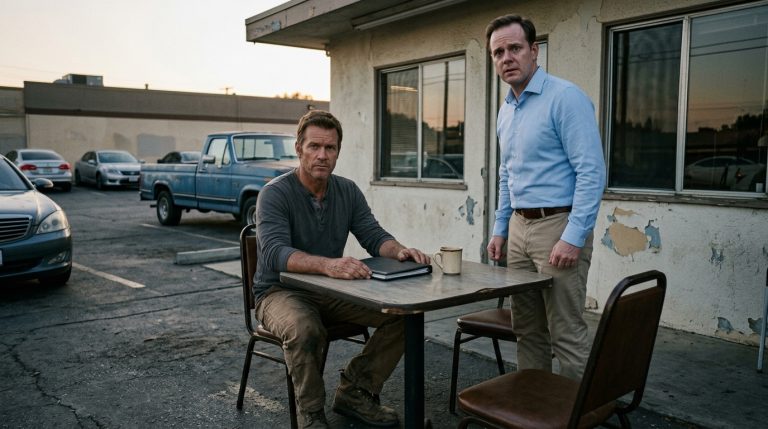
The Architecture of Retribution: How a Disabled Veteran Systematically Dismantled a Suburban Tyrant’s Power
CHAPTER 1: The Weight of the Clipboard
The knock was too sharp, too rhythmic. It was the kind of knock that expected an immediate, submissive answer. I didn’t rush. I adjusted the tension on my armrest, felt the familiar bite of the rubber grip against my palm, and steered the chair toward the door. Every rotation of the wheels across the hardwood was measured, a slow-motion advance into a conflict I hadn’t invited but was already dissecting like a tactical puzzle.
When I pulled the door open, the transition from the dim cool of my living room to the harsh, oversaturated light of the suburban afternoon felt like a physical blow. Denise stood there. She held a clipboard with the kind of white-knuckled grip that suggested it was the only thing keeping her upright. She didn’t offer a greeting. She didn’t offer a human smile. She simply gestured with her pen toward the ramp that had been my bridge to the outside world for the past two months.
“That,” she said, her voice thin and sharp as a razor, “needs to come down.”
I didn’t answer immediately. I took the time to study her. Her eyes weren’t focused on the ramp’s structure, but on the space it occupied—a territory she clearly viewed as her own personal dominion. I looked past her, toward the manicured, silent street. A neighbor was mowing their lawn three houses down, the drone of the engine filling the gaps in our silence. I calculated the distance between us, the angle of the sun hitting her face, the way her pupils didn’t track my movement but stayed locked on the wood beneath my wheels.
“Excuse me,” I said, my voice steady, stripped of the defensive tremor she was clearly hoping to provoke.
She tapped the clipboard with her pen. The sound was a harsh, dry click. “It was never approved. It’s an unauthorized structure, and it’s dragging down the aesthetic of this entire cul-de-sac. You have thirty days, or the fines start accruing at two hundred dollars a day.”
She was waiting for an outburst. She was waiting for the veteran to lose his composure, to raise his voice, to give her the ammunition she needed to paint me as the ‘volatile’ element in her perfect, ordered ecosystem. I felt the pulse in my wrist, slow and steady. I didn’t get angry. I got quiet. I let the silence stretch, watching as the smug confidence in her expression began to waver, just a fraction, because I wasn’t playing the part she had written for me.
“I have the approval letter, Denise,” I said, my voice quiet, almost conversational. “I keep it in a fireproof box.”
She blinked, her composure cracking for a microsecond before she tightened her mask again. “I’m the president of the board,” she replied, her tone dripping with a rehearsed authority. “I would know if it had been approved.”
Behind her, I noticed something—a scrap of paper fluttering near the storm drain, caught in the wind. It was a flyer for the board’s last meeting, but the date was crossed out in dark, aggressive ink. The discrepancy pulled at my mind, a small, nagging friction in an otherwise smooth narrative. I didn’t look at it, but I noted its position, storing the detail like a weapon to be cleaned and used later.
“I’ll be sure to file it properly for you,” I said, closing the door just enough to signal the end of the conversation.
The lock clicked—a solid, final sound. Outside, the silence of the neighborhood resumed, but the air felt heavy, charged. I didn’t move away from the door. I sat there, wheels locked, watching her reflection in the glass of the storm door as she stood there for a heartbeat too long, clutching her clipboard like a shield, before she finally turned and marched away, leaving the scent of stale perfume and entitlement in her wake. The move was hers, but the board was now in play.
CHAPTER 2: The False Compromise
The lock clicked—a solid, final sound—but the house didn’t feel like a sanctuary. It felt like a perimeter that had just been probed. I stood in the entryway, my hands still gripping the rubberized rims of the chair. The scent of Denise’s perfume, a sharp, synthetic floral, lingered in the stagnant air of the hall. It was an intrusion, a physical residue of her presence that I needed to scrub from my environment.
I rolled toward the kitchen, my movements fluid and practiced. Every rotation of the wheels across the floorboards was a calculation of weight and balance, a habit born from years of necessity. The house was quiet, the refrigerator humming a low, steady B-flat that usually brought me peace. Today, it sounded like a countdown.
I didn’t head for the living room to pace; I headed for the home office. The office was my command center, the place where I managed my IT consulting firm and where I kept the files that kept me tethered to the world I had built. I pulled up to the desk, the mahogany surface worn smooth by years of work. I opened the file cabinet, my fingers brushing over the labels until I found the thick, manila folder marked “Property.”
I pulled out the approval letter. It was crisp, the ink still deep and black against the professional letterhead of the management company. I laid it out on the desk next to a legal pad. I wasn’t going to let the emotion of the interaction dictate the next step. Emotion was a variable that could be accounted for and neutralized, but logic was the constant I needed to rely on.
I drafted a letter to the management company. I didn’t write it as an appeal; I wrote it as a notice of correction. I stated the facts—the original submission, the date of the approval, the signed agreement—and I attached a copy of the letter. I kept the language clinical, stripped of any frustration or indignation. I knew how these companies operated; they were layers of insulation, designed to absorb and deflect. If I hit them with heat, they would just harden. If I hit them with documentation, they would have to process it.
I sealed the envelope, the sound of the adhesive tearing like a small, sharp intake of breath. I had thirty days, or so Denise had claimed. Thirty days to dismantle a lie.
I rolled to the window. The street was quiet again, the neighbor’s mower silenced, leaving the late afternoon sun to cast long, distorted shadows across the pavement. I watched the houses, each one an identical module in this planned community. They were designed for uniformity, for the illusion of a perfect, frictionless life. But I knew better. I knew the friction was there, buried in the bylaws and the architectural committees.
I thought about the scrap of paper I had seen near the storm drain—the flyer with the crossed-out date. It was a small detail, likely nothing more than a cancelled meeting, but it sat in my mind like a jagged stone. Why cross it out so aggressively? I made a note on the legal pad: Cross-check meeting dates against HOA minutes.
I pushed away from the desk and steered toward the patio doors. The ramp waited outside, its surface clean and sturdy. I hadn’t built it to be a statement; I had built it to move through the world. But now, it was a stake in the ground. I felt a cold, hard resolve tightening in my chest, a sensation that had nothing to do with the physical pain of my injury and everything to do with the preservation of my independence.
I didn’t move onto the patio. Instead, I sat in the threshold, the metal frame of the door beneath my wheels. I watched the light shift from gold to a bruised, deepening violet. The neighborhood was settling into its evening routine—lights flickering on, garage doors closing, the soft, distant murmur of televisions. It looked peaceful, but I saw it differently now. I saw the network of lines, the invisible rules that connected each property, and the woman who thought she was the one pulling the strings.
She wanted compliance. She wanted the ramp gone. She wanted the wheelchair tucked away, out of sight, because it offended her sense of order. She didn’t realize that in trying to scrub away the ‘unauthorized’ elements of her environment, she had given me exactly what I needed: a target.
I looked at the approval letter one last time before sliding it back into the folder. I didn’t hate her. Hate was too expensive, a drain on resources I couldn’t afford to waste. I was, however, committed to the outcome. I had survived more difficult terrain than a suburban HOA; I had adapted to a life that had been fundamentally altered in an instant. This was just another calibration.
I moved away from the door and headed toward the kitchen to start dinner. The rhythm of the work, the simple, necessary motions of keeping the house running, kept me focused. I wasn’t going to spend the night worrying about the notice in my mailbox or the threat of fines. I was going to wait for the management company’s response. I would play the game according to the rules until the rules stopped making sense, and then, I would pivot.
The house felt like a fortress again, quiet and controlled. I sat at the table, my meal laid out in front of me, and listened to the silence. It was a tactical silence, the kind that exists before the first move of a game. I knew the response wouldn’t be immediate. I knew it would likely be a stall, a deflection, or a demand for further documentation.
Let them stall. I had time, and I had the paperwork. And in a world built on rules, the person who kept the best records was the one who held the power. I finished the meal, my movements precise, my eyes constantly scanning the room, already planning the next twenty-four hours. Tomorrow, I would start digging. If the management company was the insulation, I needed to find the source of the heat. I would go to the public library, access the county records, and see exactly what kind of entity this HOA was, and who was really pulling the wires behind the scenes.
The evening stretched on, the shadows in the house growing longer, more defined. I didn’t turn on the lights. I sat in the gathering dark, listening to the neighborhood wind down, already constructing the architecture of my own defense. The conflict wasn’t over. It was only just beginning to take shape.
CHAPTER 3: The Hearing
The morning sun was a cold, clinical light, reflecting off the chrome of the handrims as I maneuvered toward the front door. My folder sat in my lap, a weight of paper and intent, filled with every document, plan, and medical certification I had meticulously gathered. It felt substantial, a physical manifestation of my resolve, but as I caught my reflection in the hallway mirror, I saw the lines of tension etched around my eyes. I wasn’t just going to a meeting; I was stepping onto a field where the rules were written by the people trying to evict me.
The community clubhouse was a neutral space that felt aggressively sterile. It was designed for communal harmony, but today it functioned as a staging ground for a conflict. I arrived early, rolling through the parking lot, noting the way the asphalt gave way to cracked, uneven concrete near the entrance. I made a mental note of the slope—too steep for a standard transition, yet another barrier masked as architecture.
I entered the main room. It smelled of industrial carpet cleaner and stagnant coffee. Denise was already there, positioned behind a long, heavy table draped in a blue linen cloth that made her look like a judge. She had her clipboard—the same one, the same tight, rhythmic tapping of the pen. Beside her sat two other board members. One, a man with a nervous habit of smoothing his tie, wouldn’t meet my gaze. The other, a woman with tight, precise movements, seemed to be observing me as if I were a biological specimen.
“We have a full agenda,” Denise said, not looking up as I locked my chair into position. Her voice was thin, a wire vibrating at a high frequency. “This hearing is regarding the violation of community standards at your property. Unauthorized structural modification. Prohibited equipment.”
I didn’t answer. I simply set the folder on the table and let the silence hang there. I had learned from the previous night’s reflection that silence was a resource. I waited, counting the seconds, watching the nervous board member fidget with his watch.
“I have the documentation of the approval,” I said, my voice steady, the tone flat and objective. I opened the folder, pushing the letter across the table. It slid over the linen cloth, a stark white rectangle that demanded attention.
Denise didn’t even pick it up. She glanced at it with a dismissive flick of her eyes. “That letter is invalid. It was issued in error by a management company that no longer represents our standards.”
“The letter is a contract,” I countered, the words precise, chosen for their weight. “It was provided by the authority governing this community at the time of construction. Federal and state laws regarding accessibility modifications do not reset because of a change in management.”
The woman to Denise’s left cleared her throat. “The board has the right to determine the architectural consistency of the neighborhood.”
“Not at the cost of federal compliance,” I replied. I felt the sharp edges of the room closing in. They weren’t interested in the documentation. They were interested in the procedure, and their procedure was built to exclude. I looked down at the documents in my folder, specifically at the copy of the meeting minutes I’d pulled from the community board—the ones I had compared against the physical layout of the neighborhood last night.
There was a hole. The official minutes claimed a vote took place on the very day my ramp was approved, yet the notes made no mention of the specific design review. It was a phantom record—a document that existed to validate a decision that hadn’t been fully vetted, or perhaps, a record that had been scrubbed to justify the later ‘correction’.
“I would like to enter these documents into the record,” I said, pulling out the comparative analysis I had sketched out on my legal pad.
Denise didn’t look at the paper. She leaned forward, her expression settling into that condescending, tight smile. “This is a private community, governed by private covenants. We are not interested in outside legal interpretations, and we certainly aren’t going to be dictated to by someone who doesn’t understand the sanctity of our architectural guidelines.”
The nervous man shifted in his seat. “Perhaps we should review the—”
“We have reviewed the situation,” Denise cut him off, her voice smooth and iron-clad. “The vote is three to zero. The structure must be removed. The equipment must be stored out of sight. We are giving you an extension of fourteen days, purely out of courtesy.”
“Courtesy is not the standard here,” I said, my voice dropping an octave, losing the conversational lilt. “Federal law is the standard. If you are suggesting that this board is knowingly authorizing discriminatory actions based on a personal dislike of a necessary medical device, I need you to state that for the record.”
The silence that followed was heavy, a suffocating, dense air that filled the room. The nervous board member finally looked at me, and in his eyes, I saw not malice, but a brittle, thin-veined fear. He knew. He knew this was wrong, but he was terrified of the woman with the clipboard.
Denise didn’t blink. She tapped her pen on the table one last time—click, click, click. “The hearing is concluded.”
I watched them stand, their movements synchronized, a practiced performance of authority. I remained where I was, my hands gripping the armrests, not moving until they had exited the room. I felt the burn of the humiliation, the cold, sharp bite of the discrimination, but I channeled it. I didn’t let it bloom into anger. I let it harden into focus.
As I rolled out of the clubhouse, the sun was brighter, harsher than before. I felt the wheels crunching over the uneven concrete of the parking lot. I had the decision in writing, and I had their dismissiveness on the record. I had the lie of the meeting minutes. I had the pattern.
I reached my car and transferred the chair, the physical struggle of the movement grounding me. I didn’t head straight home. I headed toward the public library, toward the public records office, toward the place where the truth was buried under layers of official, falsified documents. Denise thought she was winning because she held the gavel. She didn’t realize that in a game of evidence, the person with the most to lose is always the one who lied first.
The engine turned over, the hum of the car a steady, rhythmic pulse. I pulled out of the parking lot, the image of the nervous board member’s face lingering in the periphery of my mind. He was the key. He was the crack in their perfect, blue-linen-covered table. And I was going to find out exactly what he was so afraid of.
CHAPTER 4: The Catalyst
The ignition clicked, and the sudden cessation of the engine’s hum felt like a loss of support. I sat in the driver’s seat for a long moment, hands resting on the wheel, the leather cool and slightly damp under my palms. The adrenaline from the hearing was beginning to cycle out, replaced by a thin, bitter clarity. I reached for the door handle, the mechanical resistance providing a small, focused point of effort.
I pulled the wheelchair from the passenger seat, the frame striking the pavement with a metallic ring that seemed to echo across the quiet driveway of my home. It was a sound I knew well—the sharp, unmistakable resonance of steel on concrete. I set the wheels, locked them into place, and moved with a practiced, singular motion into the seat. I didn’t look back at the car. My focus was on the front door, the wood grain standing out in the harsh afternoon light.
The air was stagnant, heavy with the scent of mown grass and suburban dampness. As I rolled toward the threshold, the house appeared different. It wasn’t just a home anymore; it was a contested territory. I felt a phantom ache in my lower back, a familiar, throbbing reminder of why that ramp existed. For a split second, the image of Denise’s clipboard morphed into the hard, unyielding posture of a commanding officer I had once known—a man who valued the shine on a pair of boots more than the life inside them. The realization made me grip the handrims tighter, the rubber biting into my skin. Control wasn’t just about winning; it was about refusing to be moved by someone who didn’t understand the ground they were standing on.
I reached the front door and unlocked it, the bolt sliding back with a clean, satisfying snap. I was halfway across the entryway when the heavy, rhythmic thud of a fist against the doorframe stopped me cold.
Two officers were waiting. Their shadows stretched long and narrow across the hardwood, pointing toward the back of the house like an accusation. The younger one looked as though he was struggling to keep his eyes on the floor, his jaw set in a line of forced professional neutrality. The older one, a man with deep, weary lines around his mouth, rubbed the back of his neck, a gesture of profound annoyance—not at me, but at the situation.
“We have a report,” the older officer began, his voice devoid of any real accusation, just the rote recitation of an obligation. “Unauthorized structure, prohibited outdoor equipment. The complaint specifies the wheelchair.”
I sat perfectly still, my hands resting on my knees. I looked at the younger officer, watching the way his gaze flickered to the ramp visible through the open doorway, then to my chair, and finally to the empty air beside me. There was a flicker of genuine, painful embarrassment in his eyes.
“So let me get this straight,” I said, my voice steady, the words hanging in the air like cooling lead. “She called the police because I’m sitting in a medical mobility device at my own home?”
Neither of them answered. The silence lasted, a heavy, suffocating thing that filled the gap between us. The older officer shifted his weight, his belt clinking as he let out a long, ragged breath. He looked tired. He looked like a man who spent his days refereeing disputes that had no business involving a badge.
“We’re here on a complaint,” he said, the words strained. “We’re just documenting the call.”
I didn’t argue. I didn’t reach for my files. I didn’t offer a defense, because a defense implied there was a crime to answer for. Instead, I simply waited, keeping my posture rigid, my eyes locked on the space between them. I watched the younger officer’s knuckles whiten as he gripped his notepad. He was waiting for me to break, to argue, to give them something to put in their report that would justify this intrusion.
“It’s a civil matter,” the older officer finally muttered, the words slipping out as if he couldn’t help himself. He looked at the younger one, then back to me, his eyes softening just a fraction—an admission of the absurdity, a shared recognition of the pettiness. “We aren’t going to force anyone to move a wheelchair. We aren’t going to do anything regarding the ramp.”
Before they turned to leave, the older officer hesitated. He stepped forward, not as a representative of the law, but as a man who understood the weight of a uniform. He reached out and offered a brief, firm handshake. “Thank you for your service,” he said, the sentiment quiet, almost hidden.
It was an acknowledgment of a different kind of duty—the kind that didn’t involve clipboards or neighborhood covenants. I took his hand, the grip solid and grounding, then watched them walk back toward the squad car, their steps heavy on the pavement. I didn’t move until their car pulled away, the taillights fading into the encroaching shadows.
I sat in the silence of my entryway, the door still wide open to the cooling evening. The humiliation wasn’t there anymore, replaced by a cold, sharp, and entirely functional rage. They had sent the police to my door to make me feel small. Instead, they had provided me with the final piece of evidence I needed. Using police resources to harass a citizen over a medical device—the sheer, unchecked audacity of it was a liability they couldn’t possibly survive.
I steered back to the office, my movements tight and efficient. I didn’t need the library anymore. I had everything I needed right here. The board’s actions were no longer just petty harassment; they were documented, official, and increasingly illegal. I opened my laptop, the screen illuminating my face in a pale, sterile glow. I started drafting the summary for the lawyer. I didn’t need to be aggressive. I just needed to be precise. The path ahead was no longer about defending my home; it was about the systematic, deliberate deconstruction of the woman who thought she owned it.
CHAPTER 5: The Audit
The glow of the laptop screen died down, leaving the home office cast in the long, gray shadows of the late afternoon. My eyes felt gritty, the result of hours spent staring at spreadsheets and meeting minutes. The discrepancy I had been tracking—the hole in the voting record—wasn’t just a mistake. It was a pattern. Every month, a block of “Maintenance and Legal Consultation” fees appeared in the ledger, coinciding with the exact dates of the board’s most aggressive enforcement actions.
I leaned back, the leather of my chair creaking in the silence. My palms were sweating. I reached for a glass of water, the cool condensation against my skin providing a momentary anchor to the present. The audit was incomplete; the digital records were missing the actual invoices from the management firm. They had been ‘archived’—a convenient digital barrier designed to discourage exactly the kind of scrutiny I was currently applying.
I didn’t hesitate. I pushed the laptop aside and locked the chair. I needed the physical files. I needed the paper trail that the management company, in their arrogance, assumed no one would ever bother to dig out of a dusty basement.
The drive to the management office was a steady, rhythmic progression through the suburban sprawl, a series of stoplights and turn signals that felt like a low-stakes chess game. When I arrived, the building was a nondescript brick structure, its windows reflecting the fading light. I maneuvered my chair to the entrance, the concrete ramp here ironically well-maintained—a clear attempt to project an image of legitimacy that I now knew was entirely manufactured.
Inside, the lobby was a cavern of polished marble and cold, artificial air. I approached the reception desk, the surface just high enough to be an obstacle. A young woman with a crisp, neutral expression looked up from her computer.
“I’m here to view the archives for the Cedar Creek HOA,” I said, my voice steady, the tone carrying the weight of a professional inquiry.
She tilted her head, her smile polite but entirely hollow. “We don’t allow public access to archives without a formal request from the board president. You’ll need to contact Denise.”
I didn’t react. I had anticipated the refusal, the standard bureaucratic deflection. I reached into my bag and pulled out a copy of the state’s open-records disclosure for housing associations—a document I had printed and highlighted that morning. I laid it on the desk, the paper crisp and sharp.
“I’m aware of the policy for residents,” I said, leaning in just enough to bridge the height gap. “However, this isn’t a resident inquiry. It’s a formal request regarding fiscal transparency and accessibility compliance, as currently under review by the state’s housing department.”
The woman’s expression flickered, the mask of polite indifference wavering for a fraction of a second. She glanced at the document, then back at me. She wasn’t the enemy; she was just the buffer, another layer of insulation designed to keep the reality of the management company’s actions hidden from view.
“I… I’ll have to check with the office manager,” she said, her voice lacking its earlier conviction. She stood, her chair rolling back with a harsh, synthetic whine against the floor.
As she walked toward the back offices, I looked around. The lobby was lined with files, rows of metal cabinets that held the history of a dozen different communities. This was the engine room of the tyranny—the place where the rules were printed and the fines were generated. I listened, my focus sharpening, as the sound of muffled conversation drifted from behind the heavy, frosted-glass doors.
There was a tone of sharp, quick agitation. I couldn’t make out the words, but the cadence was unmistakable: the panic of someone who realized they were holding something they shouldn’t be.
Minutes stretched into an eternity. I sat in the center of the lobby, the target of every passing glance, but I didn’t care. I felt a surge of cold, calculated purpose. My injury, the ramp, the wheelchair—they were the triggers that had brought me here, but the objective had shifted. I wasn’t just fighting for my own patio anymore. I was dismantling the architecture of their control.
The woman returned, her expression now tight, a little frantic. “The manager says there’s a system error,” she said, clutching a manila folder to her chest like a shield. “We can’t access the specific invoices you’re looking for today.”
“Then I’ll wait,” I replied, the statement firm and immovable. I wasn’t leaving without the proof. I saw her glance toward the heavy back door, her eyes wide, then back to the office manager who had appeared in the doorway—a man with a sharp, angular face and a suit that cost more than my first car. He was looking at me, his gaze cold, assessing, the look of someone who dealt with ‘problems’ for a living.
“Sir,” he said, his voice smooth, professional, and entirely devoid of warmth. “We’re closing for the day. If you don’t leave, we’ll be forced to contact the police to remove you from the premises.”
I looked at him, then at the folder the receptionist was holding. The ‘system error’ was a lie, a thin, transparent veil that he was using to hide the paper trail. I didn’t move. I shifted my hand to my phone, ready to initiate the next step of the plan. If they wanted to play hard, if they wanted to use the threat of the police to hide their fraud, I was happy to let them.
“Fine,” I said, my voice quiet, almost a whisper. “But you might want to call your insurance company first. Because when I walk out of here, I’m not going to the police. I’m going to the state auditor.”
The silence in the room was absolute, a void that seemed to swallow the hum of the air conditioner. The manager’s face hardened, the mask of the professional administrator cracking to reveal something much uglier beneath. I had moved past the decoy; I was standing on the precipice of the core truth. I didn’t have the papers yet, but I had the reaction. And that, I knew, was as good as a confession.
CHAPTER 6: The Legal Strike
The silence in the management office lobby was not empty; it was pressurized. The office manager stood silhouetted against the frosted glass of the back office, his posture one of rigid, practiced indifference. He hadn’t moved to escort me out, but his presence was a blockade. I sat in the chair, my knuckles white against the handrims, feeling the steady, rhythmic thrum of my own pulse. The receptionist, meanwhile, had stopped pretending to work; she was watching the office manager, her gaze darting between him and me, her lips pressed into a thin line of apprehension.
I didn’t speak. I didn’t need to. I had delivered the ultimatum, and I watched now as it worked its way through his composure. He was recalculating, weighing the risk of a public record of their refusal against the danger of letting me walk out with the truth.
I wheeled myself back toward the automatic doors. I needed to be outside, where the air was moving and the shadows were long. As I passed the reception desk, I saw the manager’s eyes narrow, a flicker of something colder than professional annoyance—a genuine, predatory awareness. He finally understood that I wasn’t just another disgruntled resident. I was a structural failure in his system, and he would have to find a way to patch me.
The exterior air hit me like a splash of cold water. I rolled toward my car, the pavement uneven and riddled with micro-cracks that vibrated through the frame of the chair. My mind was racing, replaying the encounter, analyzing the manager’s reaction. The system error he had cited wasn’t a mistake. It was a failsafe.
I loaded the chair into the car, my movements rapid, almost frantic. The adrenaline had spiked, and I felt a sharp, metallic taste of desperation. I had tried to play by the rules, to bring them to the table with documentation and professional requests, but the rules were just another layer of the wall. I needed a different tool.
I drove until I found a quiet parking lot on the edge of the business district, the kind of place where nobody paid attention to a car sitting idling for hours. I opened the laptop, the screen light harsh in the gathering dusk. I didn’t open the spreadsheet; I opened the blank document for the legal complaint.
My fingers flew across the keys. I cataloged everything: the initial approval, the date, the specific clause in the bylaws that defined structural modifications, and the subsequent, arbitrary reversal. Then, I detailed the interaction at the management office—the refusal, the “system error,” and the explicit threat of police involvement. It was a story of systemic retaliation, a pattern of behavior designed to isolate, intimidate, and ultimately, exhaust any resident who dared to challenge the established order.
As I wrote, I realized the full scope of the trap I’d been in. It wasn’t just about my ramp. The ramp was a test case. If they could force me to remove a legally compliant accessibility feature through intimidation, they could do it to anyone. They could define the entire community’s identity by what they removed, what they hid, and who they marginalized. Denise was just the mask; the management company was the face.
I paused, looking at the blinking cursor. A strange, cold clarity washed over me. I was looking for a single document to prove the embezzlement, but the proof wasn’t in a single invoice. It was in the accumulation of all of them. The sheer volume of legal fees suggested a community in constant, perpetual conflict—not because the residents were litigious, but because the HOA was generating the litigation to justify its own necessity.
My phone chimed—a notification from my bank. My balance was shrinking, the cost of the legal consultations and the mounting fines for ‘unauthorized equipment’ beginning to impact my daily life. They were counting on this. They were betting that I would run out of money before I ran out of resolve.
I picked up the phone and dialed the number for the disability rights attorney. She answered on the third ring, her voice crisp and immediate.
“I have the documentation of the denial,” I said, my voice low and urgent. “And I have the manager on record refusing access to public files. We’re moving past the complaint stage. We’re filing for an injunction.”
There was a pause, a short, sharp intake of breath on the other side of the line. “An injunction is a major escalation,” she said, though there was a hint of steel in her tone. “It’s going to force their hand. They won’t be able to hide behind the board anymore.”
“Let them reveal it,” I replied, staring out at the darkening lot. “I’m done with the private community rules. If they want to play by the law, let’s see how they do when the law is watching.”
We talked for thirty minutes, mapping out the filing, the discovery phase, and the inevitable pushback. She was a professional, a blade of a woman who didn’t deal in sympathies, only in outcomes. She understood the strategy: we wouldn’t just challenge the violation; we would challenge the legitimacy of the board’s entire fiscal management.
When I hung up, the car felt small, cramped, and entirely insufficient. I sat in the dark, the only light coming from the streetlamp above, and watched a stray cat trot across the asphalt. I felt a profound sense of isolation—the weight of the fight, the cold reality of the costs, and the unsettling realization that the antagonist wasn’t a person, but a mechanism.
But I also felt something else: the absence of the doubt that had plagued me since the day Denise first walked up to my patio. The target was clear now. The path forward was narrow, treacherous, and demanded everything, but it was the only way through. I started the car, the engine turning over with a steady, defiant rumble. I was going home to sleep, to prepare, and to wait for the storm. The lawsuit was drafted, the strategy was set, and the illusion of their authority was about to be broken.
CHAPTER 7: The Discovery
The silence in the parking lot was total, a stark contrast to the frantic mental friction of the previous hours. I sat in the darkness, the only movement the slow, rhythmic rise and fall of my own breathing. The legal complaint was filed, the attorney was in motion, but the missing piece—the physical, undeniable paper trail—remained a ghost. I knew the management company’s office was a fortress of digital insulation, but I also knew how they kept their secrets: they didn’t just store them in a server; they filed them.
I checked the time. It was late, the suburban landscape around me quiet, almost unnervingly still. I didn’t return home. I turned the key, the engine coming to life with a quiet, efficient purr that felt like a secret. I had one more lead, a tiny detail that had been buried in the files I’d already managed to glimpse: the off-site storage facility mentioned in a stray, misfiled vendor invoice. It wasn’t a digital archive; it was a physical one, used for old tax documents and ‘retired’ legal records.
The drive was short, a navigation through the sleeping artery of the city. I kept my eyes fixed on the road, my mind running through the contingencies. I wasn’t going to break in—that was a narrative for the movies, a messy, high-risk gambit I had no intention of executing. I was going to follow the paper. I arrived at the facility, a sprawling, anonymous complex of steel lockers and barbed-wire fencing.
I sat in the car, observing. There was a security guard at the gate, his booth lit by a single, harsh halogen bulb. He was occupied, the glow of a tablet screen reflecting in his glasses. I had the authorization code for the locker—a relic of a previous, more careless era when the HOA president had been given access for ‘emergency document retrieval.’ It was a gamble, but the management company was notoriously lax with outdated access protocols.
I rolled to the gate, my heart beating with a steady, clinical intensity. I entered the code. The gate groaned, the mechanism slow and labored, before it began to slide open. The sound was like a shriek in the quiet night. I didn’t stop. I steered the chair toward the designated row, the metallic clang of the locker doors filling the space as I navigated the narrow, dimly lit corridor.
Locker 402. I reached it, the steel cold and unforgiving under my fingers. I keyed in the secondary code. The lock clicked, a sound that felt like a thunderclap. I pulled the door open, the scent of damp paper and long-stored dust hitting me in a rush.
I didn’t waste time. I scanned the shelves, my flashlight beam cutting through the gloom. There, labeled with the name of the management firm and the fiscal years in question, were the boxes. I pulled one down, the weight substantial, and opened the lid.
It was all there. Not just the invoices, but the internal memos. The email threads between Denise and the office manager, the ones that mapped out the entire orchestration. The ‘system error’ had been a desperate attempt to keep these specific, handwritten notes from appearing in the discovery phase of the lawsuit.
I stopped. My light hovered over a specific document: a ledger of diverted funds, clearly labeled with the names of the board members who had been paid ‘consulting fees’ for their compliance. The final truth wasn’t embezzlement for profit; it was a pay-to-play scheme. The management company hadn’t been working for the HOA; they had been building a syndicate.
The weight of the paper in my hands was immense. I felt a sudden, sharp clarity, a tightening in my chest that had nothing to do with the physical strain. I wasn’t just exposing a bully; I was blowing the foundation out from under the entire structure. I took a picture of every page, the flash of the camera illuminating the dark, cramped space, turning the paper into digital, immutable evidence.
I heard the sound of footsteps—a heavy, rhythmic crunching on the gravel outside the row. My heart jumped, the flight response firing instantly, but I forced it down. I packed the files, the paper sliding into my bag with a soft, final rustle. I didn’t panic. I calculated the distance to the exit, the speed of the gate, and the time it would take for the guard to realize someone was inside.
I turned the light off. The darkness rushed back in, absolute and suffocating. I moved with precision, my hands navigating the familiar geometry of the wheels and the floor. I reached the end of the row, the faint, shimmering light of the parking lot drawing me forward like a beacon.
I made it to the car, the transition from the locker to the seat a blur of motion. I didn’t look back. I pulled away from the facility, my hands steady on the wheel, the digital evidence now sitting in my bag. The manager’s predator stare, the cold, calculating dismissiveness of the HOA board—it all felt small now, insignificant. They had built a kingdom on a foundation of sand, and I had just found the shovel. The war wasn’t over, but the final, decisive blow was already being loaded into the chamber.
CHAPTER 8: The Settlement The Sound of Concrete
The drive back from the storage facility was slow, the road stretching out like a ribbon of uncertainty in the predawn light. I kept my hand on the bag, the sharp corners of the folders pressing against my palm. Every bump in the road, every flicker of the streetlights, felt like a countdown to a confrontation that could no longer be deferred. I didn’t head home; I drove straight to my attorney’s office, the building already lit by the early shift’s urgency.
When I entered her office, the atmosphere was thick with the scent of ozone and stale coffee. She didn’t look tired. She looked expectant. I placed the bag on her desk, the sound of the leather hitting the wood like a gavel. I didn’t say a word. I just sat, my hands locked firmly on the chair’s grips, waiting for her to process what I had brought.
She opened the files, her eyes scanning the pages with a speed that spoke of years of practice. As she moved from the invoices to the email threads, I watched her face. The initial professional detachment vanished, replaced by a slow, rising awareness that what we were looking at wasn’t just a win—it was a total demolition.
“This,” she said, her voice barely a whisper, “isn’t just evidence of embezzlement. It’s evidence of a systematic racketeering scheme. The management company wasn’t just ‘working’ for the HOA. They were creating the crises, billing the HOA for their own manufactured legal conflicts, and skimming the overages into private accounts. Denise wasn’t the mastermind. She was the useful idiot, the blunt instrument they used to keep the residents in a state of perpetual, distracted conflict.”
The revelation hung in the air, a cold, hard truth that reordered everything I had experienced. The petty violations, the harassment, the police calls—they weren’t about my ramp or my patio chair. They were about creating enough noise and local division to mask the multi-hundred-thousand-dollar drain happening behind the scenes. Denise had been the face of the petty tyrant because the real tyrants were busy stealing the foundation of the community.
“What happens now?” I asked.
“Now,” she said, her smile sharp enough to draw blood, “we don’t just file for an injunction. We hand this entire package to the District Attorney’s office, and then we invite the local news to report on where their dues have actually been going.”
The next forty-eight hours were a blur of depositions, frantic press releases, and the slow, inevitable disintegration of the management company’s defenses. When the news finally broke, the fallout was instantaneous. The state auditor moved in, and within a week, the management company was stripped of its license.
The HOA board meeting, held in the same clubhouse where I had been humiliated just weeks before, was a spectacle of public collapse. I attended, rolling into the room to find a crowd of neighbors, their faces a mixture of confusion and raw, rising anger. Denise stood at the front, her clipboard gone, her hands trembling as she tried to defend actions she no longer understood. The office manager wasn’t there. He was already gone, his office cleared out, his legal team having abandoned him the moment the evidence surfaced.
The motion to resign the entire board passed with a roar of voices. I watched as Denise, stripped of her authority and facing the cold, hostile gaze of the people she had bullied for months, turned and walked out of the clubhouse. She didn’t look at me. She didn’t look at anyone. She just walked, the sound of her footsteps fading into the sudden, shocked silence of the room.
The denouement wasn’t a sudden surge of triumph; it was a slow, quiet settling of dust. The settlement, when it arrived, was comprehensive. The funds were returned, the fines were wiped, and the community was placed under an independent, court-appointed oversight committee.
The most satisfying part, however, was the sound. A month later, as I sat on my patio in the evening air, the atmosphere was transformed. A construction crew was working on the community center, the sound of concrete cutters and heavy machinery filling the air. It wasn’t the sound of a violation anymore. It was the sound of progress. They were building the accessible ramp, widening the pool gates, and pouring the curb cuts that had been denied to the community for years.
I rolled to the edge of the patio, my ramp firm and unwavering beneath me. My neighbor, an older woman who had once been afraid to speak to me, walked over, her expression soft, hesitant. “I heard they’re finally fixing the walkway by the park,” she said, a small, genuine smile touching her face. “My grandson can actually come over now.”
I nodded, the weight of the past months finally lifting. I didn’t need to explain the legal complexity or the cost. I just leaned back, watching the light fade over the rooftops. I had repaired more than just my patio. I had forced a community to look at the ground beneath its own feet, and I had cleared the way for everyone who would walk it in the future.
The evening turned to a soft, deep blue, the air cool and still. I reached down and tightened a bolt on my chair’s side panel, a small, rhythmic mechanical task that felt like the final punctuation in a long, complicated sentence. I was home. And for the first time in a long time, the rules of this place were actually, finally, fair.