The Iron Ledger: A Hardboiled Tactical Dismantling of Suburban Tyranny and Corruption
CHAPTER 1: COLD FORGE PROTOCOL
The four-pound cross-peen hammer hung dead in my right hand.
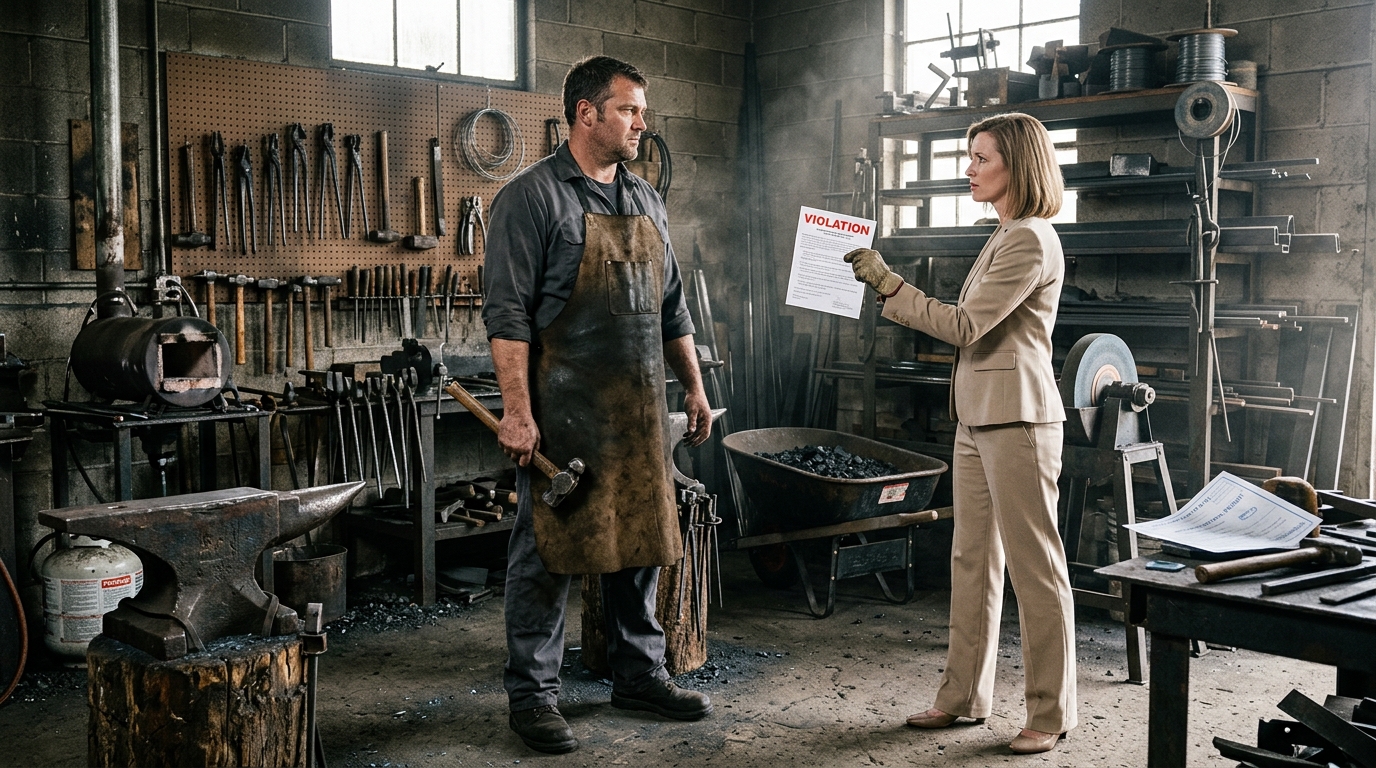
Grain-eighty steel dust clung to the sweat on my forearms. Through the roar of the propane burner, the gravel outside crushed under six-hundred-dollar loafers. Suburban footfalls. Unsteady. Heavy on the heels.
I didn’t turn. I laid the hot flat-bar across the anvil face, holding the steel with the tongs until the bright orange faded to a dull, angry cherry.
“This medieval fire pit,” a voice rasped from the workshop threshold, tight and thin like dry paper snapping, “is a Class Four aesthetic violation.”
I turned slowly.
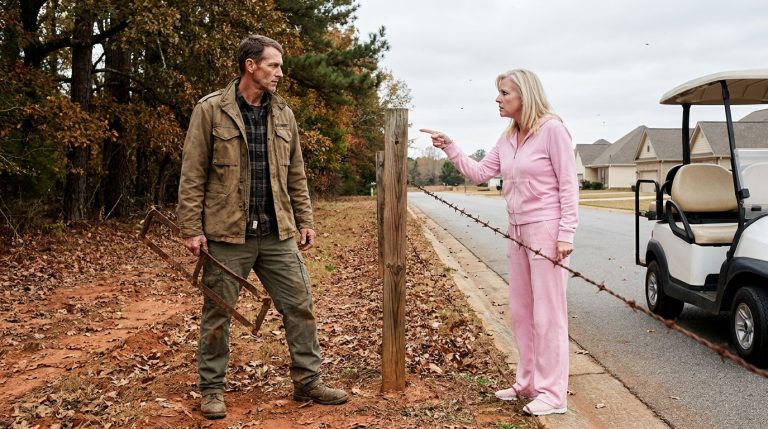
She stood six feet outside the drip line of my roof, squeezed into a beige pantsuit that looked lined with cardboard. A heavy plastic clipboard was pinned against her ribs like armor. Karen. President of the Summit Creek Estates Board. Behind her, the mid-morning sun glinted off the windshield of a white crossover idling at the curb.
“It is an unapproved commercial enterprise,” she said. Her small, wet eyes swept the rack of tongs, the fire brick, the oil slack tub. “A noise pollutant. A fire hazard. A direct affront to the streamlined lifestyle we cultivate here.”
My pulse stayed at fifty-two. Fifteen years in the Regiment teaches you to read a room before you speak in it. She wasn’t looking at the heat. She was looking at the paper on her board. Her thumb rubbed a raw, red patch on her knuckle—an involuntary tic. She was nervous, but her posture screamed manufactured dominance.
“Section 7, Paragraph C,” I said. Voice low. Flat. “Detached hobbyist structures are permitted. Approved by Thompson in writing before the ground broke.”
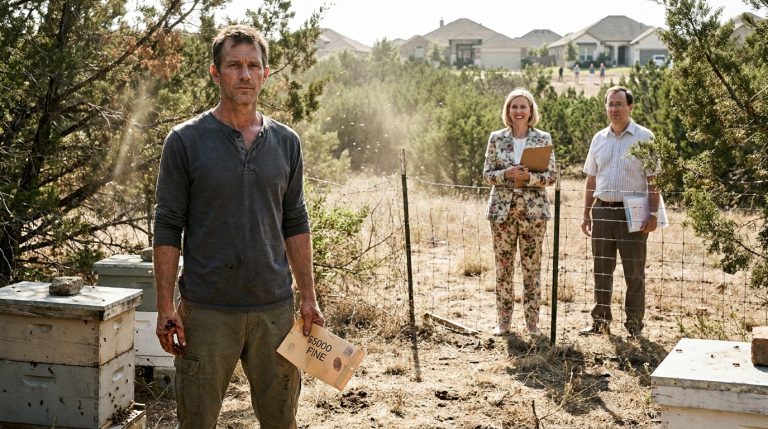
“Thompson is gone,” she snapped. She tapped a red fingernail against the clipboard. Tack. Tack. Tack. “The developer transferred governance to the residents six months ago. The board sets the standards now, Mr. Caldwell. The fines start today. Two hundred a day for the structure. One hundred for the unauthorized commercial work. Five hundred special assessment for immediate fire risk.”
Eight hundred dollars. Day one.
“You don’t have the quorum to issue unilateral assessments,” I noted.
Her lip twitched. “Pay up, or the next letter comes from our attorneys regarding a lien against your deed. Shut it down now.”
She turned on her heel, her synthetic suit whispering violently as she marched toward her car.
I didn’t argue. I didn’t raise my voice. I set the tongs on the iron rack, turned off the gas valve on the furnace, and watched the flame die in the burner tube. The sudden silence in the shop was heavy, filled only with the pinging of cooling iron.
On the workbench sat my brass drafting divider—an old tool from my grandfather’s chest. I picked it up, feeling the hard steel points bite slightly into the meat of my thumb as I spun the knurled adjustment screw.
Eight hundred a day wasn’t a fine. It was an extraction tactic.
I walked out to the edge of my driveway and looked down the asphalt ribbon of Oak Hollow Lane toward the main entrance. A quarter-mile away, the twin stone pillars of Summit Creek Estates held up three tons of hand-forged, black-lacquered iron. Scrollwork oak leaves. Twisted acorn clusters. Solid bar stock.
She didn’t know who hammered those leaves. She didn’t care.
I walked back inside, pulled the fireproof safe from under the main bench, and dialed the combination. Inside lay the original blue-stamped architectural permits, Thompson’s signed authorization, and the county fire marshal’s certification letter.
Next to them was a fresh legal pad.
I clicked a black ballpoint pen and wrote three words at the top of the grid: Summit Creek Covenants.
The forge was going cold for the day, but the perimeter had just been breached.
CHAPTER 2: PAPER TRENCHES
The steel point of the brass divider pressed into my left thumb until the skin went white. No blood. Just a sharp, clean ache that kept the peripheral noise away.
Outside the office window, the furnace had cooled completely. The silence over Oak Hollow Lane was total, the kind of stillness that usually meant an observation post was doing its job. I didn’t turn on the overhead light. One sixty-watt bulb in the desk lamp was enough to illuminate the thick, white binder of the Summit Creek Covenants, Conditions, and Restrictions.
Beside it sat the blue-stamped architectural permit from two years ago, signed in bold black ink by Arthur Thompson, the original developer. Section 7, Paragraph C was clear: Detached hobbyist structures and creative artisan studios are permitted, provided municipal code compliance is maintained.
I opened Karen’s violation notice next to it.
Her handwriting at the bottom was a sharp, jagged scribble, but the printed body of the text was what caught my eye. The font was off. The headers on the official CC&Rs used sixteen-point Times New Roman, justified left. The sheet Karen had served me used Arial, twelve-point, with uneven kerning along the margins.
I spun the knurled wheel of the brass divider, matching the distance between the top margin and the header of the official bylaws against her notice.
A four-millimeter variance.
This wasn’t an official document generated by a board administrative assistant. It was a template created on a home printer, formatted to look like a legal notice to anyone too intimidated to measure the lines.
I pulled a yellow highlighter from the desk drawer and uncapped it. The chemical smell of the ink cut through the lingering odor of iron scale. I began at page one of the master CC&Rs, scanning line by line.
Clause 4.2: Board Actions.
I dragged the yellow tip across the paper. No monetary penalty, assessment, or fine shall be levied against a lot owner without a minimum fourteen-day written notice of hearing, delivered via certified mail or hand-delivered by a designated officer of the Board, following a formal quorum vote.
Quorum required four of the five board members present. Karen had walked into my shop at 10:15 AM on a Thursday. No certified letter. No notice of hearing. No quorum.
She had acted unilaterally. A rapid-assault tactic designed to trigger immediate compliance through panic before the target could establish a defensive perimeter.
I turned the page. The paper rasped dryly against the wooden desk.
Near the back of the binder, tucked under the appendix for third-party service vendors, a small stamp caught the light. It was a low-quality ink transfer, faint along the bottom edge: Vanguard Holdings LLC — Management Advisory.
I stared at the name. Vanguard wasn’t listed on any of the original closing documents Sarah and I had signed at the title company. The primary property management company retained by Thompson had been a regional firm out of the city.
I picked up my phone, keyed in a secure browser, and pulled up the Secretary of State’s corporate registry.
Search: Vanguard Holdings LLC.
The results loaded in two seconds. Registered eight months ago. Domestic limited liability company. Status: Active.
The registered agent was listed as a post office box three towns over. No corporate officers named in the public filing. But the filing date lined up precisely with the week Thompson handed control of the HOA over to the elected resident board.
The front door clicked open down the hall. Soft, careful footsteps.
Sarah appeared in the doorway, her silhouette framed by the dim light of the kitchen. She was wearing her thick wool cardigan, her arms crossed tight against her chest. She looked at the papers spread across the desk, then at my face.
“Lily’s asleep,” she said softly. Her voice lacked its usual brightness, weighed down by the quiet tension that had settled over the house since morning. “I saw her car parked at the end of the cul-de-sac earlier. She was watching the house, Jack.”
“Let her watch,” I said.
“She talked to the Hendersons,” Sarah continued, walking over and placing a hand on the back of my chair. Her fingers were cold. “Mary called me ten minutes ago. Karen told them you were operating an industrial machine shop without insurance, that the furnace could rupture the neighborhood gas line. Mary was terrified, Jack. She asked if we were going to move.”
“We aren’t moving.”
“She’s turning everyone against us before we can even explain,” Sarah whispered. Her thumb brushed the top of my shoulder, feeling the rigid tension in my trapezius. “I know that look on your face. That’s the look you had before a deployment. This isn’t a ridge line in Helmand, Jack. It’s an HOA.”
“The tactics don’t change,” I said, my eyes remaining on the yellow lines highlighted on the page. “She relies on speed, isolation, and fear. If the neighbors are afraid, they don’t ask for documentation. They just want the threat gone.”
I stood up, took a blank manila folder from the filing cabinet, and slipped Karen’s notice inside. Next to it, I placed a clean photocopy of Section 7, Paragraph C, and a printed copy of the Secretary of State’s registry page for Vanguard Holdings.
“Where are you going?” Sarah asked as I grabbed my jacket from the hook.
“Next door,” I said, zip-locking the manila folder. “It’s time to break her isolation envelope.”
The night air was cold, carrying the damp scent of fallen pine needles and wet earth. I crossed the grass line between our properties, the wet blades squeaking under my boots. The Hendersons’ garage light was on, casting a warm yellow rectangle across their concrete driveway.
Inside, George Henderson was standing over the open hood of his 1968 Mustang, a wrench in his hand, the radio playing quiet jazz. He looked up as my shadow crossed the threshold, his posture stiffening instantly.
“Jack,” he said, setting the wrench down on the fender cover with a heavy clink. He wouldn’t meet my eyes directly. “Look… Mary’s pretty shaken up about what Karen said.”
“George,” I said, stopping three feet from the bumper. I didn’t step any closer into his personal space. I held out the manila folder. “Don’t take my word for anything. Read page four.”
George hesitated, his weathered hands hovering over his grease rag. He looked at the folder, then at my face. The absolute lack of panic in my posture seemed to anchor him. He reached out, took the paper, and pulled his reading glasses from his shirt pocket.
He read in silence for two full minutes. The only sound was the low hum of the garage refrigerator.
“Paragraph C,” George muttered, his brows knitting together. “Thompson signed this?”
“Two years ago,” I said. “It’s filed with the county recorder. And this.”
I handed him the printout of the board voting regulations.
“She told you I was operating illegally,” I said, keeping my tone entirely conversational, stripped of emotion. “She didn’t tell you that under Section 4.2, she needs four board votes to issue a single dollar in fines. She didn’t hold a vote, George. She walked onto my property this morning and made up a number.”
George looked at the paper, then back at me, a sharp crease forming between his eyes. “She told Mary the board had already approved the assessment at an executive session last Tuesday.”
“Executive sessions require published minutes within forty-eight hours,” I replied. “Ask her for the minutes.”
George slowly folded the paper and held it between two fingers. The hesitation in his eyes was gone, replaced by the quiet, rising annoyance of a man who realized he’d been lied to by someone he was forced to deal with every day.
“She tried to fine us last month,” George said, his voice dropping an octave. “Said the vintage plates on the Mustang were a commercial storage violation because the car wasn’t ‘actively registered for daily commute.’ I paid fifty bucks just to make her go away.”
“That’s how it starts,” I said. “You pay fifty to clear the noise. Next month, it’s five hundred.”
George looked past me toward the street, where the streetlights threw long shadows across the immaculate suburban lawns. “David Chen resigned from the board three weeks ago, you know. He wouldn’t talk about it. Just said he was done.”
“David Chen was the treasurer,” I noted.
“Yeah,” George said, his grip tightening on the manila folder. “He was.”
I stepped back toward the driveway apron. “Keep the papers, George. Show them to Mary.”
“Jack,” George called out as I turned to leave. He stood in the frame of his garage door, the yellow light highlighting the hard lines of his face. “What are you going to do?”
“I’m going to ask David Chen why he resigned,” I said.
I walked back across the lawn, my boots cutting clean tracks through the heavy dew. The forge stood dark against the night sky, its heavy iron anvil waiting inside. The paper trail had its first tear.
CHAPTER 3: NETWORK INFILTRATION
David Chen’s key was halfway into the door lock of his sedan when my shadow hit the driver’s side window.
His shoulders hitched up toward his ears. His right hand remained frozen on the door handle, the leather of his briefcase grinding against his trouser leg. He didn’t turn around immediately. He took a single, controlled breath, the exhaust of his cold intake visible in the 8:00 AM chill.
“I don’t have anything to say to the board, Jack,” Chen said, his voice flat, kept low so it wouldn’t carry across his neatly manicured lawn.
“I’m not the board,” I said.
I held the steel thermos in my right hand, the steam rising off the screw cap in a thin, grey ribbon. I kept four feet of distance between us—enough space to let him know I wasn’t blocking his retreat, but close enough that he had to look me in the eye if he wanted to get into his car.
Chen turned slowly. He was a man in his late fortnight forty-year range, wearing an immaculate charcoal overcoat that looked two sizes too formal for Summit Creek Estates. Beneath his collar, a red stress rash crept up his jawline.
“I saw her car at your place yesterday,” Chen said. He looked down at my boots, then at the manila folder tucked under my arm. “She told Gerald you were going to be served with an injunction by Friday.”
“She’s writing her own notices,” I said. “No quorum. No fourteen-day hearing window. She’s using Arial font and hoping I don’t know how to read a ruler.”
A tiny, involuntary twitch caught the corner of Chen’s left eyelid. He looked past my shoulder, checking the windows of the house across the street before stepping away from his car door.
“You’re a blacksmith, Jack,” Chen said, his voice dropping into a tight whisper. “You deal with hot iron. You hit things until they fit. That doesn’t work here. The paper in that office is engineered to grind you down until you’re paying legal fees just to ask for a meeting.”
“You were the treasurer for fourteen months,” I said, stepping into his line of sight. “You resigned three weeks ago. An accountant doesn’t walk away from an active ledger unless the numbers stop balancing.”
Chen’s fingers tightened on the handle of his briefcase until the leather creaked. He looked back toward his front door, where his wife was standing behind the sheer curtains, watching us.
“My wife thinks I resigned because of stress,” Chen murmured. “Drink your coffee inside. I have twenty minutes before my first client call.”
The interior of Chen’s house smelt of boiled tea and lemon furniture polish. The living room was spotless, every chair angled precisely toward a dead glass coffee table. He didn’t offer to take my coat. He walked straight to his small study at the back of the house, closed the blinds, and locked the door behind us with a sharp metallic clack.
He didn’t sit down behind his desk. He stood beside a metal filing cabinet, his hand resting on the top lock as if holding down a pressure release valve.
“I didn’t resign because the numbers didn’t balance,” Chen said, looking at the floor. “I resigned because they balanced too well. Every dollar had a path, Jack. A perfectly legal, completely documented path that led directly into a wall.”
“Explain the wall,” I said.
Chen pulled a small silver key from his vest pocket, unlocked the top drawer, and pulled out a single red tabbed divider. He laid it flat on the desk between us.
On the first page was a spreadsheet. Three columns. Dates, service items, and payment amounts issued over the last twelve months.
“Evergreen Solutions,” I read off the top line.
“Eighteen thousand dollars last quarter for common area turf maintenance and tree trimming,” Chen said. He tapped a manicured fingernail against the column. “That’s forty percent higher than the regional average for a two-hundred-lot subdivision. When I asked for the competitive bids from the spring tender, Karen handed me three proposals. Two of them were from companies out of the state that didn’t even have municipal licenses to operate in this county.”
“Fake bids,” I said.
“Phantom bids,” Chen corrected smoothly. “Designed to fail compliance so the board could invoke the emergency single-source procurement clause under Bylaw 12-A.”
“Who owns Evergreen Solutions?”
Chen didn’t answer right away. He reached out and turned the paper toward me so I could read the fine print along the bottom margin.
“The business license is held under a broad commercial registration,” Chen whispered. “The primary contact listed for vendor insurance claims is a man named Frank Miller. Karen’s maiden name is Miller. He’s her first cousin.”
The room went completely quiet for three seconds. The only sound was the distant hum of Chen’s refrigerator through the wall.
“She’s routing maintenance contracts to her family,” I said.
“That’s only the baseline,” Chen replied, his voice growing even quieter, raspy with an edge of cold panic. “That’s the small stuff, Jack. The lawn care pays her cousin’s truck payments. What bothered me was the legal retainer.”
I leaned forward, my hands resting flat on the edge of his desk. “The firm that wrote her new violation standards?”
“Smith, Kline & Associates,” Chen said. He flipped to the second sheet in the folder. “Forty-two hundred dollars paid out of the reserve fund last month for ‘specialized covenant revision.’ The lead partner on that invoice is Robert Kline. He’s married to Karen’s sister.”
I stared at the black ink on the page. The pattern wasn’t just a petty grudge against my workshop. It was an extraction mechanism.
“She’s using the HOA dues to pay her brother-in-law to write restrictive bylaws,” I said, tracing the causal line out loud. “Then she uses those bylaws to levy unilateral fines against residents. If they don’t pay, she threatens a lien.”
“And if they try to fight it,” Chen added, his eyes wide behind his wire-rimmed glasses, “she uses the HOA’s legal budget—our money—to hire her brother-in-law to represent the board against the homeowner. You can’t win, Jack. You’re paying for both sides of the war.”
I took out my phone, lined up the camera over Chen’s ledger pages, and snapped three clean, high-resolution photographs. The shutter sound was sharp in the small room.
Chen didn’t stop me. He watched the flash reflect off his desk, his face pale, but a strange, heavy weight seemed to lift off his shoulders as the data left his sole possession.
“Why didn’t you go to the county prosecutor?” I asked, slipping the phone back into my pocket.
“Because the board approved the payments,” Chen said bitterly. “She scared Gerald and Brenda into signing the checks without reading the backup documentation. On paper, it looks like bad judgment by a volunteer board, not a crime. Unless you can prove the money isn’t actually being spent on real services, it’s just a dispute over vendor pricing.”
“Then we prove the services are fake,” I said.
“You can’t,” Chen said, shaking his head. “Evergreen Solutions submits work orders for every check. Lawn aeration, irrigation repair, hazardous tree removal. They have receipts.”
“Receipts require physical evidence,” I said. I picked up my thermos from the corner of his desk. “Where is Frank Miller’s equipment stored?”
Chen hesitated, his hand hovering over the drawer. “The registration lists an industrial unit off Highway 9. Unit 4B.”
“Thank you for the coffee, David,” I said.
I turned the lock and opened the study door. Chen stood behind his desk, watching me with a mix of dread and reluctant respect.
“Jack,” he called out before I reached the hallway. “If she realizes you have those numbers, she won’t just issue fines. She’ll file an emergency injunction to seize your shop property under the nuisance clause. She’s done it before.”
“Let her file,” I said.
I walked out into the morning sun. The air was crisp, the sky a hard, clear blue. On the street outside, a white utility van bearing a faded green logo—Evergreen Solutions—turned the corner onto Oak Hollow Lane, its engine idling rough as it slowed down in front of my house.
The perimeter was moving.
CHAPTER 4: THE SHELL WAREHOUSES
The optics of the ten-by-fifty binocular lenses brought the rusted lock on Unit 4B into sharp, pebbled focus.
The white utility van that had rolled past my house forty minutes prior sat idling near the bay door. Heat heat-rippled off its hood, distorting the sun-bleached lettering on its driver-side door: Evergreen Solutions LLC. No phone number. No state contractor license digit.
A man in a grease-stained grey work shirt stepped out of the cab. Mid-forties, receding hairline, thick around the belt. Frank Miller. Karen’s cousin.
He didn’t pull a key from his pocket. He kicked the bottom corner of the overhead door with the heel of his work boot until the rusty latch popped free from the track. He hauled the door up three feet with a screech of dry steel bearings, ducked underneath, and disappeared into the shadows inside.
I didn’t move from the cab of my truck. I adjusted the focus wheel.
Through the four-foot gap between the pavement and the raised door, the interior of Unit 4B was lit only by a single bare bulb hanging from a steel rafter. No commercial mower rigs. No industrial turf aerators. No stacked pallets of fertilizer or commercial grade mulch.
Sitting on the oil-stained concrete floor was a single push-mower missing its grass bag, two rusted gas cans, and three plastic bags of hardware store potting soil split open at the seams.
Eighteen thousand dollars a quarter.
I rested the cold steel body of the binoculars on the steering wheel ring and lifted my phone with my left hand. I snapped four photos through the lens glass, capturing the front plate of the van, the open door, the hollow bay floor, and Miller dragging a half-empty bag of mulch across the threshold.
This wasn’t an operational groundskeeping company. It was a postal address with a rusty lock and seventy square feet of dead space.
I turned the ignition key, put the truck in gear, and backed out of the gravel turnout without turning on my headlights.
The match cut in my timeline occurred three miles south, where Highway 9 met the rear perimeter fence of Summit Creek Estates.
The sun was dropping behind the ridge line, casting long, purple shadows across the drainage gulley that ran along the southern boundary of the property. I parked the truck on the dirt shoulder, pulled my heavy work gloves from the glovebox, and climbed down into the culvert.
This was the edge of Lot 42. My lot.
I pushed through the thick wild blackberry vines choking the ditch line. The soil was damp, smelling of swamp gas and decaying oak leaves. Twenty feet inside the tree line, right where my property line met the common area buffer, a wooden surveyor’s stake stood wedged into the mud.
Fresh pink plastic flagging vibrated in the evening breeze.
I dropped to one knee, brushing away the matted leaf litter around the base of the stake. Etched into the weathered pine face in black grease pencil was a single designation: Vanguard Holdings — Easement Access 04.
My thumb traced the sharp edge of the wood. Vanguard Holdings again.
The decoy secret Karen was pushing—the noise, the fire hazard, the unapproved forge—was the surface smoke. She wasn’t just trying to collect eight hundred dollars a day in fines. She was building a paper trail of nuisance violations to trigger a forced sale under Section 7, Clause 12.
If a property owner defaulted on cure orders for structural violations, the board held first-right option to purchase the deed at fifty percent of assessed tax value to “remediate community hazard.”
And behind the board stood Vanguard Holdings, waiting to absorb the title and claim the unrecorded drainage easement running straight through the back acre of my forge.
They didn’t want the noise stopped. They wanted the land.
A dry twig snapped thirty feet up the embankment.
I didn’t jump. I stayed low in the ditch line, my body weight shifted back onto my left heel, my hand resting flat against the cool, damp earth.
Above the lip of the culvert, framed by the pale orange twilight, stood Gerald. The timid board member who had signed the checks. He was wearing an oversized nylon windbreaker, clutching a flashlight in one hand and a clipboard in the other.
He wasn’t looking at the woods. He was staring at my truck parked on the shoulder.
“Jack?” Gerald called out. His voice was thin, nervous, cracking on the second syllable. “Jack, is that you down there?”
I stood up slowly, the dry blackberry vines hooking into the canvas of my trousers. I climbed the muddy slope in three long strides, stopping five feet from where he stood on the gravel trail.
Gerald flinched backward, his flashlight beam whipping across my chest before dropping to my boots.
“You shouldn’t be out here,” Gerald stammered, his eyes darting toward the tree line. “Karen called an emergency board session for tomorrow night. 7:00 PM at the clubhouse. She’s… she’s bringing the legal team from Smith, Kline & Associates.”
“She brought her brother-in-law,” I said, my voice steady, unhurried.
Gerald’s mouth opened slightly. His lower lip quivered. “She said you were trespassing on common ground. She said if you don’t surrender the workshop keys by tomorrow night, the county sheriff is executing an immediate access order.”
I reached into my coat pocket, pulled out the printed photograph of Unit 4B—the hollow warehouse floor, the rusted push-mower, Frank Miller’s van—and held it out in the dim light.
Gerald didn’t want to take it. His hand trembled as his fingers brushed mine. He looked down at the image.
“Eighteen thousand dollars last quarter, Gerald,” I said softly. “That’s what you signed for. That’s your signature on check 4082.”
Gerald stared at the paper. The color drained from his cheeks until his skin looked like wet wax under the twilight. “She… she told me the equipment was stored on-site at their main depot in the city.”
“There is no main depot,” I said. “It’s a shell, Gerald. And when the district attorney looks at the bank records, your name is on every invoice.”
Gerald dropped the flashlight. It hit the gravel with a dull thud, the beam pointing harmlessly into the weeds. He covered his face with both hands, his chest heaving under the thin windbreaker.
“I didn’t get a dime,” he whispered, his voice breaking completely. “I just didn’t want her to file violations against my roof. She threatened to fine me five hundred a week for non-matching shingles.”
“Then stand up tomorrow night,” I said. I bent down, picked up his flashlight, and pressed the heavy aluminum handle back into his trembling palm. “Don’t sign another check. Don’t vote for the access order.”
Gerald looked up at me, his eyes wide, terrified, trapped between the predator he knew and the soldier standing in front of him.
“She has three votes, Jack,” Gerald rasped. “Even if I vote no, she has Brenda and herself. She only needs three.”
“She won’t have three,” I said.
I turned and walked back toward my truck. The evening air had turned bitter cold, the wind rustling through the high oaks along Oak Hollow Lane.
The initial skirmishes were over. The target date was locked: tomorrow night, 7:00 PM.
The paper trenches were dug, the evidence was mounted, and the enemy was marching straight into the killing zone.
CHAPTER 5: THE TRIBUNAL EXECUTION
Sarah’s cold fingers smoothed the seam of my left lapel twice, setting the fabric flat against my chest.
“His name is Marcus Thorne,” she said quietly. Her eyes were fixed on the silver tie bar she was pinning in place. “He’s waiting at the clubhouse parking lot. He reviewed the photographs of Unit 4B and the land survey stakes.”
“Is he ready?” I asked.
“He smiled, Jack,” Sarah said. She stepped back, her gaze lingering on the heavy black leather binder sitting on the oak table. “He said people like Karen always write down their own rope.”
I picked up the binder. The brass lock snapped shut with a heavy, metallic click.
The match cut in the timeline brought us to 6:55 PM inside the Summit Creek Estates clubhouse.
The air conditioning hummed on full blast, smelling of stale carpet powder and floor wax. Forty metal folding chairs were set up in four neat rows, every single seat occupied. George and Mary Henderson sat in the front row, their knees pressed together. David Chen stood against the back wall beside the fire exit, his coat unbuttoned, holding a thin manila envelope.
At the head of the room sat a long folding table. Karen occupied the center seat, squeezed into a bright crimson blazer. To her left sat two attorneys from Smith, Kline & Associates in identical dark grey suits. To her right sat Gerald and Brenda, both staring straight down at the laminated tabletop like condemned prisoners waiting for a sentence.
I walked down the center aisle beside Marcus Thorne. Marcus was broad-shouldered, six-foot-two, carrying a battered leather briefcase that looked old enough to have survived two courtroom decades.
“Mr. Caldwell,” Karen’s voice boomed through the small PA system, metallic and sharp. “This is an executive compliance hearing. Spectators and unapproved legal representatives are not permitted under Rule 4.”
Marcus didn’t slow his pace. He walked directly to the podium, set his briefcase on the ledge, and popped the brass latches open.
“Rule 4, Section 7-C,” Marcus said, his voice quiet, clear, and utterly devoid of effort. “Mandates open access for any assessment exceeding five hundred dollars involving real property liens. I am Marcus Thorne, licensed counsel for Mr. Caldwell. And this meeting is being recorded for the record.”
Karen’s left eyelid twitched. She tapped a red fingernail against her clipboard—tack, tack, tack—before glancing at the attorney on her left.
“This board is moving to execute an emergency access order for Lot 42,” Karen declared, ignoring Marcus entirely. She raised a stapled packet for the audience to see. “Mr. Caldwell’s unauthorized forging operation represents an unmitigated fire risk, a noise hazard, and a structural nuisance that invalidates community standards.”
“Let’s talk about standards,” I said.
I stepped up beside Marcus, unclasped the black binder, and laid page one flat on the podium speaker box.
“Exhibit A,” Marcus announced. “The original architectural approval signed by developer Arthur Thompson under Section 7-C, granting permanent clearance for the workshop. Documented with the county clerk.”
“Superseded,” Karen snapped. “The resident board updated the covenants six months ago.”
“Using Smith, Kline & Associates,” Marcus said smoothly. He pulled a sheet from his briefcase and held it up toward the audience. “A firm where the senior partner, Robert Kline, is married to your sister. A firm that has billed this HOA forty-two hundred dollars out of reserve funds without a board quorum vote.”
A collective murmur rippled through the rows of folding chairs. George Henderson leaned forward, his elbows resting on his knees.
“That’s a lie,” Karen hissed, her cheeks flushing a dark, mottled purple. “That legal review was necessary—”
“Exhibit B,” I interrupted, my voice dropping into the steady rhythm of a briefing. “Evergreen Solutions LLC. Eighteen thousand dollars paid out of community dues last quarter for turf management.”
I pulled three glossy eight-by-ten photographs from the binder and slid them across the table directly in front of Brenda and Gerald.
“Unit 4B at Highway 9 Industrial Park,” I said. “Frank Miller’s registered business depot. One push-mower. Two empty gas cans. No crew. No commercial equipment. Frank Miller is your first cousin, Karen.”
Brenda gasped, her hand flying to her mouth as she stared at the photograph of the empty warehouse floor. She spun in her chair to face Karen. “You told us they had a fleet, Karen! You said they were under contract with the city!”
“Quiet!” Karen shouted, slamming her hand flat on the table. The plastic water bottle beside her microphone turned over, spilling water across her papers. “This is an outrage! This is a coordinated attack by a disgruntled resident who refuses to follow simple rules!”
“Exhibit C,” Marcus said, his tone dropping even lower, completely cutting through her screaming. “Vanguard Holdings LLC.”
The entire room went still. The air conditioner’s whine seemed to double in volume.
“Vanguard Holdings,” Marcus repeated, looking directly at the two attorneys from Smith, Kline & Associates. “A shell entity registered to a P.O. box three towns over. The entity that placed land survey stakes along the southern boundary of Lot 42 yesterday afternoon to claim an unrecorded drainage easement.”
“Who owns Vanguard?” David Chen’s voice rang out from the back of the room, crisp and loud.
Marcus pulled the final page from the binder—a certified corporate registry filing bearing the state seal.
“The managing member of Vanguard Holdings LLC,” Marcus read slowly, “is Robert Kline. Karen Peterson’s brother-in-law. The plan wasn’t to collect eight hundred dollars in fines, ladies and gentlemen. The plan was to stack illegal assessments until Mr. Caldwell defaulted, force a foreclosure under the nuisance clause, and sell the deed to Vanguard for fifty cents on the dollar.”
“Lies!” Karen screamed. She stood up so fast her metal chair scraped violently against the linoleum floor, turning over on its side. “You’re lying! You’re a disgraced soldier playing lawyer! You can’t do this!”
“Gerald,” I said, looking past her trembling, crimson-clad figure toward the man sitting at the far end of the table. “Did you sign check 4082?”
Gerald stood up slowly. His hands weren’t shaking anymore. He looked at the photographs of the empty warehouse, then at the neighbors sitting in the rows behind him.
“I move to immediately remove Karen Peterson as President of the Summit Creek HOA,” Gerald said, his voice loud, clear, and resonant. “And I move to freeze all board accounts pending a full forensic audit.”
“I second that!” George Henderson shouted from the front row.
“I third it!” Brenda cried out, her eyes wet with tears as she pushed her chair back from the table.
“All in favor!” Gerald called out.
Every hand in the room went up. Forty hands. David Chen held his high against the back door.
Karen stood behind the table, her mouth opening and closing like a landed fish, her face pale, slick with sweat. The two attorneys beside her silently closed their leather folders, packed their laptops into their cases, and stood up without uttering a single word in her defense.
“This meeting is adjourned,” Marcus said, closing the black binder with a final, heavy snap.
The room erupted into noise—chairs scraping, voices overlapping, neighbors stepping into the aisle to slap Gerald on the shoulder.
Karen sat down slowly on the edge of the overturned chair frame, surrounded by spilled water and useless paper, her kingdom dismantled down to the floorboards in less than twenty minutes.
CHAPTER 6: THE IRON RESTORATION
The white ceramic mug felt warm against the thick calluses of my right palm.
Across the asphalt of Oak Hollow Lane, seventy yards away, a dark blue county cruiser sat idling at the curb. The deputy didn’t hurry. He walked up the concrete steps of Karen’s house, holding a stiff manila folder in his gloved left hand.
When his knuckles knocked on the front door, the sound carried clear across the morning quiet.
Karen opened the door three inches. She wasn’t wearing her beige pantsuit or her crimson blazer. She wore a faded grey sweater, her hair pinned back in an untidy knot. Through the narrow gap, the deputy handed her the folded document—a formal criminal summons issued by the District Attorney’s office for mail fraud, corporate embezzlement, and falsification of public records.
Karen’s hand twitched as her fingers touched the paper. She looked past the deputy’s shoulder, her small, sharp eyes locking onto mine across the street.
I didn’t wave. I didn’t raise my mug. I stood motionless under the awning of my shop, my thumb resting over the cold, notched edge of my grandfather’s brass drafting divider tucked into my shirt pocket.
She turned back, pulled the door shut with a muffled click, and the deputy walked back down the steps to his cruiser.
Behind me, the gas valve on the propane furnace hissed to life. Blue flame blossomed along the burner tube, casting a soft, golden light across the face of the anvil and the steel racks lining the workshop wall.
The paper war was over. The physical work remained.
By mid-afternoon, the match cut in my routine took me to the main entrance of Summit Creek Estates.
The sun sat high and clear over the twin stone pillars that flanked the development. The three-ton forged iron gates hung open, their heavy scrollwork oak leaves and acorn clusters dull, flaking under thick layers of cheap matte paint applied two summers ago by Frank Miller’s crew. Rust had bled through the lower hinges, leaving orange streaks along the mortar.
A silver sedan pulled up to the gate line and stopped. Gerald rolled down his window, stepping out with a leather clip folder in hand.
“The audit wrapped up at noon, Jack,” Gerald said, walking toward where my tool truck was parked on the gravel shoulder. He looked lighter, his shoulders set back, the nervous twitch in his cheek completely gone. “The district attorney seized the bank records for Vanguard Holdings and Evergreen Solutions. Every dollar Karen siphoned is accounted for.”
“And the reserve fund?” I asked, laying a heavy wire wheel brush across the workbench in the back of my bed.
“Restored,” Gerald said with a quiet, solid nod. “The board unanimously approved the restoration contract for the entrance. Section 7-C is permanently codified into the master covenants now. Nobody can touch your shop, Jack. Not now. Not ever.”
He held out a thick white envelope bearing the new HOA letterhead. I took it, feeling the weight of the bank draft inside—a fair, professional commission to strip, treat, and seal the main gates I had forged with my own hands three years ago.
“Thank you, Gerald,” I said.
He offered his hand. I took it—a firm, honest grip between two men who had stood their ground in the dark and cleared the perimeter together.
“See you at the board meeting Thursday, Jack,” Gerald said, stepping back into his car. “We’re voting on David Chen for treasurer.”
I watched his sedan disappear down Oak Hollow Lane before turning back to the iron structure before me.
I picked up the wire wheel grinder, pulled my safety visor down over my eyes, and squeezed the trigger. The motor whined to life, a high-pitched, steady vibration that filled the quiet afternoon.
I touched the spinning wire face to the base of the left gate leaf.
A shower of orange sparks and dry, flaking black paint cascaded onto the concrete apron. Beneath the cheap coating Karen’s cousin had slapped over the metal, the raw, dense steel I had hammered into shape remained untarnished. Solid. Unyielding. Built to endure long after the rust and paper corruption were swept away.
I worked methodically, inch by inch, moving from the root scrollwork up toward the carved oak leaves at the top rail.
By 5:00 PM, the sun was dropping behind the ridge line, painting the sky in deep shades of amber and iron grey. The gates stood bare, stripped down to their clean, dark metal, ready for the protective seal that would keep the weather out for the next fifty years.
Footsteps crunched on the gravel behind me. Small, light steps.
I turned off the grinder and lifted my visor. Lily was running down the sidewalk from our driveway, her small hand held tight by Sarah. Sarah wore her heavy wool cardigan, her face bright in the twilight air, carrying a small metal tin of biscuits.
“Daddy!” Lily called out, stopping at the base of the stone pillar. She looked up at the towering steel leaves above us. “Did you make these?”
“I made them, sweetie,” I said, setting the tool down on the tailgate.
She reached out with one finger and touched the cool, smooth surface of a forged acorn. “Are they fixed now?”
I looked past the gate, down the quiet, tree-lined street where George Henderson was waving from his driveway, where David Chen was walking his dog, and where the dark, shuttered windows of Karen’s house sat silent under the evening sky.
“Yeah, Lily,” I said, picking her up and resting her on my shoulder while Sarah stepped beside me, her hand sliding naturally into my coat pocket. “They’re fixed.”
We stood together at the threshold of the neighborhood as the streetlights flickered on one by one along Oak Hollow Lane.
Behind us, at the far end of the property, the forge was dark, but the iron was cold, stable, and secure. The perimeter held.