The Reluctant Guardian: A Story of Sanctuary, Broken Trust, and Uncompromising Protection
CHAPTER 1: THE SOVEREIGN LINE
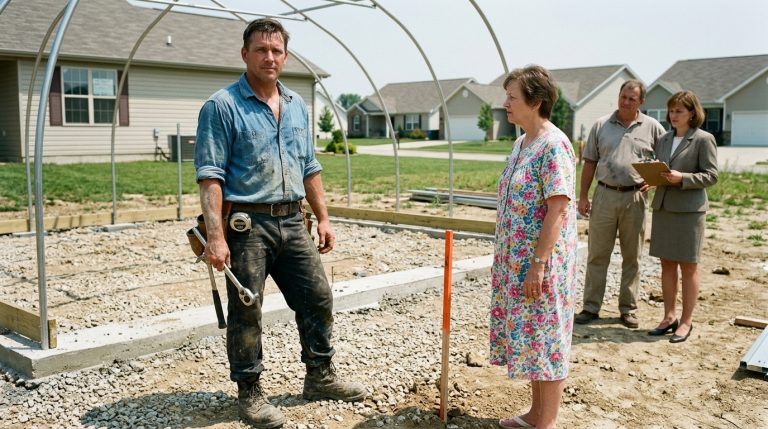
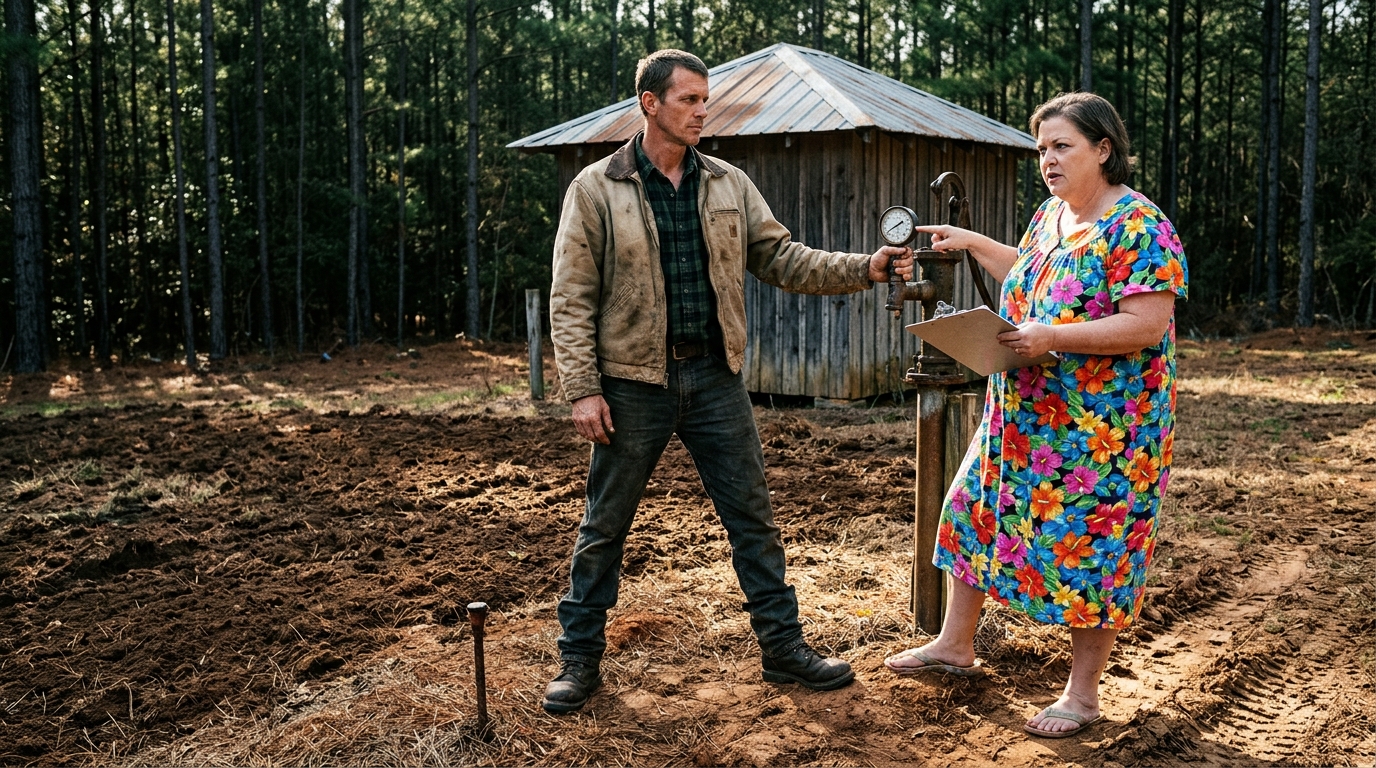
Ten feet past the surveyor’s iron pin, her floral mumu stood out against the Georgia pines like a flare in the dark.
Karen clutched a cheap aluminum clipboard against her chest. Her thumb tapped a rhythmic, impatient beat on the rusted spring clip.
I didn’t step back. My right hand stayed clamped around the brass housing of the pump gauge. The metal was cold, slick with condensation, reading eighty pounds per square inch of pure, subterranean pressure.
“That spring you found,” she said, her voice dripping with a syrupy authority that set my molars on edge. “It’s designated as a community hydrological asset under emergency bylaw 7.4. You will cease private use immediately and provide access keys to the pump house by Monday.”
I turned the brass casing a quarter-inch to the right. The thread creaked.
“This tract sits outside the residential plat,” I said. My voice was low, flat, stripped of color. “Exempt agricultural.”
“This whole development operates under one umbrella, Mark,” she said. Her eyes narrowed, scanning the long gravel driveway behind me, calculating the cost of the new sod near the barn. “We’re in a drought. The retention pond is mud. The board has emergency powers.”
“You don’t have powers past the gate.”
“Bylaw 7.4 says otherwise.” She shifted her weight, the cheap plastic of her sandals crunching into my freshly turned soil. “Two thousand dollars a day in non-compliance fines start Tuesday. Plus a lien on the access road.”
I looked down at her feet. The soil was damp, dark, turned over just three days ago when the heavy drilling rig trundled back down the lane. Eighty feet below her sandals, Confined Aquifer 80 was pushing pure water through limestone that hadn’t seen the sun in ten thousand years.
“The paper you’re holding,” I said, “doesn’t clear the gate.”
“We’ll see what the board attorney says when the county sheriff serves the order.” She raised the clipboard, pointing the corner at my chest like a small, blunt weapon. “You bought into Oakridge Estates, Mark. You don’t get to build a fortress inside a community.”
She turned on her heel, her sandals digging two shallow, ugly ruts into the grass as she marched back toward the paved cul-de-sac.
I stayed by the pump house. The manifold hummed—a steady, deep vibration beneath my boots.
Sarah was standing on the porch when I walked up the gravel line. She was holding a cold mug of coffee, her knuckles white against the ceramic. Her thumb was nervously scraping a chip in the rim.
“She was on the lawn,” Sarah said. It wasn’t a question.
“She was.”
“Mark, we spent the savings on the drill team. If they put a lien on the access—”
“They can’t.” I set the brass wrench down on the porch railing with a dull thud. “The original plat survey has a deed restriction. Section 2B.”
“She looked so sure.” Sarah’s voice cracked slightly, though she straightened her back immediately, locking her eyes onto mine. “She spoke to the women at the pool yesterday. They’re already talking about the water restrictions.”
“Let them talk.” I took the mug from her hand, setting it down before her fingers could raw-rub the chipped ceramic any further. “I’m going to the office.”
Inside, the desk was clean except for the thick black binder from our closing five years ago. I flipped past the title insurance, past the county tax maps, straight to the yellowed tissue of the plat overlay.
Article 3, Section 2B.
I traced the red ink border with my nail. The line was dark, bold, and absolute.
A sharp knock echoed from the front door.
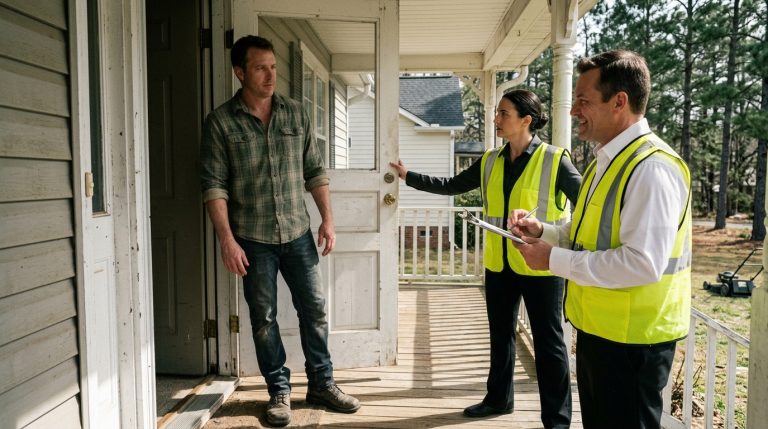
I didn’t hurry. I walked down the hall, opened the heavy oak panel, and looked at the mail carrier standing on the top step. He looked uncomfortable, avoiding my eyes as he held out a electronic scanner and a crisp, white envelope bearing the gold-foil crest of Oakridge Estates Homeowners Association.
“Certified, Mr. Davies,” he muttered. “Needs a sign.”
I pressed my signature onto the digital screen. The screen beeped—a sharp, high-pitched confirmation.
I tore the envelope open right there on the threshold.
Notice of Violation & Cease and Desist Order.
Initial Assessment: $500. Daily Non-Compliance Penalty: $100.
Authority: Bylaw 7.4 (Emergency Hydrological Asset Protocol).
My thumb ran across the fresh black ink at the bottom of the page. Karen’s signature was large, loopy, and aggressive, trailing off the edge of the line.
Behind me, the house was silent. Through the back window, the long green stretch of the pasture looked quiet, bordered by the dark wall of Georgia pines.
I walked back to the desk, pulled a blank white folder from the drawer, and wrote two words on the tab in clear, block print:
HOA ENGAGEMENT
I slipped the violation notice inside, closed the tab, and picked up the desk phone.
CHAPTER 2: PAPER WARFARE
The dial tone hummed in my ear, a flat, mechanical drone that matched the LED light reflecting off the open folder.
Under the lamp, Karen’s signature on the violation notice looked darker than the rest of the print, pressed hard enough into the heavy paper bond to raise ridges on the back of the page.
“Albright, Finch, and Montgomery,” a voice answered on the third ring, smooth and detached. “How may I direct your call?”
“Amelia Albright,” I said. My thumb pressed flat against the desk surface, feeling the slight grain of the pine veneer. “Mark Davies. Regarding a land boundary dispute in Cherokee County.”
“Ms. Albright is in consultation until two. May I take a summary of the matter?”
“Tell her it’s an agricultural parcel under Section 2B,” I said. “Tell her an HOA just attempted to leverage an unrecorded emergency order against a private well.”
A two-second pause on the line. The rustle of a notepad being turned over.
“I’ll leave the message on her desk, Mr. Davies. Expect a call by three.”
I set the receiver back down on its cradle. The plastic clicked into place with a dry, solid snap.
Outside the office window, the afternoon sun was cutting sharp, yellow blocks across the pasture grass. Sarah walked into the room without making a sound, her bare feet quiet against the floorboards. She set a sheet of printed paper on top of my folder.
“This came through the main neighborhood forum email,” she said. Her voice was too steady, the kind of calm she used when the unit moved to a new station and the housing office lost the paperwork. “They’re broadcasting it.”
I looked down at the heading printed in bold, dark ink: The Acorn Registry – Special Community Alert.
Unlawful Diversion of Shared Water Resources, the headline read. Below it, two paragraphs written in Karen’s unmistakable, overly ornate phrasing detailed a “selfish expenditure of regional groundwater during a declared drought,” framing the water flowing out of Confined Aquifer 80 as a direct drain on the subdivision’s struggling retention pond.
No names were printed, but the location was spelled out: The North Pasture Tract.
“She’s building a mob,” Sarah said quietly. Her right index finger twitched toward her thumb, picking at the edge of her nail. “I went to pick up the mail at the front box twenty minutes ago. Brenda Miller was there. She didn’t look at me. She just pulled her kids back into the SUV and drove off.”
“It’s noise,” I said.
“It’s not just noise, Mark. People read this. They believe it because it’s on the board stationery.” She leaned over the desk, her palms flat against the wood. “If they try to fine us every day, how long before they file the paperwork with the county clerk?”
“They can’t file an unrecorded bylaw,” I said, reaching for the yellow highlighter sitting beside the binder. “To record a lien in Cherokee County, they need a certified vote count signed by a notary. She doesn’t have the vote count.”
“She has the board.”
“The board isn’t the county.”
I uncapped the marker. The sharp, chemical scent of the ink filled the small space between us. I drew a thick neon line over Section 2B of our plat map, then pulled a fresh sheet of stationery from the drawer.
I didn’t write an angry letter. I wrote a notice of non-compliance, citing Georgia Code Title 44, Chapter 3, Article 106—the statute governing public disclosure for non-profit property associations. I gave them seventy-two hours to produce the physical meeting minutes, the notarized quorum record, and the certified hydrologist report claiming a link between a shallow surface pond and a deep artesian vein.
“Are you mailing that?” Sarah asked.
“Certified mail,” I said. “And an email copy sent directly to the management company’s compliance desk. If they ignore a statutory disclosure request while continuing to levy daily fines, it changes the charge from a civil boundary dispute to bad-faith extortion.”
The desk phone rang. Exactly at 2:14 PM.
I picked it up on the first chime. “Davies.”
“Mr. Davies,” a sharp, clear voice came through the speaker. No preamble. No fake pleasantries. “Amelia Albright. My assistant gave me your note regarding Section 2B. Who is the board president?”
“Karen Miller,” I said.
“And she issued a formal cease-and-desist on HOA letterhead?”
“Delivered by certified mail this morning,” I replied, sliding the white envelope toward the center of the desk so I could read the serial number. “Along with a five-hundred-dollar initial fine and a hundred-dollar daily assessment.”
A short, dry sound came over the line—a laugh that lasted less than half a second.
“Is the well on the primary residential lot or the agricultural tract?” Albright asked.
“Agricultural tract. Confined Aquifer 80.”
“Has the HOA ever funded, maintained, or cleared tax liabilities for that specific parcel?”
“Never.”
“Then Mrs. Miller has just handed us something very rare,” Albright said, the sound of paper turning briskly in the background. “She has committed a documented act of clouding a title under color of authority. I want you to bring the closing binder, the violation notice, and every issue of that newsletter to my downtown office tomorrow at nine.”
“Are we filing an injunction?” I asked.
“An injunction is defensive, Mr. Davies,” she said, her tone dropping into a cold, measured cadence. “We are going to let her issue one more fine. Let her build the paper trail until Friday. When a tyrant overreaches, you don’t cut their fingers off while they’re reaching—you wait until their hand is all the way in the trap.”
I looked out the window. Down at the end of the gravel lane, near the iron boundary pin, a white HOA maintenance golf cart had idle-parked near the fence line. A man in a high-vis vest was taking a photo of my pump house with a digital camera.
My fingers tightened around the phone receiver until the plastic creaked.
“She’s taking photos right now,” I said softly.
“Let her take them,” Albright replied instantly. “Every photo she takes on an exempt tract without a warrant is another count of civil trespass. See you at nine, Mr. Davies.”
The line clicked off.
I stood up from the desk, walked to the window, and watched the white golf cart turn around, kicking up a small cloud of red Georgia dust into the humid afternoon air.
CHAPTER 3: THE ATLANTA SHARK
The red dust stayed suspended in the heavy air long after the golf cart’s electric motor faded down the paved cul-de-sac.
I didn’t move from the glass pane for two full minutes. Beside me, Sarah didn’t speak either, though the quiet rhythm of her breathing against the quiet room was heavier than usual.
“I’m putting the closing binder in the truck,” I said.
She nodded once, her thumb brushing a stray thread on her apron. “Take the highway. The back roads have county roadwork near the bridge.”
I picked up the black leather binder, its brass corners cool against my palm, and walked out to the driveway. The morning sky over Cherokee County was already bleaching into a hazy pale blue, promising another hundred-degree afternoon. The air smelled of dry pine needles and heated asphalt.
The drive south into Fulton County compressed thirty miles into forty-five minutes of steady, rhythmic tire hum on Interstate 75. Downtown Atlanta rose out of the haze like a cluster of dark glass spires.
By eight-forty-five, I was riding the glass elevator up the core of the high-rise on Peachtree Street. The floor indicator ticked upward in silent, five-story jumps. Level 38. Level 39. Level 40.
The doors slid open with a whisper onto dark wool carpet and cold air that smelled faintly of lemon oil and old paper. Behind a seamless slab of black granite, a receptionist inclined her head.
“Mr. Davies,” she said before I reached the desk. “Ms. Albright is waiting in Conference Room B.”
I followed her down a long corridor framed by tinted glass walls. Through the glass, paralegals moved between rows of motorized filing units, their movements quiet and rapid.
Amelia Albright sat at the head of a twenty-foot mahogany table. She didn’t stand when I walked in. She had four piles of paper organized in front of her, each held down by a heavy steel weight. A silver pen lay parallel to the edge of her blotter.
“Sit, Mr. Davies,” she said, gesturing to the leather armchair across from her. Her eyes were dark, sharp, and entirely unblinking as she tracked my movement. “Let’s look at what your HOA president has been generating while she thinks no one is reading her filings.”
I set the black closing binder on the table. “You have the registry alert?”
“I have three years of her registry alerts,” Albright corrected, pulling a single sheet from under the second steel weight. “Your Mrs. Miller doesn’t just issue warnings. She builds legal narratives.”
She slid the paper across the mahogany. It was a copy of an HOA financial summary from eighteen months ago.
“Look at line seven,” Albright said.
My eyes scanned down the column of figures. Water Resource Contingency Fund: $14,500. Below it, in smaller italic font: Disbursed to Oakridge Infrastructure Group LLC.
“Who owns Oakridge Infrastructure Group?” I asked.
“Her brother-in-law,” Albright said softly. The tone of her voice didn’t rise, but the edge in it sharpened instantly. “Registered in Delano County eleven months before she drafted Emergency Bylaw 7.4. They’ve been billing your neighborhood four thousand dollars a quarter for ‘aquifer monitoring’ on a surface pond that holds six feet of runoff.”
I leaned forward, resting my forearms on the cool table surface. “She’s using my well to justify an infrastructure contract.”
“She’s doing something much more reckless than that,” Albright said. She reached for the third pile of documents and pulled out a certified copy of a land survey filed with the county register two weeks prior. “She filed a provisional drainage easement mapping your north boundary to their retention overflow zone.”
“That requires a deed modification,” I said. “Section 2B prohibits encumbrance without a ninety percent vote of the agricultural track holders.”
“Which she doesn’t have,” Albright agreed. “Which makes her filing a fraudulent cloud on your title.”
She picked up her silver pen, clicked the top once, and laid it back down.
“Here is how this moves, Mr. Davies,” she continued, her voice dropping into a steady, rhythmic cadence. “In twenty minutes, my senior partner enters a motion for a temporary restraining order in Fulton Superior Court. We are not asking them to stop fining you. We are asking the court to freeze the HOA’s capital disbursement accounts pending an independent forensic audit.”
“How will the board react?”
“Mrs. Miller will panic,” Albright said. “People who operate small tyrannies rely entirely on passive compliance. The moment an officer of the court seals an association account, the board members who signed those checks suddenly realize their personal assets are on the hook. They will turn on her within seventy-two hours.”
“And the community?”
“That is where you come in,” Albright said, looking directly into my eyes. “The legal fight happens here on this table. But the political fight happens on the ground. You need to gather the homeowners who have been paying these special assessments. You need to show them where their money went.”
She slid a manila folder across the wood to me. Inside were three single-page affidavits, pre-drafted, with blank spaces for signatures.
“Get three former board members or long-term homeowners to sign these before Thursday’s emergency meeting,” she said. “If you give me three signatures confirming she executed contracts without a board quorum, I won’t just defeat her bylaw—I will have the district attorney’s civil fraud unit outside her door by Friday morning.”
I took the manila folder, feeling the crisp, heavy stock of the paper against my fingertips.
“Who do I start with?” I asked.
“Start with the man whose property borders her east fence,” Albright said. “The one whose drainage pipe she fined five hundred dollars for being the wrong shade of brown.”
CHAPTER 4: THE BARN ALLIANCE
The manila folder was stiff under my forearm, its metal clasp digging into my ribs through my shirt as I stepped back out onto Peachtree Street.
The heat hit like a damp wool blanket. Forty-five minutes later, the truck tires crunched onto the gravel turn-off past Oakridge Estates, cutting deep into the unpaved lane toward Arthur Henderson’s property line.
His place sat on fifty acres of unmanicured timber and rough pasture. The barn was built of hand-hewn cedar that had turned the color of lead over eighty summers.
I parked beside a rusted international tractor with two flat tires. When I killed the engine, the quiet came back instantly—just the dry rasp of cicadas in the pines and the steady, heavy tick of my cooling manifold.
Arthur Henderson was standing inside the double doors of the barn. He held a grease gun over the drive sprocket of a pull-behind bush hog, his shoulders hunched under a frayed blue work shirt.
“You’re standing in my shade, Davies,” he said without looking up. His voice sounded like two gravel stones grinding together at the bottom of a well.
“Albright sent me,” I said, holding out the manila envelope.
Henderson wiped his thumb across the grease nipple, leaving a thick black smear on his denim thigh. He looked at the envelope, then at my face. His eyes were small, watery, and sharp under thick gray brows.
“Albright,” he grunted. “That woman charges five hundred dollars an hour just to tell you the county is corrupt. I could’ve told you that for a cup of black coffee.”
“She froze the HOA disbursement account twenty minutes ago,” I said.
The grease gun stayed suspended in mid-air for three seconds. Henderson’s hand didn’t shake, but his jaw clamped shut until the muscles on the side of his neck stood out like cords.
“She froze the account?” he asked.
“Pending a forensic audit,” I replied, stepping further into the cool, dark belly of the barn. The air smelled of dry hay, old oil, and cedar dust. “Karen Miller disbursed fourteen thousand dollars from the emergency fund to her brother-in-law’s firm. Oakridge Infrastructure Group.”
Henderson let out a short, wet spit onto the dirt floor. “Oakridge Infrastructure. That worthless boy drives a sixty-thousand-dollar dually and doesn’t own a backhoe.”
He set the grease gun down on the tractor deck with a dull, iron clang. He reached into his breast pocket, pulled out a pair of wire-rimmed reading glasses with one bent arm, and unhooked the manila clasp.
I watched him read the top affidavit under the dim yellow light of a single hanging bulb. His eyes moved slowly, line by line.
“She fined me six hundred dollars three years back,” he muttered, his thumb tracing the bottom margin. “Said my drainage culvert was discharging silt onto her curb line. I built that culvert in nineteen-eighty-two. The curb line didn’t exist until ninety-nine.”
“If you sign this,” I said, “it establishes a pattern of unauthorized assessment. Albright uses it to prove personal malice.”
Henderson didn’t answer right away. He walked over to a workbench made from a split oak log, pulled a stubby ballpoint pen out of a coffee tin, and pressed the paper flat against the wood.
“Who else are you seeing?” he asked.
“David Miller,” I said. “The former treasurer.”
“David’s weak,” Henderson said flatly. “He resigned because she yelled at him during an executive session. He’s got the numbers, but he’s scared of his own shadow.”
“He’s not scared of a grand jury subpoena,” I said.
Henderson signed his name in large, jagged script that cut straight through the signature line. The ink was dark blue, biting deep into the paper. He didn’t blow on the ink; he just slapped the page back into my hands.
“You tell David I said to sign it,” Henderson growled, pointing a grease-stained finger at my chest. “And you tell him if he doesn’t show up at the barn tonight, I’m coming to his cul-de-sac with my tractor.”
“Tonight?” I asked.
“You think three papers win a fight with a woman like Karen?” Henderson picked up a pair of fencing pliers from the bench, their forged steel jaws pitted with light rust. “She’s been telling the whole neighborhood you’re stealing their drinking water through Confined Aquifer 80. You don’t just need Albright’s judge, Davies. You need forty people in this barn with their eyes open.”
He turned back to the bush hog, the pliers clicking sharply against a cotter pin.
“My wife’s calling the Miller boy’s wife right now,” Henderson added over his shoulder. “Seven o’clock. Bring your plat map. And bring that fancy lawyer’s paper.”
I looked down at his signature on the affidavit. The blue ink was set.
Outside, down the gravel lane, I heard the distant, high-pitched whine of a county deputy’s cruiser rolling down the main pavement toward the entrance of Oakridge Estates.
Albright’s order had just been served.
CHAPTER 5: THE CHECKMATE MEETING
The air inside the Oakridge Estates clubhouse tasted like stale air conditioning and damp polyester.
Seventy folding chairs had been set up in straight rows across the linoleum floor, but twice that many people were standing along the back wall, crowded against the folded ping-pong tables.
At seven-fifteen, Karen Miller struck the wooden folding table with a three-inch brass gavel. The sharp thud rang off the drywall like a gunshot.
She was wearing a high-collared navy jacket, buttoned tight to her throat despite the humidity. Her hair was pulled back into a severe bun, fixed with two tortoiseshell pins. Behind her, two junior board members sat with their shoulders hunched, staring down at their identical black vinyl binders.
“This special meeting of the membership is called to order,” Karen said. Her voice came through the portable PA system with a high, metallic hiss. “We are here to address an unauthorized petition circulated by a small minority of non-compliant lot owners.”
Beside me in the second row, David Miller leaned forward, his knuckles white against his knees. His shirt collar was stained dark with sweat around the buttonhole.
“She’s not reading the agenda,” David whispered, his voice shaking. “She skipped the reading of the court order.”
“Let her talk,” I said softly, my eyes fixed on the manila folder sitting flat on my lap.
Karen gripped the edges of the folding table, her knuckles yellowing under the bright fluorescent tubes. “Certain individuals have claimed that Emergency Bylaw 7.4 exceeds board authority. They have spread malicious rumors regarding community infrastructure spending. I have here a statement from our legal counsel confirming that all water contingency measures fall under—”
A chair leg scraped violently against the linoleum.
Arthur Henderson stood up in the third row. He was still wearing his blue work shirt, the black grease smear on his thigh clearly visible under the overhead lights.
“Read the court paper, Karen,” Henderson barked. His voice cut through the PA speakers without any amplification at all.
“Mr. Henderson, you are out of order,” Karen snapped, her hand reaching for the brass gavel. “You do not have the floor.”
“Fulton County Superior Court froze your account three hours ago,” Henderson said, taking one heavy step into the center aisle. He pointed a thick, calloused finger directly at her chest. “Show the folks the injunction paper.”
A low hum started at the back of the room and rippled forward through the rows. Neighbours turned to look at each other. Brenda Miller, sitting three seats down from Sarah, pulled her reading glasses off and stared at the front table.
Karen’s face didn’t break, but her chin jerked upward a quarter-inch. “The association’s financial accounts are subject to a temporary administrative review due to a frivolous filing by Mr. Davies. It has no bearing on this recall vote.”
“It’s not an administrative review,” I said, standing up smoothly from my seat.
The room went completely quiet. The only sound was the low, steady buzz of the fluorescent transformer in the ceiling.
I opened the manila folder and pulled out three sheets of court-stamped parchment.
“This is an injunction signed by Judge Vance at two-fifteen today,” I said, holding the top page up so the blue ink seal was visible to the front three rows. “It freezes all disbursements to Oakridge Infrastructure Group. It cites three sworn affidavits from former board members confirming that Bylaw 7.4 was drafted without a quorum, without a recorded vote, and without a hydrological survey.”
Karen’s eyes locked onto mine. Her right hand twitched toward the gavel, then pulled back, her fingers curling into a tight fist against her navy jacket.
“You are not an officer of this board, Mark,” she said, her voice dropping an octave, losing its syrupy veneer and turning hard as flint. “You live on an outlying tract. You don’t pay standard residential assessments.”
“I pay under Section 2B,” I said, my voice steady, flat, carrying across the silent room. “Which gives me full voting rights on all matters affecting agricultural boundary easements. And as of four-thirty this afternoon, the county prosecutor’s civil audit division received a copy of every issue of The Acorn Registry published in the last twenty-four months.”
A woman in the fourth row stood up. “Is it true about the fourteen thousand dollars?” she asked, looking between me and the front table. “Did that go to her brother-in-law?”
“It’s a line-item contract!” Karen shouted into the microphone, the gain spiking into a painful, high-pitched squeal. She didn’t adjust the volume. “It was authorized under emergency drought mitigation!”
“There is no drought in Confined Aquifer 80,” David Miller said, his voice quiet but loud enough for the microphone to catch as he stood up beside me. He pulled a rolled-up ledger from his coat pocket. “I was treasurer for fourteen months. She wrote three checks to Oakridge Infrastructure before any bylaw was ever drafted. The dates are right here.”
He laid the ledger flat on the edge of the front table.
Karen looked down at the black ink numbers on the ledger page. For two seconds, her mouth stayed slightly open, the harsh light catching the dry lines around her lips.
The silence in the room wasn’t quiet anymore; it was heavy, suffocating, pressing in from the walls.
“The petition requires sixty percent for immediate removal,” Henderson said from the aisle. He held up a stack of white index cards tied with a rubber band. “We’ve got seventy-two percent signed and verified.”
Karen didn’t pick up the gavel. She looked at the junior board members sitting beside her, but neither of them looked back; both were staring straight down at the linoleum floor, their hands flat on their binders.
Slowly, without saying another word into the microphone, Karen reached out, clicked off the PA system amplifier box, and picked up her leather handbag from the floor.
She walked off the side platform, her heels clicking sharply against the floorboards as she headed for the emergency exit doors at the side of the room. Nobody moved out of her way, but nobody spoke to her either. They just shifted slightly to let her pass, watching her navy jacket disappear into the dark evening air outside.
The heavy steel door swung shut behind her with a soft, pneumatic hiss.
In the front row, Sarah let out a long, quiet breath, her fingers uncurling from the armrest of her chair.
David Miller looked up at me, his hand still resting on the open ledger. “What happens now?”
“Now we elect an interim board,” I said, laying the court injunction flat on the table where Karen’s gavel had sat two minutes before. “And then we clean up the paper.”
CHAPTER 6: THE FREE RIVER
The heavy steel exit door was still settling into its frame with a faint, dying hum when David Miller let out a long breath and laid his palm flat on the open ledger.
The room didn’t erupt into cheers. The noise died down slowly, like an engine running out of fuel, replaced by seventy people quietly shifting in their metal chairs and looking toward the front table.
“David,” I said, my hand resting on the edge of the mahogany podium. “Call the first motion.”
It took thirty minutes. No speeches, no raised voices. Just thirty minutes of crisp parliamentary procedure. David took the chair; Arthur Henderson moved to nominate an interim board of five; the motion carried with a show of hands that didn’t leave a single arm at a person’s side.
By nine-thirty, the linoleum floor was cleared, the folding chairs were stacked against the wall, and the key to the main office sat beside David’s phone.
Six weeks passed in the steady, quiet rhythm of resolution.
The court decree arrived on a Tuesday in late August, delivered in a stiff flat envelope signed by Judge Vance.
I sat at the office desk, the morning sun casting warm, square blocks of light across the pine veneer. Sarah stood by the open window, her fingers wrapped around a steaming ceramic mug. Her thumb wasn’t scraping the rim anymore; it rested easily against the warm glaze.
I pulled the single-page summary from the court folder and read the final order aloud.
Declaratory Judgment Entered.
1. Emergency Bylaw 7.4 declared null, void, and void ab initio.
2. Full sovereign water rights confirmed under Section 2B of the Plat Overlay.
3. Oakridge Homeowners Association ordered to issue a full retraction in all official communications, including all printed editions of The Acorn Registry.
4. Permanent injunction against encumbrance or easement claims regarding Confined Aquifer 80.
Below the judge’s signature was the civil audit annex from the district attorney’s office. The kickback annexation scheme was spelled out in cold, unadorned prose: six fraudulent invoices issued to Oakridge Infrastructure Group, totaling forty-two thousand dollars, drafted under the guise of ’emergency drought mitigation’ to force outlying agricultural tracts into municipal annexation.
Karen’s house on the cul-de-sac had a real estate sign pushed into the turf by the driveway three days after the audit was filed. Two weeks later, a moving van loaded the last of her furniture into a closed box trailer and drove past the front gate without stopping.
I folded the court order, slipped it into the black closing binder, and walked out to the porch.
The air smelled of dry pine needles and fresh soil. Down by the pasture fence, the pump house stood quiet against the tree line. The manifold hummed—a low, barely audible vibration beneath the gravel path as I walked down the slope.
I unhitched the latch on the pump house door and stepped inside.
The brass water-pressure gauge sat mounted on the intake line, its housing bright and polished where my palm had worn away the light oxidation over two months of tension. The needle pointed dead-center to eighty pounds per square inch.
I reached into my pocket, pulled out a small adjustable wrench, and set the jaw against the packing nut on the primary relief valve.
A quarter-turn to the left. A small bead of water appeared at the seam, clear and cold, dropping onto the gravel floor with a sharp, clean sound.
I tightened the nut back down—just enough to seal the thread, leaving the brass firm, immovable, and set.
Behind me, the gravel crunched softly. I turned to see Sarah leaning against the doorframe, the shadow of the Georgia pines filtering the morning light across her shoulder.
“Is it holding?” she asked.
“Eighty pounds,” I said, letting the wrench slide back into my pocket. “It’ll hold for fifty years.”
She reached out, her hand resting against my arm, her palm warm through the cotton sleeve. We stood together in the doorway for a long minute, watching the clear water from Confined Aquifer 80 run through the transparent line, feeding the pasture, the sod, and the deep roots of the land we had built.
The river beneath us was free, silent, and entirely our own.