The Cold Shield: A Father’s Uncompromising War Against Suburban Tyranny
CHAPTER 1: THE THRESHOLD CONFLICT
Her clipboard had a thumbprint smudge over the red stamp. Not fresh ink. Dry, caked grease.
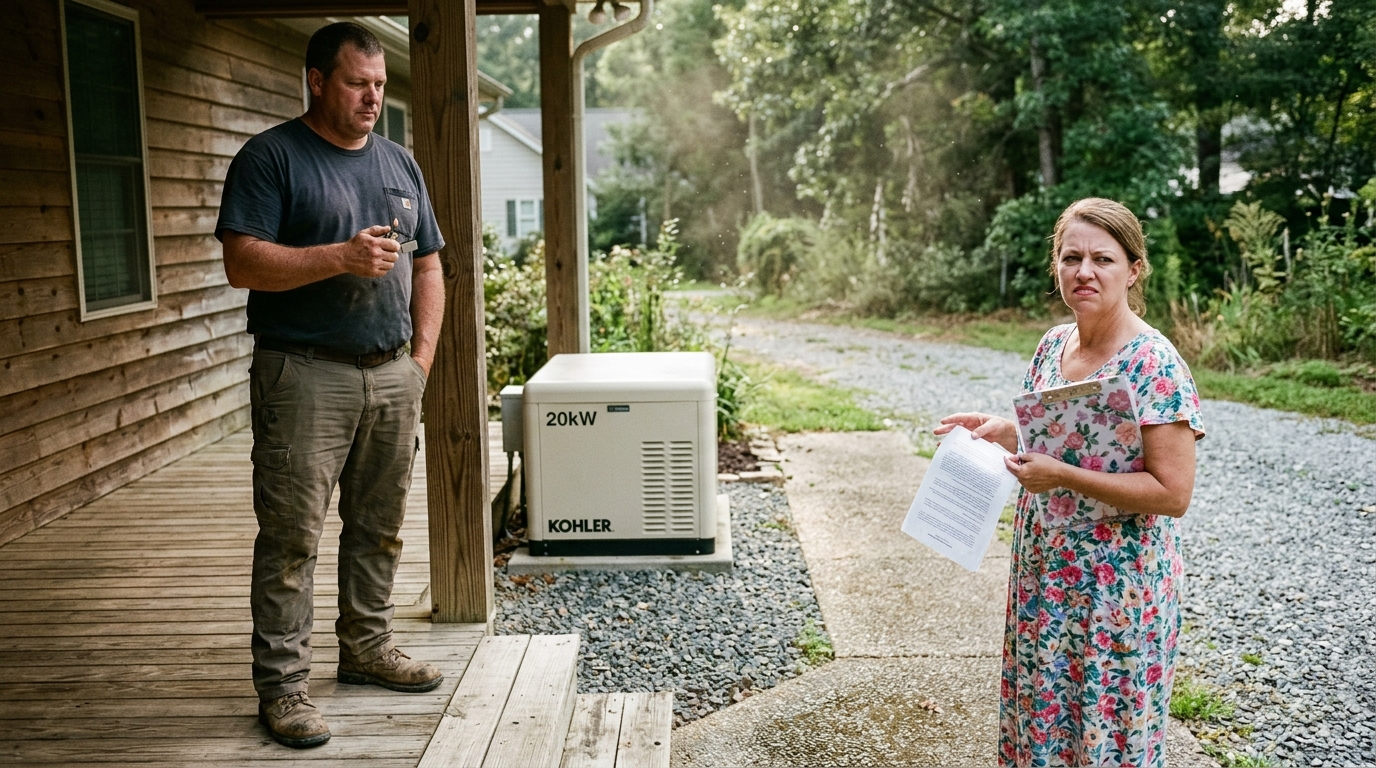
I stood on the unpainted cedar of my porch, my boots planted shoulder-width apart, watching the sweat collect in the folds of Karen’s neck. The air smelled of wet asphalt and cut grass—the humid, heavy breath of a Carolina August afternoon. Behind me, sixty feet down the gravel path, the 20kW Kohler sat on its three-inch slab of wet-poured aggregate. Silent. Cold.
“Forty-eight hours, Mr. Riley,” she said. Her voice didn’t carry. It scraped. “Class 3 acoustic and aesthetic violation. Section C, paragraph 12. You remove the unit or the daily assessments trigger at two hundred dollars. Compounding.”
I didn’t check my watch. I looked at the laminated sheet clutched against her floral mumu. Below her thumb, the text was crisp, but the header was wrong. The crest belonged to the old management firm—the one the board fired eighteen months ago.
“The unit runs at fifty-eight decibels under full load, Karen,” I said. My voice stayed in my chest, low and level, the way I used to talk over the idle of a Bradley engine. “That’s three decibels below your husband’s John Deere. The ARC notification went out by certified mail sixty-two days ago. Green card came back signed.”
“The board never ratified it.” She tapped a manicured nail against the plastic sleeve. The sound was like a dry beetle hitting glass. “Unapproved pad color. Concrete natural hue variance. Section F, paragraph 4. The rules exist to protect property values.”
Over her shoulder, two houses down, the paint on her fascia board was peeling in gray ribbons. A flock of weathered resin gnomes sat knee-deep in unclipped crabgrass along her driveway. I didn’t point at them. Pointing gives away target selection.
“Lily’s biologic stays between thirty-six and forty-six degrees,” I said. “Three vials in the door drawer right now. Twelve thousand dollars of protein-synthesized medicine that turns to poison if the compressor drops for six hours.”
Karen’s eyes didn’t soften. They narrowed, tracking the movement of my hands. My thumb was resting on the rim of my silver Zippo—flicking the flint wheel once, twice, feeling the cold steel serrations bite into the calloused pad without letting the spark catch.
“Personal medical circumstances do not override community standards,” she said. Her upper lip twitched, a micro-spasm of victory. “Friday morning. Two hundred dollars. The clock is running.”
She pivoted on her heel, her sandals slapping the hot concrete of my driveway with a wet, rhythmic crack. I stayed on the porch until her floral pattern vanished behind her untrimmed privet hedge.
Inside, the kitchen was quiet except for the digital hum of the primary refrigerator. Sarah was at the sink, her knuckles white against the rim of a ceramic mug. She didn’t ask what Karen said. She had been watching from behind the blinds.
“Mark,” she whispered, her gaze sliding toward the hallway where Lily was sitting on the rug, alignment-sorting her colored pencils. “Two hundred a day? We can’t—”
“We aren’t paying a cent,” I said.
I walked to the dining table, cleared the mail pile, and laid out the green certified receipt beside the original city permit. My thumb flicked the Zippo again. Click.
“She didn’t read the filing, Sarah. She saw something she didn’t build herself, and she wants her toll.” I pulled out my phone and dialed a ten-digit number from memory. “Frank? It’s Riley. I’ve got a petty commander breaching a perimeter. Time to set the range cards.”
CHAPTER 2: THE PAPERWORK COUNTEROFFENSIVE
“Riley.” Frank’s voice didn’t carry receiver noise. He sounded like he was sitting across a steel desk, three miles away in his corner office, thumbing through a manila folder before I had even finished speaking. “Give me the vector.”
“Section C, paragraph 12. Section F, paragraph 4,” I said. My left hand stayed flat on the dining table, fingers pinned over the certified green card. “She’s quoting outdated covenants from the 2018 management manual. She used an old stamp.”
“A ghost code,” Frank said. A pen clicked on his end. Precise. One strike. “Classic suburban overreach. They substitute volume for jurisdiction because ninety percent of homeowners fold when the letterhead looks official. What’s the physical asset status?”
“Installed. Inspected by the county water and light authority at fourteen hundred yesterday. Green tag on the gas riser.” I looked through the rear double-panes. The holly bushes held two inches of standing rainwater around their roots, but the pad sat dry, two inches above the mud line. “She wants it pulled by Friday or two hundred a day.”
“Let her trigger the fine,” Frank said. “Don’t pay it, don’t acknowledge it in writing, and don’t argue on the pavement. Every word you say on that porch is discovery she can twist. I’m filing a formal demand for the Architectural Review Committee records under State Code 55.1. I want three years of approval logs.”
“She won’t produce them,” I said.
“That’s the point. When she refuses, she establishes bad faith. Is Lily stable?”
“The unit’s cold,” I said, my thumb slipping back over the Zippo wheel. Click. “The medicine’s cold.”
“Then we let her hang her own frame. Send me high-res shots of the installation, the county inspection tag, and the green card. I’ll draft the first notice of non-compliance against the board. We hit her with the administrative burden first. Make her spend HOA cash to defend her ego.”
He hung up without a sign-off. Frank didn’t do pleasantries; battalion legal officers rarely did.
I set the phone down next to the original site survey. Beside it, printed in faded ink from a home inkjet three years ago, was a stray page from the neighborhood’s annual financial summary—a line item marked The Vanguard Ledger – Administrative Contingency. I had glanced at it during closing, buried under a hundred other disclosures I didn’t care about. I pushed it under the file folder, out of sight.
By sixteen hundred, the rain had backed off to a needle-fine mist. I grabbed a pair of work gloves and walked out to the driveway.
Dave was already there, leaning against his tailgate, a torque wrench balanced across his thighs. His silver F-150 smelled of diesel exhaust and wet dogs.
“She hit you with the mumu routine?” Dave asked. He didn’t look up as I crossed the asphalt. He was tightening a tie-down strap on a stack of plywood.
“Friday deadline,” I said. “Two hundred.”
Dave spat into the gravel. “She tried to fine me six hundred bucks last fall for my boys’ basketball hoop. Claimed the backboard had an ‘unapproved reflective index.’ I took two pages of city ordinance printouts to the open meeting and read section numbers until her treasurer looked like he was going to throw up. She backed off, but she remembers.”
“She’s using manufactured codes,” I said. “Section F.”
“She makes them up on her kitchen table,” Dave said, finally looking at me. His eyes were pale blue, set in deep sun-wrinkles from six years in the Recon pipeline. “She’s got three people on that board who just sign whatever she puts in front of them because they don’t want her looking at their properties. It’s a protection racket with a decorative mailbox rule.”
A low, rusted Buick sedan turned the corner, its muffler scraping lightly against the speed bump. It pulled into the driveway two houses down—Mrs. Gable’s place. The old woman got out slowly, holding the doorframe for balance, her hand trembling as she pulled a plastic grocery bag from the passenger seat.
I walked down the property line toward her driveway. Dave fell in half a pace behind me, his work boots silent on the damp road.
“Mrs. Gable,” I said, keeping my distance so I wouldn’t startle her.
She stopped, clutching the bag to her coat. Her pale hair was thin, pinned back with wire clips. “Oh, Mark. Hello.” Her eyes darted toward Karen’s house across the street before settling on my face. “I saw her on your porch earlier. She… she looked upset.”
“Just administrative business,” I said gently. “How’s George doing?”
Her face tightened, the skin drawing thin over her cheekbones. “The concentrator was humming strange last night. The power dipped twice around three in the morning. Just for a second, but the alarm beeped. I… I didn’t know if I should call the electric company or if it was just our house.”
“The transformer at the end of the cul-de-sac is overloaded,” Dave said, leaning his hip against her mailpost. “It’s been dropping phase every time the heat spikes. Karen knows it, too, but she won’t authorize the HOA easement for the utility company to clear the branches.”
“She told us a new transformer would cost the community four thousand dollars,” Mrs. Gable whispered, her knuckles white around the handles of her bag. “She said we couldn’t afford it this quarter because of ‘legal reserves.’ But George needs thirty liters a minute, Mark. If the power goes out for more than an hour, the emergency tanks…” She trailed off, her mouth settling into a bitter, frightened line.
“If the grid drops, you call me,” I said. “I’ve got sixty feet of heavy-duty ten-gauge cord in the shed. We’ll run it straight from my Kohler to your side window.”
“She’ll fine you,” Mrs. Gable said, a sudden sharp edge breaking through her frail voice. “She’ll claim it’s an illegal cross-property line connection. She did it to the Miller family when their basement flooded.”
“Let her write the ticket,” I said.
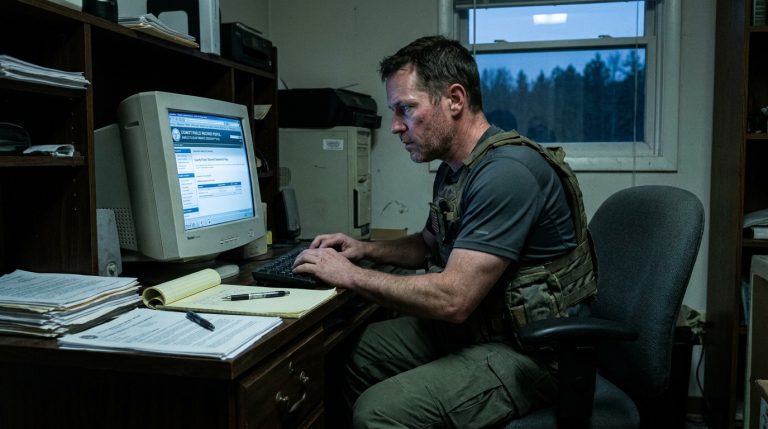
That evening, I set up a secondary binder on the dining table. Tab one: County Permits. Tab two: Decibel Log. Tab three: Certified Mail Receipts.
At twenty-one hundred, the first official fine notice arrived in my email inbox—a PDF signed with a scanned signature. Attached was an invoice for two hundred dollars, with a late fee schedule escalating every twenty-four hours.
At the bottom of the page, in fine print, was a new line item: Administrative Record Search Fee — Escrow Account 409: $50.00.
I stared at the account name. It matched the header on the old disclosure document I’d shoved under my folder earlier. My fingers tapped a slow, rhythmic beat against the edge of the wood. She wasn’t just enforcing rules; she was generating paper transactions.
I printed the PDF, added it to Tab One, and locked the binder in my desk.
Outside, the neighborhood went dark, save for the streetlamps flickering under the rising wind. Through the blinds, I could see Karen’s second-story window—a pale square of yellow light in the trees. I pulled my Zippo from my pocket, flipped the top open, and let the cold steel sit against my palm.
The storm was three days out, but the pressure was already dropping.
CHAPTER 3: THE EYE OF THE EYEWALL
The window glass vibrated before the sound reached the room—a dull, sub-audible hum that rattled the brass latch on the frame.
I didn’t open the desk lock. I kept my hand on the cold casing of my Zippo, watching the curtain shift as a wall of wind hit the pine canopy behind Karen’s house. The barometer on the hall wall was dropping through twenty-nine point ten, the needle sinking like lead in water.
By zero two hundred, Hurricane Melissa made landfall fifty miles south, pushing a three-foot storm surge up the river inlet.
I stepped out onto the back porch in my oilskins, holding a heavy halogen spotlight. The air was warm, thick as soup, smelling of salt water, torn oak leaves, and scorched copper. Down the gravel path, the Kohler sat dark, its diagnostic LEDs glowing steady green under the heavy plastic canopy.
Across the street, a violent flash illuminated the tree line—a blinding violet flare followed by a metallic pop that sounded like a 12-gauge shotgun going off in a culvert.
The neighborhood transformer at the corner blew its top bushing. Sparks showered down onto the asphalt in a dying sizzle, and every streetlamp from our driveway to the main gate went black at once.
Total darkness swallowed the cul-de-sac. No porch lights, no security sensors, no garage door indicators.
I stood in the roaring wind for five seconds, listening to the rain hammer against the aluminum siding.
Then, deep inside the Kohler’s steel housing, a solenoid clicked. The starter motor whined twice—a tight, mechanical rasp—and the natural gas engine caught with a smooth, muffled roar. The automatic transfer switch inside the utility room clacked home with a heavy magnetic thud.
Inside my kitchen, the lights flickered once and bloomed back to full power. The digital display on the refrigerator hummed back to life, reading thirty-eight degrees.
I walked down the porch steps, the rain slashing sideways into my face, and checked the line output on the generator’s side breaker. Sixty hertz. One hundred twenty volts across both legs. Steady as a heartbeat.
I turned the halogen beam toward the street.
Every house was a dead silhouette against the thrashing woods—except mine. The white siding of my front porch stood out like a beacon in the storm, illuminated by three hundred watts of soft LED floodlights.
Across the asphalt, Karen’s house was completely black. But as I tracked the beam across her front elevation, I noticed something strange about her attached garage.
A thin, grey flexible conduit—the industrial three-phase type used for heavy commercial machinery—was rigged from her secondary breaker box through a hastily cut hole in the lower door panel. It didn’t lead to a standard vehicle wall outlet. It ran straight back toward the rear utility corner, where a thick, white commercial freezer chest sat on wooden pallets. The unit’s intake fan was caked in dried dust, and a faded yellow sticker on the frame read The Fairview Audit – Property Asset Tag #088.
Her house had no power, but the heavy gauge wire running into that corner had been drew straight from the main grid tap before the transformer blew.
A sudden gust tore through the yard, snapping a six-inch oak branch that landed across my driveway with a dull crack.
I didn’t clear the wood. I adjusted the halogen beam, fixing it directly on Karen’s front steps.
A curtain twitched in her second-story bedroom. A pale face appeared against the glass, framed by dark hair, looking down at my lit driveway and the quiet, steady box humming behind the holly bushes.
She didn’t open the window. She didn’t step out into the rain.
I swung the beam back to my own pathway, walked up the steps, and wiped the rain from my face with the back of my sleeve.
In the hallway, Lily was sitting on her bed, her blanket pulled up to her chin, holding a small plastic flashlight that she hadn’t needed to turn on. The room was bright, warm, and dry.
“Is the storm big, Daddy?” she asked.
“It’s loud,” I said, leaning against the doorframe, feeling the steady vibration of the house wiring carrying power from the concrete pad outside. “But the box is doing its job. The medicine is safe.”
I walked back down to the dining room table, pulled the secondary binder out of my bag, and opened Tab One. I picked up a red pen and drew a circle around the date stamp on the city inspection tag.
Outside, the wind screamed against the rooflines, but inside the perimeter, the temperature didn’t move a single degree.
CHAPTER 4: THE MIDNIGHT REJECTION
The red ink was still damp on the paper when the second knuckle hit the door panel.
Three sharp taps. Not a knock—a demand.
I capped the pen, laid it parallel to the secondary binder, and let my right thumb rest on the steel edge of my Zippo. Click. The flint wheel didn’t spark, but the metallic snap echoed down the entry hall. Sarah didn’t come out of the kitchen, but I heard her mug set down hard on the quartz counter.
I opened the door six inches, keeping my boot braced behind the lower hinge.
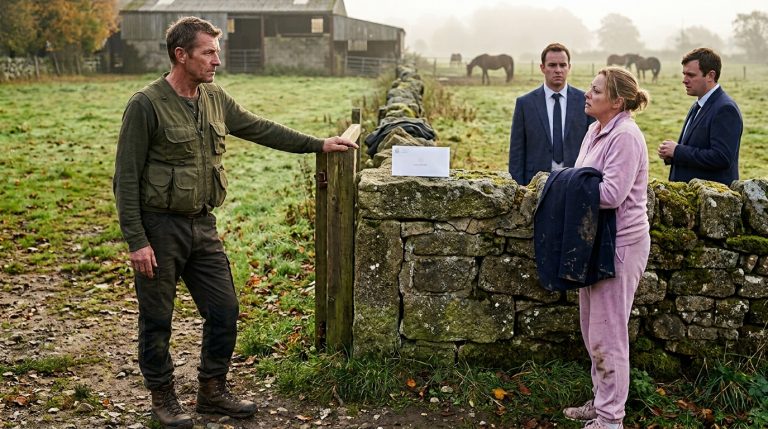
Karen stood on the porch mat, soaked to the elbows. Her floral mumu hung heavy, stained dark around the hem where runoff from the rain gutter had caught her. The wind whipped her hair into stringy gray knots against her neck. She wasn’t carrying her clipboard. Her hands were empty, fingers twitching against her sides.
“Mark,” she said. Her voice lacked the harsh rasp from two days ago. It sounded thin, diluted by the gale howling through the pines behind her.
“Karen,” I said. I didn’t step back. I didn’t open the door an inch wider.
Beyond her shoulder, the street was an abyss. The storm had stripped two oak branches onto her lawn, and her driveway lay under three inches of standing mud. My porch floodlight caught the rain slanting sideways between us, painting her face in cold, clinical white.
“The power’s out,” she said. She licked her lips, her eyes darting past my chest toward the lit foyer, where the ceiling fan was spinning at medium speed. “The main transformer at the corner blew. The whole grid is down.”
“I know,” I said. “I saw the flash from the back deck.”
She swallowed hard. Her neck muscles corded under the pale skin. “It’s going to be twelve hours. Maybe twenty-four. The utility automated line said crews aren’t dispatched until the gale winds drop below forty knots.”
“That’s standard protocol for category three landfall,” I said. “Safety threshold for bucket trucks.”
Her left hand came up, hovering near her collarbone before dropping back down. A micro-spasm shook her jaw, though the air was seventy-five degrees and thick with humidity. “My house is completely black. My phone battery is at nine percent.”
“You should conserve the charge,” I said. “Put it on low-power mode.”
“I have… I have items,” she blurted out. The words came faster now, tumbling over each other as her composure fractured. “In my garage. A commercial chest unit. It holds… specialty inventory. Omaha Steaks. Import goods. Four thousand dollars of frozen cargo that will spoil if the core temp rises above twenty degrees.”
I stared at her. Through the wet smell of pine and ozone blowing off her clothes, I caught the faint, sickly sweet odor of thawing raw beef wafting from her driveway.
“The commercial freezer,” I said, my voice dropping an octave. “The one running off the bypass line tagged under The Fairview Audit?”
Her eyes widened, a sudden flicker of panic cutting through her desperation. She didn’t ask how I knew the asset tag. She took a half-step forward, her wet shoe squeaking against the cedar deck board.
“I need an extension cord,” she whispered. Her voice was raw, stripping away two years of administrative authority in a single breath. “Just one heavy-duty line. Run it across the asphalt. I’ll pay for the natural gas consumption. I’ll… I’ll waive the concrete pad assessment. I’ll clear the fine schedule.”
The offer sat between us in the wet air—a cheap, corrupt transaction offered on a dark porch by a woman who thought authority was something you traded under the table when the lights went out.
“I can’t do that, Karen,” I said.
Her mouth stayed open. A drop of rain ran down her nose, hanging from the tip before falling onto her collar. “What? It’s a cable. You have power. Your lights are on!”
“Section C, paragraph 12,” I said, quoting the exact lines from her first violation notice, my tone flat, unyielding, and completely stripped of emotion. “Unapproved cross-property electrical modifications pose an unassessed fire and safety hazard to the common elements. Running temporary secondary lines across a public thoroughfare violates municipal code 402.B.”
“This is an emergency!” she shrieked, her voice cracking as the old rage flared up against her helplessness. “My inventory—”
“My daughter’s biologic is sitting at thirty-eight degrees behind my kitchen wall,” I said, leaning forward until my face was six inches from hers through the door gap. “That’s an emergency. Your frozen steaks are an unapproved commercial operation running in a residential zone.”
“You’re being vindictive!” she spat, her hands clenching into wet fists at her sides. “You have the capacity! You’re doing this out of malice!”
“I’m following the rules, Karen,” I said quietly. “They exist to protect our property values. Isn’t that what you told me on Wednesday?”
I didn’t wait for her response. I brought the heavy oak door forward, feeling the latch catch with a solid, mechanical click that sealed the house against the gale.
Through the glass side-lite, I watched her stand on the wet mat for five long seconds, her shoulders shaking, before she turned and stumbled down the steps into the dark.
I walked back to the dining table, picked up my phone, and dialed Frank’s direct line. It rang four times before going to his encrypted voicemail.
“Frank,” I said into the mic, my eyes fixed on the secondary binder. “She just broke. She tried to barter the fines for power to cover a commercial freezer in her garage. The asset tag reads Fairview Audit. Check Escrow Account 409 for commercial property acquisitions under her husband’s name. We’re moving to Phase Three.”
I hung up, set the phone on the table, and pulled out my spool of ten-gauge outdoor extension line from the hall closet.
The wind was screaming outside, but I had sixty feet of copper wire to run down to Mrs. Gable’s window before her husband’s oxygen reserve ran out.
CHAPTER 5: THE COMMUNITY MUTINY
The black rubber jacketing of the ten-gauge cord was cold, slick with condensation as I hauled the spool off the shelf.
I didn’t pause at the screen door. I pushed into the sideways deluge, the heavy copper coil dragging through the mud along my gravel path. The wind slammed the gate against its post with a loud crack, but my eyes stayed locked on Mrs. Gable’s front porch two doors down.
Dave met me at the edge of his driveway. He didn’t ask questions. He grabbed the trailing end of the line, his gloved hands snapping a brass locking coupler into place to extend the run another thirty feet.
“George’s backup tank is down to fifteen percent,” Dave shouted over the roar of the trees. “The pump’s stuttering!”
“Hold the slack!” I called back.
We dragged the line across the asphalt, the heavy black rubber uncoiling like a serpent through three inches of rushing rainwater. I reached Mrs. Gable’s side window, pushed through the wet hydrangeas, and shoved the heavy three-prong plug directly into the weather-sealed junction box we’d rigged through her basement sash.
Inside, a green status light flickered. A second later, the deep, rhythmic hum of George’s oxygen concentrator echoed through the glass, steady and uninterrupted.
Mrs. Gable’s face appeared behind the pane, her hand pressed against the glass, her mouth framing a single word: Thank you.
“Line’s hot!” Dave yelled, wiping rain from his forehead.
Then a flashlight beam cut through the storm—blinding, erratic, jerking wildly across the grass.
Karen was marching down the middle of the road. She held a heavy yellow flashlight in one hand and a pair of long-handled bypass shears in the other. Her soaked mumu was plastered to her knees, coated in mud from the ditch.
“Disconnect that!” she screamed. Her voice was a ragged shriek against the wind. “You are running unauthorized utility infrastructure across private easement! Section G, paragraph 2!”
She lunged toward the line, raising the steel blades of the shears above her head.
Dave stepped into her path. He didn’t raise a fist. He simply stood six-foot-two in the mud, his boots planted shoulder-width apart, his chest blocking her advance like a brick wall.
“Touch that cord, Karen,” Dave said, his voice dropping into a terrifyingly calm register that carried clearly through the gale, “and I’m calling the county sheriff for attempted murder.”
“It’s a violation!” she shrieked, her eyes wild, her face contorted in frantic desperation. “He refused my property! He’s stealing grid phase! I am the board president!”
“You’re nobody,” a voice called out from the dark.
Stan, the quiet accountant from house forty-two, stepped out from under his dripping oak tree, holding an umbrella that had been blown inside out by the wind. Behind him, two more neighbors—Brennan and Mrs. Miller—stepped onto their porches, flashlights beaming down onto the street.
“He’s keeping George alive, Karen!” Mrs. Miller shouted. “Where’s your generator? Where’s the emergency response you promised in the newsletter?”
“I… I have rules to enforce!” Karen’s voice cracked, the shears shaking in her grip. She looked around the circle of flashlights, her eyes darting from face to face, searching for a single nodding head, a single nod of compliance.
There was none. Only cold, silent glares from ten people standing in the dark, watching her hover over an oxygen line with a pair of rusty garden shears.
“Your commercial freezer is thawing, Karen,” I said, stepping up beside Dave, my boots heavy in the gravel. “The meat is going bad. And on Monday, the county auditor is going to ask why The Fairview Audit asset tag is welded to a unit pulling unmetered power from Escrow Account 409.”
Her jaw dropped. The shears slipped from her fingers, dropping into the mud with a soft thud.
She took a slow step backward, her flashlight beam shaking so violently it painted frantic arcs across the wet trees.
“You… you don’t know what you’re talking about,” she stammered, her voice barely a whisper against the storm.
“Go home, Karen,” Stan said, his voice cold and devoid of its usual timid deference. “The board is holding an emergency meeting the second the roads clear. And you’re not chairing it.”
She looked at the circle of neighbors, her face pale under the white beam of my porch light. Her authority hadn’t been revoked by a judge or a lawyer—it had dissolved in three inches of rainwater on a dead-end street.
Without another word, she turned, her wet sandals slapping against the mud, and vanished into the darkness of her blacked-out porch.
Dave picked up the shears from the mud and tossed them into his truck bed.
“Line’s holding steady,” Dave said, looking at the glowing green light on Mrs. Gable’s window sill.
“It’ll run until the grid comes back,” I said, my thumb clicking the Zippo inside my oilskin pocket. Click.
Through the trees, the wind began to turn, shifting north as the eye of the storm began its slow crawl over the coast.
CHAPTER 6: THE CHECKMATE AUDIT
The wind died before dawn, leaving the neighborhood bathed in a pale, washed-out sunlight.
Thirty-six hours later, the folding chairs inside the community clubhouse smelled of damp wool and floor wax. Forty-two homeowners sat shoulder-to-shoulder under the buzzing fluorescent tubes. Nobody was talking about lawn aesthetics.
I sat in the front row. Frank Peterson stood at my left elbow, his charcoal wool suit pressed, a thick leather briefcase sitting square across his knees. Beside me, Sarah held a freshly printed medical log showing a steady line at thirty-eight degrees throughout the entire storm.
Karen sat behind the long folding table at the front. Her mumu had been replaced by a stiff navy blazer, but her eyes were bloodshot, surrounded by dark circles. Her hands trembled as she arranged three manila folders in a neat, compulsive row.
“This emergency session of the board is called to order,” Karen said, her voice thin, straining to project over the air conditioner’s hum. She raised a small wooden gavel, holding it two inches above the table. “We are here to address unauthorized equipment installations and utility line tampering from Thursday night—”
Frank didn’t wait for her to strike the wood. He stood up, placing a single stack of white bond paper on her table with a dull thud.
“Mr. Peterson,” Karen snapped, her jaw tightening. “You are not a homeowner. You have no standing to address this board.”
“I am appearing as legal counsel for Mr. Mark Riley,” Frank said, his voice dropping into the room like a granite block. “And I am serving this board with a formal notice of personal officer liability under State Code 55.2.”
Stan cleared his throat from the far end of the board table. “What does that mean, Frank?”
“It means,” Frank said, pulling a second document from his briefcase, “that three hours ago, our firm delivered a certified forensic summary to the state attorney general’s financial crimes unit. And we copied the board’s Directors and Officers insurance carrier.”
Karen’s hands froze over her folders. “This is an internal administrative matter. Our insurance policy covers board actions—”
“Your policy covers good-faith governance,” Frank interrupted smoothly. He reached down and opened a tab bound in red tape. “It explicitly excludes intentional torts, fraud, and the unauthorized conversion of community capital. Which brings us to The Vanguard Ledger.”
A murmur rippled through the rows behind us. Dave leaned forward from two chairs over, his arms crossed over his chest.
“For three years,” Frank continued, turning to face the room, “this board assessed an administrative fee of fifty dollars per violation, routed directly into Escrow Account 409. On paper, it was listed as an emergency legal reserve. But the physical records from The Fairview Audit—which we subpoenaed from the bank this morning—show a different reality.”
Karen slammed her hand on the table. “That audit is confidential board property!”
“It was confidential,” Frank said, “until you used community legal reserves to service a sixty-thousand-dollar personal line of credit attached to your husband’s failed commercial refrigeration venture. The same business currently housing four thousand dollars of uninsured meat in an unapproved freezer chest in your garage.”
The room went dead silent. You could hear the slow drip of melting ice from the clubhouse eaves outside.
Stan stood up so fast his metal folding chair screeched against the linoleum. “You used the reserve account for personal credit?”
“It was a temporary transfer!” Karen yelled, her voice breaking into a harsh, frantic pitch. She looked around the table, her eyes wide, grasping at her fellow board members. “The board approved the contingency fund! The accounting rules allow inter-account loans!”
“Inter-account loans require a vote of the full membership,” Stan said, his face turning gray as he looked down at the bank statement Frank had laid on the table. He turned to the room, his voice shaking. “I signed those authorization sheets. She told me they were retainer fees for the HOA attorney.”
“You signed them, Stan,” Frank said coldly. “Which makes you personally liable alongside her unless you exercise your fiduciary duty right now.”
Stan didn’t hesitate. He looked at Karen, then at the crowded room of neighbors he had known for ten years. “I move for an immediate vote of no confidence in President Karen Smith, and her permanent removal from the board.”
“Seconded,” Mrs. Miller called out from the third row.
“You can’t do this!” Karen screamed, half-rising from her chair. “The bylaws require fifteen days’ written notice for a officer recall! Section A, paragraph 3!”
“Section A was superseded by the state non-profit corporation act in 2021,” Frank said, his tone entirely flat. “In cases of documented financial conversion, removal is instantaneous upon a majority vote of present members.”
Stan raised his hand. “All in favor.”
Every hand in the room went up. Forty-two palm-up votes raised in absolute, unbroken silence.
Karen looked at the sea of raised hands. Her lip trembled, her chest heaving as the last pillar of her bureaucratic fortress crumbled into dust. She didn’t strike the gavel. She let it roll out of her fingers, dropping onto the floor with a hollow clack.
She picked up her purse, pulled her coat over her shoulders without looking at anyone, and walked down the center aisle. Nobody moved out of her way; they simply leaned back to let her pass, watching her wet shoes squeak against the floorboards until the heavy glass exit doors slammed shut behind her.
By four o’clock that afternoon, the sun had dried the mud on my driveway.
The HOA board—now chaired by Stan—had already issued a formal written recission of every fine, along with a full reimbursement check for my county filing fees and a five-thousand-dollar donation to the Pediatric Autoimmune Foundation made in Lily’s name.
I sat on the edge of my back porch, my work boots resting on the grass. Beside me, a small brass screwdriver lay on a dry rag.
I picked up the Kohler’s side panel latch, tightened the set screw that had worked loose during the forty-eight-hour run, and snapped the weatherproof cover back into place. The steel box sat quiet, clean, and solid against the green holly bushes.
Dave walked down the gravel path carrying two cold bottles of root beer. He handed one to me and leaned against the porch post.
“Her house goes on the market Monday,” Dave said, taking a drink. “Stan said her husband’s packing the garage today.”
“Good,” I said.
Down the path, the back door opened. Lily ran out into the grass, wearing her bright yellow rain boots, chasing a stray bluejay that had landed on the fence line. Her cheeks were flush with color, her laughter ringing out clear and sharp through the quiet neighborhood air.
Sarah stepped out onto the porch, carrying two glasses of ice water, her face relaxed for the first time in six months. She sat beside me, resting her head against my shoulder as we watched Lily play.
I reached into my pocket, pulled out my silver Zippo, and ran my thumb over the cold steel casing. I didn’t flick the wheel. I just held it in my palm, feeling the weight of it, completely still.
The generator sat behind us—silent, ready, and cold—holding the line.