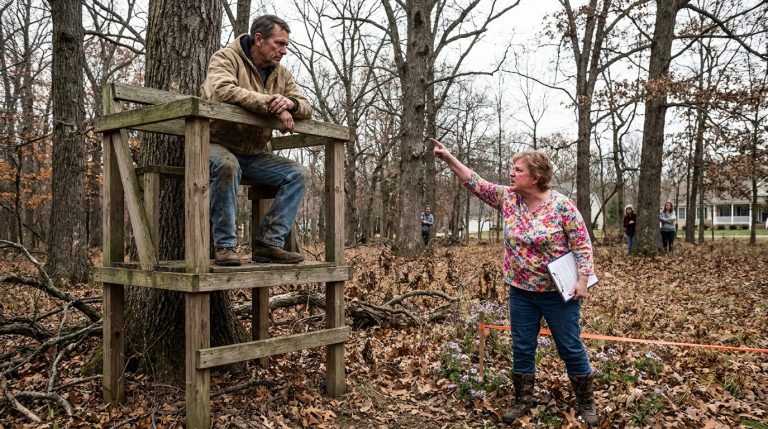
The Iron Perimeter: A Cold Campaign to Defend the Ancestral Line Against an Arrogant Invader
CHAPTER 1: THE LINE IN THE PINE
The smell of pine sap and humid North Carolina earth usually calmed me, but today, it tasted like cordite. I stood at the edge of the buffer, my boots sinking slightly into the soft, neglected loam of Miller’s Creek.
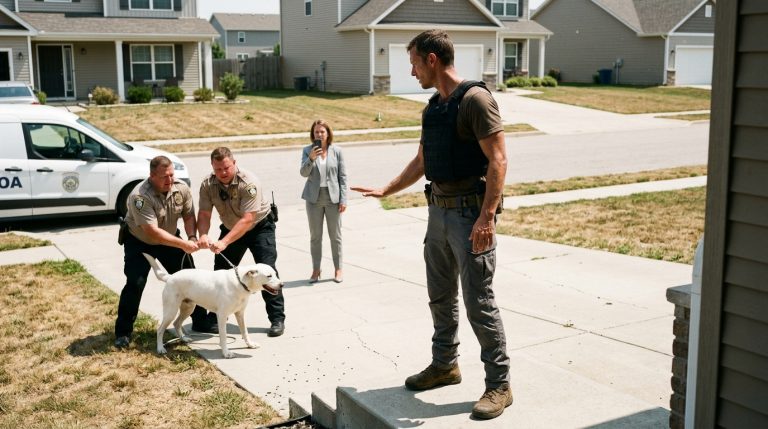
Karen—the name she’d practically spat at me five minutes ago—was currently vibrating with a brand of indignation that only comes from someone who believes their designer pantsuit confers sovereign immunity. She gestured wildly with her clipboard, pointing toward the ancient rhododendrons that leaned over the water like silent, jagged sentinels.
“This entire creek buffer is now under the purview of the Whispering Pines Beautification Committee,” she declared, her voice sharp enough to draw blood. “Your refusal to submit a landscaping plan is a direct violation of article seven, section B. We’re holding you in contempt of the community standards, Mr. Thorne.”
I didn’t answer. I just watched her. My heart rate stayed locked at a steady, rhythmic sixty beats per minute. I’d seen this look before—not on suburban boards, but on the faces of insurgents in the Anbar province when they realized they’d miscalculated their leverage. The cold, dense burn of anger was there, but I shoved it into a locked compartment in my mind.
“Mr. Thorne?” She tapped the clipboard. “Are you even listening? This is a hundred-dollar fine. If you don’t clear this brush, it doubles. And if you force our hand, we’ll bring in our own contractors and put a lien on your deed.”
A lien. She said it like it was a magic spell.
I looked at the water. My grandfather had fought through a war to buy this land. My father had taught me to read the topography of these woods so well I could navigate them blindfolded in a storm. And here was this woman, a stranger in a beige-sided house, trying to tell me that the stream my kids fished in had been retrofitted into a ‘community amenity.’
“Karen,” I said, my voice barely audible over the gurgle of the creek, yet carrying the weight of a command. She paused, surprised by the sudden stillness in my posture. “You’ve spent your life dealing with people who are afraid of paperwork. You’ve never dealt with someone who knows exactly where the bodies are buried—legally speaking.”
I stepped forward, closing the distance just enough to make her flinch, though she tried to hide it by puffing out her chest. My gaze dropped to the clipboard. The paper was crisp, expensive, and utterly wrong.
“You’re going to walk back to your gated fantasy land,” I said, my voice low and dangerously calm. “And you are going to tell your developers that they’ve made a tactical error. Because I’m not just going to dispute your fine, Karen. I’m going to dismantle your entire foundation.”
She blinked, the smug mask slipping to reveal a flash of raw, unadulterated fear. She turned to march back toward the development, her gait stiff and uneven. I reached into my pocket, my fingers brushing the edges of the deed I’d kept safe for a decade. As she crossed the invisible, contested boundary, I noticed something that made the cold in my chest turn to ice.
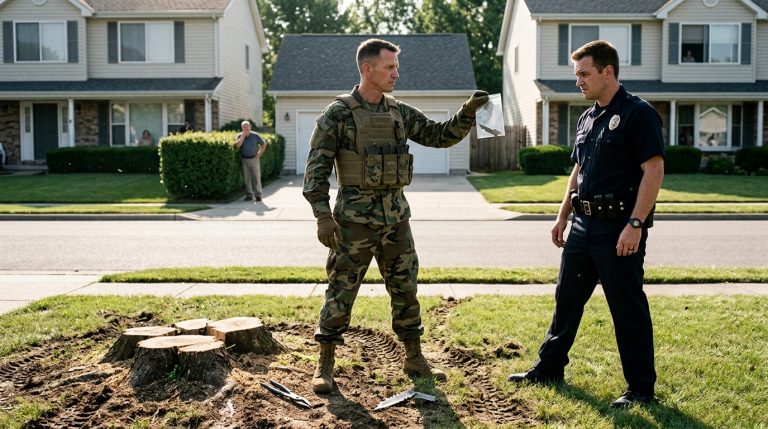
It wasn’t just the creek they were stealing. A surveyor’s stake had been driven into the ground five feet behind her, painted a violent, neon orange—and it was placed exactly where the old property corner should have been, but it was canted at an angle that suggested they weren’t just misreading the map. They were trying to hide the old survey marker.
I walked over to the stake and kicked it aside, revealing the cracked, moss-covered iron pin beneath it. My pulse skipped. They hadn’t just moved the line; they had dug up the original marker to bury the proof.
CHAPTER 2: THE RECONNAISSANCE
I didn’t pick up the stake. Not yet. I stared at the hole where the old iron pin had been, the earth still raw and dark, disturbed by someone else’s hands within the last forty-eight hours. The silence of the forest, usually a comfort, now felt like a vacuum waiting to be filled by the grinding of gears and the tearing of topsoil.
The sound was faint, rhythmic—the low-frequency vibration of a diesel engine idling somewhere across the creek, hidden by the thick veil of rhododendrons. They weren’t just redrawing the map on paper; they were preparing to reshape the physical reality of my land. I felt the familiar, sharp precision of a combat engineer’s mind clicking into place. I wasn’t just a retired Marine anymore; I was the frontline of a defense that had suddenly become kinetic.
I left the orange stake where it lay and moved back toward the farmhouse with a measured, disciplined pace. I didn’t run. Running invites panic, and panic is a variable that leads to tactical failure. My boots hit the forest floor with minimal sound. Every step was an assessment. I noted the direction of the engine noise, the lack of birdsong in the vicinity, and the way the shadows stretched across the underbrush—perfect cover for a clandestine site visit.
When I reached the back porch, Sarah was there, a mug of coffee in her hand, her eyes scanning the tree line. She knew the look on my face—the same expression I’d worn the morning we’d decided to pack our lives into a single truck during the transition back to civilian life.
“They moved the marker, didn’t they?” she asked, her voice steady.
“They moved it, buried it, and they’ve got equipment running on the eastern ridge,” I said, bypassing the porch and heading straight for the mudroom. I stripped off my boots, leaving the damp soil of the creek bed behind, and went straight to the small, windowless room I used as an office.
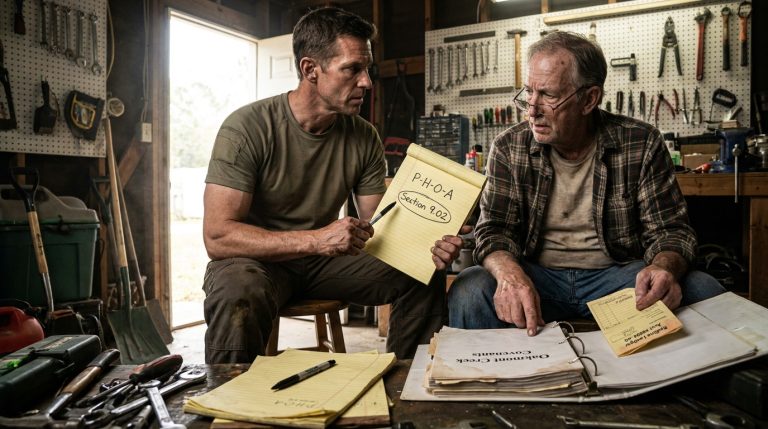
I didn’t turn on the overhead light. I clicked on the single desk lamp, the pool of yellow illumination focusing on the stacks of documents I had organized with the care of a quartermaster. My grandfather’s deed was on top, its edges worn thin, a testament to the decades of stewardship my family had provided. Beside it lay the 1985 survey, the ink still crisp and clear.
I needed to see the geography of their theft. I opened the file containing the photos I’d taken during my last run to the county register of deeds. I pulled up the image of the Whispering Pines master plat on my laptop, enlarging the pixels until the boundary lines became sharp, pixelated borders of conflict.
There it was. A jagged, artificial deviation. The line didn’t just follow the creek; it performed a precise, surgical detour, looping around Miller’s Creek in a way that screamed intent. It was too clean to be a mistake. A clerk might transpose a digit, but a surveyor doesn’t accidentally carve out a half-mile of timberland unless they’re being paid to see what the client wants them to see.
I grabbed a ruler and a sheet of tracing paper. I laid it over the top of the map, my hands moving with steady, habitual precision. I began to map out their progress. If they were working on the eastern ridge, they were targeting the old logging trail—a path that provided the easiest access to the creek. If they secured that, they could bring in heavy machinery without ever crossing the main county road. They were setting up a logistics corridor.
My mind raced, filtering through possibilities. If I called the county sheriff now, it would be treated as a civil dispute, a ‘he-said-she-said’ argument over a few feet of dirt. They wouldn’t care. To them, it was just a neighborly spat. I needed something more than an accusation. I needed a verified breach of the public trust.
I thought back to the conversation with Karen. Her arrogance wasn’t just about the HOA; it was the arrogance of someone who felt backed by a corporate Goliath. She didn’t fear the law because she believed the law was already written in her favor.
I looked at the notes I’d scrawled during my previous visits to the zoning office. Harris Development. They had presented an environmental impact study to the board to get the green light for the project. I remembered the glossy images, the promises of ‘eco-conscious’ living, the inclusion of a ‘protected water feature.’
If they had filed a false map to secure those permits, they hadn’t just committed a clerical error. They had committed fraud against the county itself.
I sat back, the chair groaning under my weight. My eyes caught a detail on the map I hadn’t fully appreciated before—a thin, dashed line running parallel to the creek. It wasn’t a property boundary. It was a utility easement, dating back to a private agreement from the late fifties, right around the time my grandfather had secured this tract. I hadn’t given it much thought, assuming it was a defunct water line, but as I looked at the overlay, I realized where it led: straight into the heart of the Whispering Pines development’s drainage basin.
If the developer was building on top of that, they were in violation of a much older, much more ironclad set of covenants than their HOA rules.
A cold, thin smile touched my lips. I had my strategy. I wasn’t going to fight their HOA board; I was going to force them to answer to the county and the utility stakeholders. But first, I had to ensure I had the proof. I needed to see exactly what they were clearing out there.
I stood up, feeling the hunger in my stomach, but ignoring it. I moved to the closet and pulled out a small, ruggedized camera bag. I packed a high-zoom lens, a digital voice recorder, and a GPS-enabled mapping tool. Reconnaissance is the foundation of any successful engagement. If I was going to dismantle their foundation, I needed to see every crack in their walls.
I walked to the back door, pausing to look back at the map. The lines on the paper were just a guide. The real war would be fought on the ground, among the trees and the mud, where the truth couldn’t be papered over by corporate lawyers. I checked my watch. 0900. I had enough light for four hours of work before the shadows became too long.
I stepped out onto the porch, the air crisp and biting. Sarah was waiting at the screen door, her eyes searching mine. “They’re still out there,” she said softly.
“They won’t be for long,” I replied, my voice hard as flint. “I’m going to see exactly what they’re building.”
I started walking, not toward the creek this time, but deeper into the woods, flanking the trail. I stayed low, moving through the thicket with the silence of a shadow. I wasn’t just a landowner anymore. I was an observer, and I was going to give them exactly the mistake they needed to lose everything.
CHAPTER 3: THE COLD ASSESSMENT
I pressed my back against the rough, lichen-covered bark of the oak, holding my breath. Thirty yards ahead, the dense curtain of rhododendrons thinned, revealing a clearing that hadn’t existed a week ago. The developer had been busy. A skid-steer loader sat motionless near the creek bank, its bucket lowered, claws biting deep into the damp earth. Beside it, a cluster of survey equipment stood on tripod legs like long-legged insects, glinting coldly in the filtered afternoon light.
The sight triggered a sharp, involuntary memory: a jagged stretch of road in Al-Anbar, where we’d been tasked with clearing a route. The same sense of impending structural collapse, the same need to identify the pivot point before the entire thing could be rendered inert. I saw the way they had cleared the brush—not randomly, but with a clear, strategic path intended to flatten the natural embankment. They were prepping for a permanent access road.
I pulled the high-zoom lens from my bag, shielding the glass to prevent any stray reflection from catching the sun. Through the viewfinder, the world sharpened into brutal detail. I scanned the equipment, the tracks in the mud, and the distant form of a man in a yellow high-visibility vest standing near the creek. He was looking at a set of blueprints, turning them slowly, his body language oscillating between boredom and impatient calculation.
He wasn’t an engineer. He was a site supervisor, the kind who was paid to ignore the fine print so long as the heavy machines kept moving.
My finger hovered over the shutter button. I snapped a series of images—the equipment serial numbers, the specific placement of the stakes, and the man’s face. Every frame was a piece of evidence. I had been worried that this would be a messy, emotional confrontation, but looking at them from the shadows, I realized that my military background had prepared me perfectly for this. This wasn’t a fight about feelings; it was a fight about logistics and documentation.
I felt the weight of the digital voice recorder in my pocket. I moved closer, sliding through the underbrush with the fluid, deliberate grace I’d practiced for years. I knew how to move in silence. I knew how to read the wind. When I was ten feet closer, I crouched behind a downed hemlock, the scent of rot and damp pine filling my nose.
The supervisor stepped closer to the creek, tossing his blueprints onto the hood of the skid-steer. A second man emerged from the brush, holding a handheld laser level.
“The grade is too steep,” the second man said, his voice carrying over the idle hum of the engine. “If we push the road another ten feet, we’re going to hit that stone formation. Harris wants this done by Friday, but the ground is too soft here.”
“Then add more gravel,” the supervisor snapped back, his tone dismissive. “I don’t care what the soil report says. The plat map gives us the green light to clear the corridor. Just keep it straight. If we deviate, the HOA president starts asking questions, and I don’t have the patience to deal with her hysterics.”
I held my breath, the recording rolling. The plat map. They knew exactly what they were doing. They were operating under the cover of the fraudulent documentation, and they were actively avoiding the physical reality of the land to force their version of the map into existence.
The supervisor kicked at a loose rock, his eyes sweeping across the terrain. For a second, he looked directly toward my position. I went perfectly still, blending into the mottled light and shadow of the forest floor. He didn’t see me, but the movement forced him to turn away. He grabbed the blueprints again, his thumb tracing a line that I knew, with absolute certainty, crossed onto my side of the true boundary.
They were building a road that legally shouldn’t exist, over a creek they had no right to alter.
The mechanical growl of the skid-steer kicked into a higher gear as the driver returned. It lurched forward, its tracks churning the mud, and began to dump a load of crushed stone exactly where the bank was most vulnerable. The vibration traveled through the earth, up through the soles of my boots, and into my bones.
I had enough. I had the confirmation of their intent, the admission that they were ignoring the soil reports, and the proof that they were acting under a fraudulent plat.
I retreated the same way I’d come, my movements becoming faster, more urgent now that the reconnaissance phase was complete. As I reached the edge of my workshop, I saw Sarah standing at the end of the gravel path. She was holding a folder. She saw me coming and walked toward me, her face pale.
“Mark,” she said, her voice trembling slightly. “A courier just dropped this off at the gate. It’s not from the HOA. It’s from a law firm in the capital. Harris Development.”
I took the envelope, the paper heavy and expensive. I didn’t need to open it to know what was inside. The bully was sending his thugs, thinking that a threat of litigation would stop me from seeing the road they were tearing into my timberland.
“They’re too late,” I said, tucking the envelope into my jacket pocket without looking at it. “I’ve got everything I need to sink them.”
I walked toward the farmhouse, the path under my feet feeling more like a line of defense than a driveway. The cold assessment was over. Now, I needed to initiate the counter-measure. I didn’t need to out-shout them; I needed to out-maneuver them. I headed for my office, the plan already crystallizing into a series of decisive, surgical actions. The battle for the line had officially escalated.
CHAPTER 4: THE DECOY UNCOVERED
I didn’t open the envelope. Not yet. Threats, like ammunition, have a limited shelf life if you let them dictate the pace of the engagement. Instead, I pulled the chair up to my computer and brought up the scanned images of the zoning applications I’d pulled from the county office.
I was looking for the flaw. Fraud, like any poorly constructed engineering project, always has a load-bearing tension point that, once identified, can bring the whole structure down.
I scrolled through the PDF of the Whispering Pines master application. It was four hundred pages of corporate fluff—environmental impact statements filled with buzzwords like “sustainability” and “natural corridor preservation.” I bypassed the marketing copy and headed straight for the annexes: the plat filings, the utility easements, and the municipal tax parcel definitions.
That was when I saw it.
It wasn’t a grand conspiracy in the center of the document; it was a triviality in the margins. The filing code for the “common area” buffer zone—the creek—didn’t match the county’s master parcel grid. In the county records, the creek was marked as a permanent drainage easement linked to the original 1952 deeds, a designation that technically barred any structure, landscaping, or modification by a third party. Yet, in the Harris Development filing, the parcel code was changed to a residential amenity designation.
The developer hadn’t just fudged a boundary line. They had performed a digital sleight of hand, re-coding a public utility easement into private residential land to bypass the environmental oversight board. They didn’t just want my land; they needed it to function as a drainage basin for their entire project. If I cleared that creek, as Karen demanded, I would be destroying the very thing that kept their development from flooding, and if they paved it, as their road plans indicated, they would be flooding my property.
I felt a surge of cold, methodical clarity. This was the decoy. The HOA wasn’t just a group of busybodies; they were the enforcement arm of a disaster-in-waiting. Karen was likely convinced she was protecting the “value” of her kingdom, completely unaware that the ground beneath her pristine suburban fantasy was technically a legal and environmental sinkhole.
I stood up and walked to the window. The moon was high, casting long, sharp shadows across the fields. I could see the edge of the timberline, a dark wall of oak and pine that stood guard over the water.
I turned back to my desk and finally ripped open the envelope from the law firm. It was exactly what I expected: a cease-and-desist letter, wrapped in enough legal jargon to choke a horse, threatening me with “irreparable financial harm” if I interfered with the “sanctioned development of authorized property.” They hadn’t even bothered to provide a survey to back up their claim. It was pure intimidation, a paper tiger meant to scare a “simple farmer.”
I reached for the phone and dialed the number I’d kept in my back pocket for days—the number for the local journalist Abernathy had suggested, the one who didn’t play nice with corporate PR departments.
“This is Mark Thorne,” I said when she picked up. The line crackled with static. “You asked for a story on the Whispering Pines development?”
“I’m listening,” the reporter said, her voice dropping into a professional, inquisitive register.
“Stop looking at the boundary disputes,” I told her, my voice steady, stripped of all emotion. “Start looking at the filing codes for the utility easements in the 2018 zoning application. Look at how they re-coded the drainage basin. You’ll find the real story there. And you’ll find that the ‘community amenity’ they’re selling is a liability that should have never been approved.”
I hung up before she could ask for more. I didn’t need to give her a lecture. I just needed to pull the thread. Once the county realized that Harris Development had manipulated the parcel codes to bypass environmental law, the entire permitting process would be forced into an audit. They wouldn’t just be dealing with me; they’d be dealing with state-level investigators.
I looked at the map again. The logic held. Therefore, if they were forced to disclose the drainage issues, the sale of the development would stall. But, I had to ensure I was clear of the fallout. I had to make sure that when the floor fell out from under the HOA and the developer, my land remained untouched.
I spent the next three hours mapping out the secondary easement lines on my own property. I realized that my grandfather’s 1952 deed had a clause I’d glossed over a thousand times—a clause about water rights and maintenance that predated the county’s modern zoning. If I played it right, I didn’t just own the land; I held the rights to the drainage itself.
The house was quiet, save for the rhythmic ticking of the wall clock. I walked out to the porch and stood in the dark. The air was colder now, the scent of damp earth rising from the woods. Somewhere in the distance, a coyote howled, a sharp, mournful sound that cut through the silence.
I wasn’t afraid. I had successfully identified the decoy secret—the HOA’s petty authority—and I had identified the weapon that would dismantle the developer: the falsified utility designation. I had the reconnaissance, I had the motive, and I had the leverage.
The door behind me creaked, and Sarah stepped out, pulling a blanket around her shoulders. “You’re still up?”
“The planning phase is almost complete,” I said, not turning around. “They think they’re attacking me with lawyers and threats. They don’t realize they’ve handed me the exact key I need to lock them out for good.”
I watched the distant lights of the Whispering Pines estates, a grid of artificial, sterile illumination against the natural darkness of the ridge. Those lights didn’t look like a kingdom anymore. To me, they looked like a cage built on a foundation of sand, and I had just found the lever that would collapse it.
CHAPTER 5: THE COALITIONS RISE
I didn’t turn on the main light. The soft amber glow of the desk lamp was enough to keep the shadows at bay, but it didn’t do much for the cold knot of tension pulling at the base of my skull. I had invited the war to my doorstep, and now, I was starting to feel the walls closing in. Every creak of the floorboards, every rustle of the wind against the siding, felt deliberate—an agent of the HOA or a scout for the developer looking for a way to break my perimeter. It was a mental trick, I knew—a byproduct of years of combat, where the mind learns to anticipate threats in the stillness—but that didn’t make the paranoia any less suffocating.
I shook it off, focusing on the screen. The email from Dave, the retired logistics officer, was waiting. He had done his part. He had been quietly organizing the discontented among the Whispering Pines residents, documenting the overreach of the HOA board with the same methodical care I’d used to build my case.
Found three more people, his message read. A couple in the cul-de-sac who were fined for the shade of their mailbox, and a widow who was told her cat was a ‘nuisance animal.’ They’re ready to talk. They’re ready to testify.
It was the fuel I needed. I started an encrypted chat, mapping out the architecture of our insurgency. I needed to move them from ‘disgruntled neighbors’ to a coherent, documentable coalition. If we were going to expose Harris Development, we couldn’t just have complaints; we needed a sworn record of the pattern of abuse.
I spent the next two hours drafting a template for a formal grievance that could be filed collectively. It wasn’t just about their individual fines anymore; it was about the way the HOA board, led by Karen, had acted in tandem with the developer to intimidate residents into silence. If the reporter could link the HOA’s enforcement of the bogus covenants to the developer’s need to secure the ‘common area,’ we would have our smoking gun.
The phone buzzed. It was an unknown number. I let it go to voicemail, but when the notification popped up, I didn’t see a call. I saw a message.
We know you’re the one talking to the press. Stop, or this gets ugly for your family.
My fingers tightened around the edge of the desk until the wood bit into my skin. Ugly? They didn’t know the meaning of the word. They were operating out of a playbook of corporate bluster, thinking that a vague threat would make me fold like a paper map. But this was my home. They had stepped over the line, and now, they were deep in territory they didn’t understand.
I didn’t reply. I didn’t save the number. I simply screenshotted it, sent it to Abernathy’s secure server, and kept working.
The next morning, I met Dave at a diner three towns over—neutral ground, well away from the prying eyes of the Whispering Pines clubhouse. He looked tired, the dark circles under his eyes a testament to the sleepless nights he’d spent organizing.
“We have a problem,” he said, not waiting for coffee. “Karen is holding a town hall tonight. She’s framing this as an ’emergency meeting’ to address the ‘vandalism’—which is what she’s calling the signs you put up. She’s trying to whip the residents into a frenzy, trying to get them to authorize a legal fund to sue you directly.”
“Let her,” I said, leaning back. I felt a cold, sharp thrill. “She’s going to hold a town hall to discuss my signs?”
“She’s going to use the community’s money to escalate this,” Dave confirmed. “She’s desperate, Mark. She’s losing control, and people like that don’t go down quietly. They burn the house down on the way out.”
“Then we’ll be there,” I said. “Not to shout, not to interrupt. We’re going to be there to listen, and when she finishes her speech, we’re going to ask the one question she can’t answer.”
“And what’s that?”
“We’re going to ask who authorized the use of community funds for a private legal dispute involving a boundary that hasn’t been legally established.”
Dave smiled, a slow, grim expression. “She won’t have an answer for that.”
I left the diner and drove toward the town where the Whispering Pines clubhouse stood. I wasn’t feeling paranoid anymore. The air felt clearer, sharper. I was moving into position. I had the coalition, I had the legal weight of Abernathy’s strategy, and I had the vulnerability of their own system.
The clubhouse was a glass-walled structure that looked out over the meticulously manicured lawn of the development. As I parked my truck and walked toward the entrance, I saw the residents gathering—a mix of confused suburbanites, angry HOA loyalists, and the quiet, nervous group Dave had organized.
Karen was at the front, standing behind a podium. She looked frazzled, her hair perfectly lacquered but her eyes darting around the room with a manic energy. She had her clipboard, her badge of office, held tight against her chest.
She began to speak, her voice ringing out through the PA system. She talked about the sanctity of their rules, the “threat” of the neighboring property, and the need for unity in the face of my “aggression.” She was painting me as the invader, the enemy of their peace.
I stood at the back of the room, my arms crossed, watching her performance. She was good—I’d give her that. She knew how to manipulate the room. She knew how to turn fear into a weapon. But she was building her house on a fault line.
When she finished, the room was thick with tension. A few people clapped. Then, the silence stretched, heavy and expectant.
I took a step forward. I didn’t raise my voice. I didn’t need to. The room was so quiet that even the hum of the air conditioner sounded like a roar.
“Ms. Karen,” I said, my voice cutting through the space with the force of an unyielding truth. “If this is a private matter between a neighboring property owner and the developer, why is the HOA board spending the residents’ money to fight it?”
Karen froze. Her face turned that familiar, violent shade of red. She looked at the crowd, then at me, her mouth opening and closing like a fish. She hadn’t expected a challenge. She had expected to be the queen, to be heard and obeyed.
She turned to her treasurer, a woman who looked like she wanted to evaporate, but the woman didn’t move. She was looking at the floor.
“That’s… that’s not for you to decide,” Karen sputtered, her voice losing its edge. “This is our community. We protect our values!”
“You protect your budget,” I corrected her, my tone devoid of anger, only cold, hard fact. “And I think everyone in this room deserves to know if that budget is being used to fight a war on behalf of a developer who lied to them about their own property boundaries.”
The whisper began then—a low, rising tide of confusion and anger. It wasn’t just a challenge; it was a breach in the dam. I stood my ground, my posture relaxed but alert, ready for the inevitable counter-move. She had tried to rally the troops, but she had invited the very information that would destroy her position.
The shift in the room was palpable. The loyalists were hesitating. The nervous residents were looking at each other, the questions beginning to form in their eyes. This was the exhale, the moment the tension broke and the reality began to bleed into the room.
CHAPTER 6: THE BOUNDARY DEFENSE
The silence was the most dangerous weapon in the room. Karen looked from the crowd to the doorway, her eyes searching for the developer, Harris, who was nowhere to be found. She was alone, exposed, and the mask of the HOA president was dissolving in real-time.
“I… we have procedures,” she stammered, her voice thin, stripped of its earlier, practiced authority. She looked to the clubhouse door as if hoping for a distraction, a fire alarm, anything to break the weight of the collective gaze.
“The procedure is simple, Karen,” I said, stepping into the aisle, my voice calm but carrying to the back of the room. “The residents asked a question. Does the HOA have the legal standing to use their dues for a private boundary dispute? Especially when that boundary is based on a plat map that isn’t even registered with the county?”
A murmur of agreement rippled through the rows of chairs. The young couple with the toddler I’d heard about were standing now, their faces hardened. A man near the front—one of the quiet, discerning ones Dave had identified—stood up, his voice firm. “We were told this was about protecting our property values. It looks more like we’re being used to protect a fraud.”
Karen’s face went white, then mottled with red. The “useful idiot” was realizing she was entirely expendable. I saw her hand tremble, the clipboard slipping slightly from her grasp. She looked like a woman realizing the floor she’d been standing on had been made of paper all along.
“This is an ambush,” she hissed, her gaze snapping back to me. “You’ve been planning this since day one. You’re not a victim, you’re an agitator.”
“I’m a property owner,” I replied, my stance steady, unyielding. “I’m defending what’s mine. You’re the one who thought you could rewrite history with a binder full of rules.”
Before she could answer, the clubhouse door swung open. It wasn’t the developer. It was the sheriff’s deputy I had contacted earlier, arriving for a scheduled welfare check on the meeting—a precaution Abernathy had insisted on. The sight of the uniform seemed to drain the last of the fight from Karen. She looked at the deputy, then back to the room, realizing that the balance of power had shifted outside of her control.
I turned my back on her. The theater was over. I didn’t need to see her walk out; the damage to her authority was absolute, and the coalition Dave and I had built was already taking over the room, the residents starting to organize a new meeting, a real meeting, without the threat of fines or the agenda of a corrupt developer.
I walked out of the clubhouse into the cool, biting air of the evening. The parking lot was dark, save for the overhead streetlights that hummed with a low, electric buzz. I felt a surge of exhaustion—the physical toll of the tension, the hours of preparation, the constant, low-level vigilance—but underneath it, there was a quiet, steady resolve.
My truck was parked near the end of the line. As I reached it, I noticed a piece of paper tucked under the wiper blade.
I pulled it out. It wasn’t a threat. It was a formal notice of an “Emergency Stop-Work Order” issued by the county’s environmental board, dated that very afternoon. The reporter had come through. The utility easement discrepancy I’d uncovered had triggered a full-scale audit of the developer’s work.
The site was shut down.
I sat in the driver’s seat, the engine humming to life, and let out a long, slow breath. I hadn’t just held the line; I had shifted the entire front. The developer’s road—the one they were so desperately trying to force through my woods—was now illegal. The machinery would have to go. The men in the high-vis vests would have to leave.
But as I pulled out of the parking lot, I felt a prickle of intuition—the same one that used to make the hair on my neck stand up in the field. The developer was quiet. Too quiet. A man like Harris didn’t just walk away when the first domino fell. He would have a contingency, a final maneuver designed to salvage what he could before the bankruptcy hit.
He hadn’t fought back tonight because he was waiting for something.
I looked in the rearview mirror. A set of headlights pulled out behind me, keeping a steady, calculated distance. It was a black sedan, nothing remarkable, but it drove with the precision of someone who wasn’t just following; they were observing.
I took the turn toward the back roads, the ones that wound through the heavy timber of my property. If they wanted to play cat and mouse, I knew the terrain better than anyone. I wasn’t going home—not yet. I was going to lead them to the boundary, to the stakes that were still standing, and I was going to see exactly how much they were willing to risk to keep their lie alive.
The battle wasn’t over. It was just moving into the dark, and I had the advantage of knowing exactly where the traps were hidden.
CHAPTER 7: THE SETTLEMENT TRAP
The rain started not as a drizzle, but as a wall of gray, hammering against the windshield and turning the gravel road into a slick, unpredictable river. My truck fishtailed as I took the sharp curve near the eastern ridge, the tires struggling for grip on the saturated earth. Behind me, the black sedan hesitated, its driver clearly unaccustomed to the treacherous, unpaved terrain that marked the transition between the manicured world of the development and the raw, ancient timberland of my property.
I didn’t slow down. I knew every root, every dip, every hidden washout of this trail. I crested the ridge and cut my lights, plunging the world into a chaotic strobe of lightning and rain. I pulled sharply into the dense thicket of pines where the old logging road vanished, cutting the engine and slipping out into the downpour.
I didn’t look back to see if they followed. I knew they would. A man like Harris, cornered and desperate, would have his fixers following me to the ends of the earth if he thought there was a chance to reclaim the leverage I’d taken.
I moved through the woods with silent, practiced efficiency, the cold rain washing away the heat of the drive. I reached the boundary marker—the primary iron pin that Tom had re-staked. I knelt in the mud, my hands finding the cool, solid metal of the survey pin. This was the point. The pivot.
A few minutes later, the crunch of heavy tires signaled their arrival. A car door slammed, followed by the metallic click of a flashlight. I watched from behind the thick trunk of an oak, my breathing steady, my senses amplified by the storm.
Two men emerged from the sedan, their suits already ruined by the mud. They were fumbling with flashlights, casting erratic beams through the rain. One of them, a man I recognized from the periphery of Harris’s legal team, was shouting something, but the wind snatched his words away.
“Find it,” the other one growled, his voice tight. “He’s been out here all day. Harris wants the proof he’s tampering with the new stakes.”
They weren’t here to talk. They were here to frame me for the very thing I was uncovering. They walked right up to the survey pin, the laser light of their beams dancing across the mud. They were standing exactly on the line I had spent months defending.
I didn’t call out. I didn’t need to. I stood up, my form emerging from the darkness of the trees like a ghost in the storm. I didn’t say a word, but the sudden shift in the air—the sudden presence of something that didn’t belong in the dark—made them whip around, their flashlights blinding and wild.
“You’re trespassing,” I said, my voice low and cutting through the thunder.
The man with the flashlight stumbled back, his beam hitting my face. He recognized me, and the arrogance vanished, replaced by a frantic, jagged confusion. He looked at the mud, at the survey pin, and finally at the woods behind me.
“We were just checking the… the boundary,” he stammered, the confidence of the boardroom failing him in the face of the storm.
“You’re on my land,” I said, stepping closer. “And you’re recording yourselves on the very devices you brought to frame me.”
I reached into my jacket and pulled out my phone, the screen glowing. I’d had the recorder running since I stepped out of the truck. “Every word you’ve said, every move you’ve made since you turned off the paved road—it’s all on a cloud drive. And by the time you get back to your car, the local sheriff will have the footage, the GPS data of your pursuit, and a detailed complaint about the corporate intimidation campaign you’re running.”
The men stood paralyzed, the rain plastering their hair to their foreheads. They had expected a farmer in a house, an easy mark to intimidate. They hadn’t expected a man who knew the geography of a battlefield better than they knew their own legal briefs.
“Leave,” I said, my voice leaving no room for negotiation. “And tell Harris that the next time he sends someone, he should make sure they have a better understanding of the law. Because this property line? It’s not just a boundary. It’s a cage. And I’m about to lock it.”
They didn’t argue. They scrambled back toward the sedan, their expensive shoes sliding in the mud, their composure shattered. I stood at the edge of the creek, watching as they fumbled to reverse on the narrow trail, the engine roaring in a desperate, grinding struggle for traction. As the taillights disappeared into the rain, I reached down and touched the survey pin again.
The storm was reaching its crescendo, the sky overhead churning with dark, electric energy. The decoy was gone. The threat was stripped of its teeth. And as the rain hammered against the leaves, I realized that I wasn’t just waiting for the final act—I was already living it. The developer would try one last, frantic play, but he was already running out of ground to stand on.
My home was silent, save for the rain. The line was held.
CHAPTER 8: THE FINAL DEMARCATION
I walked slowly into the workshop, the smell of oil and dry pine shavings greeting me like an old friend. The summons lay on the workbench where the sheriff’s deputy had left it—a last-ditch effort by Harris to tie me up in litigation before the state audit could finalize its findings. It was a bluff, and a poorly executed one at that.
I sat down at the heavy oak desk and opened the document. It was a standard motion for a temporary restraining order, alleging that my “harassment” of his contractors had caused irreparable financial damage. But as I read through the supporting affidavits, the real vulnerability surfaced. To prove his damages, Harris had been forced to submit his project’s full drainage plan and the original site-readiness certification to the court.
He had handed me the smoking gun.
The site-readiness certification confirmed that the developer had ignored the 1952 utility easement documentation—a fact that, when coupled with the fraudulent plat map I had already exposed, proved not just negligence, but intentional malfeasance. He wasn’t just losing his project; he was facing criminal charges for document falsification.
I didn’t call Abernathy. Not yet. I sat in the silence, listening to the house settle around me. The battle had been long, but the resolution was as precise as a well-calibrated machine. I had the documents. I had the support of the neighborhood coalition, who were already pushing for a full dissolution of the current HOA board. I had the county auditor’s commitment to investigate the permitting process.
The weight of the last few months seemed to lift from my shoulders, replaced by a profound, heavy sense of peace. I walked over to the corner of the workshop and picked up the original iron survey pin I’d dug up at the boundary—the one Karen had tried to bury. It was rusted, pitted by years in the soil, and heavy in my palm. It wasn’t just a piece of metal. It was the physical record of my family’s presence here, the stubborn, unyielding truth that had survived everything they threw at it.
I walked to the back door and stepped out onto the porch. The storm had passed, leaving the night air crystal clear and cold. The moon bathed the woods in a pale, silver light, and the creek, my creek, continued its steady, ancient murmur through the darkness.
A week later, the final collapse arrived.
The news didn’t come with a bang. It came as a series of quiet, bureaucratic notifications. The county revoked the Whispering Pines development permits, citing the falsified utility designation. Harris Development filed for bankruptcy before the month was out. The high-end aluminum fence—the one I had insisted on—now stood as a permanent, immovable barrier between my land and the stalled, half-finished beige ghost town that Whispering Pines had become.
I stood by the fence that afternoon, my hand resting on the smooth, cold metal of the top rail. Dave walked up beside me, a cup of coffee in his hand. He looked different—lighter, less burdened by the petty tyrannies that had once defined his life here.
“They’re taking the signs down,” he said, gesturing toward the development entrance, where a crew was removing the ‘exclusive community’ banners. “The bank is liquidating the lots. Most of them are being sold off to individuals, not builders.”
“Good,” I said. “Maybe they’ll actually build something worth living in.”
“You did it, Mark,” Dave said, watching the creek. “You kept the line. You showed us that the rules aren’t just for us—they’re for the people who think they can write them to suit themselves.”
I didn’t answer right away. I was looking at the creek. The rhododendrons were beginning to bud, and the water looked cleaner than it had in years. I reached into my pocket and pulled out the old, rusted iron pin. I found a spot near the fence—the exact point where the boundary line had been challenged—and pushed the metal into the soft earth, flush with the ground. It was hidden, buried, a silent guardian of the claim.
“It wasn’t about the line, Dave,” I finally said. “It was about who gets to decide what happens here. My grandfather bought this land because it was free. I defended it because it’s mine. And I’ll pass it on because it’s worth more than the paper they tried to steal it with.”
We stood there for a long time, watching the sun dip below the horizon, painting the sky in deep, bruised shades of purple and gold. The silence was the real victory. There was no more mechanical grinding, no more arrogance, no more fear. Just the land, exactly as it was meant to be.
Sarah appeared on the porch, calling out for dinner, her voice clear and bright in the evening air. I turned and looked at my home, the sturdy farmhouse that had stood for generations. I felt a deep, resonant calm, the feeling of a mission successfully completed. I walked back toward the porch, my stride steady, the weight of the land under my boots familiar and right. The fence was solid. The boundary was marked. And the peace, for the first time in a long time, was absolute.