The Iron Boundary: How a Veteran’s Ten Acres and a Binder of Cold Evidence Broke a Suburban Tyrant
CHAPTER 1: The Perimeter Line
The air tasted of dry oak leaves and iron.
Up in the fork of the massive oak, fifty yards past the legal boundary of Whispering Pines, Jack maintained his silence. Below him, the silk-screened floral prints of the homeowner association’s president cut a violent, erratic pattern across the manicured turf that desperately tried to swallow the wild brush. Her face was the color of a bruised plum, puffed with the righteous indignation of someone who had never once been told no by a universe built entirely of beige siding and synchronized sprinkler systems.
“That illegal structure has to come down now, or I’m calling the authorities.”
Jack shifted his weight, testing the balance of the platform. His fingers brushed against the cold head of a galvanized bolt he had driven in three hours prior. Every movement was calculated, measured against the dead silence of the ten acres of untamed woods he had bled his army pension to secure.
“Ma’am,” Jack said, his voice dropping into the flat, rhythmic cadence he had used to brief commanders in terrain far less hostile than a suburban cul-de-sac. “You’re on private land.”
She didn’t stop marching. Her boots crushed the wild asters at the margin of the clearing—the invisible, orange-taped seam where county zoning laws abruptly abandoned the jurisdiction of petty tyrants. Her small, hard eyes scanned the precise angles of the deer stand, hunting for an infraction, a crooked plank, anything that would validate the small laminated rulebook she clutched against her chest like a shield.
“This is a clear violation of Whispering Pines Estates community bylaws,” she snapped, her cadence rhythmic and practiced, honed by years of uncontested neighborhood intimidation. “Section 7, subsection B. No unapproved external structures.”
Jack looked down at his calloused knuckles. The anger didn’t flare into a hot rush; it settled in his chest like cold lead, heavy and precise. He had spent twenty years navigating the rigid machinery of military logistics, where protocol was a matter of survival. This woman was playing a game of kitchen-table despotism, treating a ten-acre rural parcel as if it were an extension of her own manicured front lawn.
“Your bylaws stop at the orange tape,” Jack replied, his tone chillingly even. “Govern yourself accordingly.”
She scoffed, a sharp expulsion of air scented faintly of cinnamon gum and absolute, unearned authority. “Don’t you get smart with me, mister. I am the president.”
Jack watched her chest heave, noting the rigid posture of a woman whose entire existence depended on the compliance of neighbors too exhausted to fight back. He kept his hands resting casually on the knee-high safety rail, his eyes narrowing as she turned on her heel, stabbing the air with a sausage-like finger before storming back toward the asphalt.
The retreat was tactical, not a surrender. As the distant slam of a white SUV door echoed through the timber, Jack reached into his pocket and pulled out a small, worn notebook, flipping it open to a blank page. He didn’t write down what she had said. Instead, he drew a small, precise square representing the platform, marked the exact coordinate of the property line, and noted the time: 0942 hours.
The first salvo was fired, but the terrain was his. And as the wind shifted, carrying the faint scent of exhaust from the departing vehicle, Jack noticed a single, pristine white envelope wedged beneath the windshield wiper of his truck parked a quarter-mile away—an impossible place for an ordinary resident to leave a notice without crossing every boundary of trespass.
CHAPTER 2: The Cream Envelope
The gravel driveway crunched beneath Jack’s boots, the sound sharp and hollow in the early morning stillness. Half a mile from the timber line, his truck sat parked beside the split-rail fence, its frosted windshield catching the pale amber light of dawn. Wedged firmly beneath the rubber wiper blade was the object he had spotted from the ridge: a square of heavy, cream-colored cardstock bearing an embossed logo of a stylized pine cone nestled between two sharp, overlapping letters.
Jack stopped three paces short. He did not touch it immediately. Instead, he let his gaze trace the edges of the paper, noting how the morning dew had already begun to dampen its lower corner, turning the expensive fiber gray.
It was an impossible intrusion. To reach his vehicle, anyone coming from the Whispering Pines subdivision had to cross a gravel access road, bypass a cattle guard, and walk forty yards up a private lane clearly marked with federal survey markers and faded orange tape. There were no tracks in the frost around the tires save for his own oversized tread marks from the previous evening. Whoever had placed this here had moved with calculated stealth, treating his private acreage as an open corridor.
With two fingers, Jack slid the envelope free from the wiper. The cardstock was thick, stiff with pretension. He flipped it over without tearing the flap. Scrawled across the back in a looping, aggressive script was a signature that looked like a barbed wire fence: Karen Peterson, President, HOA Board of Directors.
He slid his thumb beneath the adhesive seal and ripped it open.
Inside sat a formal violation notice. The date was current, stamped with a digital printer, but the name at the top was misspelled—John Wallace Jr.—a petty clerical error designed to signal that he did not quite register as a legitimate entity in their ledgers. Beneath the name, the infraction was typed out with chilling bureaucratic precision: Construction of an unapproved external structure (tree fort/hunting blind) in violation of Covenant 7B. Levied fine: Fifty Dollars ($50.00). Failure to remove within seven days will result in a doubling of the penalty.
A cold, familiar weight settled into the pit of Jack’s stomach. It was the same sensation he used to get looking at intelligence reports in sector commands overseas—the realization that an opposing force was operating under a completely detached set of rules, mistaking their own paperwork for reality.
“Fifty dollars,” Jack muttered to the empty air.
He folded the notice once, the heavy paper resisting the crease with a sharp snap, and slid it into the breast pocket of his canvas jacket. The morning air bit at his ears, but his skin felt hot, a low-grade friction burning just beneath the surface. He climbed into the cab of the truck, the door closing with a heavy, muted thud that rattled the dashboard. He did not turn the key. Instead, he reached into the glove compartment, pulled out his logbook—a thick, grid-lined composition book with a duct-taped spine—and a black ballpoint pen.
The memory of a dusty command tent in a dry sector flickered at the edge of his thoughts—files stacked high, officers arguing over jurisdiction lines while supplies rotted in the sun. Bureaucracy was a weapon, nothing more. If you didn’t log the ordnance, you didn’t exist. If you didn’t map the trench, you lost the ground.
With steady, deliberate strokes, Jack opened the book and began to write.
October 13, 0615 hours.
Item received: Notice of Infraction, Covenant 7B.
Method of delivery: Unauthorized trespass onto private vehicle, parcel ID 734-B.
Condition of delivery: Physical placement on personal property outside HOA jurisdiction.
He paused, the pen hovering over the paper as a sharp gust of wind rattled the bare branches of the maples overhead. He could picture her—Karen Peterson—sitting at a mahogany desk somewhere behind those manicured hedges, stamping papers with a self-satisfied smirk, entirely convinced that her little kingdom extended as far as her eyes could see. She was treating his ten acres like an administrative oversight waiting to be corrected.
Jack capped the pen with a sharp click. He looked out through the frosted windshield toward the distant line of oaks where his cathedral stood silent and steady in the pale light. She wanted a paper war. She wanted a structured theater of engagement where every rule was a shackle and every fine was a bullet.
He tossed the logbook onto the passenger seat, started the ignition, and put the truck in reverse. The tires crunched backward down the lane. He was not going to call her. He was not going to shout across the property line. He was going to build a file so dense, so legally airtight, that when it finally dropped, it would crush her little paper empire into dust.
CHAPTER 3: The Paper Fortress
The kitchen table was a wide expanse of scarred butcher block, smelling faintly of roasted coffee and lemon oil. Maria sat three chairs down, her nurse’s uniform already pressed and hanging on the hook by the back door, her mug cradled between both hands as she watched the ink dry.
Jack did not look up from the grid-lined composition book. His pen moved with the deliberate, heavy pressure of a man tracing topographical coordinates under fire.
“She misspelled the name again,” Maria said softly, her voice carrying the smooth cadence of someone accustomed to reading charts where a single misplaced digit could alter a prognosis. “John Wallace Jr. It’s a deliberate tell, Jack. If she treats you like a clerical error, she doesn’t have to acknowledge you’re standing on separate ground.”
“Let her misspell it,” Jack said, his voice flat. He didn’t break rhythm. “Every error is a baseline metric for the file. In logistics, an unverified log is just noise. But a documented breach with a misspelled identity? That’s an administrative paper trail that holds up in a court of records.”
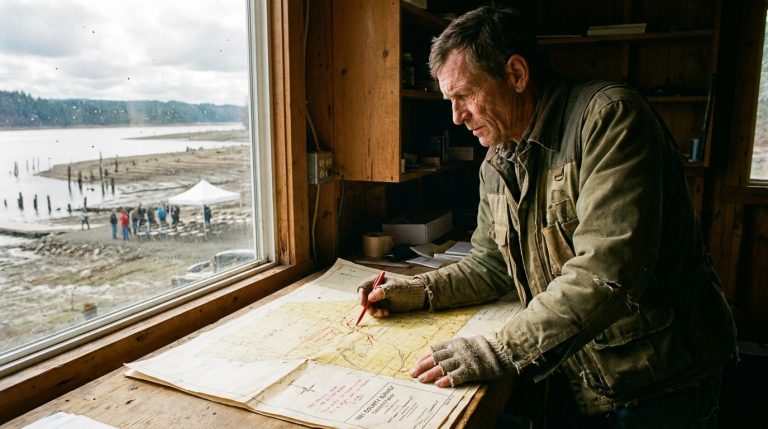
He pulled the county survey map toward him across the wooden grain. The blue-tinted blueprint, obtained straight from the county clerk’s office two weeks prior to closing on the property, was marked with crisp red ink and yellow highlighter. The boundary line of parcel ID 734-B cut a clean, uncompromising swath along the western edge of the Whispering Pines subdivision like a scar through a clean shirt. There was no ambiguity. The stream, the steep ravine, the ten acres of rugged timber—none of it belonged to the association’s master deed.
Jack reached for a fresh sheet of heavy legal bond paper. If Karen Peterson wanted to fight a war of attrition using fifty-dollar fines and embossed envelopes, she would find herself answering to a formal counter-offensive built on statutory law rather than neighborhood whim.
“You’re escalating it,” Maria observed, though there was no hesitation in her eyes, only a quiet, steady solidarity. She knew the look he wore—the same expression he had worn when organizing supply lines through hostile sectors.
“I’m establishing a defensive perimeter,” Jack corrected, aligning his ruler against the edge of the paper with a sharp click. “A bully doesn’t understand a polite conversation across the fence line. They only understand when the perimeter closes in on them.”
With precise, mechanical neatness, Jack began to draft the formal response. He did not use emotional language. He did not reference her tone or the sharp blade of entitlement she had wielded from the turf. Instead, he cited the county plat book, the state zoning codes for rural residential parcels, and the exact section of the Whispering Pines master deed that defined the association’s absolute lack of extraterritorial jurisdiction.
He attached certified copies of the deed, highlighted the specific parcel descriptions, and stamped the bottom of the document with the exact date and time of the initial confrontation. When he finished, the letter looked less like a neighborly reply and more like a federal injunction.
He slid it into a heavy-duty manila envelope, sealed the flap with a strip of reinforced tape, and pressed his palm down hard across the seam.
“The post office opens in twenty minutes,” Jack said, standing up from the table. The chair legs scraped sharply against the floorboards. “Certified mail. Return receipt requested. I want a green card with her signature on it sitting in this binder before the week is out.”
Maria watched him walk toward the coat rack, her gaze lingering on the thick, duct-taped spine of the logbook. “She won’t take it quietly, Jack. People like that don’t know how to step back.”
“Let her push,” Jack replied, pulling his canvas jacket over his shoulders, the fabric stiff and smelling of outdoor smoke and canvas. “Every move she makes outside her jurisdiction is just another pin in the map.”
He stepped out the back door, the crisp autumn air hitting his face like a physical blow. The sun was clearing the ridge, casting long, sharp shadows across the gravel lane. The deer stand sat half a mile away through the trees, silent and immovable, waiting for the next move.
CHAPTER 4: The Game Wardens Verdict
The gravel lane crunched under the tires of the state vehicle before Jack had even finished latching the gate on the western perimeter. It was a forest-green Ford pickup bearing the emblem of the Department of Wildlife and Fisheries on the side, its tires kicking up a fine spray of dust and frost as it slowed to a halt near the base of the rise.
Jack stood motionless by the post, his hand resting on the top of the pressure-treated wood. He didn’t rush. He watched the driver’s side door swing open with a familiar, heavy creak.
A large man stepped down, broad-shouldered and solid, wearing the crisp green uniform of a game warden. Mirrored sunglasses hid his eyes against the sharp morning glare, but the tilt of his head carried an immediate, unmistakable familiarity. He adjusted his duty belt, surveyed the steep grade of the timber line, and then let his gaze settle squarely on Jack.
Before the warden could take three steps toward the fence line, the crunch of a second set of tires echoed sharply from the edge of the asphalt. A gleaming white SUV pulled up short behind the state truck, stopping with an aggressive lurch. The door slammed open with a force that rattled the vehicle’s body panels.
“Right over here, officer!” Karen Peterson’s voice cut through the quiet air like a rusty saw blade. She marched across the gravel, her floral-print jacket billowing slightly around her frame, her face flushed with the kind of frantic vindication that came from absolute certainty. “This is the man I was telling you about. He’s built an illegal poaching platform right on the border of our environmental easement, and I have reason to believe he’s baiting them.”
Jack didn’t flinch. He kept his weight balanced evenly on both boots, watching her approach. She didn’t look at him; her attention was entirely fixed on the uniformed man, treating the state employee like an extension of her own private security detail.
“He’s been harassing the wildlife and creating a dangerous situation,” Karen continued, her voice rising in pitch as she gestured wildly toward the distant fork of the old oak where the deer stand sat nestled in the canopy. “There are children in this neighborhood. What if one of his stray bullets hits a house? It’s a blatant violation of local code and state safety guidelines.”
The game warden stood patiently, his arms crossed over his chest. He listened to the entire tirade without a single nod or interruption, his expression entirely unreadable behind the mirrored lenses. When Karen finally paused to draw a sharp, heaving breath, he slowly turned his head away from her and looked up toward the timber.
Jack decided it was time to close the distance. He walked slowly down the slope of the lane, his boots rhythmically crunching against the gravel until he stopped ten feet short of the two vehicles.
“Morning, officer,” Jack said, his voice dropping into its level, measured register. “Anything I can help you with?”
The warden tilted his head back. The sunlight flashed off the glass of his sunglasses. He let out a slow, heavy breath that plumed white in the crisp air.
“Morning, Jack,” he said. His voice was a low, familiar rumble. “Fancy seeing you out in this sector. Looks like you finally got that framing finished.”
With a casual flick of his fingers, the warden reached up and hooked the frame of his sunglasses down, revealing sharp, crinkling eyes and a broad grin.
Jack’s guard dropped instantly, replaced by a wide, genuine smile. It was Dave Mezer. They had spent two tours navigating worse terrain than a suburban treeline, and countless weekends tracking elk through the high country.
Karen’s triumphant smirk flickered, faltering at the edges as her eyes darted between the two men. Her jaw went slack. “You… you know him?”
“Know him?” Dave laughed, stepping forward to clasp Jack’s hand in a firm, calloused grip and clapping him once on the shoulder. “We’ve spent more nights freezing in duck blinds than she’s spent managing flower beds. What are you up to out here, Jack?”
“Official business, apparently,” Jack said, nodding slightly toward Karen, whose face was rapidly transitioning from pale pink to a mottled, angry crimson.
Dave turned back to her, his expression instantly shifting from old-friend warmth back to professional rigidity. The transformation was absolute, leaving no room for argument.
“Ma’am,” Dave said, his voice flat and authoritative. “You reported an illegal hunting structure and potential poaching activity.”
“Yes,” Karen stammered, her previous momentum evaporating into the cold morning air as she realized the authority she had summoned had just recognized her target as an ally. “That structure… it’s a hazard. It violates every community standard we hold.”
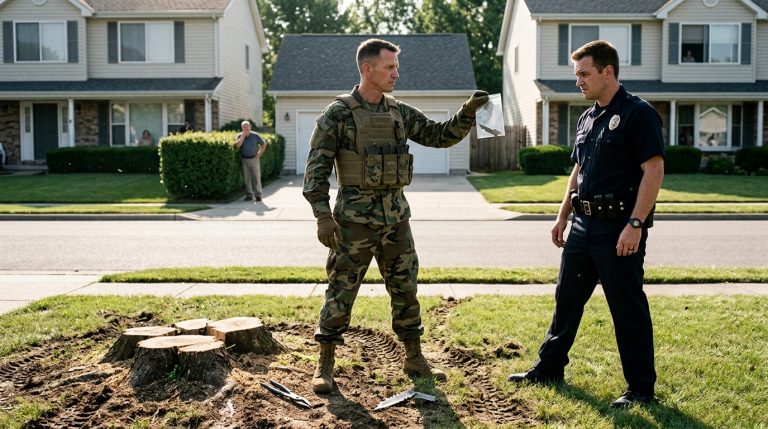
Dave walked deliberately past her, heading straight for the base of the deer stand where the 6×6 posts disappeared into the earth. He ran a gloved hand over the treated lumber, shook the ladder firmly to test its load-bearing rigidity, and pulled a compact GPS unit from his belt to verify the coordinate readouts against his digital map.
“Ma’am,” Dave called back, his voice carrying clearly across the clearing. “This is one of the sturdiest private stands I’ve inspected in five years on this job. It exceeds every state safety requirement. As for the location, my GPS places it well over three hundred feet inside a privately deeded rural residential parcel. It is entirely legal.”
He turned his gaze back to Jack. “You got your current tags and license on you?”
“Right here,” Jack said, tapping his breast pocket.
“Good man,” Dave said, before pivoting sharply back toward Karen. The friendliness was completely gone, replaced by the hard edge of state law. “Filing a false report with an active law enforcement officer is a serious matter, ma’am. It diverts state resources away from real emergencies. I’m letting you down with a verbal warning today, but if my office receives another unsubstantiated call from your address regarding this property, I will be writing a formal citation. Do you understand me?”
Karen stood frozen on the gravel, her mouth opening and closing silently like a fish pulled onto dry docks. The color had completely drained from her cheeks. Without uttering another syllable, she spun on her heel, marched back to her white SUV with stiff, jerky strides, and threw herself inside. The door slammed shut with a sharp crack that echoed off the trees.
Dave watched the vehicle kick up gravel as it spun around and tore back down the lane. He let out a low whistle, shaking his head.
“Looks like you’ve made a permanent resident out of a rattlesnake,” Dave muttered, looking at Jack.
“She’s just getting started,” Jack replied quietly, watching the dust settle over the track. “And so am I.”
CHAPTER 5: The Dark Sky Citation
The dust kicked up by the game warden’s pickup had barely settled over the gravel lane when the silence returned, heavier and sharper than before. Dave’s truck had vanished down the asphalt curve, leaving Jack standing alone by the cattle guard. The air smelled of burnt oil and damp cedar. He could still picture the rigid, porcelain set of Karen Peterson’s jaw as she retreated to her white SUV—not a posture of defeat, but the stiffened recoil of a predator temporarily denied its strike.
Jack turned away from the lane and walked back toward the house, his boots crunching rhythmically against the frozen ground. He knew how a defeated commander operated in the field. When frontal assaults failed and direct lines of advance were blocked by superior authority, the strategy shifted. They didn’t retreat; they found the backdoor.
Three days later, the mailbox at the foot of the drive delivered the expected counter-offensive.
It was another cream-colored envelope, identical in stock and embossed lettering to the first, wedged tightly between a seed catalog and a circular. Jack pulled it free with two fingers, standing right there by the roadside. He didn’t carry it inside immediately. Instead, he unclipped his pocket knife, flicked the small blade open, and sliced the top edge clean.
Inside lay a fine notice, neatly typed on heavy cardstock, bearing an increased penalty of twenty-five dollars. The infraction cited a violation of a newly minted Whispering Pines “Dark Sky Ordinance.” According to the boilerplate text, the single forty-watt motion-activated security light mounted above Jack’s back porch—positioned a full two hundred yards from the nearest subdivision lot line—emitted excessive lumens and improper shielding, thereby disrupting the nocturnal aesthetic ambiance of the neighborhood.
Jack let out a low, dry breath that plumed white in the crisp midday air. He traced his thumb over the embossed pine-cone logo at the top of the page. It was an absurdity designed with malicious intent. A forty-watt bulb tucked deep under the eaves of his back deck, shielded on three sides by heavy timber siding, could not possibly cast light across two hundred yards of dense, multi-tiered woodland.
She hadn’t consulted the board. She couldn’t have. An ordinance like that required weeks of public notices, legal reviews, and community hearings. This was an emergency decree drafted in a vacuum—probably hammered out over a single evening at her mahogany desk, passed by a phantom board consisting of herself and an absentee proxy, explicitly tailored to target his property.
“Twenty-five dollars,” Jack murmured to the empty road.
He folded the notice and slid it into his canvas jacket pocket, walking up the gentle slope toward the back deck. As he approached the steps, he paused, his eyes narrowing as he inspected the back of the house. He reached up and ran a gloved finger along the lower edge of the metal casing housing the porch light. A faint, hair-thin scratch marred the dark bronze finish near the mounting screw—fresh metal glinting under the pale sun. Someone had been close to the house while he was out clearing brush on the western ridge. Not a break-in, not an outright trespass of force, but a deliberate, probing inspection to find a vector of attack.
He stepped inside the kitchen, where Maria was setting down her nursing bag on the counter, her face carrying the quiet fatigue of a twelve-hour shift. She glanced at him, noting the rigid set of his shoulders before he even set his keys on the hook.
“Another letter?” she asked quietly.
Jack pulled the cream-colored cardstock from his pocket and laid it flat beside the toaster. “Dark Sky Ordinance. Apparently, a forty-watt bulb two hundred yards into the timber is destroying the nocturnal ambiance of Whispering Pines.”
Maria crossed her arms, walking over to inspect the paper. Her lips thinned into a straight line. “She’s manufacturing the rules as she goes, isn’t she? Every time she hits a wall with real law, she invents a new subsection to jump over it.”
“It’s not about the light,” Jack said, walking over to the dining table where his thick, duct-taped logbook lay waiting. He picked up his black pen, clicking the tip out with a sharp, metallic snap. “It’s about establishing a persistent paper trail of minor infractions. If she accumulates enough unpaid, unacknowledged fines—no matter how illegitimate—she can eventually try to file a lien or cloud a title through a sympathetic municipal circuit. It’s a slow bleed.”
“Then we don’t bleed,” Maria said, her voice dropping into an unshakeable, steady register. She pulled out the chair opposite him and sat down. “What’s our next move in the log?”
Jack opened the book to a fresh page, the paper crackling under the pressure of his palm. He didn’t look back at the emotional weight of the harassment; he focused entirely on the mechanics of documentation.
October 17, 1130 hours.
Item received: Frivolous citation, Dark Sky Ordinance (Section 14, subsection A).
Method of delivery: Personal mailbox insertion.
Associated physical note: Evidence of physical inspection/tampering near porch light housing.
“We document every single fabricated statute,” Jack said, his pen moving across the grid lines with metronomic precision. “We log the date, we photograph the physical distance, and we attach it to the growing bundle for Sarah at the law firm. But we don’t reply directly. Let her think the fines are piling up unanswered. Let her dig the trench deeper.”
He finished writing, capped the pen, and closed the logbook with a firm, satisfying thud. Outside, through the kitchen window, the autumn wind rustled the golden canopy of the woods, carrying the scent of dry leaves and damp earth. The perimeter was holding, but the friction was turning heavier, shifting from open confrontation into a cold, invisible war fought in the margins of municipal code.
CHAPTER 6: The Gnomes Defense
The kitchen door clicked shut behind Jack with a dull, heavy thud. Outside, the midday shadows stretched long and cold across the asphalt of the service road, dividing the untamed timber from the rigid, cookie-cutter symmetry of Whispering Pines Estates. Jack did not get into his truck. Instead, he adjusted the collar of his canvas jacket against the biting wind and stepped off the gravel edge, crossing the invisible boundary line marked by the rusted wire fence.
Across the street, a white SUV was parked half-hazardly, its front tires turned at a sharp angle onto the curb, blocking half of a narrow concrete driveway that belonged to an impeccably maintained brick cottage.
Jack kept his pace measured. As he drew closer, the sharp edges of the scene came into focus. Standing on the emerald-green turf of the front lawn was Karen Peterson. She towered over a stooped, elderly man who was bent almost double over a low concrete birdbath. She held a clipboard clamped tightly against her chest, her lips moving with the rhythmic, mechanical precision of someone reading a charge sheet.
Even from twenty paces away, the grating timbre of her voice carried across the dead grass.
“Section nine, subsection C, Mr. Henderson,” Karen barked, her finger jabbing downward toward the base of the birdbath. “Nonconforming lawn ornamentation. These ceramic fixtures are a direct blight on the architectural standard of this block. They come down today, or the hundred-dollar fine is posted to your quarterly account.”
The old man—Arthur Henderson—did not look up immediately. His hands, thin and spotted with age, trembled slightly as he gripped a small, painted ceramic gnome wearing a bright blue coat and holding a miniature fishing rod. He looked defeated, his shoulders curved inward like a weathered gate.
Jack didn’t break stride. He stepped off the asphalt and onto the manicured turf, his heavy boots sinking slightly into the soft, fertilized earth.
“Morning, Mrs. Peterson,” Jack said, his voice dropping into its flat, tactical register.
Karen spun around, her floral-print jacket swishing sharply. Her eyes narrowed as they locked onto Jack, flashing with instant hostility. “This is private property within the Whispering Pines association boundaries, Mr. Wallace. You have no legal standing here. This is a covenant enforcement matter.”
“Looks like a private residence to me,” Jack replied evenly, stopping three feet from the edge of the flower bed. He looked down at Arthur, whose watery eyes flicked upward in surprise. “Morning, Mr. Henderson. Cold day for gardening.”
“It’s… it’s just the gnomes,” Arthur mumbled, his voice cracking slightly as he clutched the ceramic figure tighter against his chest. “Karen says they violate the sightline rules.”
“They violate the aesthetic consistency of the entire subdivision,” Karen snapped, stepping physically between Jack and the elderly homeowner, as if she could block out his presence with pure administrative volume. “Every homeowner signed the covenant upon purchase. Mr. Henderson is fully aware of the penalty structure. A hundred dollars per fixture. And since there are six of them, that calculates to six hundred dollars due by Friday.”
Jack kept his face completely neutral. The memory of muddy sector lines and arbitrary checkpoint restrictions flashed briefly through his mind—men with clipboards inventing authority where none existed, shaking down the vulnerable because they held the stamps.
“Six hundred dollars for painted clay,” Jack said softly, his eyes fixing on Karen’s flushed face. “Funny thing about jurisdictions, Mrs. Peterson. I spent the last week reviewing the master association deed down at the county clerk’s office. Section three, paragraph four specifies that enforcement actions require a quorum of a seated board of directors. How many active members are currently on your board, ma’am?”
Karen’s posture stiffened instantly. The color in her cheeks shifted from a mottled pink to a stark, chalky white. “That is an internal administrative matter that concerns only the executive committee.”
“Right,” Jack said, shifting his weight. “Because two of the five seats are vacant, and the other two members have been living in Florida since September, leaving you to vote their proxies without written authorization. An executive committee of one isn’t a board. It’s an individual with a rubber stamp.”
Arthur Henderson slowly straightened up, his hand still resting on the rim of the concrete birdbath. He looked from Jack to Karen, the fog of intimidation lifting from his expression, replaced by a sharp, sudden spark of realization.
“You’ve been voting alone, haven’t you, Karen?” Arthur asked, his voice losing its tremor, hardening into something quiet and dry. “For six months, every fine, every warning… it’s just been you in that empty office.”
Karen’s mouth opened, but no sound came out. Her eyes darted from Arthur to Jack, her grip on the clipboard tightening until her knuckles turned yellow. She realized in that single, crushing micro-second that the illusion of absolute bureaucratic immunity had just cracked down the middle.
“This isn’t over,” she hissed, her voice dropping into a venomous whisper. She turned on her heel, marched down the driveway with rigid, jerky steps, and hauled herself into the white SUV. The engine roared to life with an aggressive whine, and the vehicle tore down the street, kicking up twin clouds of exhaust.
Silence settled back over the manicured lawn.
Arthur let out a long, shaky breath, looking down at the ceramic gnome in his hands. He wiped a thumb across the painted blue coat. “She’s been doing that to half the street for years,” he whispered. “We just… we just paid because it was easier than fighting.”
Jack reached out, taking the small ceramic figure gently from the old man’s fingers and placing it back onto the rim of the birdbath beside the others.
“Easy is how they win,” Jack said quietly. “Keep your records, Arthur. Every notice, every cancelled check, every fine receipt. Put them in a box.”
Arthur looked up, a slow, determined glint returning to his eyes. He nodded once, his grip firm. “I’ve got a whole shoe box of them in the kitchen, son. A whole box.”
CHAPTER 7: The War Room and the Shoe Box
The dining room table had been cleared of its usual cloth and converted into a tactical staging ground. Across the polished oak grain, two distinct archives lay side by side, separated only by a heavy brass ruler and a ceramic coffee mug that had long since gone cold.
On the left sat Jack’s binder, its duct-taped spine cracked open to reveal tabbed sections of certified mail receipts, zoning plat maps, and high-resolution photographs of the boundary line. On the right sat the contents of Arthur Henderson’s grocery bag: a worn cardboard shoe box filled to the brim with thirty-four separate cream-colored violation notices, handwritten warnings, and cancelled checks bearing the precise signature of Karen Peterson.
The front door clicked open, and the light footsteps of Sarah Jenkins, the young attorney from Maria’s cousin’s firm, echoed across the hallway. She shook a fine mist of autumn drizzle from her shoulders, unzipped her leather briefcase, and stepped into the dining room. Her eyes swept over the two piles of documentation, widening slightly before she pulled out a wooden chair and sat down without taking off her coat.
“You weren’t exaggerating over the phone,” Sarah said, her voice sharp and focused. She reached out, her fingers brushing the corner of Arthur’s shoe box. “This isn’t just an informal neighborhood grievance about trash cans and paint colors. This is a running ledger of targeted extortion.”
Jack remained standing at the head of the table, his arms folded across his chest. He watched Sarah flip through a stack of Arthur’s old fines—notices citing improper flag pole heights, lawn ornaments, and out-of-spec gravel grades dating back nearly five years.
“She operates by attrition,” Jack said, his voice flat and deliberate. “She finds someone who doesn’t have the energy to fight back, buries them in paperwork until they pay the fine just to buy silence, and rolls the money into an unaccounted reserve fund. I checked the county registry records for the association’s annual filings. There hasn’t been an independent financial audit submitted to the state in six years.”
Sarah pulled a yellow legal pad from her briefcase and uncapped a silver pen. The scratch of ink against paper sounded dry and precise in the quiet room. “If the state filing is missing while funds are actively being collected through compulsory fines, that crosses the line from civil overreach into something much more dangerous. We’re looking at potential breach of fiduciary duty, systematic coercion, and systemic financial opacity.”
She paused, looking up through her wire-rimmed glasses to meet Jack’s steady gaze. “If we move against her individually, she’ll weaponize the association’s legal defense fund to bleed you dry through endless procedural delays. She wants a one-on-one war of attrition where her rules govern the battlefield.”
“She’s not fighting one-on-one anymore,” a familiar, raspy voice broke into the room.
Arthur Henderson stood at the threshold of the dining room, holding a fresh grocery bag under one arm. He stepped inside, his posture straighter than it had been days prior, and placed a thick manila folder squarely on top of the table. Inside were photocopies of bank statements showing regular cash and check transfers made out to an account registered under the heading of Whispering Pines Improvement Reserve.
“I talked to the Millers down on Elm Street this morning,” Arthur said, pulling out a chair and sitting down opposite Sarah. “And Mrs. Gable from the corner. They didn’t just give me their stories—they gave me their receipts. They’ve each paid over five hundred dollars in ‘non-compliance fees’ over the last two years. None of it ever showed up on the official community balance sheets handed out at the annual meeting.”
Jack watched Sarah’s pen fly across the legal pad, her expression hardening with every line she jotted down. The pieces were locking into place with the cold, undeniable precision of mechanical gear teeth. Karen Peterson had built her entire kingdom on the assumption that her victims were isolated units, too intimidated to compare notes or check the math behind her arbitrary edicts.
“This gives us the leverage we need,” Sarah said, tapping the tip of her pen against the edge of the table. “We bypass her petty local citations entirely. We draft a formal legal demand on the firm’s letterhead, backed by your property survey, Jack, and this systemic paper trail from Arthur and the other homeowners. We demand a complete, independent third-party forensic audit of every cent passing through that association account over the past five years, accompanied by an immediate permanent cease-and-desist regarding your property line.”
“And if she ignores it?” Jack asked.
“Then we don’t file a neighborhood complaint,” Sarah replied, a cold, sharp smile touching the corners of her mouth. “We file a multi-family civil injunction in the county court, moving for a court-appointed receiver to strip the board of its administrative powers entirely. We take her gavel away.”
Jack reached out and closed the cover of his logbook, the duct tape catching the dim light of the overhead fixture. Outside, the autumn wind picked up speed, rattling the windowpanes and sending wet leaves skittering across the porch. The defensive perimeter was set. The counter-offensive was no longer a matter of holding the line; it was a calibrated strike aimed straight at the heart of her illusion.
CHAPTER 8: The Cyclops Eye
The autumn wind carried the scent of woodsmoke and dry earth across the open space separating the two properties. Jack stood on the back deck of his house, his boots resting squarely on the weathered planks, his eyes fixed on the rear elevation of Karen Peterson’s colonial fifty yards away.
Underneath the second-story eaves, mounted squarely on a heavy steel bracket, a new fixture caught the pale afternoon sun—a large dome-style security camera. Its dark, hemispherical glass lens sat unblinking, turned at a precise downward angle. It wasn’t pointed at her own lawn, nor toward the street or the side access lane. The barrel of the housing was angled directly across the property line, its electronic eye fixed squarely upon Jack’s back deck, his kitchen window, and the hidden pathway that wound through the timber toward his deer stand.
The irony was heavy enough to taste. The woman who had levied fines for the supposed “visual blight” of a handcrafted deer stand had just bolted an industrial surveillance hub to her roofline, violating every standard of privacy in the county.
Jack didn’t shout. He didn’t pick up a stone. Instead, he reached into his jacket pocket, pulled out his digital camera with a telephoto lens, and raised it to his eye. With mechanical steadiness, he clicked the shutter three times, capturing the housing from multiple angles, establishing the unbroken line of sight from her eaves right to the edge of his back door.
A sharp click behind him announced Maria stepping out onto the deck. She stopped beside him, her gaze following the line of his lens until it locked onto the black dome staring down at them. Her breath hitched, pluming white in the chill air.
“Can she legally do that?” Maria asked, her voice tight with disbelief. “Just point a camera straight into our living space?”
“It’s a gray area if it’s mounted on her structure,” Jack said, his voice dropping into its cold, analytical register. “If it’s stationary and records private areas without consent, it crosses into an invasion of privacy. But more importantly… look at the mounting bracket.”
Maria squinted, following the metal arm up to the cedar siding. “It’s bolted directly into the exterior trim.”
“Which violates section eleven of the association’s own architectural control bylaws,” Jack said, a faint, humorless smile touching the corner of his mouth. “No fixture or antenna can be attached to an exterior dwelling without written clearance from the architectural committee—a committee that she’s been running entirely by herself without a seated board quorum.”
She had overreached. In her paranoid scramble to regain dominance after the game warden’s rebuke and the lawyer’s demand letter, Karen had mounted a permanent, indisputable piece of evidence against herself on her own wall. She had built her own digital pillory.
Jack lowered the camera and turned to Maria. “She thinks she’s watching us. She thinks she’s gathering intelligence for her little war. But every second that lens stays powered on, she’s recording proof of targeted harassment that a judge won’t be able to ignore.”
“What’s our counter?” Maria asked, her eyes steady.
“We don’t take it down,” Jack said, turning back toward the house. “We document the feed, check the bylaws one more time, and let Sarah add it to the injunction package. And in the meantime… we give her something interesting to look at.”
Jack walked back inside, grabbed his logbook from the kitchen table, and meticulously recorded the exact time, date, and visual coordinates of the new surveillance installation. The perimeter was holding, and the enemy had just handed them the key to the gate.
CHAPTER 9: The Neighborhood Petition
The clipboard weighed heavy in Arthur Henderson’s hand, the wooden backplate cold against his knuckles as he stepped off the curb of Elm Street. Beside him, Jack kept pace, his canvas jacket zipped to the throat, his eyes scanning the manicured lawns and beige-sided facades of Whispering Pines Estates.
They weren’t moving through the subdivision as interlopers anymore. They were moving with the quiet, methodical momentum of a logistical survey team charting hostile terrain.
“House number forty-two,” Arthur murmured, checking a folded list against the clipboard. “Robert and Carla Gable. They’re the ones who got slapped with the forty-dollar citation back in August for letting their flowerbed spill six inches over the concrete border.”
Jack nodded once. He didn’t speak. Every step they took across the pristine asphalt felt like pressing an unexploded round deeper into soft dirt—calm, calculated, and entirely necessary.
Arthur walked up the brick walkway of number forty-two and reached out to press the brass doorbell. A sharp, melodic chime echoed from within. A moment later, the lock clicked, and the front door swung inward a few inches. A woman in her early thirties peered out, her eyes flickering with immediate, reflexive caution—the practiced defensive posture of anyone who had answered that door to find a cream-colored envelope and a penalty notice clutched in Karen Peterson’s fist.
When she saw Arthur’s stooped frame and the gentle, weathered lines of his face, the tension in her shoulders dropped an inch. But then her gaze shifted to Jack standing silently behind him in the shadows of the porch, and her expression tightened again.
“Mr. Henderson,” she said, her voice guarded. “Is something wrong with the block watch?”
“Nothing’s wrong, Carla,” Arthur said softly, holding up the clipboard with its top sheet exposed. “In fact, we’re hoping to make things right. Do you have two minutes?”
She hesitated, looking past them toward the empty street before slowly opening the door wider. “Come in out of the wind.”
The entryway smelled of cinnamon and damp wool. They didn’t go into the living room; they stood right there on the tiled foyer floor while Arthur laid out the papers. He didn’t start with speeches or emotional grievances. He opened the file directly to the summary sheet Sarah had drafted, alongside copies of the community financial ledgers and the missing state audit filings.
“For five years,” Arthur began, his voice steady and clear, “we’ve paid fines for trash cans two inches out of line, for flagpoles six inches too tall, for flowerbeds that didn’t match the beige standard. We thought it was just the cost of living here. But those fines didn’t go into the neighborhood landscaping fund.”
Jack watched Carla’s eyes track down the column of figures, scanning the total sum of unaccounted cash diverted into the reserve account controlled exclusively by a single signature. The color in her face shifted, the initial caution hardening into a cold, quiet anger that mirrored the mood of every resident they had visited that afternoon.
“Where did this go?” Carla asked, her voice dropping to a sharp whisper.
“Into accounts that haven’t seen a state-mandated audit since the previous decade,” Jack replied, his voice cutting cleanly through the quiet hallway. “And every time someone questioned the ledger, a new violation notice appeared on their windshield.”
Carla looked up from the paper, her gaze shifting between Arthur and Jack. The fear that had kept her silent for three years dissolved, replaced by the realization that the wall protecting the association’s tyranny was hollow at the core. Without a word, she reached out, took the silver ballpoint pen from Arthur’s fingers, and pressed the tip firmly against the bottom of the petition sheet.
The scratch of ink was sharp and absolute. Line by line, signature by signature, the wall was coming down.
When Carla handed the clipboard back, her name sat alongside forty-two others—nearly forty percent of the subdivision’s registered homeowners. A quorum of the governed, united not by complaints, but by the undeniable weight of the truth.
Jack took the clipboard from Arthur, checking the final tally with a quiet, practiced eye. The paperwork was complete. The perimeter was secured. There was nowhere left for the administration to hide.
CHAPTER 10: The Clubhouse Ambush
The parking lot of the Whispering Pines community clubhouse was packed tighter than Jack had ever seen it. Headlights swept across the weathered brick exterior, washing over rows of sedans and SUVs parked haphazardly along the curbs. Inside the drafty, fluorescent-lit hall, a crowd of over a hundred people filled every folding chair and lined the perimeter walls, their voices merging into a low, simmering hum of collective defiance.
Jack sat quietly in the back row beside Sarah Jenkins, whose leather briefcase rested upright against her knee like a deployed toolkit. As a non-member, Jack had no formal voice on the floor, but his presence was an anchor—a silent reminder of the boundary line across the timber.
At precisely 7:00 p.m., the side door clicked open. Karen Peterson walked in, flanked by her two board cronies who had flown back from Florida. She wore a sharp, tailored blazer and carried a thick stack of printed agendas, her expression radiating the practiced, untouchable confidence of a monarch entering her court. She strode up to the raised podium at the front of the room, expecting the usual ghost town of half a dozen apathetic attendees.
Instead, she scanned the room, and her stride faltered. Her smile stiffened, the corners of her mouth twitching as she took in the sea of unblinking faces staring back at her. In the front row sat Arthur Henderson, his posture straight, holding a clipboard like a standard-bearer.
Karen tapped the microphone. A sharp, high-pitched squeal echoed off the cinderblock walls, making several people wince.
“Welcome,” Karen began, her voice carrying a slight, nervous tremor that she fought hard to conceal. “Welcome to the annual meeting of the Whispering Pines Estates Homeowners Association. We have a packed agenda tonight, so we’ll call the meeting to order and—”
Before she could finish her sentence, Arthur Henderson stood up. The scraping of his chair legs against the linoleum sounded crisp and absolute in the silent room.
“Point of order, Madam President,” Arthur said, his voice clear, steady, and carrying across the entire hall.
Karen froze behind the podium, her fingers gripping the edges of the wooden stand until her knuckles turned white. “Mr. Henderson, the agenda is fixed by the executive board. You are out of order.”
“It is entirely in order,” Sarah Jenkins said, standing smoothly from her seat in the back row. She didn’t raise her voice, but every word cut through the air with razor-sharp authority. “My name is Sarah Jenkins, legal counsel for Mr. Henderson and forty-two resident homeowners. Pursuant to association bylaws, article three, section four, a valid petition representing nearly forty percent of the membership has been formally submitted to amend the meeting’s agenda. The floor belongs to the membership.”
A low murmur of approval rippled through the crowd, swelling into a rolling wave of confidence. Karen’s face drained of color, the pink flush of her cheeks melting into a sickly, mottled gray. She banged her gavel once, twice, the sharp wooden cracks sounding hollow and desperate against the collective weight of the room.
“I will not recognize this,” Karen shrilled, her composure finally fracturing completely, her voice cracking under the pressure. “These motions are invalid! I built this community! Without me, property values will plummet and you’ll all be living in a slum!”
Arthur did not shout back. He simply signaled toward the side wall, where a portable projector sat mounted on a metal stand, casting its beam against the blank white plaster behind the podium.
The first image clicked onto the wall in sharp, high-definition clarity: a photograph of Jack’s sturdy, beautifully mitered deer stand bathed in the golden light of an early autumn sunrise.
“This is the structure the president declared an illegal hazard,” Arthur said calmly, his voice ringing through the hall.
He clicked the remote. The image shifted instantly. The projector threw up a second, damning photograph—a close-up shot of the ugly black dome security camera bolted directly into the cedar eaves of Karen’s colonial house, its lens pointed squarely across the boundary line.
“And this,” Arthur continued, his tone dripping with quiet irony, “is the community standard.”
A wave of laughter and sharp disbelief swept through the crowd. Karen spun around, staring at the wall behind her head where her own surveillance hub was projected in giant proportions for every neighbor to see. She was trapped, exposed under the glaring light of her own hypocrisy.
Arthur raised his hand, leveling the final blow. “I move that we formally censure the president for targeted harassment and abuse of authority, and further, I move for an immediate vote of no confidence to remove Karen Peterson from the board of directors, effective tonight.”
“All in favor?” Arthur called out.
Before Karen could scream another protest, a forest of hands shot up across the room—dozens of arms raised high, united and unwavering. The vote was a landslide, a total, unyielding collapse of her paper empire. Karen stared at the sea of raised hands, her mouth opening and closing silently. Then, grabbing her purse and knocking over a glass of water in her blind panic, she turned and bolted from the podium, shoving her way down the center aisle and slamming the exit door behind her.
Silence rushed back into the hall, heavy and profound. Arthur walked slowly up the steps to the podium, picked up the gavel she had left behind, and brought it down once on the wood with a solid, resonant thud.
CHAPTER 11: The Forensic Ledger
The fluorescent lights of the community clubhouse hummed with a flat, relentless intensity. The crowd had thinned to a handful of core residents and the interim board members, but the air remained thick with the weight of exposure.
Jack stood near the side exit, his hands resting inside the deep pockets of his canvas jacket, watching the grey metal casing of a projector cooling on its stand. Across the room, Sarah Jenkins leaned over a stack of computer printouts alongside a sharp-featured man in a dark charcoal suit—the independent forensic auditor retained by the new interim board.
The auditor’s briefcase lay open on the long table, spilling out bank statements, deposit slips, and itemized ledger sheets that told the ultimate, unvarnished truth of Karen Peterson’s administrative empire. It wasn’t merely about petty architectural tyranny or neighborhood intimidation. The aesthetic bylaws, the dark sky citations, the fifty-dollar fines for trash cans and lawn ornaments—they were all a carefully constructed decoy framework. Beneath the surface layer of petty harassment lay a systematic embezzlement scheme.
“The numbers speak for themselves,” the auditor said, his voice carrying clearly across the quiet room as he handed a final summary sheet to Arthur Henderson. “Over the past five years, nearly sixty-four thousand dollars collected through punitive fines and emergency assessments was siphoned away from the community improvement reserve. It wasn’t going toward neighborhood maintenance or legal retainers. It was routed through a subsidiary shell account controlled directly by Mrs. Peterson.”
Arthur adjusted his glasses, scanning the columns of diverted funds with a grim, heavy expression. “And the landscaping charges billed for the common areas?”
“Fictitious,” the auditor replied, tapping a finger against a cancelled check. “Invoiced by a non-existent contractor, endorsed and deposited into a personal line of credit. When you build an administrative bubble with zero board oversight, you don’t just control the rules—you control the vault.”
The revelation settled over the room like cold lead. The true mechanism of Karen’s control was laid bare: her relentless policing of the subdivision wasn’t driven by a passion for pristine lawns or property values, but by the desperate financial necessity of feeding a growing deficit of her own creation. Every fine was an extraction; every rule was a tollbooth on a private road she didn’t actually own.
Sarah gathered the papers into a crisp, orderly stack and secured them inside her leather folio. She walked over to where Jack stood near the door.
“The district attorney already has the preliminary forensic package,” Sarah said quietly, her eyes meeting Jack’s. “Given the volume of misappropriated funds and the official records from Arthur’s files, this has crossed well past civil injunction territory. The charges won’t just be for harassment and false police reports. We’re looking at felony embezzlement.”
Jack nodded slowly, his gaze drifting past the glass doors toward the dark expanse of the parking lot outside. “A bully doesn’t surrender when you break their rules, Sarah. They only break when the structure supporting them collapses under its own weight.”
“It’s collapsed,” Sarah said, zipping her briefcase with a sharp, decisive click. “Now comes the real work—cleaning up the wreckage she left behind.”
Across the room, Arthur Henderson brought the gavel down once more to adjourn the special session, the sound echoing with the clean, resonant ring of an institution finally restored to its rightful owners.
CHAPTER 12: Sunrise at the Cathedral
The morning mist clung to the damp floor of the valley, a grey blanket that slowly unraveled under the weight of the rising sun. High above the timber line, nestled in the secure fork of the massive old oak fifty yards inside the western boundary, Jack sat in silence.
The air tasted of cold iron, wet cedar, and dried oak leaves. In his hands, he held a heavy steel thermos, its metallic surface cold to the touch. The lid unscrewed with a familiar, muted scrape. He poured a steaming measure into the small cup, the rich scent of dark roast rising into the crisp autumn air.
Below him, through the thinning canopy, the distant rooftops of Whispering Pines Estates caught the first amber rays of dawn. The white colonial house at the end of the asphalt lane looked different now. The ugly, domed surveillance camera under the eaves was gone—stripped away by the new homeowners during their first weekend on the property, leaving only four small screw holes in the beige trim. The U-Haul had come and gone weeks prior, its diesel engine coughing through the quiet streets as it hauled away the remnants of an empire built entirely on paper intimidation.
Footsteps sounded on the lower ladder rungs—slow, deliberate, and familiar. The pressure-treated wood groaned softly under a heavier weight as boots found their purchase on the rungs. A moment later, Dave Mezer hoisted himself onto the platform, ducked beneath the safety rail, and settled onto the bench beside Jack with a soft grunt of exertion.
Dave unzipped his camo jacket, pulled off his gloves, and held his hands out toward the steaming cup Jack wordlessly extended toward him.
“Quiet morning,” Dave murmured, blowing a thin plume of steam across the surface of the coffee.
“The best kind,” Jack replied.
They sat side by side, looking out over the unbroken expanse of timber, the orange survey tape fluttering gently in the morning breeze along the legal property line. They didn’t speak of Karen Peterson, nor of the forensic ledgers, the court-ordered receivership, or the felony filings winding their way through the county courthouse. Those were matters of the past—shards of a broken machine that had ground itself to dust against an immovable boundary.
The struggle had never truly been about a deer stand, nor about the height of a flagpole or the color of a trim. It had been about the fundamental right to exist without someone else’s arbitrary rules dictating the rhythm of one’s life.
Jack reached down to the corner of the platform where a small, heavy steel bolt had worked itself slightly loose during the windstorm two nights prior. He pulled a heavy-duty wrench from his canvas pocket, fitted the box end over the nut, and turned it clockwise with firm, steady pressure until it locked down tight against the pressure-treated timber with a solid, satisfying click.
Symbolic closure. The structure was sound, the perimeter was secure, and the world had settled back into its natural, unhurried pace.
Down in the subdivision, Arthur Henderson’s ceramic gnomes stood proudly around their concrete birdbath, a cheerful little army keeping watch over a neighborhood that had finally learned how to breathe again. Across the lane, Mrs. Gable’s vibrant flowers spilled unhindered over the edge of her concrete border in a riot of unapproved, beautiful color.
Jack took a slow sip of his coffee, feeling the warmth spread through his chest. He looked out toward the horizon where the sun was breaking cleanly over the ridge, turning the golden canopy into a sea of fire.
The cathedral in the woods had never looked more peaceful.