The Iron Ledger of Whispering Pines: A Veteran’s War Against the Bureaucratic Machine
CHAPTER 1: THE TENSION OF THE RUSTED IRON
The grease on the tow chain smelled of stale machine oil and highway salt. John watched the winch cable pull tight, biting into the vintage bumper with a sharp, metallic groan that set his teeth on edge.
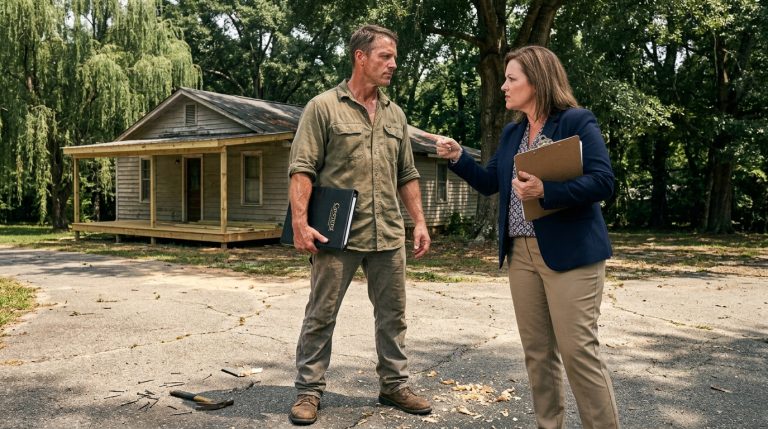
Karen stood three feet inside his property line, her sensible beige heel planted squarely on the wild clover, holding her laminated clipboard like a shield of office. She did not look at the grass. She looked only at the truck, her chin tilted at an angle that assumed absolute, unquestioned dominion over everything the horizon touched.
“I told you the terms, Mr. Miller,” Karen said, her voice dropping into that syrupy cadence reserved for recalcitrant children and subordinates. “The architectural review committee does not negotiate with aesthetic blight. Whispering Pines has a standard to maintain.”
John took a slow, measured sip of the bitter coffee. The liquid was cold, but the burn in his gut was steady—a disciplined, low-frequency heat forged during two decades of calculating structural loads under artillery fire. He did not yell. He did not drop his mug. He simply watched the vulture by the shoulder of the county road give a lazy thumbs-up to the winch operator.
“That truck has turned over on the first try since Lyndon Johnson was in office, Karen,” John said, his voice level, carrying the flat, gravelly weight of a man who measured his words by their utility. “The barn it sits next to has stood on this foundation for a century longer than your development’s corporate charter. You are standing on land surveyed before this state had a governor.”
“Paperwork changes, Mr. Miller,” she replied, tapping the plastic corner of her clipboard against her thigh. “Progress requires adjustment. And your little patch of history is currently being provisionally absorbed under Section 8, Subsection B. You have twenty seconds before I authorize the driver to haul that heap to the industrial yard.”
The winch motor whined, protesting the load as the rear tires of the Ford scrubbed sideways against the gravel. A small flake of rust, no larger than a thumbnail, sheared off the rear quarter panel and fluttered down into the dust. John’s eyes tracked its fall, noting how the morning light caught the uneven, weather-beaten texture of the primer beneath. Something about that specific patch of missing paint felt wrong—too clean at the edges, as if the metal underneath had been recently scored by a tool rather than time.
CHAPTER 2: THE PAPER TRAIL
The diesel exhaust hung in the morning air like a greasy pall, mixing with the scent of crushed clover and dry earth. John stood motionless as the Ford’s tires rolled over the property line, dragging a thin tail of dust toward the county road. Karen didn’t look back; she snapped her clipboard shut with a sharp, plastic clap that echoed off the nearest white picket fence of the subdivision, climbed into her immaculate beige sedan, and let her tires squeal slightly on the asphalt as she made her point.
John didn’t chase them. In the Corps of Engineers, running after a retreating enemy without a survey of the terrain was how you walked into an ambush. Instead, he turned his back on the county road, walked the twelve paces back to the porch, and picked up his cold coffee. His fingers wrapped around the ceramic mug until the knuckles whitened, the discipline of two decades keeping the iron lid clamped tight over his temper.
He walked inside the house, the heavy oak door swinging shut with a solid, reassuring thud that muffled the distant whine of the tow truck’s transmission. The dining room table was dark wood, scarred by thirty years of family history—coffee cup rings, small gouges from pocketknives, and the faint, pale outline where his grandfather had once laid out hand-drawn maps of the south forty.
John pulled out a thick manila folder from the wooden sideboard. Across the front, written in his own sharp, squared-off block letters with a black marker, were the words: Operation Whispering Pines.
He opened it. Inside lay the certified mail notice—the formal letter bearing the stylized green spear logo of the estate development, demanding two thousand five hundred dollars for vehicle abatement, land fines, and processing fees. Stapled right behind it was the municipal lien notification, a legal anchor dropped squarely over his title, designed to make selling, refinancing, or even sleeping peacefully at night an exercise in quiet financial strangulation.
John pulled out a legal pad, uncapped a ballpoint pen, and laid the documents out in a strict grid. His mind shifted gears, dropping the raw heat of anger and engaging the cold, mechanical rhythm of an engineer reviewing structural stress points.
“Twenty-five hundred dollars,” he murmured to the empty room, his voice raspy and low. “And a lien for a vehicle parked on private homestead land.”
The math didn’t add up under any known statute of property law. A municipal or homeowners association jurisdiction required a clear, undisputed chain of title and a voluntary covenant signed by the landowner or their direct predecessors. Whispering Pines had neither. What they had was a developer’s pencil-whipped plat map—a convenient stroke of ink drawn across a county register to make a cookie-cutter subdivision look larger and more uniform on a marketing brochure.
He reached for his desktop computer in the small study off the kitchen, listening to the old hard drive spin up with a low, familiar whir. The screen flickered to life, casting a pale, rectangular glow across his weathered face.
He didn’t waste time browsing the glossy consumer-facing pages of the Whispering Pines website, where smiling families grilled on identical patios under artificial sunlight. Instead, he navigated straight to the municipal registry archives of the county planning commission, searching for the initial incorporation filings and the preliminary plat approvals filed three years prior when the adjacent thousand acres of farmland were carved up.
The digital document loaded slowly, a massive multi-page PDF stamped with digital seals and surveyor notes. John scrolled past the marketing descriptions, past the landscape covenants dictating the height of hedge rows and the permitted shades of front-door paint, straight to the legal boundary descriptions.
There it was on page twelve. A thick, clear line demarcating the outer perimeter of the development. And sitting right on the western edge of that boundary was parcel 7B—his family’s homestead.
He zoomed in on the surveyor’s marginalia, written in a cramped, precise font that computer-generated drafts rarely bothered to hide. A handwritten note initialed by the county’s senior cartographer explicitly stated: Adjacent parcel 7B (Miller Estate) excluded from annexation due to historic homestead status and pre-existing sovereign boundary demarcation.
John stopped scrolling. He leaned back in his chair, the leather creaking under his weight, and stared at the glowing monitor.
Karen hadn’t made a clerical error. She hadn’t misread a blurry photocopy. The preliminary plat explicitly stated his land was off-limits. Which meant when she filed the paperwork claiming his ten acres had been “provisionally absorbed,” she had knowingly, deliberately manufactured a false administrative claim. She had taken a municipal document, ignored the surveyor’s exclusion note, and treated a legal boundary like an inconvenient hedge that could be trimmed with a pair of shears.
It was no longer just a dispute over a rusty bumper. It was an act of bureaucratic fraud, dressed up in corporate legalese and backed by the threat of court-ordered foreclosure.
John reached into his shirt pocket, pulled out a small pocketknife, and clicked the blade open with a crisp clack. He used the tip to carefully score a fresh index tab, sliding it onto the manila folder before writing a new label beneath the first: Evidence of Malicious Intent.
The phone on the wall buzzed with a sudden, sharp ring that cut through the silence of the room. John didn’t jump. He let it ring twice, watching the caller ID display a local prefix he didn’t recognize—likely the tow yard or an automated collection service pushing the first wave of the lien’s paperwork.
He picked up the receiver, pressed it to his ear, and let out a single, measured breath without saying a word.
“Mr. Miller?” a gruff, tired voice asked from the other end. “Look, buddy, about that truck—the yard owner said you came down here with some papers, but I’m just telling you, the lady who dropped it off, she paid the storage retainer upfront on an HOA card. If you’re pulling a fast one, my company’s the one left holding the bag when she finds out.”
John kept his tone flat, steady, and devoid of any warmth. “Your company is currently in possession of property retrieved by an unauthorized agent using a fraudulent work order,” he said, every word clicking into place like a well-oiled breechblock. “And if you want to avoid being dragged into a grand theft investigation by the county sheriff, I suggest you look very closely at whose name is on that credit card transaction receipt.”
A heavy silence stretched across the line, broken only by the distant clatter of wrenches and the hum of an air compressor in the tow yard’s background.
“An HOA card?” the voice muttered, dropping an octave lower. “She said it was an official municipal abatement.”
“She lied,” John said. “And the paperwork she handed you is a prop. I’m keeping a file, friend. And every name attached to that truck’s movement is going into it.”
John clicked the receiver down before the man could answer, cutting the connection cleanly. He closed the folder, slid it back into the sideboard drawer, and locked it with a small brass key. The first piece of the puzzle was in place, but a file full of paper wasn’t enough to stop a machine built on intimidation. To dismantle Karen’s little kingdom, he was going to have to look beyond his own fence line and find the other people she had been grinding down in the dark.
CHAPTER 3: BEHIND THE IRON GATE
The click of the telephone cradle snapping shut was too sharp in the quiet study. John stood there for a beat, his hand resting on the receiver, feeling the residual hum of the line before he turned away. The tow yard owner was spooked, and rightly so; a man running a muddy lot on the industrial outskirts doesn’t want his name tied to grand theft when a title deed gets waved in his face. But locking horns with a local towing contractor was just skirmishing. The real terrain lay half a mile down the county road, behind the decorative wrought-iron automated gate of Whispering Pines Estates.
John walked out through the kitchen, sliding his heavy leather work jacket over his shoulders. The air outside had cooled as the sun began to dip behind the western ridge, casting long, bruised shadows across the dry earth and the rusted hulls of abandoned farm equipment near his boundary line. He didn’t take his truck. He walked, his boots crunching methodically against the gravel of the county road, keeping his pace measured and deliberate.
The walk brought back memories of deployment briefings in cramped desert command tents—the kind where you study aerial photographs until the elevation lines and culverts blur together, looking for the single weak point in a seemingly impenetrable perimeter. Whispering Pines looked impenetrable from the highway. Its pristine, manicured lawns rolled out like green velvet, and the cookie-cutter houses stood in silent, uniform rows behind ornamental streetlights. But perfection is brittle. A system built entirely on rigid compliance leaves no room for human friction, and friction is what an engineer looks for when he wants to crack a structure open.
He bypassed the main vehicle entrance with its gleaming camera pillar, heading instead for a narrow footpath worn into the grass near the service utility easement—a path local dog walkers used to slip past the restricted zone. The transition from the dusty, unpaved freedom of the Miller homestead to the manicured asphalt of the subdivision was jarring. The air here smelled faintly of chlorine from backyard pools and freshly fertilized fescue, completely scrubbed of the raw scent of cedar and dry earth.
Two doors down from the main gate sat a house that looked subtly out of alignment with its neighbors. While the surrounding lawns were naked expanses of green, unbroken except for approved saplings and black mulch beds, a small, hand-painted sign sat tucked into a flower bed near the front porch. The Davidsons. We believe in science, kindness, and that love is love.
John slowed his stride, his eyes sweeping the perimeter of the property. A cold gust of wind rustled the dry leaves of a decorative oak nearby, carrying with it a faint sense of quiet siege. This was the target zone.
He stepped up to the porch and pressed the brass doorbell. Inside, a muffled chime echoed, followed by the sound of hesitation—a brief, shuffling pause before a lock clicked. The door swung inward six inches, restrained by a brass security chain. A man about John’s age, with weary eyes and the tense, hunched shoulders of someone waiting for the next shoe to drop, peered out into the dusk.
“Can I help you?” the man asked, his voice tight with defensive caution.
John kept his hands visible, loose at his sides, adopting the posture of an unthreatening surveyor rather than an intruder. “I hope so, Mr. Davidson. My name is John Miller. I’m your neighbor from the old farm up the road. And judging by that sign in your flower bed and the kind of pressure I’m seeing from the management office, I’d say we’re both fighting the same war.”
The man—Tom Davidson—stared at him for a long, silent moment. The tension in his face didn’t vanish, but it shifted, morphing from suspicion into a sudden, piercing recognition. Without a word, Tom reached back, slid the security chain free with a metallic rattle, and pulled the door wide open.
“Come inside, Mr. Miller,” Tom said, stepping back into the brightly lit, sterile expanse of a modern kitchen. “You have no idea how long we’ve been waiting for someone to push back against the gate.”
CHAPTER 4: THE HERITAGE BLIGHT
The heavy oak door clicked shut behind John, muttering a dull seal against the twilight. Inside, the air was conditioned and dry, carrying the faint, sterile scent of lemon polish and bleached tile. Tom Davidson did not offer him a seat immediately. Instead, he stood by the granite island, his hands gripping the smooth stone edge with enough pressure to whiten his knuckles. A hallway led deeper into the house, where the shadow of a woman—drawn and tight-lipped—stood half-hidden by the doorframe, watching with the guarded wariness of someone whose home had been turned into a demilitarized zone.
“You’re the one who had the truck hauled off yesterday,” Tom said, his voice dropping to a low, gravelly register. “Word travels fast through the text threads, even the encrypted ones. Karen spent half the afternoon bragging to the steering committee about making an example of the old farm.”
“She made an administrative error,” John said, stepping forward and laying his weathered leather cap on the counter. “An error she’s going to spend a considerable amount of legal currency trying to unmake.”
From the hallway, Sarah Davidson stepped into the light. Her eyes were rimmed with fatigue, but there was a sharp, assessing intelligence in her gaze as she looked over John’s military-cut hair and iron-gray posture. She didn’t offer pleasantries. She walked straight to a stainless steel refrigerator, pulled out a thick, bulging binder held together by heavy black binder clips, and dropped it onto the counter with a heavy thud.
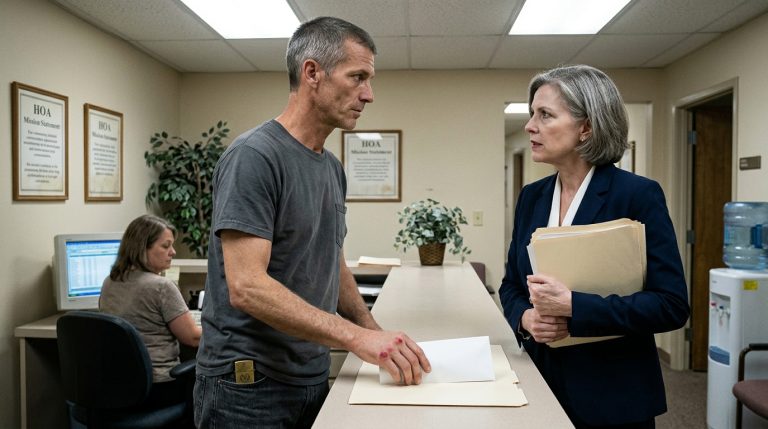
“If you’re here to tell us how to file an appeal with the architectural review committee, save your breath, Mr. Miller,” Sarah said, her voice shaking slightly with suppressed exhaustion. “We tried that route. Every form we submitted came back with a red rejection stamp and a fifty-dollar processing fee attached. They don’t want appeals. They want compliance through exhaustion.”
John didn’t touch the binder right away. He let his fingers brush against the cool edge of the counter, his eyes scanning the label taped to the spine: Violations & Assessments – 2024-2026.
“I’m not here to file an appeal,” John said quietly. “Appeals imply you accept their jurisdiction. I’m here to look at the paperwork.”
Tom slid the binder open. Inside, plastic sleeves protected dozens of photocopied notices, certified mail receipts, and threatening emails printed on heavy cream stock. John reached out, his thumb catching the corner of a notice dated six months prior. It was a fine levied against the Davidsons for an unapproved backyard playset—a wooden structure purchased for their seven-year-old son’s birthday, painted in an earth tone that failed to match the subdivision’s strict palette.
John leaned in, his eyes narrowing as he inspected the municipal stamp at the bottom of the violation notice. Something about the ink saturation was wrong. The seal of the Whispering Pines Architectural Committee was crisp, but the secondary county planning authorization stamp superimposed over it was slightly skewed—a digital paste-up rather than an embossed imprint.
“Did you pull the county record on this specific parcel clearance when they fined you for the playset?” John asked, looking up.
Tom shook his head. “We didn’t know we could. Karen told us county zoning deferred entirely to the community’s internal covenants.”
“They don’t,” John muttered, tracing the edge of the printed seal with a calloused fingernail. “County zoning laws supersede internal HOA guidelines every time. But to enforce a structural fine on a backyard installation, they have to log the GPS coordinates with the municipal tax assessor. I bet my last tank of diesel they never filed the boundary update for this block.”
Sarah took a sharp breath, her hands coming up to cross over her chest. “Are you saying the fines aren’t just unfair—are you saying they’re fake?”
“I’m saying the machinery is running on bad fuel,” John replied, his tone flat and unyielding as he flipped to the next page, revealing a notice for a satellite dish installation fine. Beneath the official letterhead, a faint ghost-image of a previous text box showed where a different dollar amount—$250 instead of $500—had been digitally wiped clean before printing.
The physical texture of the paper told the story: cheap stock run through a standard office printer, dressed up with expensive logos to look like an ironclad legal decree. It was a paper tiger built by someone who knew how to project authority, but lacked the foundational oversight to keep the seams from fraying.
John pulled a small notebook from his pocket, clicked his pen, and jotted down two dates from the margin of the documents. The pieces of the puzzle were starting to lock into a rigid, unmistakable grid. The rules weren’t designed to protect the neighborhood’s aesthetic value; they were designed to create a steady, self-funding stream of minor infractions that kept the residents off-balance, isolated, and too busy defending their own lawns to look at the ledger books.
“The wind’s shifting, Tom,” John said, snapping his notebook shut with a crisp sound that broke the heavy silence of the kitchen. “If you and Sarah are willing to pull your files out of the drawer and line them up against mine, we’re going to stop playing defense. We’re going to find out where the money from these fines is actually going.”
CHAPTER 5: WHISPERING PINES UNFILTERED
The kitchen lights of the Davidson household hummed with a low, steady frequency that felt entirely out of place given the friction hanging in the air. Tom stood beside his wife, his hand resting lightly on her shoulder as John zipped his leather jacket back up to the collar. The binder of falsified violation notices lay closed on the granite island, a solid block of evidence proving that Karen’s system of governance was built on doctored administrative stamps and intimidation. But stacking paper in a suburban kitchen wasn’t enough to break a corporate regime. To reach the rest of the neighborhood, they needed a medium that bypassed the community’s tightly monitored bulletin boards and text trees.
“If we print standard flyers and drop them in mailboxes, it’s a federal violation,” John said, his voice low and raspy as he looked from Tom to Sarah. “Karen would use that lever to bring the full weight of postal inspectors down on us before we even mounted a defense.”
Sarah crossed her arms, a thin smile touching the corners of her mouth—a sharp, calculating expression that suggested she had already anticipated the obstacle. She walked over to the kitchen desk, opened a laptop, and turned the screen toward John. The display showed a clean, minimalist web interface coded on a secure, encrypted foreign domain. Across the header, bold white lettering spelled out a stark, uncompromising title: Whispering Pines Unfiltered.
“We don’t touch the mailboxes,” Sarah said. “We use a digital drop box tied to a private server based offshore. No names, no traceable IP addresses for the users who post, but strictly verified residency via utility numbers so the board can’t claim it’s outside agitators. Anyone inside the gate can log on from their phone, read the unvarnished notices, and see exactly how many times their neighbors have been shaken down for routine maintenance.”
John leaned over the counter, his eyes scanning the layout. There were no emotional rants, no loose accusations—just cold data, itemized fine schedules, and a side-by-side comparison of architectural codes versus actual county zoning maps. It was structured like an engineering schematic: clean, legible, and devastatingly logical.
“And how do we get people to look at it without handing Karen an excuse to call the sheriff for trespassing?” John asked.
“Simple,” Tom interjected, stepping closer. “We don’t knock on doors. We use windshield wipers.”
The plan took shape over the next forty-eight hours with the quiet, methodical precision of a tactical deployment. Sarah handled the digital architecture, refining the web portal to ensure absolute anonymity for any homeowner brave enough to upload their own stories of arbitrary fines and rejected landscape permits. Tom compiled the municipal data dumps, organizing the fraudulent fee schedules into downloadable PDFs. John’s role was ground operations—scouting the perimeter, mapping the security camera blind spots along the subdivision’s internal lanes, and determining the safest window for movement.
By Friday night, the digital drop box was live, and the physical collateral was ready. Sarah had designed a sleek, postcard-sized card. On the front, a simple graphic of a garden gnome enclosed in a red prohibition circle sat above a single line of text: Tired of the rules? You are not alone. On the reverse side sat the secure web address and a QR code encrypted against tracking. Two hundred copies sat stacked in heavy cardboard boxes inside John’s workshop.
Midnight brought a sharp drop in temperature. The air turned biting, carrying the dry, iron scent of autumn frost and woodsmoke drifting down from the hills. John and Tom sat in the cab of the restored Ford F250, its engine idling with a low, muted rumble that barely carried past the heavy steel hood. They had parked half a mile outside the subdivision gates, walking the final stretch on foot to avoid triggering the automated license plate scanner at the main entrance.
The streets of Whispering Pines were dead silent. Every identical, perfectly pitched roofline cut a sharp silhouette against a starless sky. The ornamental streetlights cast a cold, amber glow over rows of identical driveways, where luxury sedans and pristine SUVs slept under protective covers.
John moved with the practiced, light-footed economy of a man who had spent decades navigating unfamiliar terrain under strict radio silence. He carried a heavy canvas satchel filled with the cards, his eyes constantly scanning the upper-story windows for motion sensors or ring cameras. Tom walked a few paces behind, covering the opposite side of the cul-de-sac.
They worked fast, never lingering at any single vehicle for more than three seconds. Pulling a wiper blade forward, sliding the card squarely beneath the rubber, and letting it snap back into place with a muffled thwack. Each card was an anonymous spark dropped into a dry magazine.
As John reached the seventh driveway on Maplewood Lane—a sprawling two-story colonial with a pristine emerald lawn—he froze mid-stride. A motion-activated floodlight flickered on twenty feet above him, bathing the driveway in harsh white light. Right beneath the sensor sat a sleek black sedan, its windshield wipers glistening with frost. And tucked neatly behind the wiper on the neighboring driveway was a shadow that didn’t belong to a tree or a mailbox—a security camera housing mounted on a low brick pillar, its small red LED blinking in the dark, recording every subtle movement in the lane.
John didn’t panic. He didn’t drop his satchel or turn to run. He simply adjusted his cap, kept his head down, stepped smoothly into the blind spot of the brick pillar, and slipped the card beneath the wiper with a single, fluid motion before melting back into the perimeter shadows. The fuse was lit. All they had to do now was wait for the oxygen to hit the flame.
CHAPTER 6: THE PAPER WALL
The morning sun cleared the distant ridge, cutting through the frosty mist and casting long, skeletal shadows across the weathered floorboards of John’s porch. He stood with a ceramic mug of black coffee, his eyes fixed on the heavy brass mailbox at the end of the gravel drive. Three days had passed since the late-night flyer drop across Maplewood Lane, and the digital traffic on Sarah and Tom’s secure server had spiked like a monitored seismic line. Residents who had lived in silent isolation for years were suddenly trading data packets in the dark. But Karen’s machine wasn’t going to roll over because of an anonymous web forum; a corporate entity built on petty extortion always fights with paper.
The delivery truck rattled up the lane around mid-morning, throwing up a cloud of dry grit before stopping by the cattle guard. John watched the postal carrier step out, drop a thick, cream-colored envelope into the box, and drive off without looking back.
John walked down the porch steps, his boots crunching over the loose gravel. He opened the mailbox door, pulled out the packet, and felt the heavy, textured weight of premium bond paper. It wasn’t a standard municipal notice. It bore the embossed, multi-colored letterhead of Dewey, Cheetum, and Howe—the aggressive legal firm retained by the Whispering Pines executive board.
He didn’t open it on the drive. He brought it inside, laid it squarely upon the scarred surface of his grandfather’s oak dining table, and sliced the corner open with a pocketknife.
The letter inside was a masterpiece of corporate intimidation. It opened with formal stiffness, accusing John of tortious interference, unauthorized communication with community vendors, and willful disregard for architectural covenants. But the real punch was buried in paragraph four. In response to Tom Davidson’s formal request for the HOA’s financial records—submitted under state statutes guaranteeing member access—the firm had erected a barricade of billable hours. Compiling three years of ledgers, bank statements, and vendor receipts would require an “unduly burdensome” allocation of administrative man-hours from their accounting division.
Therefore, the letter stated, the association would graciously fulfill the request upon receipt of an advance administrative compilation fee of seven thousand five hundred dollars, payable within ten business days, failing which the petition would be summarily dismissed.
John stared at the figure. Seven thousand five hundred dollars. It was a calculated, cynical trap designed to price transparency out of reach, transforming a legal right into an elite luxury commodity.
He didn’t reach for his checkbook. Instead, he pulled his dog-eared, heavily annotated copy of the Whispering Pines Bylaws from the sideboard drawer, flipping straight to Section Eleven. His calloused finger traced down the dense columns of legal text until it stopped at Subsection 11.4b.
“Let’s see how well your bookkeeping holds up to a basic audit, counselor,” John murmured to the empty room.
The bylaws explicitly required the association to maintain all records in an organized, accessible manner at their principal office for immediate inspection. By demanding a massive fee for compilation, the law firm hadn’t defended the HOA; they had inadvertently admitted in writing that their records were entirely unorganized, scattered, and non-compliant with their own foundational charter. The demand wasn’t a fee; it was a written confession of administrative failure.
John picked up his landline receiver, punched in a familiar capital city prefix, and waited through three rings before a brisk, authoritative voice answered on the other end.
“Riley here,” the voice barked.
“Jake,” John said, his tone flat and steady. “The other side just played their card. They tried to bill us seventy-five hundred dollars to look at the books.”
A sharp, barking laugh echoed through the earpiece. “Seventy-five grand? Or seven thousand?”
“Seven thousand five hundred,” John replied. “And they put it in writing on firm letterhead, claiming the records are too burdensome to compile.”
Silence hung on the line for a fraction of a second before Jake let out a low, appreciative whistle. “Oh, that is exquisite. That’s not a legal defense, John. That’s a signed confession that they don’t keep their house in order. Hold tight. Don’t send a dime, don’t draft a reply. I’m going to file a motion to compel by Tuesday morning, and I’m going to ask the judge to stick the legal fees right back down their throats. Keep digging, John. The floorboards are starting to rot.”
John clicked the phone down, his eyes returning to the cream-colored letter. The paper wall was thick, but it was made of glass. All it needed now was a sharp, calculated strike to shatter it entirely.
CHAPTER 7: THE BOOKKEEPERS LEDGER
The red LED light on the edge of John’s desktop computer blinked with a steady, hypnotic pulse. The house was dead quiet, save for the faint creak of timber cooling as the midnight temperature dropped outside. On the screen, a secure email client glowed against the dark room, displaying an unread message from a sender whose display name was simply a string of alphanumeric digits. There was no subject line, no greeting, and no signature. Just a single encrypted attachment labeled Discretionary_Ledger_2025.pdf.
John clicked the file open, entering the decryption key Jake had routed through an encrypted proxy earlier that evening. The document unspooled on the screen with a sharp digital snap, revealing scanned pages of financial statements, bank routing numbers, and corporate credit card slips.
This was the core seam in the armor.
According to the embedded metadata, the files had been exported from the accounting software of Whispering Pines’ third-party management company by a former employee who had quit six months prior. As John began scrolling through the line items, the structure of Karen’s administrative empire came into sharp, ugly focus. The association maintained two distinct accounts: a primary operating fund for legitimate community maintenance, and a secondary discretionary line explicitly restricted to minor administrative emergencies.
That secondary card was issued solely in Karen Peterson’s name. And her definition of an emergency stretched across a wide landscape of personal indulgence.
John leaned forward, his eyes scanning a row of scanned receipts. A purchase at a high-end home theater retailer for twelve thousand dollars—logged in the official board minutes as a “community security system upgrade.” A series of monthly charges from an exclusive regional spa—camouflaged under the sterile budget heading of Board Meeting Planning Sessions. There were charges for online boutique clothing deliveries, fuel for her personal sedan, and expensive dinners charged to corporate accounts during weeks when no board meetings were scheduled.
Even the tow truck that had hauled his grandfather’s Ford off the homestead turf two weeks ago appeared on the statement, paid directly using the HOA discretionary card under a fraudulent code for Emergency Debris Abatement.
It wasn’t merely overreach or bad judgment. It was calculated, systematic embezzlement, funded by the mandatory dues extracted from every frightened homeowner in the subdivision. The fines levied against the Davidsons for a wooden playset, the penalties assessed against the Hendersons for trimming a dying oak tree—every dollar collected under the threat of foreclosure was being funneled straight into Karen’s private lifestyle.
John reached for his notebook, his pen scratching rapidly across the paper as he tabulated the figures. The sum total of unapproved expenditures over the past twenty-four months approached a quarter of a million dollars.
He paused, his eyes catching a small, anomalous detail on one of the credit card slips. A hidden metadata tag embedded in the scanned PDF revealed that the document had been viewed and printed from an IP address registered to the law firm of Dewey, Cheetum, and Howe just three days before they mailed their aggressive cease-and-desist letter to the homestead. The lawyers weren’t just defending the board; they were actively shielding the financial conduit, billing their own exorbitant retainers back to the very accounts Karen was looting.
The paper wall wasn’t just built on intimidation; it was a mutual protection racket.
John saved an encrypted local backup of the ledger onto a secure flash drive, ejected it from the tower, and dropped the small piece of plastic into his shirt pocket. The evidence was complete. He had the fraudulent municipal annexations, the written confession of disorganized records, and now the financial trail of a criminal enterprise.
He stood up from the desk, his joints popping in the quiet room, and walked over to the window. Outside, the moon cast a cold, silver light across the rusted iron bed of the Ford F250 parked by the barn. The machine sat immovable, patient, and heavy with history. Karen thought she was running a kingdom, but a structure built on stolen funds and forged paper can only hold its shape until someone stops playing by its rules. And the next move wasn’t going to be filed in an envelope. It was going to be laid down in the open, where no amount of corporate letterhead could hide it.
CHAPTER 8: THE 1892 PATENT
The tires of the Ford crunched over the gravel as John turned off the highway and pulled into the municipal parking lot of the county seat. The morning air was sharp, carrying the dry smell of old asphalt and exhaust fumes from the delivery trucks idling near the courthouse annex. He didn’t come to argue with lawyers or trade letters with corporate proxies. He came because a piece of paper, buried deep in the county archives, represented the absolute foundation upon which every square inch of his family’s history rested.
The Hall of Records smelled of damp plaster, floor wax, and centuries of decaying wood pulp. Overhead, fluorescent tubes hummed with a high-pitched whine that set his teeth on edge. John walked past rows of heavy steel filing cabinets until he reached the public counter, where an archival clerk behind a high oak partition peered at him over the rims of half-moon spectacles.
“Help you, sir?” the clerk asked, her voice dry as parchment.
“I need access to the original 1892 homestead land patents for parcel 7B,” John said, laying his identification card flat on the worn wood. “Specifically the master tract register and the initial surveyor’s patent grant.”
The clerk blinked, her fingers tapping against her keyboard before she turned to a heavy ledger on a rolling cart. After a few minutes of searching, she disappeared into the back stacks, returning with a large, flat archival box bound in buckram cloth. She set it down on the counter with a soft, muffled thud.
John carefully unlatched the brass clasps and lifted the protective acid-free paper sheet. Beneath it lay the original land patent issued to his great-great-grandfather, Jedodiah Miller, in the autumn of 1892.
The document was a massive, yellowed sheet of heavy parchment, covered in elegant, sweeping copperplate script that had been applied with iron-gall ink. A faded red wax seal, cracked at the edges but still firmly anchored to the fiber, stamped the authority of the federal government onto the bottom corner. John handled the parchment with immense care, his calloused fingertips brushing the thick, textured weave of the cotton rag paper.
He wasn’t looking for the name; he already knew whose signature rested at the top. He was looking at the marginalia—the precise metes and bounds drawn by hand using ink that had turned a deep, rust-brown over the decades.
His eyes tracked down the legal description of the property lines, past the old oak grove marker, past the creek bed, down to the western edge where the modern boundary of Whispering Pines Estates now sat. There, written in the cramped, beautiful hand of a nineteenth-century surveyor, was a clause that corporate developers routinely gloss over when they sweep through rural counties buying up farmland in bulk.
It was an express easement.
The grant explicitly established that the owner of the Miller homestead retained a perpetual, unobstructed right-of-way for passage, conveyance, and agricultural access across all contiguous parcels, whether those parcels were held privately or incorporated into future municipal structures.
John’s breath hitched slightly in his chest. The land on which the gleaming white-columned Whispering Pines clubhouse, the communal swimming pool, and the automated security gate now sat was entirely contiguous to the western edge of his family’s original acreage. When the developers had drawn up their master plat three years ago, their title search had either skipped over the nineteenth-century patent or treated it as an obsolete relic of no consequence.
They hadn’t just built a subdivision next door. They had built their primary community amenities on a federally protected right-of-way tied directly to the Miller title deed.
John pulled out his smartphone, framing the document carefully within the camera lens to capture a high-resolution, distortion-free digital copy complete with the archival reference numbers stamped on the margin. He didn’t smile; triumph was a tactical asset, not an excuse to let your guard down. But as he locked the phone and slid it back into his pocket, he knew the game had fundamentally changed.
Karen thought she was weaponizing the law against an isolated veteran with a rusty truck. What she didn’t realize was that she had built her entire plastic kingdom directly on top of a dormant minefield, and the detonator had just been handed back to the rightful owner.
CHAPTER 9: THE PARLIAMENTARIANS GAMBIT
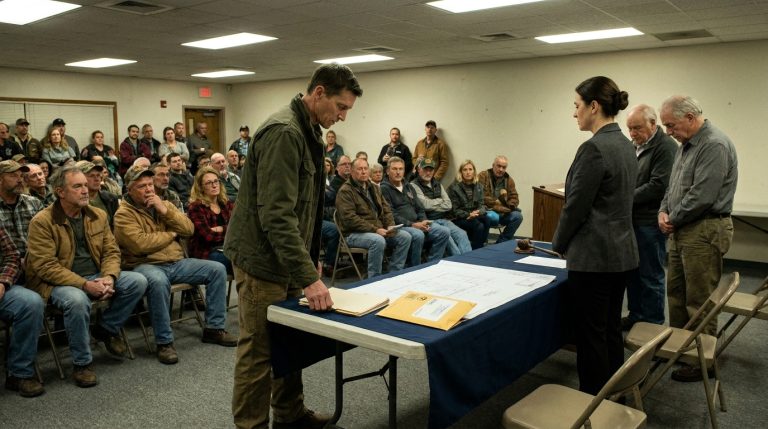
The glass doors of the Whispering Pines community clubhouse rattled as a cold evening gust swept across the manicured lawns. Inside, the large multi-purpose room was packed to absolute capacity. Every folding chair had been claimed, and residents lined the perimeter walls, standing shoulder-to-shoulder under the harsh glare of recessed fluorescent lights. The atmosphere hummed with a restless, pent-up energy—a volatile mix of long-standing frustration, curiosity, and raw defiance.
At the front of the room, seated behind a polished mahogany dais, Karen Peterson adjusted the lapel of her immaculate beige blazer. Her expression was carefully calibrated to project absolute authority, though a faint twitch near the corner of her left eye betrayed the tension humming beneath her skin. Flanking her on either side sat two members of the architectural review committee, looking like jurors waiting for a trial they expected to win by default.
Karen raised a heavy wooden gavel and brought it down sharply against the wood. The dry crack echoed through the PA system, cutting off the low murmur of the crowd.
“This special meeting of the Whispering Pines Estates Homeowners Association is now called to order,” Karen announced, her voice dripping with practiced condescension. “As per the published agenda, we will begin with a review of outstanding community grievances submitted through official channels, followed by standard board updates.”
Before the echo of the gavel could fade, Tom Davidson stood up near the third row, his posture rigid.
“Madame President,” Tom said, his voice carrying clearly across the quiet room. “I move to amend the agenda.”
Karen’s eyes narrowed into sharp, defensive slits. She leaned into her microphone, her tone hardening instantly. “Mr. Davidson, a motion to amend is out of order at this stage of the proceedings. We adhere to the pre-approved schedule.”
“According to Robert’s Rules of Order, governing all corporate procedures for this association, a motion to amend the agenda by a majority vote of members present is always in order,” a sharp, youthful voice spoke up from the center aisle.
A young man in a crisp charcoal suit stepped forward. It was the Henderson’s nephew, freshly passed through the state bar exam and carrying a leather portfolio tucked beneath his arm. He strode deliberately toward the front of the dais, meeting Karen’s glare without blinking.
“For the record, my name is Arthur Henderson, registered parliamentarian,” the young lawyer continued smoothly, turning to face the packed assembly. “I move that this assembly vote immediately on my appointment as an independent parliamentarian for tonight’s proceedings to ensure all actions comply with state nonprofit statutes.”
Before Karen could object or bang her gavel again, Sarah Davidson seconded the motion from across the room. A wave of ayes rippled through the rows of seated homeowners, swelling into a rolling, undeniable chorus that filled the hall. The vote was a landslide, executed before the board could even coordinate a defense.
Karen stood halfway up from her chair, her face flushing a mottled, angry crimson. “You cannot do this! This is a manufactured disruption by disgruntled—”
“The motion carries,” the young parliamentarian stated calmly, taking a seat at a small side table positioned directly beneath the dais. He opened a legal pad and clicked a metal pen. “Mr. Davidson, the floor is yours. Proceed with your presentation.”
Tom stepped past the front row, reached into his briefcase, and plugged a sleek digital media cable into the clubhouse’s main projection console. The overhead lights dimmed automatically, and a massive white screen flickered to life behind the dais.
The first slide appeared with stark, uncompromising clarity. It wasn’t a policy update or a landscape guideline. It was a scanned bank statement showing a twelve-thousand-dollar transfer from the association’s discretionary account to a luxury home theater supplier, juxtaposed directly beside a digital photograph of a formal fine notice issued to an elderly resident for a dying rose bush.
A collective gasp sucked the air right out of the room. Karen slammed her palm onto the mahogany dais, her voice cracking with panic. “Point of order! That’s confidential financial data! Turn that projector off immediately!”
The independent parliamentarian didn’t look up from his notepad. “Denied, Ms. Peterson. Under state transparency statutes governing nonprofit HOAs, financial records presented by members in open session are fully admissible. Continue, Mr. Davidson.”
As the second slide lit up the room—revealing spa charges, boutique shopping sprees, and the specific credit card slip paying for the tow truck that had hauled the homestead’s Ford—the murmurs in the crowd shifted from shock into a low, rumbling fury. Karen sat frozen in her chair, her kingdom of rules and intimidation crumbling onto a six-foot projection screen, while at the back of the room, John Miller stood quietly in the shadows, his hand resting in his pocket over the cold metal edge of the flash drive containing the final, unanswerable truth.
CHAPTER 10: THE POWERPOINT RECKONING
The fluorescent hum overhead seemed to sharpen as the last projected slide lingered on the white screen, displaying the itemized receipts of the discretionary credit card alongside a photograph of a resident’s fine notice for a dying rose bush. The silence in the community clubhouse was absolute, thick enough to choke on. Every eye in the crowded room remained locked on the dais, where Karen Peterson sat rigid, her face drained of color, her fingers clawing convulsively at the edge of the mahogany table.
“This… this is an outrage,” Karen finally stammered, her voice cracking into a high, brittle register that lacked any semblance of authority. She tried to stand, but her legs appeared to betray her, forcing her back down into her chair. “These documents are stolen! They’re fabricated by a cabal of disruptive elements trying to sabotage our community standards!”
“They aren’t fabricated, Ms. Peterson,” a calm, clear voice spoke from the side aisle.
Angela, the former account manager for the property management company, stepped out from the shadows near the back rows. She walked slowly down the center aisle, holding a thick folder filled with signed affidavits and original bank ledgers. The camera light from the local news reporter stationed near the exit clicked on, flooding the aisle with a sharp, blinding white glare that pinned Karen under an unsparing spotlight.
“I managed the accounts for Whispering Pines for six months,” Angela continued, her voice steady and unyielding as she stopped ten feet from the dais. “I saw every charge routed through the discretionary account. I saw the home theater installation, the boutique shopping invoices, and the retainer payments funneled to our legal counsel to keep homeowners from asking questions. Every single slide presented tonight matches the physical ledgers in our corporate archive.”
The two cronies seated flanking Karen on the board looked physically ill. One of them slowly pushed his chair back, scraping the metal legs against the linoleum floor with a sharp screech, and stood up, raising his hands in a defensive gesture. “We didn’t know,” he muttered, his voice trembling as he addressed the angry sea of homeowners. “She told us the special assessments were for community enhancements. We never saw those statements.”
“You signed off on every vendor authorization block without reading the itemized line items,” the independent parliamentarian noted coldly, not looking up from his notepad. “Ignorance of corporate malfeasance does not absolve fiduciary negligence under state law.”
Karen looked wildly around the room, her gaze sweeping past neighbors she had terrorized with notices and fines for over three years. But there were no supportive nods left, no compliant silences, no compliant smiles. There was only the cold, hard weight of accountability.
John watched from the back of the room, his hands resting deep inside his pockets. The first layer of the machine—the financial rot and the systemic extortion—had been ripped open for the entire neighborhood to see. But the true foundation of her power, the fraudulent boundary claims that had given her the legal leverage to threaten homes like the Hendersons’ and seize his grandfather’s truck, remained untouched. The final card was still unplayed.
CHAPTER 11: THE SOVEREIGN EASEMENT
The camera light from the back of the room cast a harsh, bleached glare over Karen Peterson’s face, catching the frantic dart of her eyes as her internal defenses collapsed line by line. She had built her entire administrative stronghold on the quiet assumption that no one would ever look past the corporate bylaws, that the weight of manufactured paperwork and intimidating legal letters would crush any resistance before it reached a courtroom. But the financial ledgers projected on the screen had shattered that illusion.
She turned a desperate, pleading look toward the attorney from Dewey, Cheetum, and Howe, who had spent the evening trying to make himself invisible against the wainscoting near the emergency exit.
The lawyer cleared his throat, his face pale, and took half a step forward. “Madame President… the firm advises that we reserve further comment until—”
“Save your advice, counselor,” a gravelly, resonant voice cut through the murmur of the room.
John Miller stepped out from the shadows near the back row, his boots striking the linoleum floor with a steady, unhurried cadence. Every eye in the clubhouse shifted toward him as he walked down the center aisle, his posture rigid and balanced, carrying the absolute weight of a man executing a final, calculated maneuver. He didn’t look at Karen. He didn’t look at the news reporter’s camera lens. He kept his focus entirely fixed on the mahogany dais.
When he reached the front row, he reached into his weathered leather jacket and slid a heavy, cylindrical brass case from his inner pocket. He unscrewed the cap with a dry twist, pulled out a high-resolution certified copy of the 1892 federal land patent, and laid it flat across the polished mahogany surface right in front of Karen’s trembling hands.
“You spent three years threatening homeowners with fines, liens, and foreclosures under the banner of your architectural committee,” John said, his voice flat, low, and devoid of anger. “You claimed my family’s homestead had been provisionally absorbed into your corporate jurisdiction. But you missed a fundamental detail in your title search.”
Karen looked down at the yellowed parchment, her fingers twitching away as if the paper were hot to the touch. “That’s… that’s old history,” she whispered, her voice cracking. “The county planning commission signed off on our master plat three years ago. We have the authority.”
“You have a pencil-whipped map drawn by a developer who didn’t want to pay for a proper survey,” John replied, tapping a calloused finger against the lower margin of the patent. “Read the clause, Karen. Right there, signed and sealed by the federal government one hundred and thirty years ago. It establishes an express, perpetual right-of-way easement across all contiguous parcels for the Miller homestead.”
The attorney from Dewey, Cheetum, and Howe stepped closer, leaning over the dais to peer at the nineteenth-century script. As his eyes scanned the legal description, the color drained entirely from his face. His shoulders slumped, and he let out a long, ragged breath.
“He’s right,” the lawyer muttered, his voice barely audible above the hum of the overhead lights. He looked up at Karen, his professional detachment entirely shattered. “It’s a federal land grant. It supersedes local zoning, municipal annexations, and HOA covenants combined. If he wanted to, he could file a court order tomorrow to have this clubhouse, the main gate, and the community pool dismantled because they sit directly across his legal right-of-way.”
The silence in the room deepened, hardening into something dense and permanent. The residents in the rows behind John didn’t cheer; they simply stared in stunned realization at the document that had rendered their years of subjugation completely illegal. Every fine levied, every threat issued, every lien filed against them had been executed under the authority of a fraudulent regime whose very foundation was built on someone else’s land.
Karen’s mouth opened and closed, but no sound came out. The algorithmic control she had exercised over the neighborhood, the petty tyrannies of color codes and garden gnomes, the millions of dollars looted through fake assessments—it all dissolved into nothingness against a single sheet of century-old parchment.
“Furthermore,” John continued, turning to address the entire assembly, “every action taken against any homeowner in this room was executed under the authority of a board president who was actively embezzling funds for personal upgrades. That makes every single fine, every single penalty, null, void, and legally non-existent.”
Before Karen could muster a final, desperate retort, the heavy glass doors at the entrance of the clubhouse pushed open with a quiet swing. Two uniformed county sheriff’s deputies stepped inside, moving with the calm, deliberate pace of men executing an order that had been processed hours ago. They walked down the aisle, bypassing the stunned crowd, and stopped directly on either side of the dais.
“Karen Peterson?” the lead deputy asked, his voice polite but absolute as he rested a hand near his belt. “You need to come with us.”
As they pulled her hands behind her back and secured the steel cuffs with a sharp, metallic click, Karen cast one last, venomous look toward John. “You ruined everything,” she spat, her voice tight with uncomprehending hatred.
John didn’t flinch. He looked down at her with the cold, steady eyes of an engineer who had just finished clearing a blocked culvert. “No, Karen,” he said quietly. “You built a house of cards on someone else’s foundation. I just let the wind in.”
The deputies turned her around and led her down the aisle toward the exit, the camera light tracking her every step until the glass doors swung shut behind them. The kingdom of Whispering Pines was officially finished, and the hard work of reclamation was about to begin.
CHAPTER 12: THE RUSTED FINISH
The heavy glass doors of the Whispering Pines clubhouse clicked shut, sealing out the hum of the parking lot and leaving behind a room full of people who had just stepped out of a long, airless winter. The murmurs rose slowly, swelling into a steady, collective exhale of disbelief and release. People who had avoided eye contact in the grocery store aisles for years were shaking hands, exchanging low, relieved laughs, and clapping Tom Davidson on the back. The corporate machine had stopped turning. Its levers had snapped, its ledgers had been seized, and its architect was already riding in the back of a county cruiser.
John didn’t linger in the celebrating crowd. He stepped quietly out the side exit into the cool evening air, the gravel of the parking lot crunching beneath his boots. The sky over the western ridge was painted in deep bruises of purple and burnt orange, the kind of quiet, fading light that promised a hard frost before morning.
Three weeks passed before the final paperwork cleared the county recorder’s office, a blur of motion where the neighborhood rapidly began to shed its artificial skin. The rigid beige uniformity dissolved under a wave of cheerful defiance. Backyard playsets rose like wooden castles across the manicured lawns, painted in bright, unauthorized shades. Garden gnomes and whimsical metal flamingos reappeared in flower beds, and the support-our-troops ribbon magnets returned to car bumpers without fear of reprisal. Under Tom Davidson’s interim leadership, the newly reformed association voided every outstanding fine and scrubbed every predatory lien from the public records. The law firm of Dewey, Cheetum, and Howe, facing imminent bar association sanctions for bad-faith litigation, quietly settled out of court to cover the legal costs of their hasty retreat.
Karen’s trial did not take long. Faced with Angela’s exhaustive financial ledgers, the unassailable credit card statements, and the testimony of over a hundred victimized residents, she entered a guilty plea to felony embezzlement and wire fraud. She was sentenced to three years in state prison, and her home was placed into receivership to begin the long process of paying back the funds she had siphoned from the community.
Yet, for John, the true resolution came not from courtrooms or council meetings, but from a quiet Saturday afternoon on the homestead.
The county assessor had returned to the property two days prior, accompanied by a small crew of surveyors. Working from the original 1892 federal patent and the clean, undisputed terms of the new permanent easement agreement—which formally recognized the homestead’s perpetual sovereignty while legally protecting the subdivision’s existing clubhouse and gate from disruption—they had driven fresh, iron-capped boundary markers deep into the dry earth along the old stone wall.
Now, John stood in the open bay of his weathered barn, holding a clean white shop rag. The afternoon sun slanted low through the wide timber doors, cutting golden lanes through the dust motes and illuminating the restored body of his grandfather’s 1968 Ford F250.
The truck looked magnificent. The vintage body panels had been polished to a deep, mirror-like finish, and the rear bumper—once marred by a faint patch of surface patina—had been freshly re-chromed by a specialist in the county seat, gleaming with a hard, flawless brilliance under the workshop lights. There was no trace of the chain marks left by the tow yard, no scar from the administrative battles that had nearly cost him his heritage.
John wiped a stray speck of grease from the driver’s side mirror, his hands moving with slow, practiced care. The metal felt cool, solid, and utterly real under his palms.
A car door slammed down the long gravel drive, followed by the familiar crunch of tires. John looked up to see Tom Davidson walking toward the barn, carrying a rolled-up set of architectural blueprints under one arm and a pair of cold bottles of soda in his hand. Tom’s shoulders were no longer slumped; the heavy, haunted weariness that had marked their first meeting in the kitchen had been replaced by the easy stride of a man who owned his own address.
“Thought you might need a break from the chrome, John,” Tom said, stepping across the threshold and tossing a cold bottle through the air.
John caught it cleanly out of the mid-air arc, popping the cap against the heavy wooden workbench with a sharp hiss. He took a long, cold pull, letting the fizz clear his throat before setting the glass bottle down next to a tin of machine oil.
“Not taking a break, Tom,” John said, a rare, slow smile touching the corners of his mouth. “Just finishing what started thirty years ago.”
Tom looked out past the open bay doors, his gaze resting on the old stone wall that separated the homestead from the rolling lawns of Whispering Pines. Beyond the boundary, the distant sound of children laughing by the community pool drifted faintly on the breeze—a normal, unforced sound of a neighborhood finally learning how to breathe.
“We’re having that neighborhood barbecue next weekend,” Tom said quietly, leaning against the fender of the gleaming Ford. “The kids are organizing a movie night in the park. You’re welcome to come down, though I suspect you’d rather stay up here with the deer and the coyotes.”
“I might wander down for a burger,” John replied, his hand resting affectionately on the cool, solid steel of the truck’s hood. “As long as nobody brings a clipboard.”
Tom laughed, a rich, genuine sound that echoed off the weathered cedar rafters of the barn. “No clipboards, John. We burned the spares.”
After Tom climbed back into his sedan and rolled down the drive, John walked out onto the front porch of the old farmhouse. He sat down in the wooden rocking chair, letting the evening breeze carry the rich, earthy scent of cut hay and dry earth across the porch boards. The valley was quiet. The shadows stretched long and deep across the clover fields, and the old stone wall caught the dying amber light of the sunset, glowing with a steady, unyielding warmth.
The machine had been tested, the machine had broken against the rock, and the fence line remained exactly where it had always belonged. The war was over, the peace was absolute, and the land was finally at rest.