The Weight of Water: How a Quiet Combat Veteran Dismantled a Suburban Tyranny Through Cold Calculation and Federal Law
CHAPTER 1: THE COLD WITNESS
The air smelled of damp earth and coming poison.
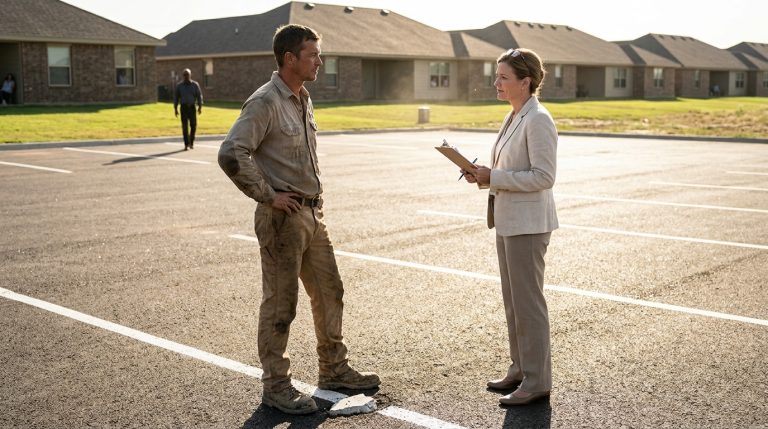
Jack stood frozen for half a second, his calloused hands resting on the cold iron handle of the irrigation headgate. Ten yards away, on the far side of the property line, Karen Brewster lowered an empty gallon-sized plastic jug. The white plastic gleamed under the early light, a glaring unnatural artifact against the rustic timber of his ten-acre farm.
The acrid chemical scent hit him then, sharp and biting, cutting straight through the organic perfume of the morning orchard. It was a calculated intrusion.
“That’ll teach you to respect the covenants, conditions, and restrictions, Mr. Miller.”
Her voice was a grating, smug cadence that always seemed to complain about the temperature or the light. She stood with her hands planted on her hips in her pastel tracksuit, a self-appointed general inspecting a conquered trench.
Inside Jack, the cold fury didn’t spike into blind panic; it flattened into absolute, surgical calm. It was the precise mental state he had relied on in the Arghandab Valley when the ground beneath a Humvee began to distort. The noise of the suburban world vanished. There was only the target, the threat, and the geometry of survival.
The water in the stone-lined ditch—a crystal-clear, quick-moving ribbon of the 1908 Miller Creek right—was already turning a sickly, milky white. The swirl churned inexorably toward the root systems of two hundred heirloom apple trees, his entire life savings and a sizable chunk of his soul.
He did not shout. He did not charge across the split-rail fence to engage in a theatrical screaming match that would satisfy her desire for a scene. A predator doesn’t telegraph its strike.
With deliberate slowness, Jack drew his phone from his pocket, switched it to video, and framed the shot. The zoom brought her smug, triumphant smirk into sharp focus—the look of a woman who genuinely believed her paper binder of HOA bylaws granted her dominion over physics and law. He captured the empty jug dropped carelessly into the brush, the milky plume spreading in the water, and the exact timestamp of the morning light.
He lowered the phone slowly, his face an unreadable mask of shadowed stone.
Karen’s smug smile faltered for a fraction of a second, a flicker of genuine unease crossing her eyes as she met his silent gaze. She had anticipated rage, resistance, or fury. She had not anticipated absolute nothingness.
Without a single word, Jack turned his back on her, his boots crunching methodically against the gravel path as he walked toward the farmhouse, leaving her standing alone in the pale dawn, completely unaware of the federal machinery she had just set into motion.
CHAPTER 2: THE EOD PROTOCOL
The front door clicked shut behind him, sealing out the pale morning light and Karen’s lingering, arrogant silhouette. Inside the quiet farmhouse, the transition from exterior observation to internal execution was instantaneous. The heat of immediate fury had burned down to cold, heavy ash, leaving behind the disciplined mechanics of a twelve-year combat engineer clearing an improvised device. There was no room for panic, no space for wasted motion. Every second possessed a specific weight, and every action demanded absolute precision.
“Sarah,” Jack called out, his voice pitched low, carrying the tight resonance of an order.
Footsteps padded quickly down the wooden staircase. Sarah came into the kitchen, rubbing the last remnants of sleep from her eyes, her thermal shirt half-tucked into her jeans. One look at his face—the set jaw, the absolute flatness in his eyes—erased any lingering fatigue. The sleep vanished from her expression, replaced instantly by a sharp, intuitive tension.
“What is it?” she asked, her voice dropping into an immediate, urgent register. “Jack, what did she do?”
“She poisoned the cut,” Jack said, already moving toward the back utility closet where the emergency gear was stowed. “Industrial bleach, heavy dose. It’s moving down toward the upper block of the orchard right now. Shut off the main headgate from the creek immediately. Stop any more clean water from entering the channel, and keep the volume contained. Every drop currently sitting in that ditch is our primary evidence.”
Sarah didn’t ask questions. She didn’t waste breath on disbelief. As a high school science teacher who spent her life managing variables and safety protocols, she understood chain of custody and contamination control implicitly. Without a word, she spun on her heel and headed out the side door toward the creek diversion valve, her boots hitting the ground with swift, purposeful strikes.
Jack dragged the heavy-duty emergency preparedness trunk out from the closet and flipped the metal latches. Inside, neatly compartmented, lay the kit he had assembled during his transition out of the service—sterile glass collection vials, heavy-duty nitrile gloves, numbered evidence tags, heavy-duty seal tape, and a digital field pH meter.
He pulled on a pair of nitrile gloves, the rubber snapping tightly against his wrists, and walked back out into the cool morning air.
The acrid smell of chlorine had settled heavier over the property, a chemical blight fouling the scent of damp earth and budding apple blossoms. At the edge of the stone-lined ditch, the water was no longer a quick-moving, clear ribbon; it was a sickly, opaque swirl that crawled sluggishly past the roots of the young Honeycrisp saplings. Already, the leaves on the nearest tree showed the early, alarming signs of curling—a biological shock from the caustic spike.
Kneeling on the damp earth, Jack uncapped the first sterile glass vial. With steady, practiced precision, he dipped it into the current just downstream from where Karen had poured her cargo, filling it to the exact baseline marker without disturbing the sediment. He sealed it, wiped the exterior dry with a clean cloth, and affixed an adhesive evidence tag bearing the timestamp: 06:14 AM.
He repeated the process two more times—taking a mid-stream sample near the center of the ten-acre parcel, and a final control sample just before the water reached the lower property boundary. Each vial was locked into a padded compartmentalized cooler resting beside him on the grass.
Next came the soil. Using a small stainless steel trowel, he gathered core samples from the ditch bank and directly from the root zone of the distressed sapling. Every scoop was bagged, labeled, and sealed with the meticulous care of a man handling unexploded ordnance. A single mistake here—a contaminated tool, an unsealed lid—could give a defense attorney a microscopic crack to crawl through. In suburban warfare, just as in the valleys of Afghanistan, sloppy documentation was a fatal vulnerability.
As he bagged the final soil sample, Sarah returned from the headgate, her breath coming in quick, shallow puffs in the chill air. She held her phone out, screen already illuminated.
“I called the state-certified environmental testing lab in the capital,” she said, her voice taut with controlled adrenaline. “I spoke directly with the lab director. I walked him through the chain of custody protocol and the nature of the chemical introduction. He said if we drive the samples to them ourselves before noon, they can run an expedited full-panel analysis by tomorrow morning for an emergency surcharge.”
“Pay it,” Jack said without a fraction of hesitation, standing up and snapping off his soiled gloves. “Use the business account. Cost is not a factor.”
“Done,” she nodded, her eyes flashing with a cold, shared resolve. “I’ve got the address plugged into the GPS. But Jack, what about the container she used? Did she leave anything behind?”
Jack turned his gaze toward the far side of the property line, across the rustic split-rail fence where Karen’s oversized sunglasses and pastel tracksuit had stood just twenty minutes prior. “She tossed the empty jug into the brush on her side of the line. I saw where it landed.”
He walked over to the fence line, his eyes scanning the dense undergrowth of wild blackberry and dry brush. There it was—a gallon-sized plastic jug, bleached white by the sun, its cap missing, wedged deep into the thorns. The chemical residue pooled in its base was still wet.
Jack did not reach across the fence with his bare hands. He retrieved a pair of long-handled metal tongs and an oversized evidence bag from his kit. With calculated slowness, he reached into the brush, clamped the tongs around the neck of the jug, and lifted it clear without disturbing the surrounding twigs or soil. He slid it carefully into the bag, sealing the top tightly. Her fingerprints, smeared across the plastic handle, were locked inside.
He walked back to the truck, placed the sealed cooler and the evidence bag onto the passenger seat, and secured them with the seatbelt.
Sarah stepped close, resting her hand lightly on the truck’s window frame. Her face was pale, her fingers interlaced tightly. “Be careful driving out, Jack. And call Marcus the second you hand those samples off.”
“Marcus already has the initial video file,” Jack said, his hand resting on the steering wheel as the diesel engine rumbled to life, filling the morning air with a low, steady vibration. “Once the lab confirms the exact concentration and composition of what’s in these vials, Marcus is filing the formal brief with the regional EPA criminal investigation division. We aren’t fighting an HOA dispute anymore, Sarah. We’re launching a federal case.”
He shifted the truck into gear, the tires crunching firmly against the gravel driveway as he turned toward the highway, leaving the poisoned ditch behind to stand as a silent, heavily guarded sentinel while the trap slowly closed.
CHAPTER 3: THE RECONNAISSANCE OF THE VULNERABLE
The dust kicked up by the F250’s rear tires settled slowly back onto the packed earth of the driveway, leaving behind a heavy, stagnant quiet. Jack stood by the barn door for a long moment, watching the horizon where the vehicle had disappeared toward the highway. The physical evidence was secured in a cooler speeding toward the capital, but the operational theater extended far beyond a single poisoned ditch. Marcus’s strategic directive was absolute: federal charges would crack the leadership, but dismantling the local infrastructure of fear required mapping the entire grid of abuse.
Jack turned away from the barn, his boots striking the gravel with measured, rhythmic precision as he walked back toward the house. He retrieved a leather-bound notebook and a dark pen from the kitchen counter—tools of documentation, clean and uncompromising.
The sun was climbing higher, casting harsh shadows across the neighborhood’s manicured lawns, a landscape governed by invisible, suffocating boundaries. In the military, intelligence gathering meant identifying the civilian population caught in the crossfire of hostile actors. Here, the hostile actor sat behind a desk of beige-on-beige decor, and the civilian population consisted of retired widows and young families too intimidated to push back.
His first objective lay two houses down.
Mrs. Gable’s property appeared modest against the cookie-cutter sprawl of Oak Hollow Estates. A weathered white picket fence, peeling slightly at the joints, enclosed a yard choked with unruly, vibrant life—bird feeders of various shapes and sizes hung from the low-hanging branches of an ancient oak tree, their metal trays spilling sunflower seeds onto the grass. It was a haven for local fauna and a direct, flagrant violation of Section 9, Paragraph C of the neighborhood code.
Jack walked up the wooden path, his eyes scanning the front door where a laminated yellow violation notice was still taped securely to the wood, held in place by strips of industrial tape.
Before his knuckles could touch the grain, the door swung inward. Mrs. Gable stood in the entryway, her frail frame draped in a soft cardigan, her eyes widening with a mixture of apprehension and fragile hope as she recognized him.
“Jack,” she breathed, her hands fluttering nervously against her apron. “I saw you drive off earlier. Is… is everything all right?”
“It’s quiet for the moment, Amy,” Jack said, his voice dropping into a register designed to soothe without losing its edge. “May I come in?”
“Of course, of course. Come in out of the cold.”
The interior of the house smelled of old paper, peppermint tea, and lavender. It was a space frozen in time, untouched by the synthetic modernization of the surrounding subdivision. As she guided him toward a floral-patterned armchair in the living room, Jack’s gaze drifted to the corner table where a stack of manila folders sat neatly arranged beside a checkbook and a collection of past-due fine notices.
“I won’t take much of your time,” Jack said, settling into the chair with the easy, controlled posture of a briefing officer. “When we spoke briefly before, you mentioned Karen’s notices regarding the feeders. I need to see the complete file, Amy. Every letter, every receipt, every canceled check.”
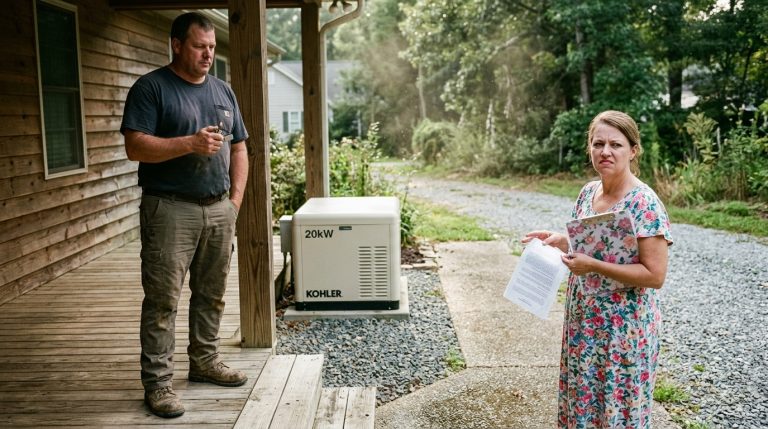
Mrs. Gable’s lower lip trembled slightly. She walked over to the side table, picked up the manila folders, and handed them over as if passing fragile porcelain. “She comes by every Tuesday,” the elderly woman whispered, her voice tightening with suppressed humiliation. “Always right after the garbage truck picks up. She has a clipboard. She measures the height of the grass by the fence line, she counts the seeds on the ground, and then she drops the fine in the box. Twenty-five dollars a week. Sometimes fifty if she claims the birds are a public nuisance.”
Jack opened the folder. The pages inside were pristine, organized with a heartbreaking level of compliance. Receipts from the post office, carbon copies of personal checks written out to the Oak Hollow Estates HOA, and formal letters bearing Karen’s sharp, aggressive signature.
A sudden, sharp memory flared behind Jack’s eyes—the dry dust of a checkpoint in Khost, the locals handing over documentation of extortion by local commanders who thought their authority was absolute. The psychological phantom vanished as quickly as it came, replaced by the cold, hard geometry of the present. Karen wasn’t a commander; she was a petty bureaucrat who had weaponized a non-profit association into a personal shakedown racket.
“You’ve been paying these?” Jack asked quietly, his eyes tracking the dates across six months of extortion.
“I’m on a fixed income, Jack,” she said, looking down at her hands, her voice shrinking into a whisper. “My late husband built those feeders for the finches before he passed away. It’s the only thing left that makes this house feel like home. When she told me she would place a legal lien on the deed and force a sheriff’s auction… I panicked. I just wanted her to leave me alone. I didn’t know who else to turn to.”
Jack closed the folder with a soft, definitive snap. The sound echoed in the quiet room.
“You won’t have to pay another cent, Amy,” Jack said, his tone leaving no room for argument. “I’m working with an attorney who specializes in dismantling systemic financial abuse. This isn’t just an HOA dispute anymore. This is a paper trail of documented harassment and extortion. I need to take these files with me to scan them into our secure record.”
“Take them,” she said, her eyes welling with tears of profound relief. “Take whatever you need. Just make her stop.”
Leaving Mrs. Gable’s house with the first dossier secured, Jack did not return home. He crossed the street toward the Sanchez family residence. In the backyard, half-visible over a low wooden fence, sat a brightly colored plastic playset—red slides, blue climbing walls, and a yellow steering wheel—surrounded by a small patch of worn grass where two small children had clearly been running earlier that morning.
As Jack approached the driveway, Mr. Sanchez stepped out of his garage holding a gas-powered string trimmer, his face set in a mask of chronic exhaustion. He dropped the tool the moment he saw Jack stepping onto the concrete.
“Miller,” Sanchez called out, wiping grease from his hands onto a rag. “I heard about the code enforcement trucks parked down by your place last week. Did she call the county on you again?”
“She tried,” Jack replied, stopping a few feet away, keeping his body language open yet entirely focused. “And the county found everything fully compliant. But I’m not here to talk about my ditch, Mr. Sanchez. I’m here to talk about your playset.”
Sanchez’s expression hardened, the exhaustion instantly giving way to defensive frustration. He glanced back toward the bright plastic structure in the yard. “What about it? She’s been fining us a hundred dollars a month because it doesn’t match the approved ‘natural earth tone’ palette. She told my wife it lowers property values. We have two toddlers, Miller. Where else are they supposed to play?”
“Nowhere, if she has her way,” Jack said evenly. “Did she ever give you written justification for the architectural waiver board’s denial?”
“There is no board,” Sanchez scoffed, shaking his head bitterly. “It’s just her. Arthur and Brenda just nod along whenever she brings up a violation. They’re her rubber stamps.”
Jack pulled out his notebook, clicking the pen. “I’m collecting statements and records from every family on this street who has received a fine from Karen Brewster in the last twelve months. I have five households already. With your documentation, we have a complete picture of selective enforcement and financial coercion.”
Sanchez stared at him for a long, calculating second. The anger in the younger man’s eyes wasn’t erratic anymore; it was aligning with the same cold, tactical clarity Jack felt in his own chest.
“Come inside,” Sanchez said, turning toward the back door. “Let me show you the stack of letters she left us. And let me tell you what Brenda from the board whispered to my wife behind the clubhouse last month.”
As the morning wore on, the grid expanded. House by house, dossier by dossier, the invisible walls of Karen’s suburban kingdom were mapped, measured, and systematically dismantled. By mid-afternoon, the secure cloud folder shared with Marcus was heavy with digital evidence—bank statements, certified letters, photographic proof of selective targeting, and sworn personal accounts.
Jack drove back down the quiet lane toward his farm, the sun dipping lower and casting long, sharp shadows across the road. The system of fear was fracturing from the inside out, and the foundation was completely set for the final trap.
CHAPTER 4: THE LABORATORY VERDICT
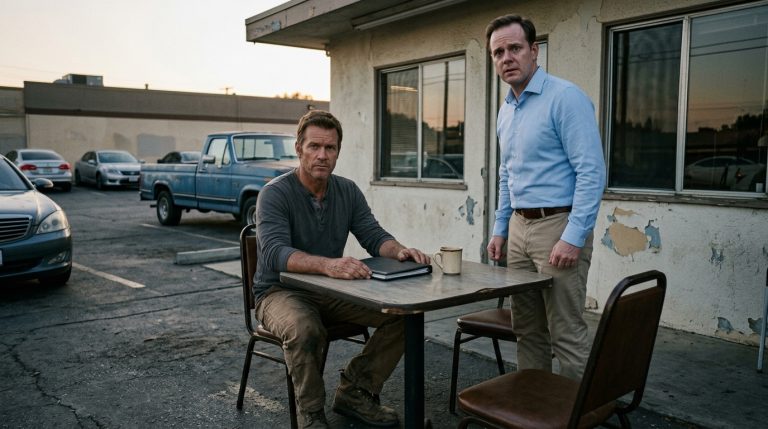
The computer screen cast a pale, cold luminescence across the dark surface of the kitchen table. Outside, the shadows of the apple orchard stretched long and jagged across the grass, swallowed by the creeping dusk. Jack sat motionless, his eyes tracking the dense columns of data, scientific readouts, and mass spectrometry charts displayed in the PDF file sent straight from the capital.
Case Number 734-B.
The digital summary page didn’t deal in speculation or neighborhood grievances; it spoke the absolute, unyielding language of chemistry. The primary contaminant was sodium hypochlorite, concentrated at a level that had spiked the ditch water’s pH to twelve—a caustic threshold lethal to both plant and aquatic life. But it was the secondary finding, nestled discreetly in the lower third of the toxicological breakdown, that turned the cold certainty in Jack’s chest into a hard, metallic weight.
Elevated concentrations of lead and mercury.
Jack leaned closer, his eyes narrowing as he read the technician’s attached addendum. These heavy metals were entirely absent from modern, commercially packaged household bleach. Their molecular signature pointed directly to older, degraded industrial chemical agents—substances that did not come off a standard supermarket shelf, but rather lingered in forgotten corners of rusted garden sheds or institutional storage units, festering for decades.
He thought of the two weathered, partially leaf-covered jugs he had recovered from the brush line during his perimeter sweep. Karen hadn’t merely run to the store for a quick bottle of cleaning fluid; she had exhumed something old, toxic, and deliberate. She had weaponized environmental poison against his land.
The quiet hum of the refrigerator in the corner was interrupted by the sharp chime of an incoming message notification. Jack minimized the lab report. A secure window popped open, displaying a cluster of files uploaded from Marcus’s legal terminal. A second later, the phone buzzed against the wood.
Jack picked it up on the first ring.
“Jack,” Marcus’s voice came through the receiver, tight, fast, and humming with a relentless, razor-sharp energy. “I’ve got the lab PDF open on my end. Have you reached the bottom third?”
“I’m looking at it,” Jack said, his voice flat and controlled. “Lead and mercury traces. Industrial signature.”
“It changes the entire operational scope,” Marcus said, his tone sharpening. “This isn’t just malicious mischief or a local property code infraction anymore. By introducing heavy metals into a tributary feeding a protected watershed, she crossed cleanly out of civil code and deep into federal felony territory under the Clean Water Act. The U.S. Attorney won’t just look at this file; they’ll prioritize it. But it also means we can’t play cute with local mediation. We have to trap her where she feels most invincible.”
“Her throne room,” Jack murmured, staring out the dark window toward the distant lights of the Oak Hollow Estates clubhouse.
“Exactly,” Marcus confirmed. “The annual HOA meeting is three days away. She’s currently drafting her agenda to push through a special assessment and slap a permanent lien on your property to force the ditch closed. She thinks you’re quiet because you’re beaten. We let her keep thinking that. We let her build the gallows right up until the moment she steps onto the stage.”
“And the neighborhood dossiers?” Jack asked, tapping a finger against the edge of the table where the digital files from Mrs. Gable and the Sanchez family were securely archived.
“Fully compiled,” Marcus said. “Statements from five distinct households detailing systematic financial intimidation, selective enforcement, and extortion. We bundle those not as federal charges, but as the foundational motive showing a prolonged, abusive pattern of behavior that culminated in environmental sabotage. When we drop that binder on the table, the board members—Arthur and Brenda—won’t be able to claim ignorance anymore. They’ll either share the liability or turn on her to save themselves.”
“Understood,” Jack said. “Send the final draft of the federal complaint package to my terminal by midnight. I’m printing hard copies for the briefing.”
“Will do, Jack. Hold the line. We break her command structure on Thursday night.”
The line clicked dead. Jack lowered the phone to the table. The screen of his laptop continued to glow, casting sharp, defined lines across his knuckles. The strategy was locked, the evidence was absolute, and the trap was meticulously set. He stood up from the chair, walked over to the back window, and looked out into the absolute dark of the orchard where the young saplings stood against the night air. The war for his land was narrowing down to a single room, a single gavel, and the final, crushing weight of accountability.
CHAPTER 5: THE ANNUAL MEETING
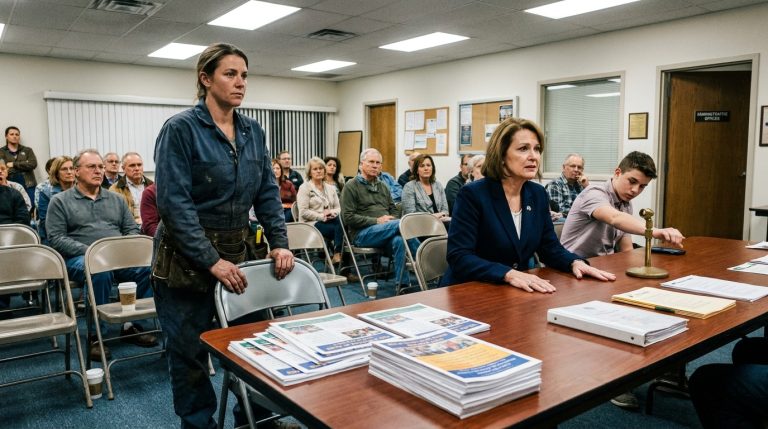
The community clubhouse was packed to capacity, fifty residents crammed into a narrow room beneath glaring overhead fluorescent lights. Jack walked through the double doors with Sarah holding tight to his right arm, her fingers locked around his wrist with a reassuring pressure. Inside his discreet black briefcase rested the projector, the laptop, and the heavy physical portfolio containing Marcus’s final, bulletproof briefing documents.
At the front of the room, seated at a long folding table draped in green felt, Karen Brewster presided over the gathering with an air of absolute, unassailable monarchy. She wore a garish floral pantsuit that clashed harshly with the industrial drabness of the walls, her fingers tapping rhythmically against the wooden handle of a small gavel. Beside her sat Arthur the dentist and Brenda the realtor, their postures stiff, mirroring the practiced indifference of a rubber-stamp tribunal.
Jack and Sarah took seats midway back, flanked discreetly by Mrs. Gable and Mr. Sanchez. No one spoke. The room hummed with a tense, low-frequency anxiety, the accumulated weight of months of petty tyranny hanging heavily in the stale air.
Karen banged her gavel once, cutting off the murmurs. Her voice, grating and high, cut through the PA speakers.
“As you all know,” Karen began, her gaze sweeping over the crowd with calculated condescension, “the board has been working diligently to resolve a long-standing compliance issue concerning Mr. Miller’s property at 124 Miller Creek Road. Despite our best efforts to extend grace, he has continued to harbor a dangerous, unesthetic open water hazard that threatens our shared property values.”
Murmurs rippled through the rows. Karen leaned forward, her smile tightening into something predatory.
“Therefore, the board is calling for an immediate vote. We propose levying a special assessment of twenty thousand dollars against Mr. Miller’s property, backed by a permanent lien to ensure the immediate filling of the ditch. All in favor—”
“Point of order, Madam President.”
The voice was low, flat, and absolute, cutting through the room with the unyielding authority of a command. Every head snapped toward the middle row. Jack remained seated for a fraction of a second before standing up, his frame straight, his eyes locked entirely on the woman at the front table.
Karen’s face mottled into a harsh, dark red. “You are out of order, Mr. Miller. Sit down immediately or we will have you removed.”
“Article Three, Section Four of the association’s bylaws,” Jack countered, his voice steady and carrying effortlessly across the room without shouting, “explicitly grants any member subject to a special assessment the absolute right to address the community for five minutes before a vote is executed.”
A flicker of genuine panic crossed Karen’s eyes, quickly masked by defensive fury. She looked down at her binder, flipped a page, and realized she was trapped by the very text she had weaponized against others for years.
“Fine,” she spat out, her lips thinning to white lines. “Five minutes. Make it quick.”
Jack didn’t walk to the podium. He remained standing right where he was, stepping into the aisle. Sarah unlatched the black briefcase resting on her knees, pulling out the compact projector and a small portable extension cord.
A sudden technical glitch threatened to derail the momentum—the clubhouse projector port failed to recognize the laptop’s HDMI output. For five agonizing seconds, the screen remained stubbornly blue. A ripple of nervous whispers broke out across the rows. Karen’s smile flickered back, sharp and victorious.
“Equipment failure, Mr. Miller,” she jeered, leaning into her microphone. “Your little performance is over. Sit down.”
Without breaking stride, Jack reached down, bypassed the wall unit entirely, and plugged the laptop directly into a portable adapter he had packed in his tactical kit, spinning the collapsible screen around to face the side wall. The blue glow vanished, replaced instantly by a sharp, crisp digital frame.
The room went instantly, suffocatingly dead silent.
Displayed on the wall in towering high-definition clarity was the early morning footage taken from the edge of the orchard. The dawn light, the stone-lined ditch, and Karen in her pastel tracksuit stepping forward to upend the plastic gallon jug, sending a thick, milky plume cascading into the water.
A collective gasp swept through the rows. People physically recoiled, eyes darting from the screen to Karen, whose expression had instantly drained of all color.
“This footage,” Jack said, his voice dropping into a cold, rhythmic cadence, “was recorded on Tuesday, May fourteenth, at 5:47 AM. That is our association president trespassing across a property line to intentionally discharge chemical toxins into a historic waterway.”
He clicked forward. The next slide revealed the certified laboratory report, the massive pH spikes highlighted in glowing red, and the undeniable molecular signature of heavy metals—lead and mercury—extracted from the water samples.
“That chemical agent was industrial-grade bleach contaminated with heavy metals,” Jack continued, stepping slowly down the aisle, his eyes sweeping across the stunned faces of his neighbors. “And under federal statute—Title Thirty-Three of the United States Code—discharging pollutants into a protected waterway that feeds directly into Miller Creek is not an HOA violation. It is a federal felony.”
The weight of the words dropped over the room like an anvil. Karen sat paralyzed, her hands gripping the edges of the folding table so hard her knuckles turned translucent. Arthur and Brenda stared straight down at their notes, refusing to look at her, their silence screaming absolute complicity.
Before Karen could stammer a defense, Mrs. Gable stood up from her seat two rows ahead, her frail frame trembling slightly, but her voice clear and resonant.
“She fined me twenty-five dollars every week,” Mrs. Gable said, looking directly at the cowering board members, “because my late husband’s bird feeders didn’t match her aesthetic. She threatened to take my home.”
Mr. Sanchez stood immediately after, his jaw set. “She threatened to ruin us because our kids’ playset wasn’t painted beige.”
The dam had broken. One by one, neighbors stood up—voices that had been silenced for years rising in a chorus of steady, undeniable truth. Karen shrank back into her floral pantsuit, her kingdom of petty rules instantly pulverized by the cold, heavy reality of the law.
Jack turned away from the front table, pulling out his phone. He dialed a pre-programmed number, stepped toward the side exit, and spoke three quiet words into the receiver.
“The time is now.”
CHAPTER 6: THE FEDERAL ARREST AND THE RETURN OF THE STREAM
The heavy double doors of the community clubhouse swung inward with a sharp, pneumatic hiss that cut through the low murmur of the room. Two men and a woman in dark blue raid jackets stepped across the threshold, the bright yellow letters across their backs gleaming under the fluorescent tubes: EPA CID. They were flanked instantly by two tactical agents in heavy vests bearing bold US MARSHAL insignia across the chest.
The ambient chatter died on the spot, replaced by a suffocating, absolute vacuum of sound.
Agent Sterling led the entry, his stride measured and devoid of theatricality. His eyes swept the packed rows with the absolute calm of a man executing a routine protocol before locking onto the front folding table. Karen Brewster sat frozen in her floral pantsuit, her mouth slightly parted, her face shifting from mottled red to a pale, chalky gray.
Sterling stopped three paces from the table, withdrew a silver badge and a crisp folded document from his breast pocket, and let his voice carry across the silent hall.
“Karen Brewster?”
Karen’s throat worked convulsively, but no sound escaped her lips. A pathetic, jerky nod of her head was her only confirmation.
“You are under arrest,” Sterling stated, his voice flat, professional, and entirely devoid of emotion, “for violation of Title Thirty-Three, United States Code, Section Thirteen-Nineteen-C—the knowing discharge of a pollutant into a water of the United States.”
The sharp metallic click of handcuffs echoed off the concrete walls like a pistol shot. As the agent stepped behind her and secured her wrists, the reality of the machinery she had triggered finally crashed down. This was no longer a matter of HOA rules, fine notices, or paper binders; it was the unyielding weight of federal law.
As the marshals escorted a completely uncomprehending Karen down the central aisle, she passed directly by Jack. Her eyes met his for a fleeting, hollow second. There was no defiance left, only a vast, empty bewilderment. She had assumed her petty authority was an armor, unaware that it was simply a glass cage.
Sterling paused beside Jack on his way out, giving a brief, sharp nod of acknowledgment before turning his attention to the two remaining board members. He leveled a cold stare at Arthur the dentist and Brenda the realtor, who sat cowering in their seats.
“You two,” Sterling said quietly. “Stay put. We have a few questions about corporate complicity and financial extortion.”
The doors swung shut behind the marshals, sealing the arrest. Slowly, the heavy tension in the room fractured into a collective, shuddering exhale. Neighbors began to move, not with the frantic energy of a mob, but with the quiet, deliberate grace of people waking from a prolonged nightmare. Mrs. Gable crossed the short distance to Jack and Sarah, burying her face against Sarah’s shoulder with a sound of profound relief. Mr. Sanchez clapped a heavy, steady hand onto Jack’s shoulder, offering a grip that needed no words.
Jack stepped away from the crowd and walked back out into the cool, star-lit night air. The transition from the fluorescent glare of the clubhouse to the open expanse of the valley felt like emerging from a deep trench.
He drove back to the ten-acre farm in total silence, the truck’s engine humming a steady rhythm against the dark asphalt. The legal aftermath played out over the following months with the cold precision of a well-executed plan. Karen pled guilty to a federal felony count under the Clean Water Act, accepting a sentence of probation, heavy restitution for the soil and tree remediation, and a lifetime ban from ever serving on a board or association again. Arthur and Brenda resigned in disgrace, turning over their corporate ledgers to avoid criminal liability. The Oak Hollow Estates HOA was effectively dissolved, replaced by an independent oversight committee led by Mrs. Gable, who immediately issued full refunds and interest to every family targeted by the previous regime.
Three months after the clubhouse confrontation, Jack stood alone beside the stone-lined ditch on his property.
The water moved swiftly and silently through the channel, a crystal-clear ribbon catching the golden light of the late afternoon sun. He knelt down, resting his calloused fingers against the cold damp stone of the headgate. The young Honeycrisp saplings farther down the row had been replanted with the help of his neighbors, their green leaves stretching upward into the open air, unmarred by chemical burn.
The peace he had sought when he first left the service wasn’t an absence of friction or a world without conflict. That world didn’t exist. Peace was the quiet, unshakeable confidence born from standing your ground, maintaining discipline in the chaos, and trusting in the strength of a community that refused to break.
Jack stood up, wiped his hands on his jeans, and walked back toward the farmhouse as the sun dipped below the distant ridgeline, leaving behind a sky of deep, enduring amber.