The Mechanic’s Secret: How One Renegade’s Brass Washer Saved the Skies of Britain
CHAPTER 1: THE COLD GARAGE FLOOR
The brass disc was cold enough to stick to bare skin.
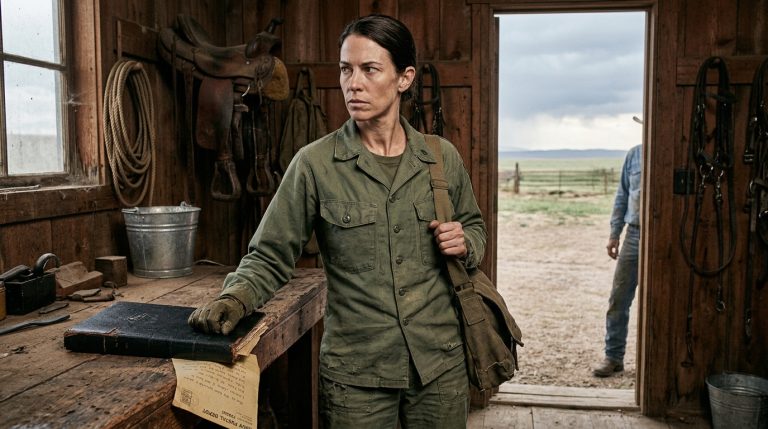
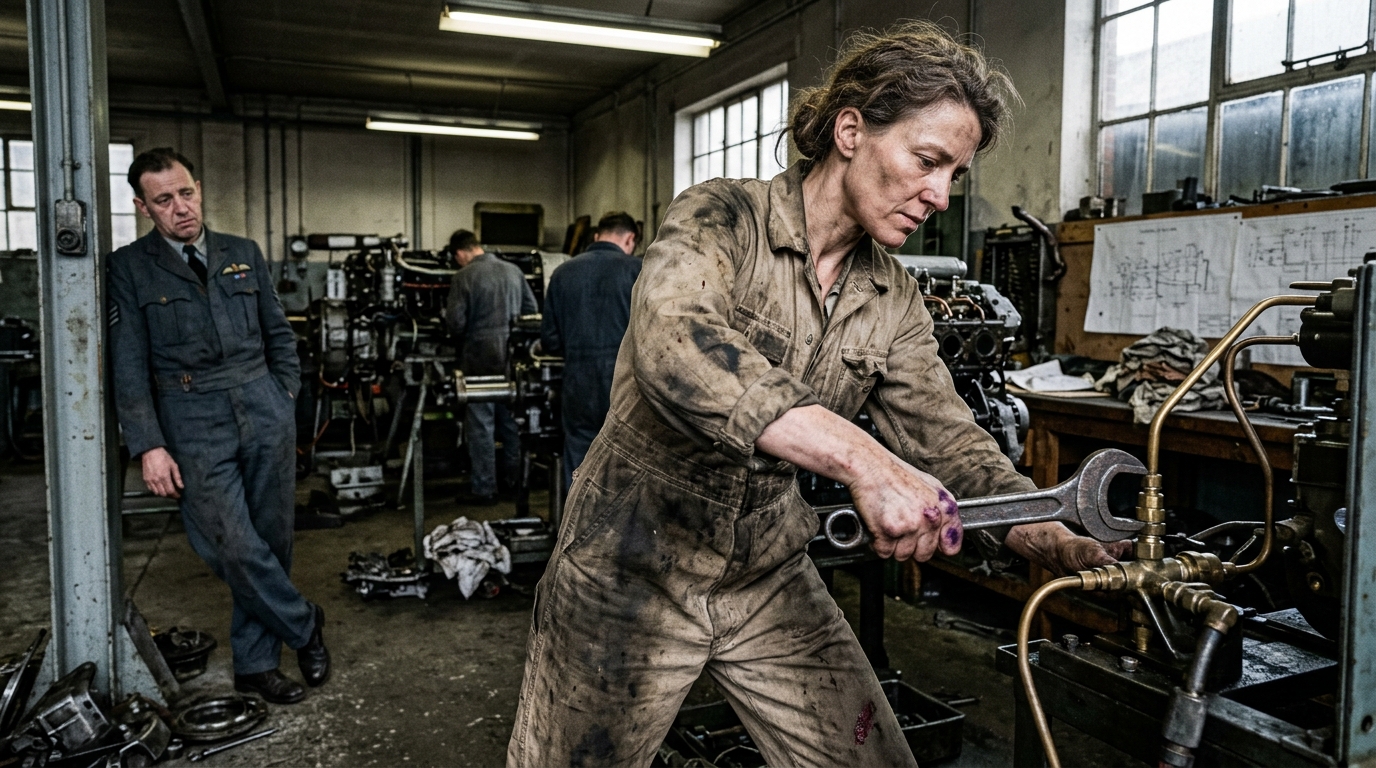
Beatrice Schilling sat on the concrete floor of the Farnborough workshop, her knuckles dark with carbon black and 30-weight engine oil. The small brass circle sat in the center of her palm, no larger than a sixpence, its center pierced by a single hole precisely 0.04 inches wide. Outside, the November frost was settling into the corrugated iron roof, setting off a sharp, metallic clicking as the building cooled.
In her right hand, she turned a small steel calibration gauge, rolling the hardened metal across her calluses to check the margin.
Across the wooden workbench lay twenty-three combat reports from the Battle of Britain. Each one carried the same cold bureaucracy stamped across the header: Engine cutout during negative-G maneuver. Duration 2.3 seconds. Enemy aircraft escaped.
She didn’t need to read the rest. She knew the mechanics of it like the stroke of her own Norton’s piston. When a Spitfire pushed into a steep dive, gravity reversed, shoving petrol to the top of the carburetor float chamber. The float dropped, the needle valve jammed wide open, and raw fuel drowned the supercharger in a heartbeat.
“They’re calling it an act of God in the Ministry memos,” Sergeant Miller said, leaning against the cold frame of the test rig. He spat a shred of cheap tobacco onto the shavings. “Saying Rolls-Royce needs three years to build an injection pump.”
“It’s not an act of God,” Beatrice said. Her voice was flat, dry from the coal dust in the radiator air. “It’s a flooded pipe.”
She picked up the brass disc and slid it into the mouth of the fuel line fitting. It fit with a dull, suction-tight click.
“If you starve the flood, the float never drowns,” she muttered. She picked up a heavy iron spanner, the cold metal biting through her canvas gloves, and began torqueing the union nut onto the test rig’s intake.
The spanner slipped on a burred edge. The steel corner gouged straight into her thumb, tearing skin and leaving a thick, dark smudge of grease and blood along the brass fitting. She didn’t flinch. She simply wiped the smear across her canvas trousers and tightened the nut until the threads groaned.
“You’re going around the Air Ministry board,” Miller said, his voice dropping an octave as he glanced toward the glass office at the end of the bay. “There’s no signature on that requisition form, Beatrice. You put an unvetted washer in a Service engine without a signed clearance, and they won’t just fire you. They’ll put you in a cell at Tower Hill.”
“They can put me wherever they like,” Beatrice said, standing up and wiping her hands on a rag that smelled strongly of kerosene. “After the engines stop dying.”
She reached for the hand-crank on the fuel-pressure simulator, her boots gripping the icy concrete. She didn’t have an official order. She didn’t have a stamp of approval from Whitehall. All she had was four inches of copper pipe, a piece of brass, and a problem that needed fixing before dawn.
She threw her weight against the iron crank. The heavy flywheel groaned, the leather belt snapped tight, and the smell of raw aviation spirit filled the freezing room.
CHAPTER 2: MIDNIGHT ON THE NORTON
The single headlamp beam sliced a yellow funnel through the blackout rain, reflecting off the slick, unlit tarmac of the Kent countryside.
Beatrice leaned low over the handlebars, her right thumb still stiff and throbbing inside her waterlogged canvas glove where the spanner had gouged it. In her canvas saddlebag, six machined brass restrictors wrapped in oily rags clinked against a set of flat wrenches with every pothole that rattled her spine.
She didn’t have an escort, a signed transit order, or a Ministry stamp to get past the airfield perimeter. If the sentries at the gate checked her papers against the nightly manifest, she’d spend the rest of the storm sitting in an interrogation room at Croydon.
The heavy wooden barrier of Biggin Hill’s southern gate materialized out of the dark, glistening like wet iron. A guard in a damp groundsheets stepped into the road, raising an oil-burning lantern.
Beatrice didn’t slow down until the front tire was three inches from his knee, the single-cylinder engine idling with a wet, heavy thump.
“R.A.E. R&D,” she said, her voice cutting clean through the downpour before he could speak. She didn’t offer a pass; she reached down, grabbed her cold iron spanner from the bar bag, and shook off a cluster of rain droplets onto his boot. “Dispersal Hut Three. Tell Harris the Merlin fuel unions arrived, or you can explain to 11 Group why the dawn patrol stays on the grass.”
The guard hesitated, the yellow light catching his tired eyes, then lifted the wooden beam.
Dispersal Hut Three smelled of stale tea, high-octane aviation fuel, and damp wool. Under the dim blue blackout bulbs, ground crews swarmed over the shadowed bulk of a Spitfire Mk I, their boots echoing on the concrete bay.
Sergeant Harris stood on a wooden crate, his arms buried elbow-deep in the open cowling of a Merlin engine, his face smeared with black graphite grease.
Beatrice kicked her motorcycle stand down, peeled off her soaked gloves, and unzipped the saddlebag. She pulled out a rag-wrapped bundle and set it on the edge of Harris’s tool chest with a dull metallic clunk.
Harris didn’t stop turning his wrench. “You’re late, Schilling. And you’re not supposed to be within ten miles of a frontline station without a Wing Commander’s escort.”
“The Ministry doesn’t work past five o’clock,” Beatrice said, unrolling the cloth to reveal the six brass discs, each gleaming under the blue light. “The Germans do.”
Harris wiped a hand across his forehead, leaving a streak of black oil across his grey hair. He picked up one of the discs, holding it up to the bare bulb, peering through the 0.04-inch hole.
“This isn’t an approved part,” Harris said quietly, his voice flat. “I put this in Al Deere’s fuel line, and if that engine starves at ten thousand feet, it’s not the Air Ministry they’re going to hang.”
“It won’t starve,” Beatrice said, stepping closer until she could smell the cold tobacco on his tunic. She pointed her grease-stained thumb straight at the brass center. “Six weeks on the Farnborough bench. Zero cutouts. It restricts the flood during a dive, nothing more. You’ve buried eleven boys this month, Harris. Are you going to wait three years for Rolls-Royce to sign a piece of paper?”
Harris looked down at the tiny brass washer in his palm, his thumb tracing the machined edge, then looked over his shoulder at the dark Spitfire waiting in the shadows.
CHAPTER 3: THE UNSANCTIONED FLIGHT
The canopy slid forward with a harsh, metallic rattle, locking Deere into the cramped cockpit.
Beatrice stood three paces outside the hangar door, the rain soaking straight through her wool trousers as the Spitfire’s twelve-cylinder Merlin engine turned over. The starter motor whined, coughed once with a plume of thick blue exhaust, and then roared into a deafening, throaty idle that vibrated straight through the wet concrete into the soles of her feet.
Sergeant Harris leaned out of the hangar bay, his grease-stained hands tucked tight under his armpits against the chill, his eyes locked on the nose of the fighter.
“If that brass fitting chokes the line when he throttles up,” Harris shouted over the thunder of the exhaust, “he won’t even clear the perimeter trees.”
“It won’t choke,” Beatrice said, her voice swallowed by the engine noise. She didn’t look at Harris. She kept her eyes on the exhaust stacks, watching the color of the flame licking out of the manifolds—a clean, pale blue.
The Spitfire pivoted on its landing gear, its long nose swinging toward the grass runway. Deere didn’t know about the tiny brass disc welded into his fuel union. He thought he was flying a standard morning sweep over the English Channel. If the modification failed under high pressure, he wouldn’t have time to process the betrayal before his propeller went dead.
The fighter accelerated down the strip, spraying twin ribbons of muddy water behind its tires, then lifted into the low, bruised belly of the clouds.
The roar faded into a hollow hum, then into complete silence.
The airfield returned to its grey, monotonous pulse. Ground crews dragged ammunition crates across the gravel. A tractor backfired near the armory.
Beatrice walked over to the wooden bench beside Dispersal Hut Three, sat down, and pulled her steel calibration gauge from her pocket. The thumb on her right hand was swollen and stiff where the spanner had cut her, the dried blood dark beneath a fresh smear of graphite. She rolled the heavy steel bar back and forth over her knee, feeling every microscopic nick in the metal.
“Eighty minutes of fuel,” Harris said, stepping out under the dripping eaves with two tin mugs of steaming, dark tea. He handed one to her without looking at her face. “If he meets anything over the coast, he’ll be using full power.”
“He’ll dive,” Beatrice said. She took the mug, letting the scalding tin burn through her wet gloves, but didn’t drink. “When a Messer gets on his tail, he always dives.”
“And if the float jams open anyway?”
“Then we both go to prison,” she said simply. “And Deere doesn’t come home.”
The minutes dragged with the agonizing weight of rusted gears.
At the one-hour mark, the sky remained empty. A tea leaf floated in Beatrice’s untouched mug, settling at the bottom of the cooling brown liquid. She didn’t shift her position on the bench. Her back remained straight, her thumb constantly rolling the steel gauge against her trousers, counting the seconds by the mechanical click of the metal against her belt buckle.
Then, at two hours and twelve minutes, a distant, high-pitched pitch-change cut through the low drizzle over the south boundary.
A single Spitfire broke through the cloud base, its Merlin engine singing with a smooth, unbroken hum that didn’t miss a beat.
CHAPTER 4: BLOOD ON THE BRASS
Deere dropped down from the wing root onto the wet grass, his goggles pushed up on his forehead. He didn’t look tired; his face was flushed red from adrenaline, his teeth flashing as he slapped Sergeant Harris hard on the shoulder.
“Whatever you did to that fuel manifold, Harris, do it to every crate on the line,” Deere said, his voice loud over the hiss of hot engine oil. “Two 109s tried to dive away over Dungeness. I pushed into a vertical dive, nose down, full throttle. The Merlin didn’t even cough. I put thirty rounds into the second one’s tail before he knew I was still on him.”
Harris looked at Beatrice. She stayed by the wing, her swollen thumb hooked into her coat pocket, rolling her steel calibration gauge against the brass disc she still held hidden in her palm.
Before Harris could speak, the crunch of gravel behind the dispersal hut signaled an arriving car. A black Austin 10 pulled onto the grass, its tires spinning briefly in the mud before coming to a stop.
A civilian stepped out into the rain. He wore a crisp, dry trench coat, a bowler hat, and carried a thick leather clipboard clamped shut with a steel latch. Behind him, two armed RAF military policemen stepped out of the rear doors, their brassards stark and white against their blue uniforms.
“Flight Lieutenant Deere,” the man said, his voice clipped, dry as bone. He didn’t look at Deere; his eyes swept over the wet cowling of the Spitfire. “I am Inspector Vance, Air Ministry Contracts and Safety Directorate. This airframe is impounded under Defense Regulation 55.”
Deere blinked, stepping between Vance and the aircraft. “Impounded? I just brought this machine back from a kill over the coast.”
“You brought back an aircraft subjected to an unauthorized, illegal structural modification,” Vance said. He tapped a fountain pen against his clipboard. “We received an anonymous teletype from Farnborough two hours ago. An unvetted component was installed in this engine without Ministry certification, safety board approval, or a signed work order.”
Harris took a step forward, his fists clenching at his sides, grease smudging his trousers. “The modification saved his life, you bloody pencil-pusher. The engine didn’t cutout.”
“That is entirely irrelevant, Sergeant,” Vance said, his gaze shifting to Beatrice. His eyebrows lifted slightly, a thin, patronizing smile touching his lips. “And you must be Miss Schilling. A technical officer who seems to think her background in motorcycle racing qualifies her to alter Crown property.”
Beatrice didn’t flinch. She pulled her right hand from her pocket and stepped past Deere, stopping two feet from Vance’s polished shoes.
“The float chamber floods during negative-G,” Beatrice said, her voice flat, steady. “The 0.04-inch restrictor prevents drowning. It takes two minutes to install and costs less than a shilling.”
“It is an unapproved alteration,” Vance replied, stepping closer, weaponizing his position with cold authority. “Your little experiment is over, Miss Schilling. The MPs will seize this aircraft. You will hand over all technical notes, tools, and remaining components immediately, or you will be removed from this station under arrest.”
Beatrice held Vance’s stare, feeling the cold weight of the brass washer in her fist. She didn’t have an authorization form. She didn’t have the Ministry stamp. But as Vance turned to sign the impound warrant on his clipboard, her eyes caught the edge of a carbon copy tucked under his official papers—a heavily redacted 1937 technical report bearing the exact same fuel-flow calculations she had derived six weeks ago.
CHAPTER 5: THE CORNERED HANGAR
Rain water trickled off the edge of the tin roof, splashing against the toe of Vance’s leather boot. He pulled his trench coat tighter around his neck, adjusting his grip on the heavy clipboard.
“You’re looking at confidential Ministry documents, Miss Schilling,” Vance said, his hand sliding over the paper to cover the red stamp. “I suggest you step back before I instruct the escort to take you into custody.”
Beatrice reached out and pressed her grease-stained thumb directly onto the steel latch of his clipboard, holding it fixed in place.
“Page three, paragraph four,” Beatrice said, her voice dropping into a low, raspy pitch. “Royal Aircraft Establishment fuel-flow trial, October 1937. Restrictor orifice test on float-chamber pressure. You’ve had the math for four years.”
Vance tried to pull the board away, but her grip didn’t slip. The blood dried on her thumb smeared across the edge of his white warrant paper.
“That report was archived after proper administrative review,” Vance snapped, his jaw clenching as he raised his voice to maintain control. “The board determined that field modifications introduce unacceptable operational risks to military assets. Rolls-Royce is developing a complete fuel-injection system under an exclusive defense contract. That is the approved engineering protocol.”
“Rolls-Royce is three years away from delivering that pump,” Flight Lieutenant Deere interrupted, stepping up beside Beatrice, his flight jacket smelling of raw aviation spirit. “My squadron is flying today. Not in three years.”
“You do not determine procurement schedules, Lieutenant,” Vance spat, turning his chin up. “You fly the equipment you are given by the Air Ministry.”
“I fly what keeps my engine running,” Deere said, his hand dropping to the brass buckle of his harness. “And if you touch that Spitfire, I’m taking my pilots to the station commander’s office to report intentional sabotage of operational aircraft.”
Vance’s face paled slightly, a thin line of sweat breaking out along his upper lip despite the freezing wind. He jerked the clipboard out from beneath Beatrice’s thumb, turning toward the two armed MPs standing by the Austin 10.
“Sergeant, seize this aircraft immediately,” Vance ordered, pointing a trembling finger toward the Spitfire’s wing. “And place this civilian under formal military arrest for interfering with an official inspection.”
The two MPs hesitated, their eyes shifting from Vance’s crisp necktie to Deere’s combat wings, then down to Sergeant Harris, who had stepped out of the hangar holding a twenty-four-inch steel breaker bar across his chest.
“Touch that engine line,” Harris said quietly, his boots planted firm in the mud, “and you can bleed the fuel system yourselves.”
Vance stiffened, his fingers digging into the leather edges of his clipboard as he realized the ground crew wasn’t backing down. He drew a sharp breath, his eyes darting toward the open road leading out of the station.
“This isn’t over,” Vance said, his voice shrill as he backed toward the car door. “Every one of you will face a general court-martial by nightfall.”
CHAPTER 6: THE UNBROKEN LINE
The exhaust fumes from the Austin 10 hung heavy in the damp morning air, slowly dissolving into the drizzle.
Harris spat onto the gravel, turning his head to spit out a bit of grit before looking down at the heavy steel breaker bar still resting across his forearms. “He’ll be at 11 Group HQ before noon, Beatrice. By three o’clock, he’ll have a signed order from the Ministry to seal every hangar on this base.”
“He can bring whatever paper he wants at three,” Beatrice said, her voice quiet, even. She pulled her grease-stained hand from her pocket and tossed the small, dark brass disc up once, catching it smoothly in her palm. “By three o’clock, every Merlin on the line will already have one of these fitted.”
Flight Lieutenant Deere unlatched his collar, taking a long, deep breath of the rain-cooled air. He looked at the tiny hole in the center of the washer, then down at his own flight boots, still caked with mud from the grass runway.
“They won’t court-martial the entire frontline,” Deere said, a hard, dry grin cutting across his jawline. “Not while the Germans are sitting twenty miles across the water. Give me three more of those discs, Miss Schilling. I’ll fit my flight’s machines myself.”
“You won’t have to,” Harris grunted, picking up his tool chest by the iron handle with a dull, heavy clatter. “My lads can fit a restrictor in ninety seconds flat. We don’t need a drawing, and we certainly don’t need a Ministry stamp.”
Beatrice didn’t offer a speech. She didn’t write a memo or file a formal protest with Whitehall. Without an official paper order, without a single signature from the Air Ministry, she simply handed the remaining brass washers to Harris, one by one, until her palm was empty.
The contract suppression, the delayed three-year redesigns, and Vance’s legal threats collapsed under the sheer, undeniable reality of three thousand running engines.
By late afternoon, the drizzle had cleared into a pale, freezing blue sky over the Kent countryside.
Beatrice sat on her Norton 16H near the edge of the Farnborough workshop bay, wiping a thin layer of dark oil off the motorcycle’s cooling fins with an old cotton rag. Her thumb was still tender where the spanner had cut her, but the bleeding had stopped, leaving a thin, clean scab.
Across the yard, the quiet hum of the bench test rig hummed in a steady, unbroken rhythm. No cutouts. No dead air. Just the plain, cold physics of a tiny piece of brass holding the line.